

VALIX
@RetroValix • 11,927 subscribers
AI Builder & Researcher | 5Y in Crypto | Vibe Coder
Shorts


Videos

This guy built a two-sided trading bot on Polymarket and made $233,695 His algorithm trades short-term crypto Up/Down markets using asynchronous complete-set accumulation and dynamic inventory management: 1. Starts building inventory almost as soon as the market opens Its first purchase occurs a median of 33 seconds after the market opens It keeps buying through most of the trading window. In 5 minute markets, its last purchase occurs a median of 223 seconds after opening 2. Adds the opposite outcome to its position It bought both Up and Down in 88.76% of markets It starts buying the opposite side a median of 35 seconds after its first purchase. It then keeps switching between outcomes as the market reprices 3. Turns most of its inventory into complete sets 89.82% of the shares it buys can be matched into Up + Down pairs The average combined cost of a pair is 96.35c, giving it an edge of 3.65c But this is not pure arbitrage Only 58.66% of two-sided markets ended up with an average combined Up + Down cost below $1. The remaining 10.18% of shares are unpaired, leaving a directional residual Its Polymarket account: norm1e69 You can build your own trading bot here: (A trial is available after signing up) The algorithm’s main edge comes from asynchronous pairing: it keeps switching between Up and Down, matches most of its inventory into complete sets, and retains directional exposure through the unpaired remainder
VALIX178,246 次观看 • 19 天前

This guy built a late-resolution bot on Polymarket and made $98,842 His algorithm almost always waits until the final seconds of 5 minute BTC Up/Down markets before building a directional position: 1. Monitors the market for most of the trading window and enters near resolution 98.2% of its purchases occur in the final minute The median first entry occurs 56 seconds before the market ends For the first four minutes, it tracks BTC’s price movements. It then starts buying its chosen outcome in small amounts 2. Buys the more likely outcome if it still considers it undervalued 89.8% of its fills are at 50c+ More than half of its purchases are at 80c+, and those trades account for 65.9% of its total volume 3. Uses the opposite outcome to adjust net exposure It bought both sides in 29.55% of markets If it holds 100 Up shares and buys 40 Down shares, part of the position becomes hedged, while 60 Up shares remain directional If it then buys another 140 Down shares, its original Up position is fully hedged, and the directional residual shifts to Down Buying the opposite outcome lets it reduce or fully reverse its directional exposure Its Polymarket account: NIULAI4 Stats: > Trades per active hour: 53.89 > Average trade size: $26.56 > Win rate: 81.42% NIULAI4’s main edge comes from late-entry probability trading: it waits for a stronger BTC signal near the end of the market, buys the undervalued outcome, and uses the opposite side to rapidly adjust its exposure if conditions change
VALIX161,286 次观看 • 21 天前

This guy built a trading bot on Polymarket with an average trade size of $8 Result: +$251,218 His bot trades 5 and 15 minute crypto Up/Down markets using a hybrid of directional trading, latency edge, and dynamic hedging: 1. It looks for edge using its own model It tracks momentum, acceleration, order flow imbalance, and spot feeds relative to the reference price of the current market Based on this data, it constantly recalculates its own fair value for Up and Down. It enters a position when it detects mispricing 2. When the signal changes, it quickly adjusts its exposure If momentum reverses, it can reduce the existing side or start accumulating the opposite outcome In 86.2% of markets, it traded both sides. The dynamic hedge constantly adjusts net exposure based on the model’s latest signal It’s Polymarket nickname: nj23adsknml3 Follow this account and trade on Polymarket through this app: It’s stats: > Trades / active hour: 516 > Average trade: $8.13 > Win Rate: 49% The main edge of this guy’s HFT algorithm comes from speed. It tries to detect changes in fair value on external crypto markets before they are reflected in Polymarket prices It then captures the temporary mispricing and quickly adjusts its directional exposure with every new market move
VALIX371,614 次观看 • 1 个月前

This guy built an HFT algorithm on Polymarket with an average trade size of $38.62 Result: +$489,494 The bot trades 5 minute BTC and ETH Up/Down markets using two-sided accumulation, complete sets, and a directional residual: 1. Starts accumulating both sides almost immediately The bot first buys one side and begins buying the opposite outcome almost immediately The median delay between its first Up and Down purchases is 7.5 seconds It then continues accumulating both sides as prices change within the market 2. Builds complete sets below $1 The main goal of the paired inventory is to achieve: VWAP(Up) + VWAP(Down) < $1 Its average combined VWAP is 97.93c, giving it an edge of 2.07c 3. Keeps a directional residual on top of the hedge The bot does not try to maintain a 1:1 balance between Up and Down In paired markets, the median ratio between the larger and smaller sides of its inventory is 1.44× If its fair probability leans more strongly toward Up or Down, the algorithm increases its inventory on that side while keeping the opposite outcome as a hedge leg Its Polymarket account: x-MoneyForWhiskas The bot’s main edge comes from combining complete sets with directional skew: the core position is hedged through Up + Down below $1, while additional inventory remains on the side its model considers underpriced
VALIX142,654 次观看 • 29 天前

This guy built an HFT algorithm on Polymarket with an average trade size of $35.88 Result: +$470,883 His algorithm trades short-term crypto Up/Down markets. It combines directional trading and dynamic hedging, while forming complete sets with part of its inventory: 1. Finds undervalued outcomes using its own fair value estimates It factors in the underlying asset’s price relative to the opening price, the time remaining, momentum, volatility, the speed of price movements, and spot/perp data If its model values Up at 65c and the price on Polymarket is 55c, it starts building a position 2. Buys the opposite side when the market changes direction If the underlying asset reverses direction, it starts buying the opposite outcome to reduce its net directional exposure This hedges part of its existing position 3. Turns the hedge into a complete set If each matched Up + Down pair costs less than $1, that portion of the position has a structural edge regardless of how the market resolves It keeps the unpaired remainder as a directional residual on the side its model considers undervalued Its Polymarket account: mo-money You can build your own trading bot here: (A trial is available after signing up) The bot’s main edge comes from a combination of fair-value entry and dynamic hedging: it first builds a position in an undervalued outcome, then uses the opposite side to reduce exposure or form a complete set
VALIX88,765 次观看 • 20 天前
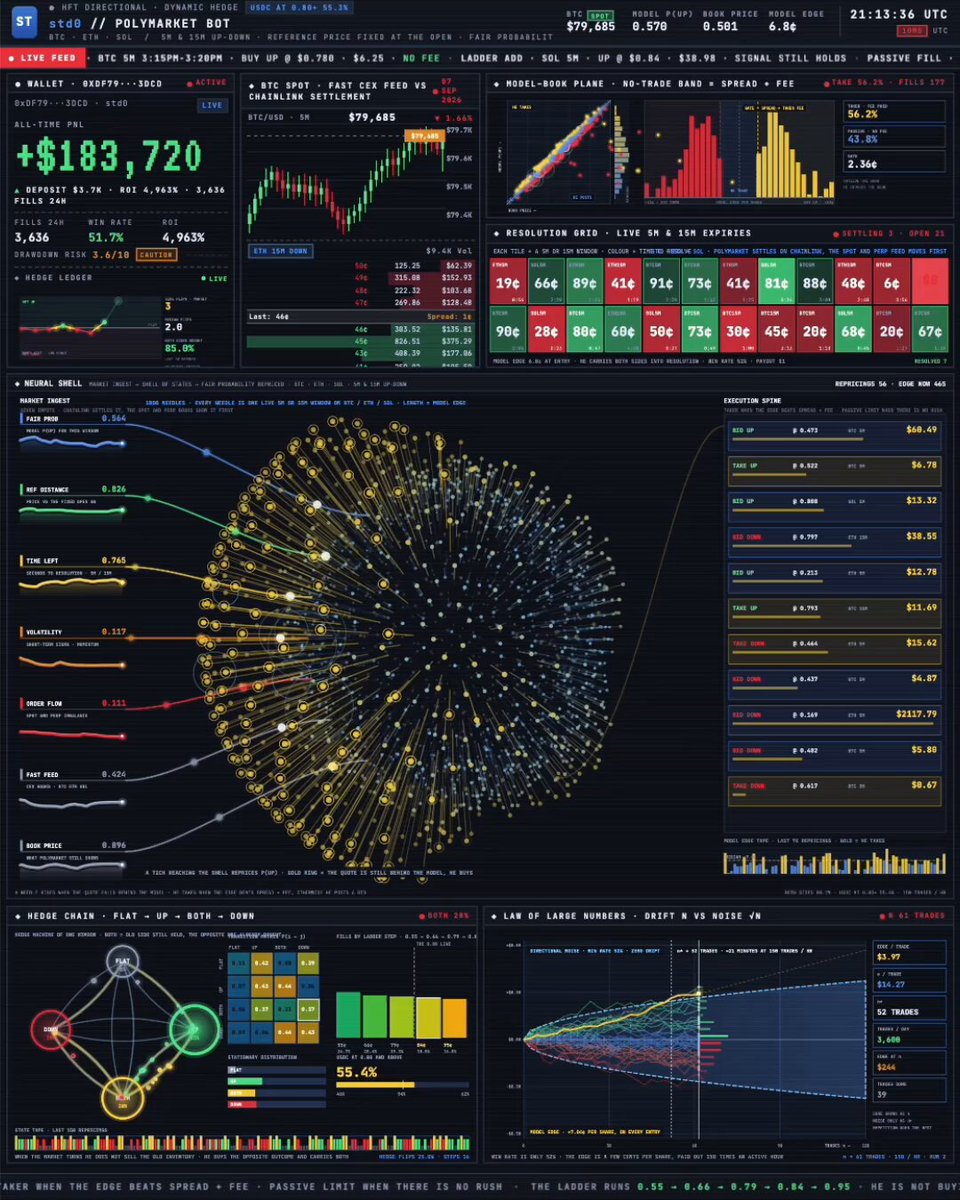
This guy built a trading bot on Polymarket with an average trade size of $28.64 Result: +$183,980 His bot trades 5 and 15 minute crypto Up/Down markets using a hybrid of directional trading, dynamic hedging, and volatility harvesting: 1. It looks for edge using its own fair-value model The model takes into account distance from the opening price, volatility, momentum, acceleration, order flow, and external spot/perp data It enters a position when it detects mispricing. As the signal gets stronger, it gradually increases its position 2. When the price reverses, it builds a hedge using the opposite outcome If the underlying asset changes direction, it doesn’t sell its existing inventory. Instead, it starts buying the opposite side This turns part of the existing position into a hedge, while its new directional exposure shifts according to the current fair-value estimate You can build your own trading bot here: (Trial period available after registration) This HFT algorithm’s Polymarket nickname: std0 Its main edge comes from constantly repricing probabilities and properly managing its positions
VALIX132,547 次观看 • 1 个月前

This guy built a passive grid bot on Polymarket and made $87,305 His algorithm trades short-term Up/Down markets using a fixed price grid, two-sided accumulation, and a directional residual: 1. Places BUY limit orders on a 10-cent grid 95.2% of its fills occur at price levels spaced 10c apart It provides liquidity at fixed price levels in advance and waits for market repricing to fill its orders 2. Buys the opposite outcome as the market moves It bought both Up and Down in 63.6% of markets The median number of switches between sides is 2 per market In total, 59.8% of all shares can be matched into Up + Down pairs 3. The directional residual provides the main edge Matched Up + Down pairs mainly reduce exposure, while the remaining unpaired shares stay directional In two-sided markets, its larger position was on the right side 53.7% of the time Its Polymarket account: 98euf98a You can build your own trading bot here: (A trial is available after signing up) The algorithm’s main edge comes from a passive 10-cent grid and managing directional skew: paired inventory makes the position safer, while the unpaired remainder retains a small statistical advantage
VALIX39,655 次观看 • 13 天前

This guy built an HFT algorithm on Polymarket with an average trade size of $23.59 Result: +$246,578 The bot trades short-term crypto Up/Down markets using dynamic hedging and a directional residual: 1. First buys the outcome its model considers underpriced It continuously estimates the fair probabilities of Up and Down and compares them with prices on Polymarket The bot builds a position whenever it detects a mispricing 2. Buys the opposite side when the signal changes If the underlying asset reverses, it does not close its initial position. Instead, it starts accumulating the opposite outcome It bought both sides in 90% of markets 3. Turns part of the position into complete sets below $1 In two-sided markets, the median combined cost of Up and Down is 94.5c But this is not pure arbitrage The median inventory imbalance is 40%, so after pairing both sides, the algorithm is left with a directional residual Its Polymarket account: pspspsps5 You can build your own trading bot here: (A trial is available after signing up) The main edge of this HFT algorithm comes from continuously shifting directional exposure as its fair probability estimates change, while purchases of the opposite outcome function either as a hedge or as part of a complete set
VALIX78,946 次观看 • 28 天前

This guy used Grok Bot to build an HFT algorithm on Polymarket Result: +$617,464 over 128 days This algorithm trades 5 minute BTC and ETH Up/Down markets using asynchronous complete-set accumulation, inventory management, and a directional residual Several AI agents work together as one system: 1. Buys both outcomes The median gap between its first trades on each side is 7.5 seconds 2. Uses repricing to lower the combined cost As BTC or ETH moves, it keeps buying Up and Down at different prices to bring their combined average cost below $1: VWAP(Up) + VWAP(Down) Edge 2.07c 3. Keeps a directional residual The median ratio of the larger position to the smaller one is about 1.44 : 1 The excess shares form a directional position in the outcome its fair value model considers more likely This trader’s Polymarket account: x-MoneyForWhiskas Most profitable trades: $1,038 -> $3,496 (+236.8%) $1,578 -> $4,811 (+204.9%) $1,664 -> $4,233 (+154.5%) The algorithm’s edge has two layers: it builds complete sets for less than $1 per pair and keeps a directional residual alongside them
VALIX21,700 次观看 • 7 天前

This guy built an HFT algorithm on Polymarket with an average trade size of $10 Result: +$262,402 His bot trades 15-minute BTC/ETH Up/Down markets using a hybrid of two-sided market making, volatility harvesting, and asynchronous complete-set accumulation: 1. It builds positions where Up + Down Buys Up at 42¢, then later buys Down at 53¢ > Complete set = 95¢ -> 5¢ gross edge 2. It leaves a directional residual on top of the paired inventory For example: > Buys 100 Up + 150 Down > 100 Up + 100 Down form complete sets, while the remaining 50 Down maintain directional exposure Around 86% of all purchased shares are part of the paired position, while the remaining inventory acts as the directional layer of the strategy His Polymarket nickname: aswfadq1555 You can build your own trading bot here: (Trial period available after registration) This guy’s stats: > Trades / active hour: 324 > Average trade: $10.51 > Win Rate: 50% The main edge of his HFT algorithm comes from using volatility within 15-minute markets to asynchronously accumulate Up and Down for less than $1. The unmatched remainder is kept as directional exposure Using this strategy and his algorithm, this guy steadily grows his capital
VALIX135,222 次观看 • 1 个月前

This guy built a trading bot on Polymarket with an average trade size of $72.40 Result: +$196,060 His algorithm trades BTC and ETH markets using directional trading, market making, and dynamic inventory management: 1. Builds a position gradually and manages it as prices change It buys Up or Down in small amounts, then adjusts its position size as the underlying asset’s price changes If the outcome it bought rises in price, it can sell part of its inventory and hold the rest if it still considers that outcome undervalued 2. Uses the opposite side as a hedge or to build complete sets It bought both sides in 71.6% of markets For example: > Up = 32c > Down = 67c > Up + Down = 99c That pair provides a 1c edge regardless of the result It also buys the opposite outcome to hedge or reverse its position 3. Keeps part of its inventory directional If it holds different numbers of shares on each side, the unpaired portion stays open For example: > 200 Up > 130 Down 130 Up + 130 Down form a neutral position. The remaining 70 Up shares stay directional Its Polymarket account: 0xdb5 The algorithm’s main edge comes from a combination of complete sets, hedging, and a directional residual
VALIX24,517 次观看 • 9 天前

This trader built a two-sided inventory bot on Polymarket with an average trade size of $10.51 Result: +$306,781 His algorithm trades 15 minute BTC and ETH Up/Down markets using asynchronous pairing, volatility harvesting, and inventory management: 1. Buys both sides at different times It keeps BUY limit orders open on both sides and waits for the market to move BTC falls -> Up gets cheaper -> it buys Up Then BTC rebounds -> Down gets cheaper -> it buys Down 2. Uses volatility to build complete sets It alternates between buying the two outcomes when their prices dip, using volatility within each market The goal is to buy both outcomes for a combined cost below $1 per pair 3. Keeps a directional residual About 86% of the shares it buys can be matched into Up + Down pairs It holds the remaining shares as a directional position until resolution Its Polymarket account: aswfadq1555 You can build your own trading bot here: (A trial is available after signing up) Stats: > Trades per active hour: 324 > Average trade size: $10.51 > Win rate: 50% The algorithm’s main edge comes from volatility harvesting. It uses market movements to buy Up and Down at different times, then matches part of its inventory into complete sets and keeps the rest directional
VALIX31,561 次观看 • 14 天前

This guy built a trading bot on Polymarket and made +$295,910 His bot trades 5 and 15 minute crypto Up/Down markets using a late-resolution strategy, where most of the position size is deployed when the outcome is getting close to final: 1. It starts with a small directional position At the beginning of each market, it records the reference price and tracks Chainlink TWAP along with external spot/perp feeds During the early stage, it builds a small position. This acts like a probe while the model’s confidence is still relatively low 2. It increases the position as the outcome gets closer to certainty The algorithm constantly recalculates probability. As resolution gets closer, it can estimate more accurately whether the result can still change 3. If the signal changes, it buys the opposite side In 88.2% of markets, it trades only one outcome. In 11.8% of cases, it buys both Up and Down. The opposite side works as a hedge His Polymarket nickname: BoneOhio Follow this account and trade on Polymarket through this app: The main edge of this guy’s HFT algorithm appears during the final minutes of the market. It estimates how close the outcome is to being locked in and concentrates most of its position size where the model sees mispricing
VALIX96,435 次观看 • 1 个月前

This guy built an HFT algorithm on Polymarket with an average trade size of $40 Result: +$223,542 His bot trades short-term BTC/ETH Up/Down markets using a hybrid of passive market making, inventory rebalancing, and opportunistic complete-set formation: 1. It accumulates outcomes below its fair value It places BUY orders in advance and waits for them to get filled. The average price per share acquired is 46.6c 2. When the market moves, it turns part of the inventory into cheap complete sets If its Up orders get filled first and then the underlying reverses, making Down cheaper, it starts accumulating the opposite side In two-sided 5-minute markets, the median combined VWAP of both sides is around 94.8c 3. It keeps part of the inventory directional It doesn’t try to fully balance Up and Down. If it can buy a cheap hedge, part of the position turns into complete sets. If not, the original inventory remains directional His Polymarket nickname: PBot-6 You can build your own trading bot here: (Trial period available after registration) This guy’s stats: > Trades / active hour: 46.11 > Average trade: $39.67 > Win Rate: 50% The main edge of his HFT algorithm comes from consistently getting fills below its fair value and building arbitrage positions
VALIX99,339 次观看 • 1 个月前

This guy built an HFT bot on Polymarket and made +$129,680 The bot trades 5 minute BTC Up/Down markets using complete-set accumulation and a directional residual: 1. Continuously accumulates both sides of each market It places BUY limit orders on both Up and Down and waits for BTC movements to change the outcome prices When one side becomes cheaper, the bot gets fills on that side. As the market reprices, it starts buying the opposite outcome at prices that keep the combined cost of Up and Down below $1 The weighted average cost of its complete sets is 98.43c, giving it an edge of 1.57c 2. Keeps part of the position directional After pairing, about 21.3% of the position value remains as unbalanced inventory. It chooses which outcome to hold based on its model’s signal Its Polymarket account: nagi777 Build your own trading bot here: (A trial is available after signing up) The bot’s main edge comes from two layers: most of its inventory is paired into complete sets costing less than $1, while the remainder is kept as a controlled directional residual
VALIX52,479 次观看 • 1 个月前

This guy built an HFT bot on Polymarket with an average trade size of $8 Result: +$243,619 His bot trades 5- and 15-minute crypto Up/Down markets using a directional latency strategy with fast position switching: 1. It looks for latency between external crypto markets and Polymarket It gets the underlying price from external sources and tracks momentum, acceleration, order-flow imbalance, and distance from the starting price of the current window Based on this data, it constantly recalculates its own fair probability for Up and Down 2. It trades mispricing before Polymarket fully reprices If the external market has already moved, but the outcome price is still lagging, the algorithm sees an edge and starts building a position 3. It quickly changes direction and dynamically hedges the old position If the signal reverses, it can sell the old side or start accumulating the opposite outcome, constantly rebuilding its net exposure His Polymarket nickname: nj23adsknml3 You can build your own trading bot here: (A trial period will be available after registration) This guy’s edge is built on speed. The bot tries to detect changes in external market prices before they are fully reflected on Polymarket, then quickly rebuilds its position after every new signal It repeats this micro edge thousands of times and keeps growing its capital
VALIX85,048 次观看 • 2 个月前

This guy built an HFT bot on Polymarket with a $50 average trade size Result: +$220,792 His bot trades 5-minute BTC/ETH Up/Down markets using a hybrid of inventory rebalancing, dynamic hedging, and accumulating cheap complete sets: 1. It builds complete sets so that Up + Down costs less than $1 It uses limit orders to buy different sides during different phases of the underlying asset’s movement Average cost of a matched complete set: $0.9387. Edge = 6.13¢ 2. It leaves directional residual on top of the hedged inventory Part of the capital gets a structural edge through pairing, while the rest keeps exposure on the side the algorithm sees as stronger For example: 200 Up + 150 Down 150 Up + 150 Down form complete sets, while the remaining 50 Up stay as a directional position You can build your own trading bot here: (Free trial available after registration) Stats: > Trades / active hour: 284 > Average trade: $49.8 > Win Rate: 50% His Polymarket nickname: hot-garbage This guy’s edge is built on two main layers: he turns most of his inventory into Up + Down < $1, while using the unmatched remainder as a directional position Using this strategy, he captures a consistent edge, repeats it thousands of times, and steadily grows his PnL
VALIX87,974 次观看 • 2 个月前

This guy built an HFT algorithm on Polymarket with an average trade size of $53 Result: +$129,923 His bot trades short-term BTC/ETH Up/Down markets using a hybrid of two-sided market making, complete-set accumulation, and inventory rebalancing: 1. It accumulates Up and Down at different points during the market It keeps BUY orders on both sides and uses intramarket volatility to get fills at different prices For example: > Up = 47c -> some time later Down = 52c > Up + Down = 99c -> 1c gross edge 2. It leaves a small directional residual After forming complete sets, it keeps some directional exposure when its own fair probability model sees an edge based on: > Underlying asset data from external sources > Order book depth > Momentum, acceleration, and volatility His Polymarket nickname: Polkadot-Frog Follow this account and trade on Polymarket through this bot: The main edge of his HFT algorithm comes from repeating the same cycle over and over again That’s how he captures a consistent edge and steadily grows his capital
VALIX69,356 次观看 • 1 个月前

This guy built an HFT algorithm on Polymarket with an average trade size of $60 and a 55% win rate Result: +$311,667 His bot trades short-term crypto Up/Down markets using a combination of directional trading and dynamic hedging: 1. Looks for mispricing using its model For each market, it records the reference price and uses fast spot/perp feeds to track the underlying asset Its model continuously recalculates outcome probabilities based on price relative to the reference, momentum, acceleration, volatility, time to resolution, and order flow Its signal looks like this: > Model Edge = p_model(outcome) - PM price For example: > p_model(Up) = 67c > Current Up price = 60c Model Edge = 7c As long as this gap remains, it keeps buying that side 2. Uses the opposite outcome to adjust its inventory If the market reverses and its fair probability estimate shifts toward the other side, it often buys the opposite outcome This reduces net exposure and, at favorable prices, can turn part of the position into complete sets costing less than $1 each Matched inventory acts as a hedge, while the remainder stays directional Its Polymarket account: antsaslyku The algorithm uses external price feeds to continuously update its fair probability estimates. Buying the opposite outcome lets it hedge its inventory while continuing to follow its directional signal
VALIX21,850 次观看 • 16 天前

This guy built an HFT algorithm on Polymarket with an average trade size of $18.69 Result: +$88,641 The bot trades short-term crypto Up/Down markets using a passive maker grid, asynchronous accumulation, and a directional residual: 1. Places BUY limit orders across a fixed price grid It provides liquidity at multiple price levels in advance and waits for the orders to fill 2. Accumulates the opposite outcome as the market moves It bought both Up and Down in 63.6% of markets Orders on one side fill first. Once the market reprices, orders on the opposite side start filling Within each market, it switches between Up and Down a median of 2 times 3. Keeps part of its inventory directional After pairing both sides, a directional residual remains. The size of this residual becomes the main source of PnL In markets where it bought both sides, the outcome with the larger inventory won 53.7% of the time Its Polymarket account: 98euf98a Follow this account and trade on Polymarket through this app: The bot’s main edge comes from a two-part strategy: matched Up/Down positions reduce exposure, while the remaining directional residual drives most of its PnL
VALIX44,860 次观看 • 1 个月前