Block Diffusion: Interpolating Between Autoregressive and Diffusion Language Models... "Block diffusion sequentially generates blocks of tokens by performing diffusion within each block and conditioning on previous blocks. By combining strength from autoregressive and diffusion models, block diffusion overcomes the limitations of both approaches by supporting variable-length, higher-quality generation and improving inference efficiency with KV caching and parallel sampling."show more

Tanishq Mathew Abraham, Ph.D.
21,813 次观看 • 1 年前
🚨Announcing our #ICLR2025 Oral! 🔥Diffusion LMs are on the... rise for parallel text generation! But unlike autoregressive LMs, they struggle with quality, fixed-length constraints & lack of KV caching. 🚀Introducing Block Diffusion—combining autoregressive and diffusion models for the best of both worlds! 👇1/7show more

Marianne Arriola
150,803 次观看 • 1 年前
(1/2) Check out "𝐏𝐨𝐥𝐲𝐃𝐢𝐟𝐟: Generating 3D Polygonal Meshes with... Diffusion Models"! Our model operates directly on the polygons of 3D meshes and generates novel shapes as output through an iterative diffusion process.show more
Matthias Niessner
57,947 次观看 • 2 年前
⚡ Video diffusion is slow. PDD changes that. 🚀... Introducing Parallel Decoding Distillation, our latest work on accelerating video diffusion models. Paper: Page: By Neta Shaul, Julius Berner, and Chao Liu. Below PDD on LTX-2.3 🔊show more

Arash Vahdat
21,595 次观看 • 2 个月前
🚀 Self-speculation brings 6.75x real speedup for LLM generation... with SGLang inference! Same model drafts future tokens in Diffusion mode → then verifies them in AR (causal) mode. One model and one KV cache. Just different attention masks. Thanks to perfect alignment, we get 2× longer acceptance lengths than MTP techniques (Eagle-3, MTP, dFlash). We run 2 forward passes… but the 2× higher acceptance means we break even - and with zero overhead from extra drafter, KV cache, or LM head that comes with MTP - those are not free. Last week we released Nemotron-Labs-Diffusion + Tri-mode LLMs! We did continued pre-training on Ministral-3 models by switching attention patterns (block causal bidirectional). Result: one model that runs AR mode, Diffusion mode, and Self-Speculation. Diffusion mode already shows high benchmark accuracy - excited to see what happens when someone beats left-to-right acceptance! 🔥 Github: Paper: SGLang inference: Try the models on HF:show more

Pavlo Molchanov
66,604 次观看 • 4 个月前
DimensionX: Create Any 3D and 4D Scenes from a... Single Image with Controllable Video Diffusion TL;DR: Create 3/4DGS from Video Diffusion Note: Some first inference code released (not all yet). Contributions (cited): • We present DimensionX, a novel framework for generating photorealistic 3D and 4D scenes from only a single image using controllable video diffusion. • We propose ST-Director, which decouples the spatial and temporal priors in video diffusion models by learning (spatial and temporal) dimension-aware modules with our curated datasets. We further enhance the hybriddimension control with a training-free composition approach according to the essence of video diffusion denoising process. • To bridge the gap between video diffusion and real-world scenes, we design a trajectory-aware mechanism for 3D generation and an identity-preserving denoising approach for 4D generation, enabling more realistic and controllable scene synthesis. • Extensive experiments manifest that our DimensionX delivers superior performance in video, 3D, and 4D generation compared with baseline methods.show more

MrNeRF
17,062 次观看 • 1 年前
Massive update for AI Engineers! Training diffusion models just... got a lot easier. dLLM is an open-source library that does for diffusion models what Hugging Face did for transformers. Here's why this matters: Traditional autoregressive models generate text left-to-right, one token at a time. Diffusion models work differently - they refine the entire sequence iteratively, giving you better control over generation quality and more flexible editing capabilities. The problem? Building and training these models required stitching together scattered tools and reimplementing research papers from scratch. Most of the tooling has been scattered and is hard to reproduce. dLLM changes this: It unifies everything you need to train, evaluate, and deploy diffusion language models: ↳ Scalable training with LoRA, DeepSpeed, and FSDP support ↳ Unified evaluation that abstracts away inference complexity ↳ Ready-to-use recipes for pretraining, finetuning, and evaluation The library includes implementations of models like LLaDA and Dream, plus training algorithms like Edit Flows that enable insertion, deletion, and substitution operations. The team just released ModernBERT-Chat models showing you can turn BERT into lightweight chatbots through masked instruction tuning. This is practical and worth exploring. The setup is straightforward. Run locally with Accelerate or scale to multi-node clusters with Slurm. If you're working with language models and want to explore diffusion-based approaches without rebuilding infrastructure, dLLM gives you a production-ready starting point. Link to the repo in the next tweet.show more

Akshay 🚀
64,011 次观看 • 11 个月前
1/ Happy to share UniDisc - Unified Multimodal Discrete... Diffusion – We train a 1.5 billion parameter transformer model from scratch on 250 million image/caption pairs using a **discrete diffusion objective**. Our model has all the benefits of diffusion models but now in multimodal space! - flexible compute-quality tradeoff, zero-shot inpainting and editing, better control via classifier-free guidance and lower latency! We open source everything - our code, weights and the training dataset.show more
Mihir Prabhudesai
105,076 次观看 • 1 年前
Switti -- a new scale-wise transformer for text-to-image generation... 🦾 🔥 Improved generation of fine-grained details. Outperforms existing T2I AR models and competes with state-of-the-art T2I diffusion models while being up to 7x faster.show more

Gradio
29,314 次观看 • 1 年前
Diffuman4D: 4D Consistent Human View Synthesis from Sparse-View Videos... with Spatio-Temporal Diffusion Models Contributions: • We introduce Diffuman4D, a novel diffusion model that generates spatio-temporally consistent and high-resolution (1024p) human videos from sparse-view video inputs. • We propose a sliding iterative denoising mechanism that enhances both the spatial and temporal consistency of generated long-term videos while maintaining efficient inference. • We design a human pose conditioning scheme to enhance the appearance quality and motion accuracy of generated human videos. • We plan to release our processed version of the DNA-Rendering dataset, which we believe will benefit future research in this area.show more
MrNeRF
24,729 次观看 • 1 年前
Wow. AI-generated animation from a video. This experiment combines... video of dance choreography by Erica Klein and hok with AnimateDiff and a text prompt. #AnimateDiff feels like the missing link in diffusion video generation -no flickering! More soon. #stablediffusionshow more

Nathan Shipley
172,681 次观看 • 3 年前
You can now use Flux and other image generation... models for free on PUBLC, including: - Flux.1 Schnell & Flux.1 Dev by BlackForestLabsAI - Unofficial - Stable Diffusion 3 by Stability AI - SDXL-Lightning-4Step by ByteDance Unleash your creativity✨ Try it now -show more

PUBLC
648,901 次观看 • 2 年前
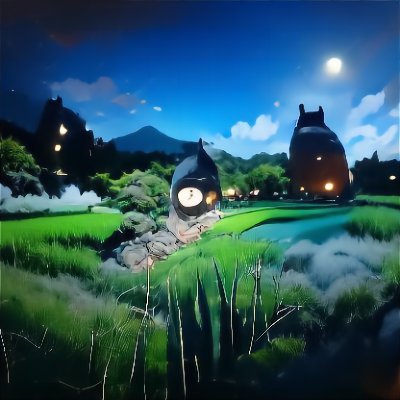
Show-o One Single Transformer to Unify Multimodal Understanding and... Generation discuss: We present a unified transformer, i.e., Show-o, that unifies multimodal understanding and generation. Unlike fully autoregressive models, Show-o unifies autoregressive and (discrete) diffusion modeling to adaptively handle inputs and outputs of various and mixed modalities. The unified model flexibly supports a wide range of vision-language tasks including visual question-answering, text-to-image generation, text-guided inpainting/extrapolation, and mixed-modality generation. Across various benchmarks, it demonstrates comparable or superior performance to existing individual models with an equivalent or larger number of parameters tailored for understanding or generation. This significantly highlights its potential as a next-generation foundation model.show more
AK
124,085 次观看 • 2 年前
Most recent diffusion language model research (that I’ve seen)... seems to be using masking as the noising process. It looks like, however, most closed-source models (Google Gemini Diffusion and possibly Inception Labs’ Mercury) use a different noising process, where instead of masking tokens, they replace them with different tokens (either with a random token or a semantically similar token). I wondered how they were getting such high throughput with the latter noising process, since I believed that optimizing inference with KVCache approximation would be more difficult (for various reasons). I visualized this noising process with tiny-diffusion and compared it to normal unmasking, and was very surprised to see how fast the generation “settles” into a reasonable output, and then only slightly refines afterwards, requiring much fewer steps in total. Unmasking (where tokens are never remasked, the typical implementation) is inherently limited in generation speed by the fact that an increase in tokens decoded per step leads to more errors due to the mismatch between individual and marginal token probability distributions we sample from. The token replacement noising process seems to have a much different set of characteristics. Because we sample each token per step, every token makes “progress” towards the final output each iteration (in addition to *potentially* giving other tokens more information in future steps). Generally, masking has outperformed other noising processes, which is probably why most research focused on it (using smaller models). But the paper referred to in the retweet shows that random replacement as a noising process may scale better as model size increases. Big labs might have noticed these results much earlier (due to having drastically more training resources and being able to test larger models), which may explain the discrepancy in the choice of noising process. I’m gonna test this with larger models, since tiny-diffusion only has 10M parameters.show more

nathan (in sf)
40,440 次观看 • 9 个月前
We are also releasing self-contained lecture notes that explain... flow matching and diffusion models from scratch. This goes from "zero" to the state-of-the-art in modern Generative AI. 📖 Read the notes here: Joint work with Ezra Erives.show more

Peter Holderrieth
476,988 次观看 • 7 个月前
We took a 30B model and split it in... two to write tokens in parallel instead of one at a time. Introducing Nemotron-Labs-TwoTower: a diffusion language model from NVIDIA Research adapted from Nemotron-3-Nano-30B-A3B. Here’s how it works: one half holds the context, the other writes the tokens, with both reusing the pretrained model instead of training a new one from scratch. We found it kept 98.7% of the original model’s quality at 2.42× faster generation.show more

NVIDIA AI
763,100 次观看 • 3 个月前
Introducing 📦𝗔𝗿𝘁𝗶𝗟𝗮𝘁𝗲𝗻𝘁🔧 (SIGGRAPH Asia 2025) — a high-quality 3D... diffusion model that explicitly models object articulation, paving the way for richer, more realistic assets in embodied AI and simulation: – Generates fully articulated 3D objects – Physically plausible joints & motion – High-fidelity 3D Gaussian appearance – Supports generation from a single real image arXiv: Project: Code (coming soon):show more

Xingang Pan
11,553 次观看 • 11 个月前
Wonderland: Navigating 3D Scenes from a Single Image Contributions:... • First, we introduce a representation for controllable 3D generation by leveraging the generative priors from camera-guided video diffusion models. Unlike image models, video diffusion models are trained on extensive video datasets. This enables them to capture comprehensive spatial relationships within scenes across multiple views and embed a form of "3D awareness" in their latent space, which allows us to maintain 3D consistency in novel view synthesis. • Second, to achieve controllable novel view generation, we empower video models with precise control over specified camera motions. We introduce a novel dual-branch conditioning mechanism that effectively incorporates desired diverse camera trajectories into the video diffusion model. This enables expansion of a single image into a multi-view consistent capture of a 3D scene with precise pose control. • Third, to achieve efficient 3D reconstruction, we directly transform video latents into 3DGS. We propose a novel latent-based large reconstruction model (LaLRM) that lifts video latents to 3D in a feed-forward manner. With this design, during inference, our model directly predicts 3DGS from a single input image, effectively aligning the generation and reconstruction tasks—and bridging image space and 3D space—through the video latent space. Compared with reconstructing scenes from images, the video latent space offers a 256× spatial-temporal reduction while retaining essential and consistent 3D structural details. Such a high degree of compression is crucial, as it allows the LaLRM to handle a wider range of 3D scenes within the reconstruction framework, with the same memory constraints.show more
MrNeRF
52,849 次观看 • 1 年前
Decentralized Diffusion Models power stronger models trained on more... accessible infrastructure. DDMs mitigate the networking bottleneck that locks training into expensive and power-hungry centralized clusters. They scale gracefully to billions of parameters and generate photorealistic images with just a week of training on eight independent GPU nodes. They’re easy to implement, adopt DiT hyperparameters directly and outperform standard models FLOP-for-FLOP.show more

David McAllister
46,480 次观看 • 1 年前
World modeling and imitation learning have largely been considered... two disparate worlds. In our recent work, Unified World Models, just accepted to #RSS2025, Chuning Zhu provides a dead-simple unifying solution: just train a joint diffusion model over actions and future states, but with *decoupled* diffusion time steps across these modalities. Manipulating these decoupled time steps then allows for marginalization or conditioning on actions or states; a single model can serve as a policy, forward dynamics model, video prediction model, or inverse dynamics model by simply setting diffusion timesteps carefully. The resulting model can leverage video datasets along with robot training data much more effectively, and shows improved robustness, generalization, and flexibility. This is exciting because it is frustratingly simple, scalable, and shows strong improvement on real-world robotics problems. Please refer to Chuning Zhu 's excellent thread for more details! More details/code can be found on our website and in the paper -show more

Abhishek Gupta
11,430 次观看 • 1 年前
🚀New paper out - We present Video-MSG (Multimodal Sketch... Guidance), a novel planning-based training-free guidance method for T2V models, improving control of spatial layout and object trajectories. 🔧 Key idea: • Generate a Video Sketch — a spatio-temporal plan with background, foreground, and motion in the pixel space. • Encode this structure directly into the latent space of the diffusion model during generation, which does not require fine-tuning or additional memory during inference. 🧵show more
Jialu Li
35,258 次观看 • 1 年前