Easily position hands around objects with Zemalate's simple Blender... tool, which adds collision-aware behavior to finger bones. Available here:show more

80 LEVEL
67,846 Aufrufe • vor 23 Tagen
One thing I appreciated about 007 First Light is... its use of procedural body animation, similar to Uncharted 4. The character’s hands naturally interact with nearby objects while moving, which is still relatively rare in games and adds a noticeable layer of realism.show more

GameVerse
1,796,690 Aufrufe • vor 1 Monat
As ferry pilots, we often fly 20-25 hours across... long distances and frequently need to service the engine oil enroute. Especially so with the more tired engines. Turbine oil comes in cans, and since we have to go through security to get to a job, we don’t have tools. Fortunately the on-board crash axe is the PERFECT tool for the job. If you put one finger over the top hole, and move swiftly and smoothly into position and then release your finger - you can pretty easily hit the filler tube with little to no spillage 👍🏼 Unfortunately it’s not possible to do while also filming, so you’ll see no evidence of my (ahem) “perfect pour”show more

Steve Giordano
752,140 Aufrufe • vor 2 Jahren
NASA recovery team opening the Artemis capsule Here we... see the message "not flat" on his helmet... very interesting how they're even making a big deal out of it now! It's quite astonishing that the guy didn't even burn his hands on a capsule that, just minutes before, was supposedly exposed to temperatures of around 2,800 °C. Temperatures at which even steel would have long since melted. Instead, it can be easily touched with bare hands, as if it had just emerged from a lukewarm bath. These alleged re-entry temperatures are far above the melting point of steel (approx. 1,500 °C). In any iron foundry, glowing steel would react dramatically when quenched in water, but apparently not here. NASA is just laughable.😂show more

Andy
22,345 Aufrufe • vor 2 Monaten
WATCH: Bernie Sanders FREEZES when asked if Congress should... grant Ghislaine Maxwell immunity to testify. Something’s off here. The body language says it all. CNN’s Kaitlan Collins asked a simple question: “Would you be okay with Congress giving her immunity to testify? That’s what she wants.” Bernie threw up his hands and stumbled: “I haven’t thought about it.” “I... I... don’t know the answer to that…” [Long pause] Collins followed up: “No position?” Bernie replied with an awkward grin: “You’re the first person who has asked me about it…” When she asked if he’d share once he had an answer: “You’ll be the first.” Very odd.show more

The Vigilant Fox 🦊
1,281,006 Aufrufe • vor 11 Monaten
There are three main issues here 1. The truck... on the left is on the fast lane, which is correct.✅ 2. The second truck, with a dustbin-, is partially on the fast lane but not moving as it should. Its incorrect position -should be on the slow lane, alongside the danfo the yellow buse (public transport) 3. The driver of the red car is the main culprit. He lacks driving experience and failed to calculate his entry into the lane properly. Instead of entering at a safe speed of around 150-160 mph, he entered recklessly. A simple press of the brake for 4 seconds could have avoided the problem. The issue lies with the red car driver's poor entry into the lane. The award 🥇 goes to danfo driver . Give that danfo man a cool beer 🍺show more

Wellness Researcher
169,045 Aufrufe • vor 1 Jahr
Today is also Shiroko's birthday, the other Shiroko. She... came from far away, traveling a long and winding road to be here now. Same name, same birthday, but the weight of the years between them could not be more different. Still, this Shiroko is someone who chose to get back on the pedals again. Every day she finds something broken and brings it back to life with her own hands, and that tells you everything. Some quirks seem to stay the same no matter which world she comes from, though. Why not visit her first today, Sensei. A simple day like a birthday can remind her that she has a place to come home to. #BlueArchiveshow more

BlueArchive
102,403 Aufrufe • vor 2 Monaten
Speaking of Dreams.. still kinda crazy to me how... perfect of a match a tool like that is for generative AI workflows. Intuitive game engine/creative sandbox that allows you to build almost anything, running underneath a Gen AI render. Sculpting, painting, interacting with your two hands in 3d space, here using two move controllers which by now is tech from 2010. I haven't seen ANY way to interact with 3d that allows for the same fast and intuitive sculpting without forcing you to wear a VR headset. I made this scene a few years ago in 2 and a half hour or so as part of a 1 scene pr. episode of The Last of Us, and ran it through a combo of Runway and Sora to get to this result.show more

Martin Nebelong
19,510 Aufrufe • vor 10 Monaten
004/100 Buttons. A bit of the process on building... an animation. When looking at a finished animation or in this example a finished button, it can look quite complex inside the CSS. But when building it, it’s more like a lot of simple steps, one after another. Here I had the idea to make some kind of text animation like the footer logo on the Osmo site. I try to add the base animation with no complex easing, for example transition: translate 0.4s ease. Starting with just moving the one text from bottom to top and the other text to top. Adding a stagger, play around with it. Searching for a way to make it more circular. On the research I found the sin() function inside CSS which can build a more smooth non linear curve for the stagger which creates this circular effect. And step by step adding more complexity like, different easing for hover/hover-out, opacity, 3D transform and more. I use also the sin() function to rotate the letters, so the middle ones are getting more rotated than the outer ones. Another thing which helps is to add a small delay on hover, for example 0.05s or 0.1s, you don’t really see the difference, but when you hover pretty fast on and out it doesn’t get that jumpy. I’m using here GSAP’s SplitText to split every char into spans. And then I’m adding a CSS index variable to every span, starting from the center. SplitText can provide CSS index variables, but you cannot tell it from which direction. For the sin() it’s also important to have a max length, so I add another CSS variable with the max char number on it. Crafting 100 Buttons with Osmo ⏳ Total time: 63hshow more

Eduard Bodak
166,023 Aufrufe • vor 2 Monaten
The video smooth zoom on the Samsung Galaxy S26... Ultra is still the closest thing to a professional camcorder experience in the smartphone industry today. In fact, it’s even easier to control than the iPhone. On many other phones, video zooming requires constant finger movement and very precise control. The zoom speed can easily become inconsistent, suddenly speeding up or slowing down. Samsung works differently. You simply hold your finger at a certain position, and the phone continues zooming at a constant speed. The entire process feels extremely stable and linear. It genuinely resembles the powered zoom control of a professional video camera. This logic is fundamentally related to Samsung’s AI slow motion technology. They share the same core foundation: real time control over motion trajectories, speed transitions, and frame interpolation. What you’re seeing here was shot in very windy conditions using Samsung’s Pro Video mode, continuously zooming from 5x to 25x. Aside from some slight stutter during optical lens switching points, the continuous zoom transition within digital zoom ranges is arguably the closest thing to a professional camera currently available on a smartphone. So if the future Samsung Galaxy S27 Ultra really removes the 3x telephoto camera, it could actually improve the video zoom experience further. Fewer optical switching points would theoretically reduce transition jumps and stutters, making the entire zoom range feel even more natural and continuous.show more

Ice Universe
25,951 Aufrufe • vor 2 Monaten
Update on Lulu: She's doing very well! 😍 Eating,... brighter, pooping and peeing normally and her wound is looking great 👍🏻💪🏼😍 We are bringing her home today 😁🙏🏻 I'm sure she'll thrive when she's in her own surrounding with familiar faces. She needs around 3 months to recover fully, which will be a real pain for her, because she loves being in the thick of it 😩😂 Thank you once again to everyone who made it possible for our Lulu to have the treatment and surgery. We appreciate it sooo much 🙏🏻🙏🏻🙏🏻🐾❤ To help us get through another month, you can make a donation here: Or, on our website via bank transfer using any transfer app: No amount is too small. It all adds up and keeps us going 🙏🏻🙏🏻🙏🏻🐾🐶😺❤show more

Lovina Animal Welfare
140,089 Aufrufe • vor 2 Monaten
Introducing my new OSS framework: OhSnap provides really simple... way to record and reproduce the data your users saw when encountering an issue (bug/crash), integration in your project should take a few minutes at most. Majority of bugs are related to data you have to deal with and often times we have to work with frequently changing data via network API's. Even if you have access to multiple environments (prod/staging/dev) it's still going to be PITA to reproduce a lot of bugs your user saw, since we often get to them a long time after the bug occured... OhSnap allows you to easily record any data your app downloads, pack it and put it on server so that you can replay it on your device later on, while connected to debugger and save hours of development time trying to figure out what exactly they experienced! Here's a demo of 2 app instances running, and me manipulating what server reply I'll be getting, there is 1 line of code needed to record and reply this data (outside of just setting up your framework). I built this so that I can show dev tool building process for the members of which I encourage you to join if you want to put your engineering efficiency at a different level😉show more

Krzysztof Zabłocki
30,484 Aufrufe • vor 2 Jahren
This work makes a humanoid robot do simple parkour... moves by looking with a depth camera and choosing the right move on the fly. The big deal is that it turns lots of small human moves into long, real-time robot behavior, without hand-coding every transition or retraining for each new course. A humanoid robot is usually good at steady walking, but it often fails when it has to do fast moves like jumping up, vaulting, or rolling, and then keep going to the next obstacle. The hard part is that you cannot easily collect training data for every possible obstacle shape, distance, and mistake, so robots end up learning a few moves that only work in a narrow setup. This work starts from short clips of real human parkour moves, like stepping over, vaulting, climbing, and rolling. It uses motion matching, which is basically a smart “pick the next clip that fits best right now” search, to stitch those short clips into a long, smooth plan that looks like a human doing a whole course. Then it trains a controller with reinforcement learning (RL), which means the robot learns by trial and error to copy that plan while staying balanced and not falling. After training separate expert controllers for different moves, it compresses them into 1 controller that uses only onboard depth sensing and a simple “go this fast in this direction” command. In real tests on a Unitree G1 humanoid, it can clear multiple obstacles in a row, adapt when obstacles get moved, and climb a wall up to 1.25m.show more

Rohan Paul
37,121 Aufrufe • vor 5 Monaten
At the age of thirteen, in the late 1940s,... Thomas Fogarty, newly bereft of his father, found himself employed at Cincinnati’s Good Samaritan Hospital, sorting supplies and learning the rhythms of the place from the ground up. With time and a certain doggedness, he moved from the stockroom to the operating room, working his way up to the role of scrub technician, where he stood at the surgeon’s elbow, handing over instruments. Back then, the approach to removing blood clots from an artery was crude and perilous. It was a bit like a ritual sacrifice—that involved slicing the artery wide open in a procedure that could easily stretch over nine hours and leave the patient with incisions from the abdomen down both legs. The outcome, more often than not, was dismal. Many didn’t survive, many others ended up with amputations. It was during those hours at the operating table, observing the struggle of clot removal, that Fogarty began to wonder if there might be a way to make the process a bit less medieval. He retreated to his garage with little more than a length of tubing, a surgical glove, and an idea. There, he crafted a tool so simple that it verged on the audacious. He started with a urethral catheter, flexible yet sturdy enough to navigate through a clot. To the end of the catheter, he attached a tiny balloon made from the finger of a latex glove. Once past the clot, the balloon could be inflated with saline from the other end of the tube, expanding it to the width of the artery and then pulled back—bringing the clot along with it. The device was so simple, so staggeringly clever, that when he demonstrated its use, the surgeons were equal parts gobsmacked and irritated. With it, clot removal (embolectomy) was no longer a barbaric ritual but a neat, almost gentlemanly procedure. Like removing a cork from a bottle. Thomas Fogarty went on to become a cardiovascular surgeon. That little embolectomy catheter he dreamt up became the very first minimally invasive surgical device. Here’s a video showing how it’s done: through a small incision in the groin, under local anesthesia.show more

Ambarish Satwik
49,730 Aufrufe • vor 1 Jahr
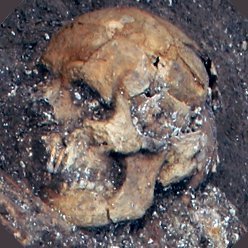
Facial reconstruction of a 3,750-year-old acromegalic Aryan smith from... Chelyabinsk He belonged to the proto-Indo-Iranian Sintashta culture, which traces its origins farther to the west in Europe. In the late 1970s, archaeologists discovered a fortified settlement of the Sintashta people in the Troitsk district of the Chelyabinsk region, which was named Chernorechye-III. A few years later, not far from it, researchers also identified the ancient cemetery of Krivoe Ozero, where its inhabitants may have been buried. In the third grave of barrow number ten, archaeologists found the skeleton of an adult who had been buried on his side with bent legs and arms, with the hands positioned close to the face. Alongside the skeleton, scientists found ceramic vessels, animal bones, metal objects and fragments of them, as well as pieces of ore and slag. Anthropologists determined that the skeleton belonged to an adult man approximately 164-167 cm tall, who died at an age of over 50. On his bones they identified signs that during his life he had performed heavy physical labor, with more strain on the arm muscles than on the legs. Together with the finds of ore, slag, and metal items, this suggests, according to the researchers, that the burial most likely belongs to an ancient metallurgist who worked in processing copper ore, forging bronze tools, and possibly frequently pumped air into furnaces using bellows. In addition, anthropologists noted this man’s atypical appearance, which differed significantly from the general Sintashta population. Apparently, he suffered from acromegaly - a pituitary disorder that leads to the enlargement and thickening of cranial bones. Moreover, the analysis of ore from this man’s grave showed the presence of material from gold-copper-porphyry deposits. The nearest such deposit with evidence of ancient mining is located in the Ural-Mugodzhary mining-metallurgical center - roughly 300-350 kilometers south of the cemetery. This likely indicates contacts between the Sintashta people and inhabitants of more southern regions. The paleoanthropological material from the site was described by G. V. Rykushina (Rykushina 2003), unfortunately only at the individual level. The author noted the presence of morphologically different skulls in the sample - Europoid (kurgan 1, burial 3; kurgan 10, burial 3; kurgan 10, burial 34), gracile Europoid (kurgan 9, burial 7), and a Europoid skull with equatorial features (kurgan 10, burial 6). Based on the study of pathological markers (such as mastoiditis, cranial infections, and diseases of the dental-jaw system), the author suggested that this group had immigrated from a different climatic zone (Rykushina 2003: 360). A particularly specific skull that should be noted is from kurgan 10, burial 3, which is characterized by overall maturization, dolichocrany, a high cranial vault, a large facial skeleton, and moderate horizontal profiling with a strongly projecting nose. One must agree with G. V. Rykushina’s observation of signs of hormonal disorders that led to the development of acromegaly (Rykushina 2003: 352). This likely caused changes in the size of the facial skeleton, primarily in height and width. However, even without considering these pathologies, this skull is quite distinctive. (E. P. Kitov, A. A. Khokhlov, P. S. Medvedeva 2018) The man had a medium-large cranial length of 182 mm, a medium-small cranial width of 135 mm, and a broad cheekbone width of around 145 mm.show more
Ancestral Whispers
3,473,947 Aufrufe • vor 7 Monaten
My books go here now. 📚 Toddler behaviors can... sometimes seem difficult to interpret - but, in truth, often follow common patterns or “schemas.” Schemas are most commonly associated with Jean Piaget, the Swiss psychologist who coined the term decades ago. But over the intervening years, researchers have identified at least 9 common toddler play patterns. Which brings us to this little cutie, who is engaged in one of them: Transporting. As toddlers become mobile, they develop a keen interest in moving themselves - and other objects - from place to place. This behavior remains common well into the preschool years. Ever wonder why household items miraculously end up at school? Or why your preschooler’s pockets are full of rocks? As random as it can seem, it’s all a part of their play. Blame the transporting schema. Transporting can be frustrating at times, like when an entire pile of books appears in your hallway - but it helps to understand that this isn’t just your toddler creating chaos. It’s them learning and growing - and following a predictable toddler urge. This great example was posted to TT by sammci9.show more

Dan Wuori
1,209,414 Aufrufe • vor 2 Jahren
(Yes i know the movement is exaggerated, its just... to show the motion, it also doeant move like jello when in vr) -Left is before, Right is after- Ok wall of text time for the nerds Literally everything is the same on both sides except the position of 1 bone (made sure that even after adjusting, the collider would still be in the same spot) The reason for this change is because she wanted to be able to clap her ass in vr, and last time i did this all i did was add a toggle for a hidden bone that moved, and its angle would trigger the sound. Which was because that with my previous position, the cheeks could never really meet in the middle when in motion unless you just pushed them together with your hands, and i wanted to just have the sound actually be triggered by them colliding with each other This is also the first time ive used endbones to help drive the movement, so now thanks to that and all my previous experimenting with squishing as well, I can now get bones to move exactly how i want them to move when in natural motion. And i know a lot of people are gonna ask me to teach them how or explain my thought process but i literally just go off feeling lmao. Like, i just kinda visualize in my head how i want the motion to look, and then i just kinda know where to put everything, so im not even sure how to even start explaining rip. I have the things that artist want where they can just make the shit in their head exactly how they envisioned it lol I have a few more ideas i want to try, so we'll see if theyre good enough to get a tweet lol Thank you for coming to my ted talkshow more

Pixel
27,240 Aufrufe • vor 1 Jahr
In Gaza… A Small Spark Can Turn Into a... Catastrophe What makes it even harder is that water is not easily available, leaving families helpless as flames consume tents and everything inside them. In this video, a tent made of nylon and fabric caught fire today, turning within minutes into a disaster threatening dozens of neighboring tents. People rushed to save whatever they could, while others were forced to dismantle their tents out of fear that the fire would spread. Here, the fire does not only consume a tent — it destroys everything a family owns: clothes, blankets, mattresses, food, and the few memories that survived war and displacement. This is the reality thousands of displaced families in Gaza live every day, where preparing a simple meal or heating water can suddenly turn into a tragedy that leaves a family with nothing in a matter of moments. In Gaza, even a temporary tent is no longer a safe place. The fire here does not only burn fabric — it burns what little shelter and sense of safety people have left.show more

Sameh Ahmed 𓂆 🇵🇸
10,904 Aufrufe • vor 1 Monat
Facial reconstruction of a 1,300-year-old North Caucasian Alan from... Kislovodsk The Alans were an Iranic Sarmatian tribe who appeared in the region between the Don River and the Caspian Sea around the 1st century AD. Having taken part in the major migrations and political events of Europe, a group of Alans also settled in the Caucasus, where they mixed with and influenced the local populations. This individual belonged to a man over 60 years old. His cranial type was identified as Caucasoid, but with elements of East Asian traits, likely linked to the Huns, a Turkic people who also settled in the Caucasus and other regions, like the preceding Alans. He had an artificially elongated skull. The tradition of altering skull shape was characteristic of the Sarmatians (especially the Late Sarmatians), who settled across a vast territory. It was also widespread among the closely related Alans, and the Huns likewise practiced cranial deformation. To achieve such an unusual head shape, a newborn’s skull was tightly wrapped with a ritual leather band decorated with beads, threads, and pendants. It was worn until the bones became firm, after which it was no longer needed, the formed skull would then retain its shape. According to one modern theory, cranial deformation was most likely used to signal belonging to an influential group or to display social status, such as an elite position. The reconstruction was created in collaboration with anthropologist Alexey Nechvaloda. The main reference and starting point for this approximation was the sculptural facial reconstruction made by Sergey Alekseyevich Nikitin, Russia’s leading expert in craniofacial reconstruction, for the “Krepost’” museum in Kislovodsk, in which he modeled the left half of the Alan’s face.show more
Ancestral Whispers
138,597 Aufrufe • vor 8 Monaten