Harrier elevator ride... had never seen this before "The... "Farley Takeoff," developed by legendary test pilot John Farley, involved hovering a Harrier jet at 100 feet before pitching the nose up to a steep 60-degree angle while still in a hover. Once in this vertical position, he would apply maximum power to "rocket climb" away, a "seat of the pants" maneuver that was strictly forbidden for Royal Air Force and Royal Navy service pilots due to its extreme difficulty and lack of instrument guidance. Credit: Hawker Siddeley (later British Aerospace/BAE Systems)" ℹ️historyphotographedshow more

Francisco Cunha
701,341 Aufrufe • vor 5 Monaten
This F-15 fighter jet is hooked up mid-air to... a tanker getting topped off when the pilot decides it’s time to go. The second he disconnects he banks hard and blasts away over the patchwork farmland below while the text pops up saying the Air Force doesn’t do “goodbye” — they just hit you with a “SEEEYUH!” and disappear into the sky. Would you ever ride along in a jet that treats aerial refueling like a quick gas station stop before vanishing like it was never there? Or is this exactly why USAF pilots live in a whole different reality from the rest of us?show more

Ryan Cey
49,310 Aufrufe • vor 4 Monaten
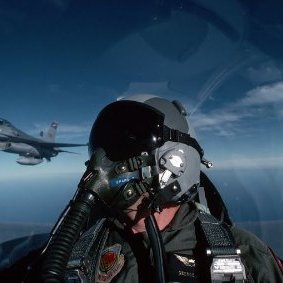
Ever seen an F-16 this aggressive? 😱 This pilot... showing why the Viper is still king of the skies. Watch this Turkish Air Force F-16 carve through the sky with brutal high-G turns, steep vertical climbs, and razor-sharp energy management over the Black Sea. The F-16 is built to sustain up to 9G, and in the hands of a skilled pilot, it becomes one of the most agile fighters ever created. Every maneuver is a masterclass in precision, power, and confidence. 📽️: ekmenfatihhshow more
Airforce Geek
60,625 Aufrufe • vor 25 Tagen
August 1990, two hikers walking near Calvine in the... Scottish Highlands reported seeing a large, diamond shaped object hovering in the sky. The men claimed the object was metallic and remained stationary for several minutes before blasting upward at high speed. They also reported observing a military jet aircraft in the vicinity, which appeared to circle near the object. It appeared to be a Harrier VTOL jet. One of the hikers photographed the scene, producing a image that later became one of the most discussed UFO photographs in the United Kingdom. The photographs were reportedly submitted to local UK authorities and eventually passed to the Ministry of Defence (MOD). For years, the case was unknown to the public, making people go even more overload government secrecy. Later, a version of one image resurfaced through investigative journalism that I have attached. What do you think this is?show more

Jason Wilde
37,792 Aufrufe • vor 5 Monaten
This effect was captured within the time it takes... to bake a single cake using edelkrone motion control devices with flawless position accuracy and with just one camera. This is a new generation effect that has never been seen before in the world. In this age where competition in content production is at its fiercest, we are proud to be able to offer such a feature to our customers for free to help them get ahead in the competition. As edelkrone, we are committed to pushing the boundaries of innovation and delivering the never seen before.show more

Kadir Köymen
161,073 Aufrufe • vor 2 Jahren
The Boulton Paul P.111, was Britain's tiny experimental delta-wing... jet built right after WWII to unlock the secrets of tailless deltas. Powered by a Rolls-Royce Nene turbojet, it first flew on October 10, 1950, with detachable wingtips for quick tests between blunt and pointed shapes — one of the earliest pure research platforms for this config. Legendary test pilot Ben Gunn called it "touchy" and "like flying a razor's edge" due to its razor-sharp handling and extreme sensitivity. After a landing mishap, it was rebuilt into the P.111A ("Yellow Peril" in its bright paint, note:my coloring process didn't pick up on that), pushing near Mach 0.98 before retiring in 1958. 👀show more

Aviation Archive - Tim Farmer
14,246 Aufrufe • vor 5 Monaten
A Wing And A Prayer Before Jump Doors: The... Insane "Wing-Slide" Technique of the 1930s. The Soviet Tupolev TB-3, a legendary heavy bomber that served as the cradle for the Soviet VDV (Airborne Forces) long before modern safety standards existed, and the unique and harrowing deployment method that predates the standardized jump doors and static lines we know today. Before the invention of dedicated troop transport aircraft with side doors, Soviet strategists had to improvise. The paratroopers would climb out of the open cockpits and hatches of the Tupolev TB-3 while in flight. They would then gingerly walk along the corrugated metal fuselage-battling the slipstream-to position themselves on the broad roots of the wings. At the pilot's signal, they would simply slide off the trailing edge of the wing, pulling their ripcords manually as they fell away. This method, often performed at air shows for high-ranking officials (including Stalin), was a terrifying display of courage and a testament to the "human factor" in early Soviet doctrine.show more

Brian Roemmele
77,923 Aufrufe • vor 7 Monaten
The pilot was unable to recover the aircraft from... the roll, and by the time he realized what was happening, he was already too close to the ground. If the jet had a higher thrust-to-weight ratio, it might have had a better chance of recovering. Delta wings rely heavily on high angles of attack to generate lift at low speeds. This results in: High induced drag Significant vortex drag Rapid energy loss during turns Keeping the nose up to maintain a high angle of attack also reduces the pilot’s ability to see the ground, limiting situational awareness. Altitude warnings are then the primary source of awareness, but during airshows pilots often disregard these alerts because they know they will be performing low-altitude maneuvers. This is one reason we saw no ejection from the Tejas. Being at low speed, low altitude, in an under powered jet, operating a delta-wing aircraft under high drag and vortex drag, and having the nose slightly up, thereby reducing forward and downward visibility, means the flawed design of Indian Tejas contributed to the Tejas crash. I have frame freezed in the video where any other jet would have successfully got out of this roll but Tejas crashed. The machine betrayed the man and a pilot was lost. I will place the blame of Tejas crash on politics and designers.show more

Irves
310,169 Aufrufe • vor 9 Monaten
Alaska C-17 accident was 16 years ago July 28... 2010: a USAF C-17 crashes in Alaska (US), all 4 aboard die. Crew was on practice maneuvers for an air show, jet stalled on a right turn shortly after takeoff. Investigators stated plane was flown outside of its safety limits, noting breaches of SOP and CRM. Inquiry noted pilots “overconfidence” in a risky low-altitude maneuver, despite stall warnings that the crew ignored. This accident had some similarities to the 1994 B-52 crash at Fairchild AFB, in which the command also failed to stop unsafe display flying.show more
Francisco Cunha
21,700 Aufrufe • vor 23 Tagen
A Bell 407 collided with a open hangar door... while trying to depart a airport hangar alleyway in Utah. I’ve seen several similar accidents happen over the years and this accident was easily preventable. For all the helicopter pilots out there, please do not takeoff from a small hangar alley like this and at a bare minimum close the hangar door. This 407 produces hurricane force winds with its rotor wash and could have easily forced FOD out of the hangar and into the aircraft. This aircraft was on a dolly with a tug and it would have probably taken the pilot an extra 5 minutes to find a more open and suitable location to depart from. You can also produce your own mechanical turbulence from the rotor wash hitting buildings and going back into your rotors make your hover less stable. Thankfully the only occupant onboard was the pilot and they were able to walk away with non-life threatening injures according to news reports. I also highly encourage unhooking any tow equipment for the dolly and moving it out of the way before taking off. So many times it just comes down to simple laziness and complacency. PS. Those are some gorgeous looking hangars! 🎥 KSLshow more

Thenewarea51
57,518 Aufrufe • vor 1 Jahr
This is real gun camera footage from a P-51... Mustang, chasing a German Bf 109 down to the treetops until it goes down in flames. The American pilot flying it, Lt John Kirla, shot down five enemy planes in a single day, becoming an ace in one mission. This footage captures one of his victories over a Bf 109. This is his story.. From Trainee to the Yoxford Boys John Kirla was not a born fighter ace. He was an ordinary young American who had come up through flight training in Texas, graduating at the start of 1944. He learned his trade on trainers, moved up to fighters, and got just 15 hours in the P-51 Mustang before being sent to England as a replacement pilot. He joined the 362nd Fighter Squadron of the 357th Fighter Group, a unit based at Leiston that was already becoming a legend. The 357th was the first group in the Eighth Air Force fully equipped with the Mustang, and it would go on to produce more aces than any other fighter group in the Eighth, including Chuck Yeager and Bud Anderson. Kirla was the newest pilot in a squadron already filled with experienced aces. His job was to escort American bombers deep into Germany and protect them from the Luftwaffe. On November 27 1944, he got the day that would define him. Five Victories in One Mission That morning the 357th ran headlong into a massive swarm of German fighters trying to get at the bombers. Kirla's flight dropped their fuel tanks and dived straight into the middle of it. Almost immediately, the fight became a swirling, low-level brawl of Mustangs, Messerschmitts, and Focke-Wulfs twisting across the sky. Kirla picked out his first target and opened fire, and from that moment he did not stop hunting. In his own account, he spotted a Bf 109 that was attacking an American bomber. He went after it, closed to just 30 yards, and when the German threw his fighter into a tight barrel roll straight down toward the ground, Kirla stayed glued to his tail and, in his words, clobbered him all over until he went down. An Ace in a Day He kept finding more. Again and again through that wild, sprawling fight, Kirla latched onto an enemy aircraft and did not let go. At one point he watched a German fighter shoot down one of his fellow Mustang pilots right in front of him, and closed in for revenge. As he described it afterward, he opened fire, saw pieces start to fly off the enemy aircraft, and watched it fall out of the sky like a leaf drifting to the ground. Rather than breaking away and climbing back to safety, Kirla chased his targets down low, following them almost to the ground, the fighters weaving over villages and treetops until the enemy aircraft finally went down. By the time the fight was over, John Kirla had shot down five German aircraft in a single mission. He had become an ace in a day, one of the relatively few American fighter pilots to achieve that in a single mission. The Mustang That Changed the Air War The Mustang was the aircraft that made days like Kirla's possible. The P-51 combined long range, high speed, and deadly firepower, and it could follow the bombers all the way to their targets and fight the German fighters on equal or better terms. By the end of the war, P-51 groups had claimed close to 5,000 enemy aircraft shot down, about half of all American air-to-air kills in the European theater. Kirla's own group, the 357th, became the top-scoring Mustang group in the Eighth Air Force. Flying one of the finest escort fighters of the war, men like Kirla helped turn the tide of the air war over Germany. The gun-camera film rolling every time he pressed the trigger captured it all, including the footage you are watching. John Kirla's Legacy John Kirla flew on to the end of his combat tour and finished the war as a double ace, credited with 11 and a half enemy aircraft destroyed in the air. He was awarded the Silver Star and the Distinguished Flying Cross for his courage in the skies over Europe. He had gone from a trainee with a handful of hours in a Mustang to one of the deadliest fighter pilots in one of the deadliest fighter groups of the war, in the span of a single year. The footage of his Mustang chasing a Bf 109 down to the trees is only a few seconds long. But behind those few seconds is a young American who climbed into a fighter, dove into a swarm of the enemy, and shot down five of them before the day was out. This was the story of John Kirla. I post a story like this every single day. Most people never see them. Follow so you don't miss the next one.show more

Untold War Stories
156,714 Aufrufe • vor 1 Monat
𝐓𝐡𝐞 𝐅𝐚𝐥𝐥 𝐨𝐟 𝐏𝐫𝐢𝐧𝐜𝐞 𝐇𝐚𝐫𝐫𝐲: 𝐖𝐡𝐲 𝐁𝐫𝐢𝐭𝐚𝐢𝐧 𝐖𝐢𝐥𝐥 𝐍𝐞𝐯𝐞𝐫... 𝐅𝐨𝐫𝐠𝐢𝐯𝐞 Prince Harry, once the shining light of the royal family, has now become a figure of contempt in Britain, a man who has not only turned his back on his family but, more egregiously, sold out his country. His actions over the past few years have burned every last bridge, leaving the British public with nothing but scorn for the man who once stood shoulder to shoulder with the people. The Oprah interview was the tipping point. It was here that Harry, complicit in silence, allowed Meghan Markle to imply that a member of the royal family had concerns about the skin colour of their son, Archie. The accusation was seismic, sending shockwaves through the UK. But what made this worse—what made it utterly unforgivable—was Harry’s inaction. His failure to stand up for his family while his ailing grandfather, Prince Philip, was in his final days showed a callous disregard for the pain it would cause. No matter the issues he may have had behind closed doors, to go on international television and sully the name of the institution that raised him was seen by many as nothing short of treachery. And as if the Oprah debacle wasn’t bad enough, we were later subjected to 𝘏𝘢𝘳𝘳𝘺 & 𝘔𝘦𝘨𝘩𝘢𝘯, the Netflix mockumentary thinly veiled as a love letter to themselves but in truth, a very public airing of grievances. It was here that Meghan’s mocking of the royal tradition of curtsying to Queen Elizabeth shocked us Brits. With a poorly executed theatrical bow and a laughable comparison to medieval times, she belittled a gesture that symbolises respect and duty—values the British monarchy stands for. And Harry? He smirked. His silence, again, was deafening. How could any grandson, raised in the folds of such tradition, allow his wife to mock the woman who represented so much to so many? The British people watched, aghast. That smirk—that quiet complicity—was a betrayal not just of his family, but of us, the British public who had once held him in such high regard. Queen Elizabeth, beloved and respected, was the embodiment of duty and grace, and for Harry to stand idly by as she was mocked before her passing will never be forgiven. The wound is deep, and it’s raw. Then came the memoir 𝘚𝘱𝘢𝘳𝘦. If the Netflix series was a veiled attack, 𝘚𝘱𝘢𝘳𝘦 was an all-out assault. Page after page of grievances, personal attacks on his father and brother, intimate family moments laid bare for the world to see. The British public has always respected the monarchy’s ability to keep private matters within the palace walls. Harry tore that tradition apart. And for what? A quick buck, a bit of global attention. The title of ‘spare’ may have haunted him his whole life, but now it’s clear: the role he once resented is one he’s embraced—no longer a prince, but a spare to the very values that once defined him. For us Brits, it isn’t just the content of his attacks that hurts—it’s the fact that he’s chosen to air them so publicly, so vindictively. The monarchy is not just his family; it is the backbone of British history, culture, and identity. To see it so easily discarded and vilified by one of its own is a wound that may never heal. No, Britain will not forgive Harry. The man who was once the cheeky prince with a ready smile and a heart for service has become a symbol of betrayal. He has betrayed his family, his country, and his role in history. And for that, there is no going back.show more

𝕋𝕙𝕖 𝕎𝕒𝕟𝕥𝕠𝕟 𝕎𝕖𝕟𝕔𝕙
126,659 Aufrufe • vor 1 Jahr
Went and paid my respects at the tiny unincorporated... little village in Westmoreland County Pennsylvania of "Forbes Road" where men have fought to protect our liberty and treasure, even before our country was formed. The military road was built by General Sir John Forbes and cut by a young George Washington of the Colonial British Army during the French and Indian War to attack the French garrison at Fort Duquesne in what is now Pittsburgh and passes through this village. 100 feet away lies a Memorial for all who have served our country since World War I through the wars in Afghanistan in Iraq. An extraordinary amount of men are on this honor roll who stepped up when duty called for a village so tiny.#MemorialDay.show more

ZitoSalena
15,567 Aufrufe • vor 2 Monaten
The IDF released this strange cockpit video of a... pilot over Tehran striking a target. 💥 It seems pointless on viewing, but if you listen to the audio of the pilot (Hebrew), we begin to understand the significance. The pilot assures he has his 'pickle' locked on target and is releasing.. Meaning he is using his internal systems and Heads Up Display to drop JDAM/conventional iron bombs directly over the target/Tehran. Bombs that will glide down to target. That is the standard way fighter bombers drop bombs - however, it is far too dangerous normally to fly over a defended target in this manner and drop bombs. The majority of Israeli & US Strikes over heavily defended areas use standoff weapons - Missiles fired from planes that travel to the target while the Jet is dozens, if not hundreds of miles away from enemy air-to-air defenses, and safe. This is not a video about a pilot dropping a bomb - It's a video of the historic moment the USA & Israel established full air supremacy over Tehran, the capital of Iran. Thanks for coming to my TED Talk! 😅 *edit the video did not embed. I fixed it.show more

Ron M.
1,198,492 Aufrufe • vor 5 Monaten
USAAF 14th PRS Spitfire PR Mk XI gunned down... at point blank range likely by a Luftwaffe Me 262 jet fighter in 1944 The incident pictured most likely involved Spitfire PR Mk XI PL782 flown by 2nd Lt Robert B Hilborn. The aircraft was intercepted over Lechfeld by Leutnant Alfred Schreiber of Erprobungskommando 262 in Me262 A-1a WerkNr. 110372 "White 3". This latter unit was the first to deploy the Messerschmitt jet and would later form Kommando Nowotny. Hilborn managed to bail out of his stricken aircraft and was taken prisoner. The USAAF insignia on the top of the port wing is clearly visible as the aircraft banks away and both the severe vibration on firing and size of the cannon shell impacts suggest 30mm gunfire consistent with the Me 262's MK 108 battery in the nose, and the jet aircraft would also have been able to comfortably keep up with the fast unarmed photoreconnaissance Spitfire variant at altitude. The 3cm Minengeschoss high-capacity shells were formidable projectiles each containing over 70 grams of high explosive and were designed to detonate within six or so inches of having penetrated the aircraft skin, destroying the aircraft structure in the process and rendering the aircraft unflyable after only a few hits. The amount of debris flying off the Spitfire after only three visible detonations is testament to the devastating effect of such fire. The US 14th Photographic Reconnaissance Squadron began to train with British-made Supermarine Spitfire Mk V fighters in July 1943 before equipping with the photographic reconnaissance PR Mk XI variant later that year. The squadron flew combat reconnaissance missions in the European Theater of Operations from August 12th 1943 until April 25th 1945. The squadron's Spitfires flew the majority of the target photography missions, including the first Spitfire reconnaissance mission over Berlin in March 1944, while the other squadrons of the 7th Photographic Group (Reconnaissance) equipped with F-5 Lightnings concentrated on photographic mapping. Deep penetration missions included reconnaissance of oil refineries to determine when repairs had been performed that could justify returning them to Eighth Air Force's target list. The Squadron earned a Distinguished Unit Citation for reconnaissance missions flown over France between May 31st 1944 and the end of June. The squadron flew over 300 successful sorties to support Operation Overlord, the invasion of Normandy. It flew missions over the Netherlands to support Operation Market Garden in October 1944 and conducted damage assessment of Germany until July 23rd 1945. In late 1944, the Spitfires, flying solo missions and relying only on speed and altitude for defense, began to prove vulnerable to the jet powered Messerschmitt Me 262 fighters entering service with the Luftwaffe. A squadron aircraft lost on September 5th 1944 was probably the first Army Air Forces loss to a German jet fighter. Erprobungskommando 262 had been formed in April 1944 at Lechfeld just south of Augsburg, as a test unit (Jäger Erprobungskommando Thierfelder, commanded by Hauptmann Werner Thierfelder) to introduce the Me 262 into service and train a corps of pilots to fly it. This was not Leutnant Schreiber's first go at an Allied reconnaissance plane, while flying over Munich on July 26th he encountered a Mosquito PR Mark XVI of No. 540 Squadron RAF piloted by Fl. Lt. A.E. Wall. Schreiber attempted to shoot down the unarmed Mosquito, though Wall evaded Schreiber's three attack runs and was able land safely at Fermo in Italy after what was the first air to air interception by a jet fighter in history.show more

hw97karbine
108,413 Aufrufe • vor 1 Jahr
#ThisDayThatYear | 26 May 1999 #OpSafedSagar — the Indian... Air Force’s codename for its air operations during the KargilWar1999 — was launched in support of ground forces under Operation Vijay. It aimed to flush out Pakistani regulars and intruders who had occupied Indian positions along the LoC in the Kargil sector. This was the first large-scale use of air power in the Kashmir region since the 1971 Indo-Pak War. Never before had an air force been tasked with such high-altitude precision operations in rugged mountainous terrain—making it a watershed moment in military aviation history. Operation Safed Sagar was a trailblazer in many ways: it saw air power employed in unconventional roles, demonstrated the effectiveness of limited use of air assets in a localised conflict, and shattered the long-held notion that use of air power would inevitably escalate into full-scale war. The operation not only showcased the versatility and resolve of the Indian Air Force but also established the deterrent value of calibrated air strikes—even in a low-intensity conflict. It proved that air power could decisively alter the course of battle without crossing international boundaries. #IndianAirForce #OpSafedSagar #IAFHistory #IAF रक्षा मंत्री कार्यालय/ RMO India Ministry of Defence, Government of India HQ IDS ADG PI - INDIAN ARMY INshow more
Indian Air Force
114,113 Aufrufe • vor 1 Jahr
This face was placed on a temple roof for... one specific job: to scare evil away before it ever got inside. The Temple of Zeus at Aizanoi, built under Emperor Hadrian in the 2nd century AD, is considered the best-preserved Zeus temple in all of Anatolia. Displayed at the site is a massive carved bust, originally an akroterion, a roof ornament, from the temple's northwest gable. In Greco-Roman belief, a face like this was apotropaic, meaning its purpose was to ward off evil simply by being seen. Not decoration. A warning, carved in stone, mounted where everyone would notice it. Nearly 2,000 years later, she's still up there watching.show more

Ancient Content
1,682,256 Aufrufe • vor 1 Monat
🙏🇺🇸🙏 U.S. Air Force Captain Seth R. Koval —... one of six Airmen who lost their lives while supporting Operation Epic Fury. For those who knew Seth, he was far more than a pilot or an officer in uniform. He was a husband, a father, a son, a brother, and a friend whose presence filled the lives of the people around him with love and strength. Seth grew up dreaming of becoming a pilot. That dream eventually became a life of service, one he carried with pride every time he put on his uniform. Those close to him say he loved what he did and felt honored to serve others through his work in the Air Force. But the people who knew him best remember something even greater than his career. They remember a man who was loving, generous, and kind-hearted. A man who always looked for ways to help others. Someone who could fix almost anything, who loved the outdoors, and who never hesitated to put the needs of others before his own. Above all, Seth was a devoted family man. His wife shared the heartbreak their family is now facing, describing the unimaginable pain of losing the person she loved most. In her words, Seth was not only an exceptional Airman, but the most incredible husband, father, son, brother, and friend anyone could ask for. She shared that one of the greatest honors of her life was standing beside him as he achieved the dream he had carried since childhood — becoming a pilot and serving his country. Though his life was cut far too short, Seth's legacy continues to live on through the family he loved deeply, especially in the smile of his young son who will carry a part of his father's spirit forward. For the Koval family, the days ahead will not be easy. Yet they have expressed deep gratitude for the love and support that has surrounded them during this painful time. Across communities and within the Air Force family, many people are remembering Captain Seth R. Koval not only for the uniform he wore, but for the life he lived - a life marked by service, faith, and love for others. Today we pause to honor him and to keep his family, friends, and fellow Airmen in our thoughts. - May Capt. Seth R. Koval rest in peace, and may his service and legacy never be forgotten 🙏🇺🇸🙏show more

G-PA
13,018 Aufrufe • vor 5 Monaten
The US delegation throws away all Chinese-issued items before... leaving 🇨🇳🇺🇸 Before boarding Air Force One in China, members of the American delegation, including President Trump, dumped everything they had received during the visit into a trash bin at the foot of the stairs. This included accreditations, disposable phones, badges, and other items given by Chinese officials. Due to extreme cybersecurity concerns, the entire US delegation used only “burner” phones. Their personal devices were stored on the plane in Faraday bags that block all signals.show more

Visegrád 24
1,790,552 Aufrufe • vor 3 Monaten
Here's the ATC audio clip of my final landing... ever. From humble beginnings in a DA40 to ~600 hours in a Vision Jet at 31,000 feet, I love to fly. Due to my growing personal and professional obligations, my final and best ADM decision as a PIC was to stop. This was my toughest landing. The skies were clear. The wind was straight down the runway. It's my home field I've landed at hundreds of times. But I knew it was my last. You can't hear it in the clip but my voice felt shaky. I'm doing my best to focus on a safe landing but I knew that was the last "cleared to land" readback I'd ever give. The landing was smooth. I parked the jet, locked her up, and gave her one last pat on the nose. We had good times. I'm no longer a pilot. Locking in for what's next. 🫡show more

Mitchell Hashimoto
105,168 Aufrufe • vor 2 Monaten