Satya Nadella: Microsoft’s latest Wisconsin AI data center keeps... yearly water consumption no higher than that of 1 local restaurant. "The cooling loop is filled once and the data centre can operate effectively with zero water consumption. Daily water usage across a year is roughly equivalent to what a single restaurant would use" The mechanism is mainly about replacing evaporative cooling with closed-loop direct-to-chip liquid cooling, so water moves like coolant inside a sealed machine rather than being boiled off into the air. Hot GB200-class AI racks produce too much heat for normal air cooling, so cold liquid is pushed through pipes into the servers and across metal cold plates touching the hottest chips. The liquid enters the rack cool, absorbs heat from the chips through cold plates, then exits the rack at a higher temperature and carries that heat through pipes to a huge cooling system outside the compute floor. Microsoft says Fairwater sends that hot water to cooling “fins” beside the datacenter, where 172 20-foot fans blow air across the fins and dump the heat into the outside air. The important detail is that the air cools the water through metal surfaces, so the water does not need to evaporate the way many older datacenters use cooling towers. The cooled liquid then returns to the servers, repeats the loop, and keeps absorbing heat from the chips. In older data centers, heat is often removed partly through cooling towers. Hot water meets moving air, some water evaporates, and that phase change carries heat away. Effective, but it consumes fresh water continuously. But Firwater is a closed loop because the same coolant keeps circulating through sealed pipes: it absorbs heat from the chips, releases that heat through radiator-like fins, then flows back to the chips again. For Wisconsin Fairwater, Microsoft says more than 90% of the facility uses closed-loop liquid cooling, while the remaining portion uses outside air and switches to water only on the hottest days. ---- From "Microsoft" YouTube channel, (link in comment)show more

Rohan Paul
86,654 次观看 • 1 个月前
Water usage has been a hot topic in the... AI data center world, but the numbers may surprise you. According to the Manhattan Institute, data centers use 0.2 percent of daily water usage in the U.S. and that number has dramatically decreased in the past few years due to a new method: liquid cooling. By moving to 45°C liquid cooling, AI factories in favorable climates can use dry coolers instead of conventional cooling-tower-based systems, cutting facility cooling water use from roughly 2.6M gallons per MW per year to near zero. Liquid cooling enables AI factories to be both water and energy efficient, while creating opportunities for heat reuse and dispersal to local communities, allowing these factories to become energy grid assets. Learn more below ⬇️show more

NVIDIA
33,854,354 次观看 • 3 个月前
🇨🇳 China's answer to a brutal heat wave: send... out the water trucks. On the hottest days, sprinkler trucks hose down the roads so the water evaporates fast, pulling heat off the asphalt and cooling the air around it. It keeps the pavement from softening and takes the edge off the street-level swelter. They pull double duty too, knocking dust out of the air while they're at it. Writer: Julieshow more

Mario Nawfal
1,456,685 次观看 • 3 个月前
What looks like a server boiling underwater is actually... one of the most advanced cooling technologies used in modern computing This demonstration showcases a two-phase immersion cooling system, a method increasingly explored for high-performance computing and AI infrastructure where traditional air cooling becomes less efficient. Instead of using fans to move heat away, server components are submerged in a specialized non-conductive dielectric fluid that safely surrounds the electronics without causing electrical short circuits. As processors generate heat, the liquid absorbs thermal energy and begins to boil directly at the component surface.show more

Amazing Things
105,586 次观看 • 4 个月前
Compute in action at $WULF: CB-1, our first AI... & HPC colocation building, is already powering workloads at scale. How do we keep all that compute cool? Rear-door heat exchangers — a liquid-cooled system that stops hot air at the source and sends it back chilled and ready ❄️ 🔁 Smart cooling. High performance. Built for the future.show more

TeraWulf
16,903 次观看 • 1 年前
China just took AI infrastructure underwater. The country has... reportedly launched a wind-powered underwater data center near Shanghai, designed to cool AI servers using seawater instead of traditional cooling systems 🌊🤖 Around 2,000 servers are said to be sealed inside submarine-grade modules, helping reduce land use, water consumption, and cooling energy. The project is powered by offshore wind and built for AI workloads, big data, and large-scale computing. Why it matters? AI is creating massive demand for electricity, cooling, and infrastructure. If underwater data centers prove reliable, they could become a new way to scale AI while using less energy. But the challenge is huge: corrosion, maintenance, sea conditions, and long-term reliability still need to be proven.show more

Neha Singhal Trader
173,906 次观看 • 3 个月前
Big dawg El Niño coming this summer and fall!... This is a bit science-y… but easy I promise. So follow along. You are looking at a vertical cross section of the tropical Pacific Ocean at the Equator with depth downward deep into the ocean. Left side is west near Asia. Right side is east near South America. It’s where we measure El Niño, the king control knob of the climate. One main way we know it’s coming is “subsurface heat”. See the dark red shades moving east under the surface and rising upward? That’s the El Niño developing! El Niño is a build up of hotter than normal water on the surface Eastern Tropical Pacific Ocean. What’s cool (or hot) is that the water comes from the West Tropical Pacific. During cool La Niña years it’s like a piggy bank. The West Pacific hoards and stores the heat near Asia. Then every couple-few years that warm water sloshes back East. It first appears under the surface where we measure it. It surfaces in late spring and El Niño grows in Summer to fall. You can tell by the magnitude of warm subsurface water that this looks like a biggie! So how will it impact us? For one, it typically subdues Atlantic hurricane season. That doesn’t mean no storms - just less active than it would have otherwise been. Also it releases lots of Heat… so it super charges heat waves around the planet and floods too - it all tends to be more immense and intense. And you can bet Earth will experience its hottest days on record coming later 2026 into 2027. El Niño is one of the biggest climate forces on Earth and it has a profound impact on world-wide weather because of all the heat released into the atmosphere from the ocean.show more

Jeff Berardelli
11,897 次观看 • 7 个月前
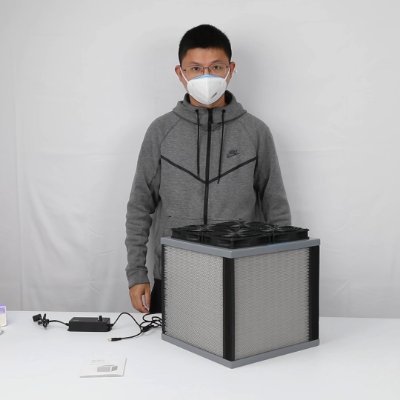
This is a device I use in my office:... it draws outdoor air from outside the window into the room, passes it through a filter, and then vents it indoors. The excess air pressure pushes indoor air out through the gaps around the door. This way, indoor carbon dioxide, particulate matter, and VOCs can be reduced to very low levels. Even an air purifier with activated carbon cannot achieve this effect, because air purifiers cannot lower CO2 concentration. This device is modified from an AirFanta 3Pro. I reversed the fan installation and connected two reducing adapters so that the final diameter matches that of this plastic expandable duct. Finally, I sealed the window with a sealing fabric, leaving only an opening the same size as the duct. Its only drawback is the lack of heat exchange, so it requires some additional air conditioning load. It would be unsuitable in very cold or very hot places.show more
Adam Wong
86,037 次观看 • 5 个月前
Elon Musk just named it. Starmind. One million AI... satellites, each a flying data center wider than a 747, cooled by panels that glow their heat into the void. This is not Starlink. Starlink moves internet. Starmind moves thought. Each satellite, the AI1, carries 150 kilowatts of compute on a 70-meter span of solar cells, runs the model on board, and beams the answer down. No building, no grid, no water. The reason is in SpaceX's own IPO filing. The AI market it values at 26.5 trillion dollars hits a wall of electricity and water that Earth cannot supply at a sane price. Orbit erases both. The sun never sets up there, and a 147-year-old law does the cooling: in a vacuum, heat escapes only as infrared, so a panel facing the 3-kelvin void radiates it straight out, no water touched. Run that panel hotter and it sheds heat 16 times faster for double the temperature. What Earth data centers burn rivers to do, a glowing wing does for nothing. Musk flagged the problem himself, in the same filing. SpaceX cannot get enough chips to build this yet, and the fab meant to fix that, Terafab, ten times the size of Tesla's Austin gigafactory, may fail. The prototypes do not fly until 2027. Astronomers are already in revolt over a million new lights crossing the sky. Days ago, Masayoshi Son, who owns the whole AI stack on the ground, called space data centers pointless. Musk just named his and put a million of them on the drawing board. One man is reading his balance sheet. The other is betting on the laws of physics. The piece works out which one the void rewards.show more

Shanaka Anslem Perera ⚡
290,576 次观看 • 3 个月前
The ongoing record-breaking heat wave in the West will... continue while expanding across the Central U.S. through the weekend. Based on preliminary data, there have been around 50 March high temperature records broken since March 17 and more than 150 daily high temperature records broken. Record setting temperatures are expected to continue over the next several days. Most areas will see temperature departures of 25 to 35 degrees higher than normal for this time of year. However, some locations in the central Plains on Saturday could see departures exceed 40 degrees from normal! Overnight low temperatures will also be well above average, providing little relief from the heat. The early time of year, prolonged nature of this heat wave, and limited seasonal acclimation will increase the risk of heat impacts especially among sensitive populations or those without effective cooling. Adjust plans to limit strenuous outdoor activities to early morning hours, drink plenty of fluids, and seek air conditioned spaces. For more heat safety tips visit:show more

National Weather Service
40,360 次观看 • 6 个月前
SPRING WATER > DEAD WATER Most people are drinking... dead water! The quality of your water is of the utmost importance to superior health and inner energetic vibrancy! Either tap water from old municipal water pipes with heavy metal build up and other pollution - or water that’s been sitting in a plastic bottle for months. The structure of which means the H2O molecules are clumped together, lowering the efficiency that your cells can absorb the water. You can vortex water to bring these molecules back into a better electrical charge, but natural spring water having bubbled through the Earth is perfectly aligned and structured Additionally, most spring waters contain powerful minerals content in their natural form. You can also bring dead water back to life by adding structured living water to it - such as a squeeze of fresh juice or a little bit of fresh spring water to a larger bottle of dead water. So go to Findaspring . com and take glass bottles to go fill up your spring water today.show more

⚡️🌞 Sol Brah 🌞🐬
86,482 次观看 • 2 年前
The Panama Canal is not only one of the... most amazing feats of engineering because of its sheer size, but also because of its many ingenious solutions. The canal is filled with fresh water in order to separate the salt water and flora and fauna of the two oceans it connects. It passes through three different lakes. These are the Gatun Lake near the town of the same name, Alajuela Lake, and Miraflores Lake. That is also why it's affected by the drought periods. One of these, is currently causing issues for the global supply chain. Low water levels at the Panama Canal, which relies on fresh water from lakes, means bigger, heavier ships can’t get through, creating a bottleneck.show more

Massimo
1,147,175 次观看 • 2 年前
Watch #Melissa meander on a path right through some... of the hottest (deep) waters on the planet, powering one of the strongest hurricanes ever, then leave a cool wake behind as it turns hot water into power to charge its rain and wind. The #caribbean in October is notorious for monster hurricanes and Melissa literally moved over the hottest waters not just in the Atlantic but also in the entire Caribbean. How it ended up there is part luck, part climatology, and - in a local sense - partly that storms without steering can sometimes be tugged towards areas with the greatest heat/ instability. #hurricane #fyp #jamaicashow more
Jeff Berardelli
524,424 次观看 • 11 个月前
SEVEN RTX 3090S IN A WATER TANK FOR AI... SERVER it is a private AI server with the power bill moved into your room. not a clean Mac mini. not a quiet box under a monitor. loose vertical GPUs sit inside a transparent tank. bubbles rise through distilled water. ALLIED CONTROL is printed on the side. it looks closer to a lab accident than a normal workstation. but the logic is obvious: seven RTX 3090s = seven 24GB cards. that is the used-market shortcut for people who want local inference without paying cloud tax on every run. put Ollama, llama.cpp, vLLM, Open WebUI, Tailscale, Qwen, DeepSeek, or Llama on top. now the box can handle client files, code agents, scraping jobs, evals, transcription, and boring overnight work. not because it beats frontier cloud models. because it changes the bill shape. no rate limit. no per-token anxiety. no sensitive client context leaving the building. no monthly stack quietly turning into rent. the ugly part is physical. seven 3090s can pull serious power, dump serious heat, and punish lazy cooling. distilled water is the weird visual, not a setup tip. real immersion rigs live or die on coolant chemistry, insulation, pumps, maintenance, and whether the room can handle the heat. local AI PCs are becoming less like gaming builds and more like small private data centers. the early question is not: can it run ChatGPT? it is: what work is repetitive, private, expensive in the cloud, and worth owning in hardware?show more

kocer
591,647 次观看 • 2 个月前
Nature-inspired gripper! 🦎 A chameleon doesn't grab its prey,... but its tongue wraps around it. Festo built a gripper that does the same thing, and the mechanism is more elegant than it looks. The FlexShapeGripper is an elastic silicone cap sitting on a water-filled chamber. It works as a double-acting cylinder, one chamber holds compressed air, the other is permanently filled with water. Vent the air chamber, and the water-filled silicone pulls itself inwards. The cap folds over whatever is underneath and locks around its shape. The grip is form-locking, so the object's own geometry does the work of holding it. → Adapts to any shape, including delicate and irregularly shaped items where rigid jaws fail → Can pick up and deposit several objects in one operation → Pneumatic drive, minimal energy consumption → The silicone cap maps directly onto the chameleon's tongue Always good to see the mimicry developments from Festo! :) ~~ ♻️ Join the weekly robotics newsletter, and never miss any news →show more

Lukas Ziegler
846,547 次观看 • 1 个月前
In the first video, people in Donetsk are seen... greeting a water tanker. In the second video, during the rain, people try to collect at least a drop of water because the water pipeline from the Siverskyi Donets was destroyed by the Russians. When Donetsk was not occupied by Russia, the city hosted the European Football Championship, as well as concerts by Rihanna and Beyoncé. Now, there is no more running water in the city. According to the schedule, water only appears in taps once every three days, and even then it doesn’t reach every household, so water has to be delivered by tankers, with long queues forming for it. People use plastic bags as toilets, and this filth spreads everywhere. This is happening not only in Donetsk - water is supplied once every two days in a number of other cities, including Mariupol. This is how Russia 'liberated' Donbas. Why is this happening? In the past three and a half years - since Russia launched its full-scale invasion of Ukraine in February 2022 - reservoirs in Donetsk Oblast have significantly dried up. The water supply system from the Siverskyi Donets River was destroyed. The region’s reservoirs and underground water sources are not enough to meet the needs of the population, in part due to the extensive network of coal mines. When the self-proclaimed “DPR” and “LPR” were created in 2014, Ukraine did not cut off this water channel, as it was still supplying water to Mariupol, which remained under Ukrainian control. But at the start of the Russian invasion in February 2022, the situation changed: the Russian army, during its offensive, destroyed a unique hydraulic structure that had supplied the region’s largest cities with water. The Russian authorities decided to build a new canal - the Don–Donbas canal - which was supposed to begin in the Rostov-on-Don area. It soon became clear that the new water pipeline, first of all, could not provide the region with the necessary amount of water, and second, it was built with numerous violations, with a large portion of the budget embezzled during construction. Crimea is also suffering from a water shortage, and the situation is worsening. One of the reasons why Russia is striving to seize southern Ukraine is that it sees this as a way to "solve the water issue" for the occupied territories.show more

Anton Gerashchenko
476,786 次观看 • 1 年前
🦔Turn your sound on for this one. This is... what it sounds like to live next to an AI data center, 24 hours a day. In Dowagiac, Michigan, residents sued after a facility run by Hyperscale Data ran around the clock at 78 decibels outside their homes. The company offered to buy their houses rather than fix the noise. One family has lived on that street for nearly a century. My Take This isn't one town with one bad facility. Microsoft faces a class-action in Wisconsin over data center noise residents can hear a mile and a half from the property line. In Virginia, one-third of data centers sit within 200 feet of homes. Noise from thousands of servers can hit 96 decibels, and diesel backup generators reach 105, which is a jet overhead. Residents report headaches, nausea, and sleep problems. Property values near this kind of infrastructure drop up to 20%. The company response in Michigan was to offer to buy the homes rather than quiet the facility, homes that families spent decades in, priced against a corporate buyout. Water in Oregon, wells in Georgia, ratepayer costs in Louisiana, river water in California, and now noise in Michigan and Wisconsin. None of this was in the brochure when these projects got approved. Closed-loop cooling and proper sound barriers exist and would solve most of this, but they cost more, so the companies skip them and the neighbors lose sleep and equity instead. Hedgie🤗show more

Hedgie
718,192 次观看 • 2 个月前
the smallest useful physical AI project has two jobs:... 1 notice one thing 2 do one thing about it this small demo puts a flame inside a test box water comes through the tube and the flame goes out that is the first loop: physical world → sensor reading → decision → action i put together a practical ESP32 guide to building that layer! distance, motion, heat, sound, touch, and a safe first project to start with👇show more

ard
57,342 次观看 • 29 天前
This is a turbine blade from a 571 MW... General Electric gas turbine. It sits inside the hottest part of a machine where combustion gases can reach roughly 1,600°C, while the turbine rotor spins at 3,000+ rpm depending on the grid. At that speed the blade tips are a couple of metres out and the centrifugal load is in the range of something like 10,000+ g or more. And yet this blade isn't bolted to the rotor. It’s root slides into a precision Fir-tree groove machined into the turbine disc, spreading the enormous centrifugal load across multiple contact surfaces instead of concentrating it through a fastener. The hottest first stage buckets are single crystal nickel superalloys like Rene N5 or similar. No grain boundaries, which is what would fail first under the heat and creep The blade is also cooled internally and protected by thermal barrier coatings, allowing the metal itself to remain far below the temperature of the gas flowing around it. At full power you’re looking at 571 MW and about 93 tonnes of natural gas burn rate an hour, that’s roughly a tonne and a half every minute. And the exhaust still contains enormous amounts of usable heat. In a combined cycle plant, that heat is recovered in a heat recovery steam generator, which boils water into steam. The steam then drives a second steam turbine, extracting energy that would otherwise disappear out of the exhaust into the environment. The result is more than 64% thermal efficiency, compared with about 44% for the gas turbine operating alone. For a sense of scale, A single gas turbine installation of this scale can supply electricity equivalent to roughly 600,000+ homes. What’s still odd is that, the blade carrying all of this load can still look like a simple piece of metal being hammered into a slot to the untrained eye. Source, 1989alibekshow more

Ammanichanda
87,158 次观看 • 1 个月前
Building gigawatt scale datacenters in the oceans may be... even easier than I had previously thought. Normally for OTEC cold deep sea water and warm surface waters are needed. Because that gigawatt is generating a lot of heat as an end product of compute, along with some additional solar thermal collection, we won’t need warm surface water at all, allowing these datacenters to go almost anywhere with enough depth. Additionally, that gigawatt of heat may be hotter than surface seawater normally used for OTEC, allowing for much shallower piping (200m instead of 1000m) while also being more efficient. The availability of unlimited cold water for the condenser is the key factor we can’t replicate on land. This brings the potential energy generation for ocean based compute up from 10 terawatts to potentially thousands of terawatts, as the locations are not limited to areas with the warmest surface waters. The excess energy needed for hundreds or thousands of people to also live on these structures is minimal compared to that needed for compute.show more

Ben Silone
79,214 次观看 • 3 个月前