Wonderland: Navigating 3D Scenes from a Single Image Contributions:... • First, we introduce a representation for controllable 3D generation by leveraging the generative priors from camera-guided video diffusion models. Unlike image models, video diffusion models are trained on extensive video datasets. This enables them to capture comprehensive spatial relationships within scenes across multiple views and embed a form of "3D awareness" in their latent space, which allows us to maintain 3D consistency in novel view synthesis. • Second, to achieve controllable novel view generation, we empower video models with precise control over specified camera motions. We introduce a novel dual-branch conditioning mechanism that effectively incorporates desired diverse camera trajectories into the video diffusion model. This enables expansion of a single image into a multi-view consistent capture of a 3D scene with precise pose control. • Third, to achieve efficient 3D reconstruction, we directly transform video latents into 3DGS. We propose a novel latent-based large reconstruction model (LaLRM) that lifts video latents to 3D in a feed-forward manner. With this design, during inference, our model directly predicts 3DGS from a single input image, effectively aligning the generation and reconstruction tasks—and bridging image space and 3D space—through the video latent space. Compared with reconstructing scenes from images, the video latent space offers a 256× spatial-temporal reduction while retaining essential and consistent 3D structural details. Such a high degree of compression is crucial, as it allows the LaLRM to handle a wider range of 3D scenes within the reconstruction framework, with the same memory constraints.show more

MrNeRF
52,801 Aufrufe • vor 1 Jahr
DimensionX: Create Any 3D and 4D Scenes from a... Single Image with Controllable Video Diffusion TL;DR: Create 3/4DGS from Video Diffusion Note: Some first inference code released (not all yet). Contributions (cited): • We present DimensionX, a novel framework for generating photorealistic 3D and 4D scenes from only a single image using controllable video diffusion. • We propose ST-Director, which decouples the spatial and temporal priors in video diffusion models by learning (spatial and temporal) dimension-aware modules with our curated datasets. We further enhance the hybriddimension control with a training-free composition approach according to the essence of video diffusion denoising process. • To bridge the gap between video diffusion and real-world scenes, we design a trajectory-aware mechanism for 3D generation and an identity-preserving denoising approach for 4D generation, enabling more realistic and controllable scene synthesis. • Extensive experiments manifest that our DimensionX delivers superior performance in video, 3D, and 4D generation compared with baseline methods.show more
MrNeRF
17,039 Aufrufe • vor 1 Jahr
Create a 3D model from a single image, set... of images or a text prompt in < 1 minute 😮💨 This new AI paper called CAT3D shows us that it’ll keep getting easier to produce 3D models from 2D images — whether it’s a sparser real world 3D scan (a few photos instead of hundreds) or your favorite 2D image generator like Midjourney (just an image). How does this magic work? “This architecture is similar to video diffusion models, but with camera pose embeddings for each image instead of time embeddings. The generated views are passed into a robust 3D reconstruction pipeline to create the 3D representation (Zip-NeRF or 3DGS)”show more

Bilawal Sidhu
92,792 Aufrufe • vor 2 Jahren
Human Hair Reconstruction with Strand-Aligned 3D Gaussians Contributions (cited):... – We propose a new 3D line lifting scheme that uses a modified 3DGS reconstruction technique to lift 2D orientation maps into a 3D field while also providing refinement of the camera parameters; – We introduce a dual representation of hair strand polylines and 3D Gaussians to achieve differentiable rasterization of hair strands and leverage photometric constraints for strand-based hair reconstruction; – Based on these components, we propose a coarse-to-fine optimization method for prior-guided hair reconstruction that leverages both latent and explicit representations of the hairstyle.show more
MrNeRF
106,525 Aufrufe • vor 1 Jahr
🚀New paper out - We present Video-MSG (Multimodal Sketch... Guidance), a novel planning-based training-free guidance method for T2V models, improving control of spatial layout and object trajectories. 🔧 Key idea: • Generate a Video Sketch — a spatio-temporal plan with background, foreground, and motion in the pixel space. • Encode this structure directly into the latent space of the diffusion model during generation, which does not require fine-tuning or additional memory during inference. 🧵show more

Jialu Li
35,060 Aufrufe • vor 1 Jahr
DroneSplat: 3D Gaussian Splatting for Robust 3D Reconstruction from... In-the-Wild Drone Imagery Abstract: Drones have become essential tools for reconstructing wild scenes due to their outstanding maneuverability. Recent advances in radiance field methods have achieved remarkable rendering quality, providing a new avenue for 3D reconstruction from drone imagery. However, dynamic distractors in wild environments challenge the static scene assumption in radiance fields, while limited view constraints hinder the accurate capture of underlying scene geometry. To address these challenges, we introduce DroneSplat, a novel framework designed for robust 3D reconstruction from in-the-wild drone imagery. Our method adaptively adjusts masking thresholds by integrating local-global segmentation heuristics with statistical approaches, enabling precise identification and elimination of dynamic distractors in static scenes. We enhance 3D Gaussian Splatting with multi-view stereo predictions and a voxel-guided optimization strategy, supporting high-quality rendering under limited view constraints. For comprehensive evaluation, we provide a drone-captured 3D reconstruction dataset encompassing both dynamic and static scenes. Extensive experiments demonstrate that DroneSplat outperforms both 3DGS and NeRF baselines in handling in-the-wild drone imagery.show more
MrNeRF
21,346 Aufrufe • vor 1 Jahr
We are excited to introduce Stable Fast 3D, Stability... AI’s latest breakthrough in 3D asset generation technology. This innovative model transforms a single input image into a detailed 3D asset in just 0.5 seconds, setting a new standard for speed and quality in the field of 3D reconstruction! Alongside this release, we’ve also published a technical report that highlights how we achieve fast inference speeds with reduced baked illumination and material parameters. 👾You can learn more and access the report here:show more

Stability AI
438,350 Aufrufe • vor 1 Jahr
🚀 Introducing GenLit – Reformulating Single-Image Relighting as Video... Generation! We leverage video diffusion models to perform realistic near-field relighting from just a single image—No explicit 3D reconstruction or ray tracing required! No intermediate graphics buffers, directly in the pixel space! 📄 Dive into the paper: 🎥 Project page & demos: 🛠 Code coming soon! #GenerativeAI #ComputerVision #Relighting #DiffusionModels #Graphics 🧵 1/5show more

Haven Feng
22,442 Aufrufe • vor 1 Jahr
Diffuman4D: 4D Consistent Human View Synthesis from Sparse-View Videos... with Spatio-Temporal Diffusion Models Contributions: • We introduce Diffuman4D, a novel diffusion model that generates spatio-temporally consistent and high-resolution (1024p) human videos from sparse-view video inputs. • We propose a sliding iterative denoising mechanism that enhances both the spatial and temporal consistency of generated long-term videos while maintaining efficient inference. • We design a human pose conditioning scheme to enhance the appearance quality and motion accuracy of generated human videos. • We plan to release our processed version of the DNA-Rendering dataset, which we believe will benefit future research in this area.show more
MrNeRF
24,729 Aufrufe • vor 1 Jahr
Chop the gradients ✂️! We found that truncating decoder... gradients in latent video diffusion to a fixed window allows us to finetune on videos with pixel-wise perceptual losses without running out of memory. Pixel losses have been essential for image generation and reconstruction, but until now, they haven't scaled to long-duration, high-resolution video diffusion due to recursive activation accumulation in causal decoders, leading to OOM during training 💥📉. Project: Video diffusion models can do a lot more 🚀 when you can backprop the decoder! Post-process neural rendered scenes, super-resolve videos, harmonize lighting in controlled synthetic driving scenes, and inpaint videos — all in a single step ⚡ with a quick finetune from a standard diffusion model.show more

Felix Heide
28,323 Aufrufe • vor 3 Monaten
NVIDIA AI Released DiffusionRenderer: An AI Model for Editable,... Photorealistic 3D Scenes from a Single Video In a groundbreaking new paper, researchers at NVIDIA, University of Toronto, Vector Institute and the University of Illinois Urbana-Champaign have unveiled a framework that directly tackles this challenge. DiffusionRenderer represents a revolutionary leap forward, moving beyond mere generation to offer a unified solution for understanding and manipulating 3D scenes from a single video. It effectively bridges the gap between generation and editing, unlocking the true creative potential of AI-driven content. DiffusionRenderer treats the “what” (the scene’s properties) and the “how” (the rendering) in one unified framework built on the same powerful video diffusion architecture that underpins models like Stable Video Diffusion..... Read full article here: Paper: GitHub Page: NVIDIA NVIDIA AI NVIDIAnewsroom NVIDIA AIDevshow more

Marktechpost AI Dev News ⚡
104,741 Aufrufe • vor 1 Jahr
NVIDIA just released a very impressive text-to-video paper. Video... Latent Diffusion Models (Video LDMs) use a diffusion model in a compressed latent space to generate high-resolution videos. Here's a brief overview of how it works: 1. Pre-train image LDM on a dataset of images. 2. Turn the image LDM into a Video LDM by adding temporal layers to model video frames. 3. Fine-tune the Video LDM on encoded video sequences to create a video generator. 4. Temporally align diffusion model upsamplers to generate high-resolution videos. 5. Validate Video LDM on real driving videos of 512x1024 resolution, achieving state-of-the-art performance. 6. Apply the approach in creative content creation with text-to-video modeling. Paper: Project:show more

Lior Alexander
158,558 Aufrufe • vor 3 Jahren
✨ Made a new mini feature on Photo AI:... [ Grab from 3d model ] So the problem is we're at that stage in time (typical for AI) where image-to-3d models are not good enough but are fun to play with, but we know they'll be good enough in 1-2 years With [ Make 3d model ] you already can turn any Photo AI pic into a 3d model but it still looks hyper clunky and deformed, but it works! One cool idea I had to make that more useful and made now: Let people make a 3d model then change the view of the it with the 3d viewer, then press [ o ] and it grabs a frame of the 3d That image you can then [ Remix ] (img2img), and it becomes a real photo again and that in turn you can then turn into a video again with [ Make video ] So that essentially gives you a fully freeform camera position control to take photos with One thing I need to fix is the background/skybox, I kinda need to take the original photo and remove the person and just get the background for the 3d model viewer, in this case it should be white, but it's a start!show more

@levelsio
119,210 Aufrufe • vor 1 Jahr
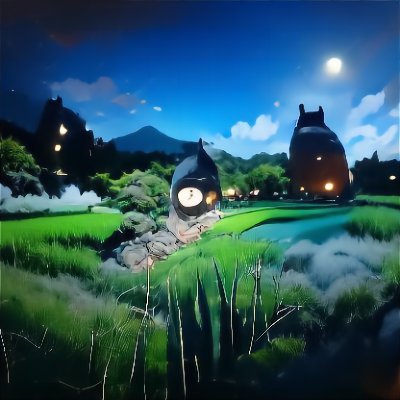
Rerender A Video: Zero-Shot Text-Guided Video-to-Video Translation paper page:... Large text-to-image diffusion models have exhibited impressive proficiency in generating high-quality images. However, when applying these models to video domain, ensuring temporal consistency across video frames remains a formidable challenge. This paper proposes a novel zero-shot text-guided video-to-video translation framework to adapt image models to videos. The framework includes two parts: key frame translation and full video translation. The first part uses an adapted diffusion model to generate key frames, with hierarchical cross-frame constraints applied to enforce coherence in shapes, textures and colors. The second part propagates the key frames to other frames with temporal-aware patch matching and frame blending. Our framework achieves global style and local texture temporal consistency at a low cost (without re-training or optimization). The adaptation is compatible with existing image diffusion techniques, allowing our framework to take advantage of them, such as customizing a specific subject with LoRA, and introducing extra spatial guidance with ControlNet. Extensive experimental results demonstrate the effectiveness of our proposed framework over existing methods in rendering high-quality and temporally-coherent videos.show more
AK
375,123 Aufrufe • vor 3 Jahren
Self-Calibrating Gaussian Splatting for Large Field of View Reconstruction... Note: Check below for full video. Abstract (cited): "In this paper, we present a self-calibrating framework that jointly optimizes camera parameters, lens distortion, and 3D Gaussian representations, enabling accurate and efficient scene reconstruction. Our technique is particularly effective for high-quality scene reconstruction from large field-of-view (FOV) imagery taken with wide-angle lenses, allowing the scene to be modeled from a smaller number of images. We introduce a novel method for modeling complex lens distortions using a hybrid network that combines invertible residual networks with explicit grids. This design effectively regularizes the optimization process, achieving greater accuracy than conventional camera models. Additionally, we propose a cubemap-based resampling strategy to support large FOV images without sacrificing resolution or introducing distortion artifacts. Our method is compatible with the fast rasterization of Gaussian Splatting, adaptable to a wide variety of camera lens distortions, and demonstrates state-of-the-art performance on both synthetic and real-world datasets."show more
MrNeRF
17,206 Aufrufe • vor 1 Jahr
Single video → a reframeable 4D Gaussian Splatting scene.... Not a sequence of separately built 3D frames played back like a video. This is one continuous space-time scene, reconstructed from a single clip shot on an iPhone 16. We combine feed-forward Gaussian generation, 3D tracking, and 4D Gaussian Splatting, aiming to deliver it as a compact 4D video file that runs on your phone. Still early R&D. The goal: make 4DGS something anyone can create and experience, not just researchers with a camera rig.show more

KIRI Engine - 3D Scanner App
24,722 Aufrufe • vor 2 Tagen
Combining the explicit control of 3D software with the... creativity of generative AI models is a promising yet underrated workflow. Build your 3D scenes procedurally by describing them in natural language, then take them all the way with your image & video models of choice. Tools like intangible are built around such a workflow so you don't need to duct-tape apps together. Pretty cool!show more
Bilawal Sidhu
37,629 Aufrufe • vor 1 Jahr
As announced in partnership with NVIDIA at CES, we’re... excited to introduce Stable Point Aware 3D (SPAR3D), setting a new standard in 3D generation. Ideal for running on NVIDIA RTX AI PCs, SPAR3D enables real-time editing and complete structure generation of 3D objects from a single image in under a second. You can download the weights on Hugging Face and code on GitHub, or access the model through the Stability AI API. Learn more here: (1/3)show more
Stability AI
181,441 Aufrufe • vor 1 Jahr
This is some quietly impressive work on making video... world models actually controllable in 4D space. VerseCrafter lets you take an input image, use something like Blender to animate the 3D camera path and object trajectories, then uses that to condition generation. Scribbling in 2D feels so crude in comparison. The authors represent everything in a shared 4D world state - static background as a point cloud, moving objects as 3D gaussian trajectories. The gaussians are an interesting choice because they capture position, shape, and orientation probabilistically rather than forcing rigid bounding boxes or category specific models like SMPL-X for human bodies. They bolt this onto frozen Wan2.1 with a lightweight adapter, so they get a strong video prior. They also built a pipeline to auto extract 4D annotations from real world videos to train this puppy. It doesn't look sexy yet, but IMO this is the interface video world models need - actual 3D authoring tools to exert control rather than crude scribbles and prompt incantations.show more
Bilawal Sidhu
25,802 Aufrufe • vor 6 Monaten
Apple just trained a 3D Gaussian head reconstruction model... on 10,000+ subjects. Feed-forward. No test-time optimization. New identity in, reconstructed Gaussian head out. The UV-parameterized Gaussian representation decouples the number of Gaussians from the number and resolution of input images, making it practical to train with many high resolution views. And the heads are not just static either: text-conditioned identity generation, plus blendshape-driven latent animation across identities. We've been building in the 3D Gaussian Splatting space for a while. The gap between "research demo" and "works on real people at scale" is closing fast.show more
KIRI Engine - 3D Scanner App
12,125 Aufrufe • vor 1 Monat
📢GeomHair: Reconstruction of Hair Strands from Colorless 3D Scans📢... We present a novel method to reconstruct hair strands from colorless 3D scans by extracting orientation cues directly from the mesh surface geometry by finding local characteristic lines and from shaded renderings using a neural 2D line detector. We enhance the reconstruction with a diffusion prior trained on synthetic hair data and adapted to each scan using a tailored text prompt, allowing us to recover both simple and complex hairstyles without relying on color input. To support further research, we also introduce Strands400, the largest publicly available dataset of 3D hair strand reconstructions from real-world scans of 400 different people, featuring complicated hairstyles, such as ponytails and buns. 🌍 📷 Great work by Rachmadio Noval L. Artem Sevastopolsky Egor Zakharov @ness_prisshow more
Matthias Niessner
12,466 Aufrufe • vor 1 Jahr