𝗛𝘆𝗱𝗿𝗼𝗴𝗲𝗻 𝗰𝗮𝗿𝘀 𝗸𝗲𝗲𝗽 𝗰𝗼𝗺𝗶𝗻𝗴 𝗯𝗮𝗰𝗸 𝗶𝗻𝘁𝗼 𝘁𝗵𝗲 𝗱𝗲𝗯𝗮𝘁𝗲. For... years, most of the focus has been on battery EVs. But recently I came across something interesting: NamX’s hydrogen SUV, developed with Pininfarina. Instead of relying on lithium batteries, the vehicle uses removable hydrogen capsules. A few things stand out: → Around 𝟴𝟬𝟬 𝗸𝗺 𝗿𝗮𝗻𝗴𝗲 → 𝗙𝗮𝘀𝘁 𝗿𝗲𝗳𝘂𝗲𝗹𝗶𝗻𝗴, in just a few minutes → No dependence on 𝗹𝗶𝘁𝗵𝗶𝘂𝗺 The most interesting idea is the CapX capsule system, designed to make hydrogen refueling simpler and more flexible. Hydrogen mobility has struggled for years mainly because of infrastructure. But innovations like this show how engineers keep trying to rethink the problem. Sometimes progress does not come from replacing the dominant technology. Sometimes it comes from challenging the assumptions behind it. Curious: 𝗗𝗼 𝘆𝗼𝘂 𝘁𝗵𝗶𝗻𝗸 𝗵𝘆𝗱𝗿𝗼𝗴𝗲𝗻 𝗰𝗮𝗿𝘀 𝗰𝗼𝘂𝗹𝗱 𝗯𝗲𝗰𝗼𝗺𝗲 𝗮 𝗿𝗲𝗮𝗹 𝗮𝗹𝘁𝗲𝗿𝗻𝗮𝘁𝗶𝘃𝗲 𝘁𝗼 𝗯𝗮𝘁𝘁𝗲𝗿𝘆 𝗘𝗩𝘀? #Innovation #Hydrogen #CleanEnergy #FutureOfMobility #Technologyshow more

Pascal Bornet
16,225 Aufrufe • vor 5 Monaten
🚨 BMW HAS SOLVED ONE OF HYDROGEN’S BIGGEST PACKAGING... PROBLEMS. The company has developed a new “Hydrogen Flat Storage” system for the iX5 that uses seven slim hydrogen tanks instead of two large ones. This flat design fits into the same space as the high-voltage battery pack used in the electric iX5. This is significant because it allows BMW to build the hydrogen-powered iX5 on the same production line as petrol, diesel, plug-in hybrid, and fully electric versions without major changes to the factory or vehicle architecture. The system stores 7kg of hydrogen at 700 bar and gives the iX5 an estimated range of 385 miles. BMW plans to start series production of the iX5 Hydrogen in 2028, using a fuel cell developed in partnership with Toyota. Why this matters: • One of the biggest barriers to hydrogen vehicles has been packaging the tanks without sacrificing interior space or requiring completely separate production lines • This modular “flat storage” approach makes hydrogen powertrains much more practical to manufacture at scale • It gives BMW flexibility to produce multiple powertrains on one platform depending on demand and regional infrastructure The deeper implication: While battery electric vehicles currently dominate, BMW is continuing to develop hydrogen as a parallel technology, particularly for larger vehicles and longer-range applications. Being able to build both BEVs and FCEVs on the same line is a pragmatic engineering step that could make hydrogen vehicles more commercially viable in the future if the refuelling infrastructure catches up. Follow for more frontier automotive and energy technology.show more

TheNewPhysics
2,071,461 Aufrufe • vor 2 Monaten
Did you know that electric vehicles can go back... into Thermal Runaway weeks later? The ‘smoke’ you see isn’t actually smoke, it is a highly flammable, toxic and explosive vapour. Some of the key components are: HCN - Hydrogen Cyanide C6H6 - Benzene C7H8 - Toluene C2H4 - Ethylene H2 - Hydogen O2 - Oxygen CO - Carbon Monoxide CO2 - Carbon Dioxide HF - Hydrogen Fluoride NO2 - Nitrogen Dioxide HCI - Hydrogen Chloride CH4 - Methane It is important to note I’m not against Lithium Ion Batteries (or EVs), they can be a good thing and will no doubt change lives and innovation for years to come, however the technology currently is way ahead of the solution in the event of an incident. We need urgent legislation, education, training and operational guidance for dealing with these incidents. For more information on Thermal Runaway, and the dangers of Lithium Ion Batteries please see the link below (and please check your smoke alarms):show more

The Secret Firefighter UK
39,010 Aufrufe • vor 3 Jahren
🚨 A HYDROGEN FUEL CELL SUBMARINE DRONE JUST ACHIEVED... WHAT BATTERY-POWERED AUVs HAVE FAILED AT FOR 15 YEARS LONG ENDURANCE, DEEP DEPTH, AND ACOUSTIC STEALTH ALL AT ONCE. The Envoy AUV from Cellula Robotics completed a fully submerged mission covering 2,023 km over 385 hours. Crucially, it did this with a realistic, punishing profile: more than 4,000 turns and maneuvers, not a simple straight-line test. It also operates at depths up to 3,000 meters and produces almost no acoustic signature. Powered by proton exchange membrane (PEM) hydrogen fuel cells, the only byproduct is water. This breaks the long-standing trade-off in autonomous underwater vehicle design where improving one capability (range, depth, or stealth) usually destroys the others. Why this matters: • Battery AUVs have been fundamentally limited by energy density adding more batteries increases weight and drag, which cancels out the gains • Hydrogen fuel cells deliver more than twice the energy density of lithium-ion batteries while enabling true long-endurance missions without frequent surfacing • The vehicle can loiter on the seabed using a suction anchor for days or weeks, dramatically changing operational concepts for pipeline inspection, cable monitoring, and naval surveillance • It is already in the hands of Defence Research and Development Canada The deeper implication: This is more than just an impressive endurance record. It represents a genuine shift in what is possible for persistent, covert subsea operations. For navies and offshore industries that have spent years compromising between mission duration, depth capability, and detectability, hydrogen fuel cells are now offering a practical way to stop making those trade-offs. As these systems mature and scale, we could see a new generation of autonomous underwater platforms that operate for weeks or months with minimal support fundamentally changing how we monitor critical infrastructure, conduct scientific surveys, and maintain undersea awareness. How do you think hydrogen-powered AUVs will change subsea operations compared to today’s battery-limited systems? Follow for more frontier robotics, energy, and defense technology.show more
TheNewPhysics
110,556 Aufrufe • vor 1 Monat
Who likes a nice animation? 🤓🔋 Here you find... out when lithium-ion batteries will be the most competitive for providing peak capacity (PC)... Or when is hydrogen becomes the best for integrating renewables (RE)? Let's walk through the cheapest storage technologies over time. 1⃣ Colours represent the technologies with the lowest lifetime cost. 2⃣ The axes show discharge duration and cycling frequency. They cover the whole spectrum from second-by-second balancing applications (bottom right) up to inter-seasonal storage (top left), and everything in between. 3⃣ Shading indicates how strong the cost advantage is over the second cheapest technology. The evolution of this competitive landscape is based on projected reductions in investment costs over time. These come from statistically-derived which are published in Monetizing Energy Storage: Wonder what it would look like if pumped hydro is not an option? Or where and when a radically new, better technology would fit into this mix? Explore these questions and more on Get in touch if this is of interest!show more

Dr Iain Staffell
226,616 Aufrufe • vor 2 Jahren
🚨 CATL SAYS LITHIUM-AIR BATTERIES COULD ONE DAY DELIVER... 1600+ KM RANGE WITH ENERGY DENSITY APPROACHING PETROL. The world’s largest battery maker is pushing a radical “breathing” battery technology that replaces heavy nickel, cobalt and manganese with lithium metal and oxygen pulled directly from the air. In early lab tests, researchers have already achieved around 1,200 Wh/kg more than four times today’s best lithium-ion cells. With further development, CATL believes the technology could theoretically reach ~12,000 Wh/kg, close to the energy density of petrol itself. Why this matters: • It could slash battery weight and cost dramatically • Small EVs might achieve 1,600+ km of real-world range • It removes dependence on scarce metals like nickel and cobalt • A 1,000-cycle prototype with 1,600 km range would theoretically last 1.6 million kilometres The deeper implication: Lithium-air represents one of the few battery chemistries that could genuinely match or exceed the convenience of petrol without massive compromises. If the enormous technical hurdles (moisture sensitivity, cycle life, and oxygen management) can be solved, it wouldn’t just improve EVs it could fundamentally change what’s possible for electric aviation, long-haul transport, and portable power. We’re still very early. Current prototypes are far from commercial, and most experts expect mass production only after 2030 at the earliest. But the fact that the company producing over half the world’s high-voltage batteries is seriously pursuing this shows how transformative the payoff could be. Would you rather see solid-state batteries win the next decade, or do you think lithium-air could leapfrog them entirely? Follow for more frontier battery technology and energy breakthroughs.show more
TheNewPhysics
17,944 Aufrufe • vor 1 Monat
As I sit here in DC this week, we... are closer to something I was not sure I would ever see. I have been working in this industry since 2015. For most of those years, the defining feature of crypto in Washington was not policy. It was the absence of it. A gray zone where serious people built serious things under a constant cloud, never quite sure which rules applied or whether the ground would move beneath them. This week the CLARITY Act sits on the Senate calendar. A federal framework for digital asset market structure, the thing this industry has wanted for the better part of a decade, is closer than it has ever been. It is not law yet, and there are real hurdles left. But the distance between where we stood a few years ago and where we are sitting today is hard to put into words. I keep thinking about the work that got us here. Over the past year I watched Chainlink move from outside these conversations to inside them. Sergey at the White House for the signing of the GENIUS Act. The Department of Commerce putting government economic data onchain. Meetings with the SEC that became real interpretive guidance. Conversations with the lawmakers now writing the rules. None of that happens by accident. It happens because people keep showing up, year after year, and make the case in rooms where it is not yet obvious. And there is something fitting in it. The entire premise of what we build is verification. Making truth provable. Removing the question of what is real. The work here in DC is the same thing in a different form. Trading a decade of ambiguity for something the industry has never actually had. We are not at the finish line. But sitting here, it is hard not to feel the weight of it. The gray zone is ending. What comes next is something this industry has never had. Clarity.show more

Chris Barrett
14,798 Aufrufe • vor 1 Monat
So, by now I'm sure you saw the AI... fanart recreation of the Princess Mononoke trailer. It got a LOT of feedback, mostly from people telling the creator what a terrible thing he did and how AI assisted workflows can never be used for anything good or meaningful and most of all that it can never be used for art. That's such nonsense. Of course it can. If it's wielded by artists and great storytellers, great things will come of it. If you hand a violin to someone on the street they'll be able to make it make sounds.. if you hand it to a talented musician it becomes a conveyer of thoughts, emotion and art. Here's a small scene from Mononoke that I did an AI take on.. it's far from perfect and to animate this properly would require much more work. The AI workflows we have today are lacking so many control elements. But to think those things won't come.. come on. Of course they will. But most importantly, in a way where they don't overtake the art completely, but instead acts like an "amplifier" of the artists using the tools. This technology will be in most of our creative tools in the very near future with full controllability. Oh and I never liked the idea of turning old disney classics into live-action films, or doing the same with the beautiful work of Studio Ghibli. But for the purpose of this post I hope you'll forgive me ;-) #art #animationshow more

Martin Nebelong
18,377 Aufrufe • vor 1 Jahr
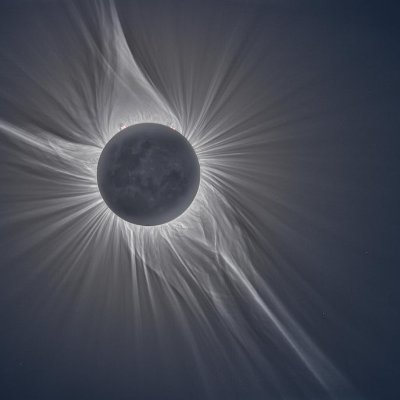
Astronomers just watched a star explode - and saw... its insides exposed. For the first time in history, scientists got a direct look inside a star at the moment it went supernova - revealing inner layers that had, until now, only existed in theory. A massive star 2.2 billion light-years away reached the end of its life and exploded in a brilliant burst of light. But something was off. When researchers analyzed the spectrum of light from the explosion, they didn't see the usual lighter elements like hydrogen, helium, or oxygen. Instead, they saw silicon. Sulphur. Argon. Elements normally buried deep inside a star's core. This wasn't supposed to be possible. According to stellar models, massive stars - those at least eight times the mass of our Sun - are layered like onions. Their cores are packed with heavy elements like iron, while progressive lighter layers of silicon, oxygen, and carbon sit above. Hydrogen and helium form the outermost shells. These outer layers usually obscure everything underneath. Astronomers believe the star violently ejected its outer layers in the final stages of life – not just the hydrogen and helium, but even the middle shells that hide the deeper interior. It’s possible that extreme instability in stars more than 100 times the mass of our Sun could cause this kind of shedding. While similar “pre-explosion outbursts” have been seen in other stars, this is the first time they’ve exposed the inner structure so clearly. The supernova was first detected by the Zwicky Transient Facility in California. Within 24 hours, astronomers triggered rapid follow-up observations with Hawaii’s Keck Observatory and captured the light signature before the explosion faded. That speed was critical. Supernovae evolve quickly, sometimes over just a few hours, and once the star’s material expands and cools, the deeper layers disappear from view. Read the study: Schulze, Steve, et al. “Extremely Stripped Supernova Reveals a Silicon and Sulfur Formation Site.” Nature Credit: Keck Observatory/Adam Makarenkoshow more
Black Hole
26,579 Aufrufe • vor 11 Monaten
The past year has seen me have a renaissance,... in the truest sense… I won’t go into details now but will at some point before long. What has brought so much happiness to my life and those around me this past year has been my falling back in love with sport. Cycling has, and always will be, my number one. Yet I’d forgotten that I simply love sport, not for results but for the sheer joy of doing it, I’d completely forgotten that the health of my mind is intrinsically connected to the health of my body. I’ve rediscovered the love I had for sport that existed before the world of professional cycling took over in the way it did. I’ve been pushing myself and trying new things this past year, indifferent to the results, just out having fun and at times going deeper than I thought I was capable of anymore. Last week I got on a TT bike for the first time in a decade, Factor Bikes built me a bike, I’ve been looking at it for two years and decided it was time to get fitted, getting back on it felt like going home. Anyway, the long and the short of this is that it’s inspired me to create a club to inspire and be inspired. A community for us to share our love for getting out there and doing it, because I’ve realized that although I spend most of my sporting life on my own I derive the most pleasure when feeling part of something. It’s in its early days, I’ve called it Sporting Club CHPT3 aka SCC3, I’d love you to check it out and join. It’s still in its infancy, but I hope it’s going to grow into something that will inspire you as much as me.show more

David Millar
111,710 Aufrufe • vor 2 Jahren
This is cavitation inside a piston diaphragm pump. Most... engineers spend their entire careers hearing this destructive phenomenon. Almost none ever get to see it with their own eyes. When pressure drops below a critical threshold, liquid instantly flashes into vapor, creating thousands of microscopic bubbles throughout the system. It happens in milliseconds, invisible to the naked eye in standard metal pumps. But when pressure rises again, those bubbles don't just disappear quietly. They collapse violently, sending shockwaves rippling through the metal components. The result is catastrophic. Valves get destroyed. Seals get shredded. Pump chambers get hollowed out from the inside, one microscopic implosion at a time. Cavitation is one of the most destructive forces in industrial fluid systems, responsible for equipment failures that cost thousands of dollars per incident. Engineers have studied it for decades through sensors, pressure readings, and the telltale sounds it makes. But they've never been able to watch it happen in real time. Until now. The clear plexiglass head on this LEWA pump changes everything. For the first time, pump engineers can observe cavitation as it occurs, watching the bubble formation and violent collapse that destroys their equipment. It's like finally seeing the invisible enemy that's been wreaking havoc on industrial systems. This is what happens when engineering innovation meets visualization technology. Sometimes the most powerful breakthroughs come from simply making the invisible visible.show more

Mechanical Knowledge
522,453 Aufrufe • vor 1 Monat
Many still misunderstand Elon and Tesla's mission Elon has... a deep concern for humanity, which is why he takes on the toughest problems He's doing it because if he doesn't, nobody will Tesla started the EV revolution... before, nobody even wanted to build EVs. Literally nobody wanted to do it Everyone treated EVs like boring golf carts It was not easy. Being first in the industry means you have to build everything from the ground up, and there is no one you can learn from Tesla got very close to bankruptcy many times... often weeks away Combustion engines had over 150 years of innovation but for EVs, it was the last 15 years that truly made the difference And look at the result: Tesla didn't just build a successful EV; the Tesla Model Y has been the best-selling car in the world for three consecutive years (2023–2025), beating every single gas vehicle on Earth Not to mention, Tesla had to build the entire charging infrastructure from scratch, creating a massive global Supercharger network just so people could drive their cars reliably Other EVs also heavily rely on this network, and Tesla is still helping the competition by opening up their chargers and open-sourcing their patents so anyone can use them for free Without Elon, the world would still be lagging in gas enginesshow more

X Freeze
18,841 Aufrufe • vor 3 Monaten
When a spacecraft leaves Earth, it doesn’t just fire... its engines and head straight to its destination. In many missions, especially those going beyond low Earth orbit, there’s a more subtle and elegant strategy at play, one that uses gravity itself as part of the navigation system. This is often called a gravity assist, or a slingshot maneuver. But in the case of missions like #Artemis II, what’s being used is a closely related idea known as a free-return trajectory. At first glance, it might sound simple: the spacecraft goes to the Moon, loops around it, and comes back. But the physics behind it is anything but simple. Instead of relying on continuous propulsion, the spacecraft follows a carefully calculated path through the gravitational field of the Earth–Moon system. It is launched with just the right speed and direction so that, as it approaches the Moon, the Moon’s gravity bends its trajectory. The spacecraft is effectively flung around the Moon, redirected onto a path that naturally brings it back toward Earth. No major engine burn is needed for the return. Small trajectory corrections may still be required, but gravity does the heavy lifting. That’s the key. This kind of trajectory is not just efficient, it’s also safe. If something goes wrong with the spacecraft’s engines or onboard systems, gravity itself ensures the return. It’s an inherent backup plan, built into the trajectory from the very beginning. The same fundamental idea appears in gravity assists used across the Solar System. When a spacecraft flies past a planet, it can gain or lose speed by exchanging momentum with that planet. From the spacecraft’s point of view, it’s as if it has been accelerated without using fuel. In reality, it has borrowed a tiny amount of orbital energy from the planet itself. That’s how missions like Voyager reached the outer planets, and how probes continue to explore regions far beyond what their onboard fuel alone would allow. But there’s an important distinction. An interplanetary gravity assist is typically used to change speed and direction, often increasing the spacecraft’s energy. A free-return trajectory, like the one used in Artemis II, is designed for something more specific: a path that naturally loops back to Earth without requiring additional propulsion. It’s less about gaining energy, and more about shaping a trajectory that guarantees a return. To understand why this works, it helps to stop thinking in straight lines. In space, motion follows curves defined by gravity. The spacecraft is constantly falling, first toward Earth, then toward the Moon, and then back toward Earth again. What looks like a loop is really a continuous free fall through a changing gravitational landscape. This way of navigating space reveals something deeper. We tend to think of engines as the drivers of motion, but once a spacecraft is on its way, gravity does most of the work. The art of spaceflight is not just about thrust. It’s about knowing when not to use it. #GoodLuck #Artemis NASA Artemisshow more

Erika
234,886 Aufrufe • vor 4 Monaten
More Batteries vs. Submarines Now that the German TKMS... and the French Naval Group have massively adopted lithium-ion batteries, following the Japanese lead, this is consolidating as a major trend, just as I had predicted. The next stage will be solid-state batteries, and at that point, we'll essentially be discussing only speed and submerged endurance in comparison to nuclear submarines. Since solid-state batteries are lighter, they will allow for a greater number to be installed, freeing up space for more powerful propulsion systems. Naval Group has already sold a version of the Scorpène to Indonesia capable of remaining submerged for up to 80 days. That's with lithium-ion batteries. Imagine what this could exceed, more than double, with solid-state batteries. In practical terms, a more powerful engine combined with solid-state batteries in the proportions that Naval Group is now using in the Scorpène would provide three times the speed, meaning something like 10–15 knots at constant speed while maintaining around 50 days submerged. This would give a range of 40,000–50,000 km, requiring less than one hour on the surface for a fast recharge. For speeds above 25 knots, simply adding more batteries and a better engine would suffice, as the solid-state system has high power output. All this at 15–20% of the cost of a nuclear submarine. And if the choice is to power the batteries with a micro-reactor, it would cost 25–35% of a conventional nuclear one. Then someone will say: “But a nuclear sub can stay submerged for years.” That makes no difference at all, since even with around 60 days of endurance, the crew still needs to surface to resupply provisions. The big advantages remain: battery-powered subs are superior in silence, and speed can be addressed with larger battery packs.show more

Patricia Marins
103,224 Aufrufe • vor 8 Monaten
🚨 RESEARCHERS JUST MADE WATER-BASED BATTERIES LAST OVER 2,800... HOURS WITH RECORD CAPACITY. A team in South Korea has developed a simple zwitterionic electrolyte additive that dramatically improves the performance of aqueous (water-based) batteries a technology long seen as a safer, cheaper, and more environmentally friendly alternative to lithium-ion. The additive forms tiny nanostructures that guide zinc to deposit evenly on the electrode and create a protective layer that prevents corrosion and unwanted side reactions with water. This solves two of the biggest problems that have limited aqueous batteries: uneven metal buildup and rapid capacity fade. In testing, the modified batteries achieved a world-leading areal capacity of 8.10 mAh cm⁻² and ran stably for more than 2,800 hours. Why this matters: • Aqueous batteries are non-flammable and use abundant, low-cost materials, but have historically suffered from poor lifespan and performance • This approach improves both cycle life and capacity at the same time — something many previous solutions struggled to achieve together • It uses a simple additive rather than requiring expensive new materials or complex manufacturing changes • The technology is particularly relevant for large-scale energy storage needed for renewables and AI data centers The deeper implication: We’re getting closer to making safe, scalable, and affordable grid storage a reality. While lithium-ion still dominates, aqueous batteries could become a strong contender for stationary storage where safety, cost, and longevity matter more than energy density. A small molecular tweak unlocking major performance gains shows how materials engineering at the nanoscale can have outsized real-world impact. This is the kind of incremental but meaningful progress that compounds over time. How important do you think safer, water-based batteries will be for the future energy grid compared to improving lithium-ion or other alternatives? Follow for more frontier energy storage and battery materials research.show more
TheNewPhysics
22,736 Aufrufe • vor 2 Monaten
🚨 MERCEDES JUST PUT A MOTOR ONLY 8 CM... THICK INTO A CAR THAT CAN HIT 62 MPH IN 2.1 SECONDS. Instead of conventional radial flux motors, Mercedes is betting big on axial flux technology. In these motors, the electromagnetic force flows parallel to the axle, allowing two magnetic rotors to sandwich a central stator in a flat, disc-like layout. The result is dramatically smaller and more powerful. The front motor in the new all-electric Mercedes-AMG GT 4-door Coupe is just 9 cm wide. The rear motors are even thinner at roughly 8 cm each. Despite their tiny size, they help launch the heavy performance car from 0-62 mph in just 2.1 seconds, with a top speed of up to 186 mph. Why this matters: • Axial flux motors are significantly more power-dense and can be up to 50% lighter than traditional designs • Their extreme thinness frees up packaging space in the vehicle for better weight distribution, aerodynamics, or interior room • Mercedes acquired YASA in 2021 and has spent years developing the complex manufacturing processes needed to build them at scale • The technology is debuting in a high-performance AMG model, showing Mercedes is serious about using it in its most demanding cars The deeper implication: While most of the EV conversation focuses on batteries and software, the electric motor itself is undergoing a quiet revolution. Axial flux designs have long been seen as theoretically superior but extremely difficult to manufacture at scale. By solving the production challenges and putting these motors into a real high-performance car, Mercedes is pushing the entire industry forward. The next generation of electric performance cars may not just have bigger batteries they may have fundamentally better motors. We’re watching the physical hardware of EVs evolve as dramatically as the software has. How important do you think motor technology (rather than just battery size) will be for the future of electric performance cars? Follow for more frontier automotive engineering and electric vehicle technology.show more
TheNewPhysics
399,616 Aufrufe • vor 1 Monat
This Kharjit caveman, known as Commander Shinia, is saying... in the local language: "Kill Pakistan’s army and police." Worse, he claims that Allah Himself ordered this killing. People with this kind of thinking and ideology have caused severe damage to Islam and Pakistan. He acts as someone’s facilitator, yet still uses the name of Islam. It’s very possible he works for a foreign intelligence agency, because no Pakistani or Muslim could even think of doing what this long-haired commander is calling for, let alone act on it. Our only request is this: He is a local resident of Thor and for years has been sitting comfortably, issuing such announcements and fatwas with his group. This gang has martyred many travelers, Pakistan Army soldiers, and police officers. Sometimes they call themselves Taliban, sometimes Al-Qaeda, sometimes Fitnat-ul-Khawarij, sometimes just “commanders.” Their names and organizations keep changing, but the place and the people stay the same. It’s a strange story. We’ll just say this: Because of them, Diamer’s education, progress, peace, and stability have been destroyed. The area’s reputation is ruined, and largely because of them, Diamer suffers the highest poverty and unemployment. The time has come to eliminate them completely, in every sense. Whatever sacrifice is needed, the people of Diamer must make it and must cooperate with the government in every way. The government should also realize that these groups must be fully wiped out from Diamer to gain the trust of people. The tourism and business season has already started. By releasing videos like this, they create fear inside and outside Pakistan, blocking trade, tourism, and development. By spreading terrorism and panic on the Karakoram Highway, they want to inflict heavy damage on the nation and the country.show more

War Analyst
15,465 Aufrufe • vor 3 Monaten
I'm an artist, and for a long time now,... my work has been about catching viral words and cultural moments that define our time and turning them into art. The idea for "Special Slop" has been brewing in my mind for a while, but it was waiting for the final push. That push came when the word "SLOP" was named the word of the year. That's when everything clicked, and I knew it was time. So, "Special Slop" is my art project where I explore this theme through crypto tools. It consists of three parts: The $SSLOP token is as a digital art object and our common symbol. Unique NFTs will be a series of works where I artistically reinterpret the whole aesthetic of "special slop." What concerns content, I’ll be creating content to explain, showcase, and develop the project's idea to build a community around it. A key part of this project is reaching a broader audience that isn't typically into crypto. I'll be creating and sharing videos on TikTok ( and X to explain, showcase, and develop the project's idea. This is about building a community around cultural curiosity, not just blockchain technology To put it simply, I'm taking a meme and trying to turn it into something meaningful and interesting from an artistic perspective. Welcome to the process. ca - HFxgTCXzpZNAMPARmdQ89pNRpBWCuSBMfnzdk5yXpumpshow more

benedict ✦
16,295 Aufrufe • vor 7 Monaten
Aidan O'Connell gets sacked on his final play last... night and in my opinion the sack is on the #Raiders QB just as much as it is on LT Andrus Peat. AOC has a 3 step drop which means the play is designed for him to get the ball out quick. If you don't get the ball out then a QB is going to need to Create something. But what you don't want him to do is back pedal into a sack. Peat does lose the rep, but he does a good job recovering and pushing the DE up the field. I think AOC's ability to feel pressure, get away from it, and throw on the run were some things I saw from him last year where he struggled with. So I do hope next week he shows a little bit more in that. Overall the play didn't work because Luke Getsy designed a really poor play where the spacing is off, I will talk about this more on my Youtube channel later today but you can clearly see that Bowers was supposed to be a natural pick for Tre Tucker at the bottom of the screen. But the spacing didn't work and the WR and TE run into each other.show more

Sanjit T.
68,301 Aufrufe • vor 2 Jahren
There is a marble quarry in the Italian Alps... that has been working since 1387, but in 639 years it has had only one customer... The quarry is at Candoglia, at the mouth of the Ossola valley. On 24 October 1387, Gian Galeazzo Visconti decided that the cathedral going up in his city should be built of marble rather than brick, and handed the quarry over to the Veneranda Fabbrica del Duomo, the body established to build it. He also granted the stone free passage down the waterways to Milan. The blocks went by raft from the river Toce into Lake Maggiore, down the Ticino, along the Naviglio Grande, then through a system of locks into a small lake in the centre of the city, a few hundred metres from the site. The bargemen carried the letters AUF, for "ad usum fabricae", for the use of the works, which cleared the cargo through customs without charge. People in Lombardy still say "a ufo" for something got for nothing, and the phrase is traditionally traced back to those barges... Mark Twain came in 1867 and noticed something most visitors walk past: "We saw a new statue put in its niche yesterday alongside of one which had been standing these four hundred years." It has never stopped: around a thousand tonnes of Candoglia marble still comes out of the mountain every year, and all of it goes to the same building. In a workshop in the Certosa district, sculptors cut replacements for whatever the weather has eaten away, from the same stone, for the same institution, founded in 1387. The cathedral was declared finished in 1965 but the quarry never stopped, because a cathedral like this is not something you complete... it is inherited, kept, and handed on. As John Ruskin wrote in The Seven Lamps of Architecture: "When we build, let us think that we build forever. Let it not be for present delight, nor for present use alone; let it be such work as our descendants will thank us for; and let us think, as we lay stone on stone, that a time is to come when those stones will be held sacred because our hands have touched them, and that men will say, as they look upon the labour and wrought substance of them: ‘See! This our fathers did for us.’"show more

James Lucas
98,321 Aufrufe • vor 15 Tagen