Video wird geladen...

Video konnte nicht geladen werden

Zur Startseite

4. 3rd & 4th line between Sason - Jharsuguda will strengthen Odisha's economy, logistics efficiency & enable faster train movement on Howrah-Mumbai route. 🛤️ Cost: ₹1,181 Cr. 🛤️ Length: 35 km route length; 87 km track length 🛤️ Traffic: 29 million tons cargo; more mail/exp/semi-high speed trains

44,660 Aufrufe • vor 1 Jahr •via X (Twitter)

9 Kommentare

Profilbild von Ashwini Vaishnaw
Ashwini Vaishnawvor 1 Jahr

4 major railway projects approved by Cabinet with total cost of ₹18,658 Cr. 📍Covering 15 districts in 3 states 🛤️ Adding 1,247 km 🧵👇🏻

Profilbild von Ashwini Vaishnaw
Ashwini Vaishnawvor 1 Jahr

1. 5th and 6th line between Kharsia – Naya Raipur – Parmalkasa will provide direct connectivity to new areas such as Baloda Bazar, enabling new industries & cement plants. 🛤️ Cost: ₹8,741 Cr. 🛤️ Length: 278 km route length; 615 km track length 🛤️ Traffic: 21-38 million tons cargo; 8 mail/exp/semi-high speed trains

Profilbild von Ashwini Vaishnaw
Ashwini Vaishnawvor 1 Jahr

2. Doubling of Gondia – Balharshah line in Maharashtra will enhance passenger and cargo movement between the Northern and Southern states of India, boosting tourism & economic activity in the region. 🛤️ Cost: ₹4,819 Cr. 🛤️ Length: 240 km route length; 268 km track length 🛤️ Traffic: Additional capacity for running more cargo & mail/express/passenger trains

Profilbild von Ashwini Vaishnaw
Ashwini Vaishnawvor 1 Jahr

3. Jarapada - Sambalpur 3rd and 4th line will increase economic activities in Talcher-Angul area. It will further enable running of more passenger and express trains in the region. 🛤️ Cost: 3,917 Cr. 🛤️ Length: 127 km route length; 277 km track length 🛤️ Traffic: 27 million tons additional cargo; more mail/exp/semi-high speed trains

Profilbild von Ashwini Vaishnaw
Ashwini Vaishnawvor 1 Jahr

5. The projects are result of PM Gati-Shakti National Master Plan for multi-modal connectivity. Aims to: ✅ Enable faster passenger & goods transport ✅ Lower logistic costs ✅ Save 95 Cr. litres of oil ✅ Cut 477 Cr. kg CO2 emission every year (equiv. to planting 19 Cr. trees!)

Profilbild von Square Deal Recordings & Supplies
Square Deal Recordings & Suppliesvor 1 Jahr

🚂✨ Check out our Railroad Crossing Keychain! Perfect for train lovers and collectors alike. 🚦 🛤️🔑 Get yours today and stay on track in style. #RailroadCrossing #Keychain #TrainLovers #Collectibles

Profilbild von ଜନବାର୍ତ୍ତା
ଜନବାର୍ତ୍ତାvor 1 Jahr

Thanks ashwiniji.. You are invited to sambalpur... We are eagerly waiting.

Profilbild von R.K.Verma 🌊​🇷​​🇫​
R.K.Verma 🌊​🇷​​🇫​vor 1 Jahr

@RailMinIndia @AshwiniVaishnaw @RavneetBittu @IR_CRB @IR_EDCHG @comnrly @NWRailways @GMNWRailway @CptmNwr @drmbikaner @SrDCMBKN @SRDOMBKN श्रीधाम एक्सप्रेस और ब्रह्मपुत्र मेल का विस्तार वाया रेवाडी,सादुलपुर, हनुमानगढ़ तक किया जाये इस क्षेत्र कि सबसे महत्वपूर्ण मांग है 🙏🙏🙏

Profilbild von ꜱʜɪᴠ ᴮᴴᵁ
ꜱʜɪᴠ ᴮᴴᵁvor 1 Jahr

Great intent, best wishes

Ähnliche Videos

Transforming Mumbai’s Commute...🚇 Mumbai Metro Route 3, Phase 2-A : A new era of Seamless, World-Class Connectivity! Flagged off 'Phase 2A of Mumbai Metro 3 from BKC to Acharya Atre Chowk (9.77 km)' today at BKC, Mumbai today. Under Hon PM Narendra Modi Ji's leadership, the metro network across India—particularly in Maharashtra—is expanding rapidly. Metro Line 3, the country’s longest underground line, stands as an 'Engineering Marvel'. Launched in 2017, the project is nearing completion at remarkable speed. The final phase, from Acharya Atre Chowk to Cuffe Parade, is expected to open to the public this August, with an inauguration by the Hon PM Narendra Modi Ji. The newly inaugurated route includes 26 stations, each with multiple entry points. Notably, Metro Line 3 will link directly to the airport, allowing passengers to travel seamlessly by metro. Construction on other lines is progressing rapidly, with 50 km of new routes set to be added this year and next. Soon, commuters across the Mumbai Metropolitan Region (MMR) will be able to travel by metro, monorail, local train, and bus using a single integrated ticket. Mumbai Metro Route 3, Phase 2-A Highlights: ✅ Total stations: 6 (All underground) ✅ Route length: 9.77 km ✅ Headway: Every 6 minutes 20 seconds ✅Fares: ₹10 – ₹40 ✅Trains in service: 8 Top Features of the New Metro Line: ✅Fully air-conditioned trains and stations ✅Reserved coaches for women passengers ✅Advanced baggage scanning and passenger screening ✅Well-lit, secure stations and platforms ✅24x7 surveillance with CCTV and security staff ✅Seamless mobile connectivity across trains and stations ✅Accessible restrooms with baby diaper-changing facilities ✅Multilingual passenger guidance system ✅LCD screens for infotainment and ads ✅Dynamic digital route maps ✅Full wheelchair access for PwDs ✅Fire and smoke suppression systems in every coach ✅Emergency communication systems between passengers and control room Connectivity : ✅Seamless connectivity to major business hubs like BKC and Worli ✅Future integration of BKC station with Metro Line 2B and Bullet Train ✅Easy access to religious places like Siddhivinayak Temple, Mahim Dargah & Church ✅Direct metro access to popular entertainment hubs including Shivaji Park, Yashwant Natya Mandir, Ravindra Natya Mandir, and Plaza Cinema Mumbai’s other metro lines have been well received by the public. This project marks another key step in making the city’s transport faster, smarter, and more inclusive. Eknath Shinde - एकनाथ शिंदे Ashwini Bhide MumbaiMetro3 Maha Mumbai Metro Operation Corporation Ltd #Maharashtra #Mumbai #MumbaiMetro3

Devendra Fadnavis

33,579 Aufrufe • vor 1 Jahr

Many people still don't grasp just how quickly India is moving 🇮🇳 The new Delhi-Mumbai Industrial Corridor (DMIC) will be completed in the next few years. The $100 billion project started in 2007 and has seen significant Japanese investment since the start. Stretching approximately 1,500 kilometers between the capital city Delhi (metro pop. of 34M) and India's financial capital Mumbai (metro pop. of 21M, this initiative will enhance connectivity and stimulate economic growth by developing smart cities, industrial parks along a new Delhi–Mumbai Expressway and the new Western Dedicated Freight Corridor (railway). The 1350 km 8-lane wide (expandable to 12-lane) expressway connecting the two mega-cities will be completed next year and will reduce the travel time from 24h to 11h. The 1500 km Western Dedicated Freight Corridor (WDFC) will also be completed in 2025. The high-speed line will support freight trains reaching 1,500 m (4,900 ft) length pulled by electric locomotives running at speeds greater than 100 km/h (62 mph). The tracks will be entirely grade-separated and have a generous loading gauge of 3,660 mm width and 7,100 mm maximum height allowing for double-stacked shipping containers to be transported on flatcars. This allows for single trains to have a 400+-container capacity. The corridor will reduce the travel time for containers from 50 h, by the existing freight train, to 17 h while significantly increasing the transport capacity on the route as well as decreasing transport costs. The DMIC megaproject also incorporates 9 Mega Industrial zones of about 200-250 sq. km, 3 ports, 6 airports and a 4000 MW power plant. India is rapidly outpacing China in both demographic and economic growth. The 21st century won't be the Chinese century. It will be the Indian century.

Visegrád 24

207,110 Aufrufe • vor 1 Jahr

Reviewed Key Rail Projects during the Parliamentary Standing Committee on Railways' study visit to Bengaluru. 1. Whitefield-Kengeri Suburban Rail Project: The 35-km Whitefield-Kengeri suburban rail (Parijatha line) will not be scrapped. The Modi Government-approved DPR for the 149.348-km Bengaluru Suburban Rail Project remains intact. 2. Panathur Railway Underpass (RUB): K-RIDE has already commissioned one vent way of the Panathur Railway Underpass (RUB), and the other will be commissioned by January 2025. 3. Carmelaram Rail Overbridge (ROB): The construction of the railway portion of the Carmelaram Rail Overbridge (ROB) is in progress. However, the approach work has been halted due to delays in land acquisition by the BBMP. 4. New Trains to Kempegowda International Airport: Requested a feasibility study for the introduction of new trains to Kempegowda International Airport from Bengaluru City, especially Whitefield. 5. Bengaluru Cantonment-Whitefield Quadrupling: The quadrupling of the Bengaluru Cantonment to Whitefield section will be completed by June 2025. 6. Doubling Projects: The doubling of the Hosur-Salem line via Yesvantpur station and the Baiyyappanahalli-Hosur line will be completed by August 2025. 7. Status of the Circular Rail Network: a. Oddarahalli-Devanahalli Segment: The survey is complete, and the DPR was submitted to the Railway Board on 23.09.2024 for ₹1638.24 Cr. The Railway Board has requested the complete DPR by February 2025. b. Remaining 6 Segments (Devanahalli-Malur-Heelalige-Hejjala-Solur-Nidavanda-Oddarahalli): The survey work is ongoing. 8. Bengaluru-Mumbai High-speed train: Proposed the introduction of a high-speed train between Bengaluru to Mumbai. 9. MEMU Trains Between Kengeri and Whitefield: Proposed the introduction of additional MEMU trains between Kengeri and Whitefield. 10. Namo Bharat Rapid Rail: Proposed the introduction of Namo Bharat Rapid Rail between Bengaluru-Tumakuru and Bengaluru-Mysuru.

P C Mohan

64,510 Aufrufe • vor 1 Jahr

4 hours. Two massive trusses. One major step forward for Mumbai’s next high-speed road corridor. MMRDA has achieved a major construction milestone on the 13.9-km Elevated Eastern Freeway Extension (EFE), with the successful erection of the two Main Trusses of its Segment Launcher, each 59 metres long and weighing 160 tonnes, on the busy Eastern Express Highway. The entire complex operation was completed within a record 4-hour window, with the actual erection of both trusses taking just 1 hour. The operation was executed through meticulous planning, stringent safety measures and seamless coordination between MMRDA and the Mumbai Traffic Police. So, what happens next? With the Main Trusses now in place, the Segment Launcher will begin erecting 1,632 precast segments, each weighing approximately 90 MT, span by span. These will form the 25-metre-wide single-cell segment superstructure, accelerating viaduct construction and taking the project into its next major phase. And what does this mean for Mumbai? The EFE is a fully elevated, 6-lane high-speed corridor connecting Anand Nagar in Thane with Chheda Nagar in Ghatkopar, designed to create a faster, more reliable route while easing congestion on the Eastern Express Highway, one of Mumbai’s busiest transport corridors. Once completed, the EFE is expected to reduce travel time between South Mumbai and Thane to approximately 20–25 minutes, making everyday journeys faster while strengthening connectivity across the Mumbai Metropolitan Region. Watch 4 hours of precision unfold in minutes. ⏱️ #MMRDA #EasternFreewayExtension #EFE #MumbaiInMinutes #MMRDAMovesMumbai #MumbaiInfrastructure #Mumbai #Thane #ReimaginingMMR #RebootingMumbai #ReshapingMMR CMO Maharashtra Devendra Fadnavis Eknath Shinde - एकनाथ शिंदे Dr. Sanjay Mukherjee Maha Mumbai Metro Operation Corporation Ltd MAHARASHTRA DGIPR PIB in Maharashtra 🇮🇳 PIB India

MMRDA

30,092 Aufrufe • vor 27 Tagen

Soon: South Mumbai–Thane in just 25 minutes MMRDA has commenced construction of the Elevated Eastern Freeway Extension, a 13.9 km, fully elevated 6-lane high-speed corridor that will dramatically reduce travel time between South Mumbai and Thane to 25–30 minutes, while easing daily congestion on the Eastern Express Highway (EEH)—one of Mumbai’s busiest arterial routes serving lakhs of commuters every day. The corridor will run from Anand Nagar, Thane to Chheda Nagar, Ghatkopar, with key links at Mulund, Airoli, JVLR, Vikhroli, Kanjurmarg, Mankhurd and Ghatkopar. In Thane, the corridor will merge seamlessly with the Anand Nagar–Saket Elevated Road near the erstwhile Mulund Octroi Naka, forming a continuous high-speed route. It will also provide seamless onward connectivity to the Samruddhi Expressway. Once completed, the project will significantly improve traffic flow, lower emissions, and offer a faster, more reliable and greener commute to lakhs of citizens, while boosting economic activity across the MMR. As part of MMRDA’s commitment to sustainable development, and in consultation with experts and green activists, the Vikhroli–Ghatkopar stretch was realigned to save 127 Pink Trumpet trees. A total of 4,175 new trees will be planted as compensatory green cover. Key Highlights: ✔️ Construction of 2.5 m diameter monopiles, robust piers, 40-m spans, and a 25-m single-segment superstructure ✔️ Single-pile, single-pier system — first-of-its-kind for an elevated road in MMR ✔️ Up–down ramps near Mulund Check Naka, Airoli Junction & Vikhroli Junction ✔️ 3+3 lane elevated toll plaza near Navghar Flyover ✔️ Designed for uninterrupted, safe, high-speed movement Status Update: • Preliminary survey works completed • Test piles completed • Geotechnical investigation mostly done • Utility identification substantially completed • Working piles and pier casting in progress A faster, greener and more connected Mumbai Metropolitan Region is taking shape — one pillar at a time. #MMRDA #EasternFreewayExtension #MumbaiToThane #25MinuteCommute #MumbaiInfrastructure #ViksitMMR #UrbanMobility #NextGenConnectivity #MumbaiDevelopment #SeamlessConnectivity #HighSpeedCorridor #MumbaiInMinutes #FutureReadyMumbai #SustainableMumbai #TransformingMMR #MMRGrowth #MumbaiMetropolitanRegion #TransformingMMR #ReimaginingMMR #RebootingMumbai #ReshapingMMR CMO Maharashtra Devendra Fadnavis Eknath Shinde - एकनाथ शिंदे Dr. Sanjay Mukherjee MAHARASHTRA DGIPR PIB India

MMRDA

84,016 Aufrufe • vor 8 Monaten

Redefining Connectivity: Mumbai’s Journey Towards Integrated Mobility Delighted to inaugurate, flag off, and unveil the stone plaque of 'Metro Line 9: Dahisar (East) to Kashigaon (Phase-1)', ‘Metro Line 2(B) Deshbhakt N. G. Acharya Udyan - Diamond Garden to Maharashtra Nagar, Mandale (Phase-1), and e-Bhoomipujan of the Automated Rapid Transit System (Pod Taxi) Project for Bandra-Kurla Complex, and the launch of 'Tunnel Boring Machine - Nayak' for the 'Thane-Borivali Underground Tunnel Project' in Mumbai, marking a significant step towards seamless connectivity and transformative urban mobility. Metro services have commenced today on the 4.7 km corridor from Dahisar East to Kashigaon, with four stations along the route, enhancing connectivity and making travel between Mumbai and Mira-Bhayandar faster and more convenient. This project, with an investment of approximately ₹6607 crore, will reduce the current travel time from 1-2 hours to nearly 30 minutes. In the upcoming phases, this corridor will be integrated with Metro Line 3, enabling seamless travel from Mira-Bhayandar to Colaba. With over 100 kilometres of metro lines now operational, Mumbai has emerged as the second-largest metro network in the country after Delhi. In the coming years, the network will expand further with the completion of several ongoing projects, strengthening connectivity across the city. The first phase of Metro Line 2B, spanning 5.6 km with five stations, is now operational from today. Once the rest of the phases are fully completed, this transformative project will seamlessly connect the East-West and North-South corridors, enabling smoother and more efficient travel across the city. Notably, this will be the first metro line to connect with the Harbour Line, marking the beginning of a new chapter in Mumbai’s integrated urban transport network. The e-Bhoomipujan of the innovative ‘Pod Taxi’ project was undertaken in the BKC area, marking a significant step towards strengthening last-mile connectivity. This automated system will enable commuters to reach within 100–150 metres of their destinations, enhancing convenience and efficiency. The Thane-Borivali Twin Tunnel Project is a landmark initiative that will significantly decongest Mumbai and Thane cities. Spanning 11.84 km, including a 10.25 km twin tunnel stretch, this transformative corridor is designed for efficiency and safety, featuring two traffic lanes and one emergency lane in each tunnel. The tunnels are being constructed in a safe, efficient, and eco-friendly manner, keeping in mind the ecological sensitivity of the Sanjay Gandhi National Park. DCM Eknath Shinde ji, DCM Sunetratai Pawar, Minister Mangal Prabhat Lodha ji, Minister Adv. Ashish Shelar, Minister Pratap Sarnaik, MP Naresh Mhaske, Mumbai Mayor Ritutai Tawde, MLC Pravin Darekar, MLC Niranjan Davkhare, MLA Sanjay Kelkar, Thane Mayor Sharmilatai Pimpalolkar-Gaikwad, MLA Mangesh Kudalkar, MLA Tukaram Kate and other dignitaries were present. Eknath Shinde - एकनाथ शिंदे Sunetra Ajit Pawar Mangal Prabhat Lodha Adv. Ashish Shelar - ॲड. आशिष शेलार Pratap Baburao Sarnaik Ritu Tawde Niranjan Davkhare Sanjay Kelkar Mangesh Kudalkar - मंगेश कुडाळकर Tukaram Kate MMRDA Maha Mumbai Metro Operation Corporation Ltd #Maharashtra #MumbaiInMinutes #MMRDAMovesMumbai

Devendra Fadnavis

16,998 Aufrufe • vor 4 Monaten

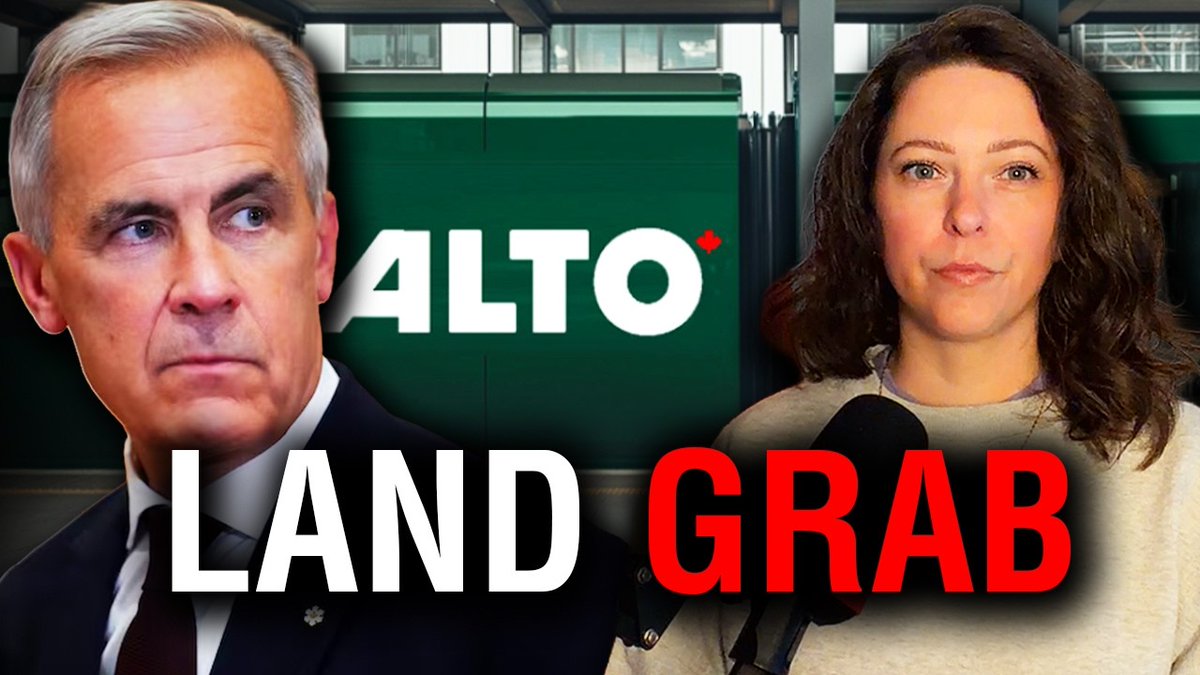
🚨 Latest law allows Liberals to clear private property for their high-speed rail monstrosity🚆 The proposed 300+ km/h bullet train would link Toronto to Quebec City along a dedicated corridor with five mandated stops along the way. Bill C-15 received royal assent after moving swiftly through the Liberal-packed Senate last week. Marketed as an omnibus budget bill, the legislation quietly embeds the High-Speed Rail Network Act within it, effectively handing the federal government sweeping new tools to fast-track the ALTO high-speed rail project. The proposed 300+ km/h bullet train would link Toronto to Quebec City along a dedicated corridor with five mandated stops along the way. A public-private partnership led by the CADENCE consortium, which includes AtkinsRéalis (formerly SNC-Lavalin), now holds special fast-track authority to acquire land. The route carves a straight, 60-metre-wide (more than 200 feet) fenced corridor through prime farmland, rural homes, wetlands and ecologically sensitive areas across southern Ontario and Quebec. And Bill C-15 has just rewritten the rules, declaring the project “for the general advantage of Canada,” securing federal jurisdiction and bypassing standard processes under the Canada Transportation Act. It streamlines the Impact Assessment Act and, most significantly, amends the federal Expropriation Act specifically for ALTO. If the Minister of Transport determines land is required, the Crown is automatically deemed to need it for a “public work.” There is no mandatory prior negotiation. Landowners receive abbreviated notice and a short 30-day window to file written objections, with no public hearings and many longstanding appeal rights stripped away or diluted. Farmers whose fields are bisected, drainage systems destroyed, and operations fractured will face a process that treats private property as an inconvenience to industry, rather than a right. Preliminary cost estimates already range from $60 billion to $90 billion, yet no finalized business case or detailed engineering has been made public. If history is any indication, a mega-project like this will be unlikely to stay on budget. Proponents promise halved travel times and economic gains, but those benefits must not come at the expense of due process and property rights. This is not the first time Ottawa has used legislation to seize land from rural Canadians. In 1969, the federal government expropriated roughly 39,000 hectares for Mirabel International Airport in Quebec, displacing thousands of families. The project delivered massive social and environmental disruption but was ultimately underused; much of the land was later sold back to families, yet the damage was already done. Closer to home, the case of Frank Meyers of Quinte West, Ontario, stands as a stark warning. A fifth-generation farmer whose family had worked the land since 1798, Meyers lost 220 acres in 2012 when the government expropriated it for an alleged expansion of Canadian Forces Base Trenton. He rejected the $1.6 million offer, returned the cheques unopened and fought the process every step of the way. In 2014, while he was away, his farmhouse and barns were demolished. Years later, the promised military relocation never materialized. The land sat idle — a “dead zone” of former productive farmland — until reports surfaced in 2023 that it would become an ammunition depot, far from the original justification. Seize private land first and argue value later, rewriting rules whenever a shiny new flagship project demands it, isn’t governance, it’s power without restraint. Rural Canadians warned this line would be crossed, and Bill C-15 doesn’t just prove them right, it proves the warnings were ignored. Tamara Ugolini 🇨🇦

Rebel News

12,845 Aufrufe • vor 4 Monaten

$AMD $5 Trillion MC Is Inevitable Long Term👑 This thread will focus more on Inference! 2026 EPYC "Venice" $TSM 2nm to save Large GW Scale Inference by 40% more than Prior Turin gen. Context: EPYC Turin achieves ~$0.001 per million tokens for batch inference vs $0.02-$0.12/ million tokens as I wrote the thread below. Venice is going to lower cost down to $0.0005-$0.0006/Million Tokens. OpenAI spent roughly $20B on Inference and Training, where 80-90% of that was for Inference per Analysts. AKA Renting Compute is Expensive AF! In this thread, I want to focus on why most analysts and investors are underestimating the role EPYC "Venice" and future Gen on overall Data center revenue. And $TSM ramping up 2nm supply early is a confirmation that AMD will be a major buyer long term. I will also link the thread the Gap between AMD Analysts & Reality and 2nm Ramp Thread so you have more comprehensive view of what I'm writing here. Before I go into detail this is my 2026 Projection: AI GPUs: $35-$50B EPYC Data Center: $15B-$17B Client Segment: $12-$13B Gaming: $6B Embedded: $4B-$5B Total Revenue $70-$100B Non-GAAP net income $18B-$25B Non-GAAP EPS $10.97-$15.40 Foward P/E 55x-70x= $603-$1,078 AMD's Analysts are projecting $0 Revenue for MI450 and sluggish EPYC Growth. Meaning, all analysts are either full of 💩 or Sexist, you decide! Analysts are also projecting 0% growth on AMD "Secret Weapon" Chip as $MSFT said we are at significant Windows refresh and upgrade cycle. Do you think TSMC would allocate more 2nm supply to $AMD at $0 MI450 revenue and sluggish EPYC? 1. EPYC is going to be the leader in lowest Inference! Current Turin cost saving is 95% vs $NVDA or 98-99% on Inference cost when you factor in renting Inference compute from Amazon Web Services, Microsoft Azure, or $NVDA Neocloud pets. TSMC claimed: 10-15% higher performance at iso-power, 25-30% lower power at iso-speed, and ~15% higher transistor density compared to 3nm. This reduces operational expenses (energy, cooling) while increasing throughput per chip. EPYC Turin achieves ~$0.001 per million tokens for batch inference (via vLLM on models like Llama 3 70B), driven by high core counts and low hardware costs. EPYC Venice offers ~1.7x overall performance and up to 70% more compute capability per core, with up to 256 cores (512 threads). Enhanced vector/AI instructions and open-source firmware (openSIL) optimize for inference workloads. AMD Incorporates AI Engines (now part of AMD's XDNA) for on-chip acceleration, improving efficiency for low-latency and edge inference. This reduces reliance on discrete GPUs, lowering system complexity and TCO. Venice SKUs are projected at $3,000-$15,000 ($5,000 for 256-core flagship), far below NVIDIA Rubin ($50,000-$90,000) or AMD's own MI450 GPUs ($40,000-$50,000). High memory bandwidth (up to 1.6 TB/s) supports efficient batch inference. Venice is designed exactly for Large customers that want to lower Inference Cost and MI450 Helios is for Customers that want Training at lowest TCO, TDP as well as lower Upfront 1GW scale(Full build $35-$40B vs $NVDA $55B-$80B). 2. Real World Example: OpenAI's 2025 inference spend reached ~$20B, escalating to even higher total compute rental (mostly inference) amid token volume growth(from video generating). By 2026, with usage doubling (consistent with industry trends: token demand grows 2-5x YoY), assume OpenAI processes ~1,800 billion million-tokens annually $NVDA Blackwell at $0.02-$0.12 is $36B(most optimized) Rubin is projected to be at $0.01/million tokens or $18B annual Inference Cost vs $AMD Venice $0.0005/million tokens or $0.9B annual Inference Cost => Massive saving for OpenAI or anyone that are paying 80-90% Annual Bill for Inference compute. In short, it is unsustainable to pay this much rent vs owning for all current AI players for the medium to long term. Rubin excels in low-latency decode (if Groq integration from $20B deal in 2027-2028), but Venice dominates batch (80% of inference by 2030). Actual savings depend on deployment scale (OpenAI's 6GW AMD plans), electricity rates, and software maturity. If Rubin only hits $0.03, savings swell to $53.1B vs. $17.1B. 3. Will running Inference on Venice and future Gen slow down response generation in 2026 and beyond? Human perception of "fast enough" for chat, agents, search augmentation, summarization, coding assistance is roughly Meaning, EPYC may generate $100B a year on data center revenue, Hence $MSFT $AMZN $META $GOOGL OpenAI xAI and 42+ Countries are leaning AMD for Inference, because the cost saving is MASSIVE! 4. Regular users (you, me, people using ChatGPT, Claude, Gemini, Grok, Perplexity...) are extremely unlikely to notice any slowdown and in many cases might even experience slightly faster or more consistent response times if the industry heavily shifts toward AMD EPYC for inference. What actually happens when companies save massively on inference? When OpenAI , Anthropic , Gemini , Grok Meta .... save billions on the batch/enterprise/RAG layer using EPYC Venice, they typically do one or more of these things with the savings, none of which make your chat slower but enhancing their bottom line(Profit) ~Keep prices the same → make more profit ~Lower subscription prices / increase free tier limits ~Train bigger & better models more frequently ~Offer longer context windows ~Add more reasoning steps / tool calls / agents per query ~Improve multimodal capabilities ~Build more data centers / reduce throttling during peaks In practice the consumer experience usually gets better, not worse, when inference becomes dramatically cheaper. Prime example is $META leaning AMD heavily or currently AMD largest customer. or Grok 2 to Grok 3 heavily used AMD for Inference saving. And most Grok Users reported Groke responses snappier, not slower. 5. What does this mean for potential Revenue? Noted that TSMC is massively ramping 2nm supply for $AMD both MI450 and EPYC. EPYC Conservative projection: FY2025: $10.5B(best Est) FY2026: $16B FY2027: $29B FY2028: $49B FY2029: $75B FY2030: $100B Large customers: $META OpenAI $MSFT $AMZN $GOOGL xAI (Apple?) Smaller customer: $DELL $HPE $SMCI and 42+ other countries. The roadmap to $5 Trillion is very much inevitable as Inference Cost from Renting or owning $NVDA are too high, but $NVDA will still dominate Training market share, where MI families are likely to take 15-20% market share, but the TAM is also expanding Rapidly. Most Institutions are projecting $2-$3Trillion TAM by 2030. $NVDA said $4 Trillion. Dr. Lisa Su said $1 Trillion+ by 2030. So you decide on how much TAM. If you enjoy this kind of analysis, Slap the Like/Repost and Bookmark to please the X Algo as it is Free.99! If you want to support my work further, consider subscribe to see more in-depth analysis! Alright, that is it. Not Financial Advice!

Mike

102,223 Aufrufe • vor 7 Monaten