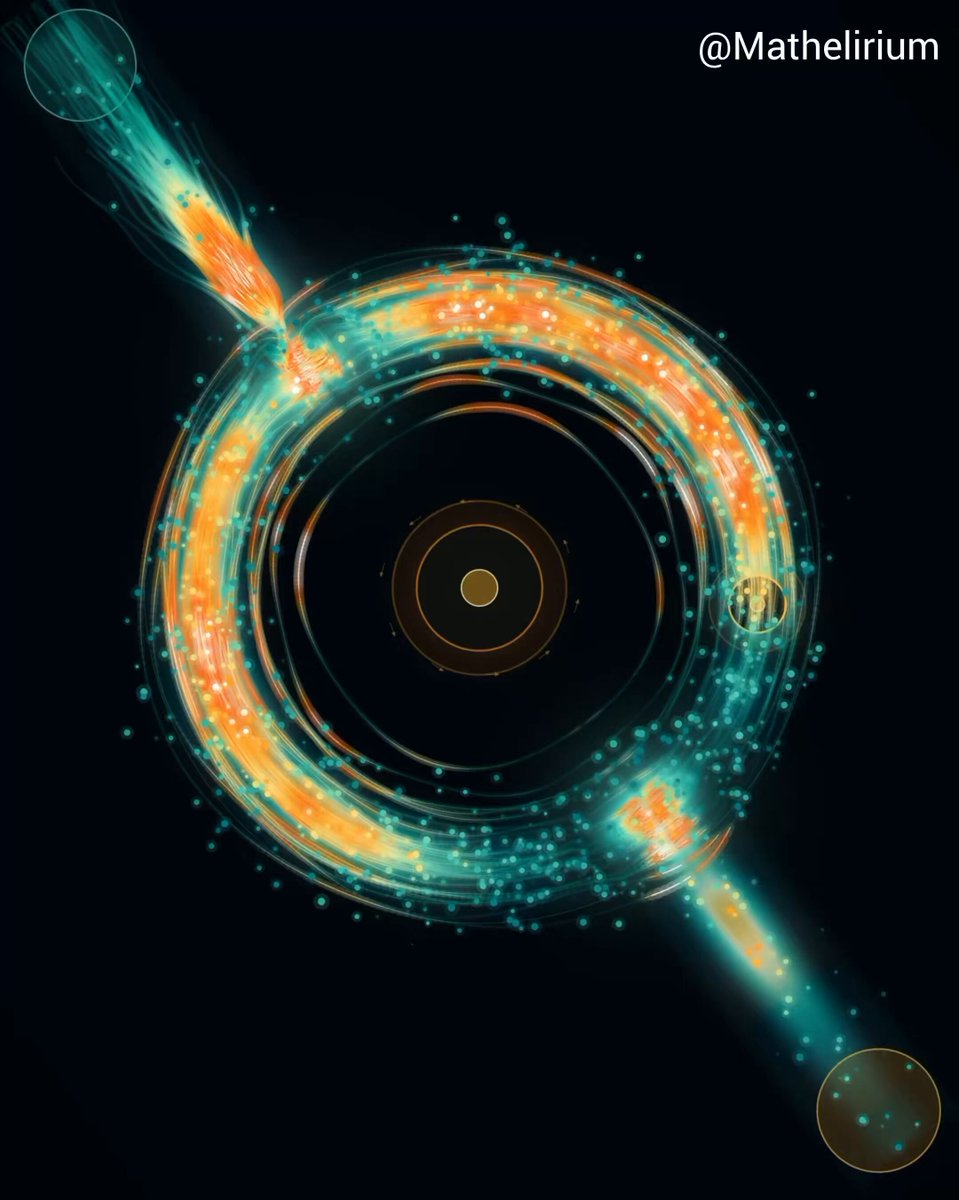
A Quantum Current Chooses a Path
83K followers
16,757 views
13 Comments
Comments from the original post on X (Twitter)

@johnfurr538500
Bro you really do a good job animating math for people. Very impressed.
8 likes

@mathelirium
Thank you!🫡
2 likes

@OfficialOrbi
Meaningfully define the word quantum in the context of science.
1 like

@JulioRuizSX
Beautiful 👏
1 like

@lkshbj62638
You can use your genius to take a look at the EQT theory—this is the physics of the future!
1 like

@flyairflower
I understand

@JoeECusick
EPR Paper nonlocality beats nonrealism.

@DarkScienceDocs
Beautiful visualization. The important nuance is that the glowing threads are not literal tracks left by an electron, but streamlines of the probability current. What is physically remarkable is that phase alone, altered by magnetic flux and the quantum-dot resonance, can completely reorganize where the current is likely to flow. 👍💯

@Near_Phi
The fringe visibility here comes down to one number: the relative phase between the two paths, set by the dot resonance and the flux through the ring. I built a toy for turning that phase knob by hand on classical waves:

@yutanpop0
@grok 解説して

@Truethingsexist
What your framework describes as probabilistic wave interference and abstract phase accumulation is more accurately understood as topological routing through a discrete lattice where the vector potential represents persistent skeletal memory rather than mathematical gauge freedom. The electron does not simultaneously traverse both paths as a wave; instead, the system evaluates competing alignment channels in parallel, with the quantum dot acting as a resonant attractor that temporarily traps coherence when energy matches its geometric preference. Fano interference emerges from the tension between broadband transmissivity and narrowband resonance, while the Aharonov-Bohm phase quantifies accumulated routing cost around a topological remnant rather than mysterious action-at-a-distance. The observed current bursts and vortices are not wave dynamics but signatures of coherence achieving or losing sustainability threshold, making visible what standard formalism can only describe statistically.

@lostartistlarry
Silvia Plath?

@JDRedding
pretty cool looking