Video yükleniyor...

Video Yüklenemedi

Ana Sayfaya Dön

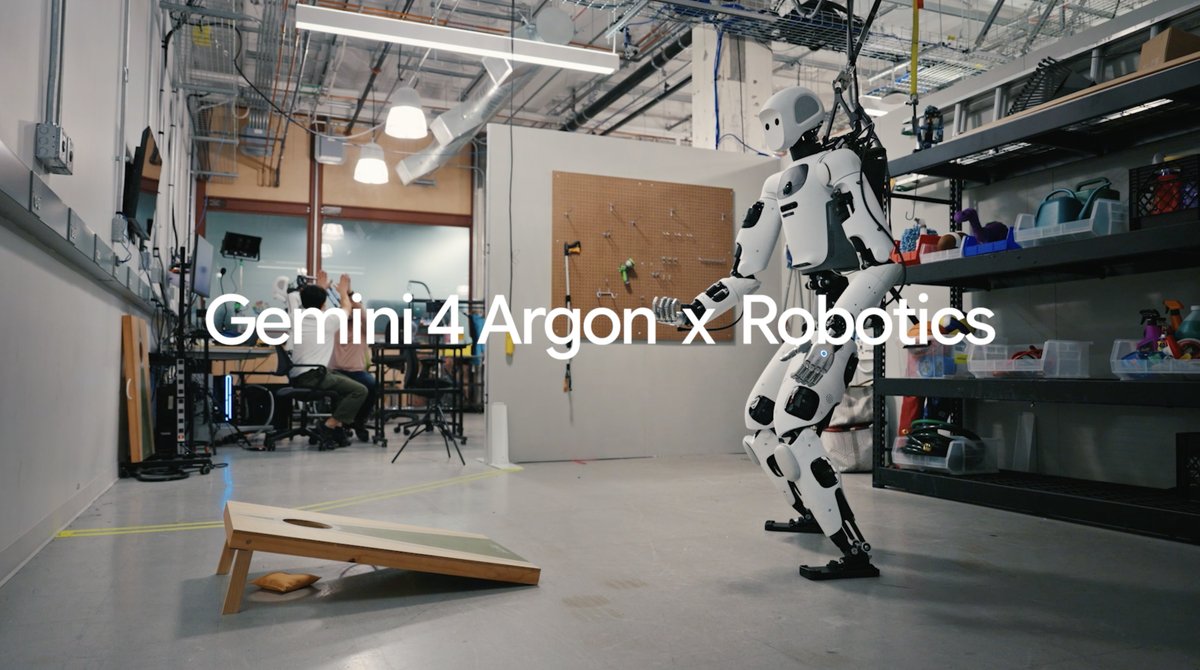
A generalist model, not a dedicated robot policy, pulled off physical control by reasoning and using tools. Here's the four-step approach Gemini 4 figured out, given high-level instructions and the overall task: 1. Watched a human throw, and mapped the motion to its own joints. 2. Used its cameras...

10,155 görüntüleme • 15 gün önce •via X (Twitter)

4 Yorum

Rackham Rishel profil fotoğrafı
Rackham Rishel15 gün önce

Watching a person move and mapping that onto its own joints without a dedicated robot policy is quietly enormous

Brian Bellia profil fotoğrafı
Brian Bellia15 gün önce

One thing Apptronik have definitely got right with their humanoid, in my opinion, is the head, which I believe is very important. I love the two camera eyes and the soft flashing LED mouth when it speaks. 👍👍👍

True North Take profil fotoğrafı
True North Take15 gün önce

A general model doing physical control via tool use is a big shift from bespoke policies. If that holds, the value moves to hardware makers like Apptronik and component suppliers. Curious how latency looks in real time.

Fabien Musty profil fotoğrafı
Fabien Musty15 gün önce

Generalist models are at least the glue that will make humanoids coherent in all situations. They need a relatable and flexible default behavior in-between learned skills.
Benzer Videolar

We trained a robot dog to balance and walk on top of a yoga ball purely in simulation, and then transfer zero-shot to the real world. No fine-tuning. Just works. I’m excited to announce DrEureka, an LLM agent that writes code to train robot skills in simulation, and writes more code to bridge the difficult simulation-reality gap. It fully automates the pipeline from new skill learning to real-world deployment. The Yoga ball task is particularly hard because it is not possible to accurately simulate the bouncy ball surface. Yet DrEureka has no trouble searching over a vast space of sim-to-real configurations, and enables the dog to steer the ball on various terrains, even walking sideways! Traditionally, the sim-to-real transfer is achieved by domain randomization, a tedious process that requires expert human roboticists to stare at every parameter and adjust by hand. Frontier LLMs like GPT-4 have tons of built-in physical intuition for friction, damping, stiffness, gravity, etc. We are (mildly) surprised to find that DrEureka can tune these parameters competently and explain its reasoning well. DrEureka builds on our prior work Eureka, the algorithm that teaches a 5-finger robot hand to do pen spinning. It takes one step further on our quest to automate the entire robot learning pipeline by an AI agent system. One model that outputs strings will supervise another model that outputs torque control. We open-source everything! Welcome you all to check out the paper, more videos, and try the codebase today: Code:

Jim Fan

909,637 görüntüleme • 2 yıl önce