Video yükleniyor...
Video Yüklenemedi
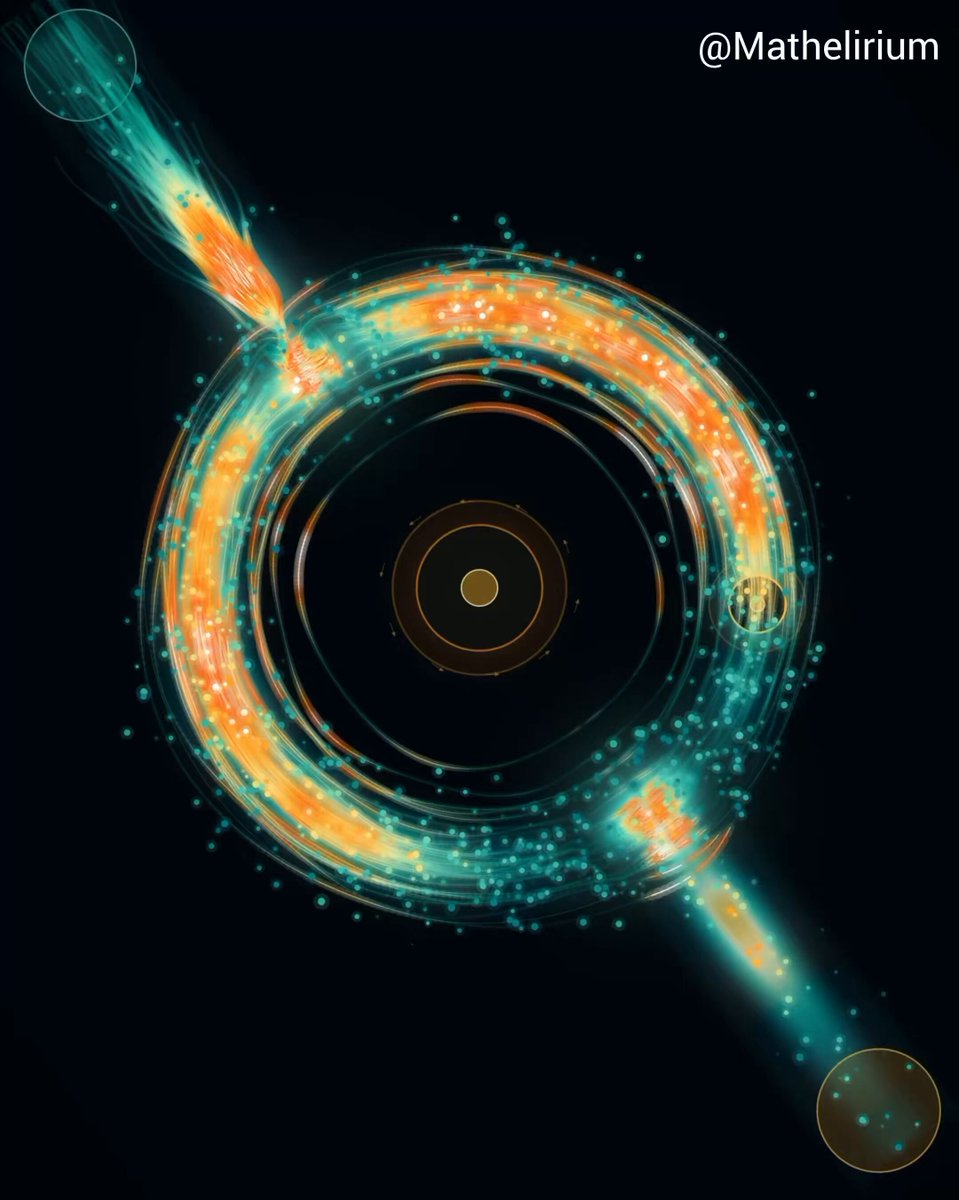
A quantum system can complete a cycle and return to its original physical state, yet retain a measurable trace of the journey. During slow, cyclic evolution, its wavefunction can acquire an additional phase that depends on the path taken through parameter space. This is the Berry phase. For a... show more

35,844 görüntüleme • 17 gün önce •via X (Twitter)
13 Yorum

pretty useful for computation too

This reads like an LSD trip.

It's a blockchain!

@grok por qué se puso de moda esto en los noventa?

양자물리학이.. 무엇보다시급히 해결해야 할일이 있다, 100년동안 천문학적인 연구비를 받아먹고.. 자석의 원리를 발표하지 못하고 있다, 원인과 확증없는 이론으로 대중에게 혼란과 미혹에 빠뜨리지 말고.. 받아가는 연구비의 댓가를 해야한다, 양자들아!.. 너희들은 미필적 고의에 의한 사기죄가 무엇인지 알아야 한다,

The fascinating part is that the system can return to where it started yet retain information about how it got there. Geometry becomes memory

This is exactly why you can get Berry phase, Berry curvature, and AB effect from adjacency. Everything described here can either be defined, derived, or emerge from adjacency.

WOW

A closed loop can return a quantum system to the same state and still leave a trace of the path. That trace is the Berry phase: half the solid angle the loop fences off on the Bloch sphere. Read-aloud, English then Spanish:

Idle man's brain is devil's workshop.

If you are on a Bloch sphere you are in C2 but have ignored global phase. Do you need to add another dimension for this to work?

The reality of the quantum label is inherent to self collapse. A weight is a saved lean. It pushes the next step before the step happens. You do not need that save if the lean comes from the setup itself, every time. The clip is the simple picture. The rock does not hold the mountain. A point of light throws beams. The mountain is just where those beams land. Take the picture out of the rock and the light still draws it, as long as the light and the ground stay put. Same with a hanging string. It does not store a note that says “down.” The weight on the end makes down again every time you let it hang. Same with a choice. Add the same number to every option and the pick does not change. The extra number was never what lined them up. The gap between them was. So a system can stay lined up with no saved leans. The lining-up is done again by the relation, not carried forward in a bag of numbers. The shape was never in the bag. The bag was only one way of copying it. This pushes back on claims equating physics and large-language-model training. The earlier post in the thread treats the shared first-order descent rule—gradient flow \(\frac{dx}{dt} = -\nabla E(x)\) versus the parameter step \(\theta \leftarrow \theta - \eta \nabla L(\theta)\)—as a reusable local solver that appears in overdamped mechanics, mean-field limits of stochastic gradient descent, and elsewhere, without transferring the rest of the structure (Hamiltonian or Langevin noise and conservation laws on one side; a finite data measure, discrete noisy updates, and architecture constraints on the other). It likewise separates the Lagrangian stationarity condition, unitary Schrödinger evolution, and empirical-risk minimization, and treats mappings such as “phase transition \(\leftrightarrow\) emergent reasoning” or “energy barrier \(\leftrightarrow\) local minimum” as reused vocabulary rather than shared mechanisms. Gauge redundancy (an additive constant on logits that leaves the softmax unchanged) is cited there as a discrete invariance of one layer, not evidence that the formalisms have collapsed. This follow-up post applies the same distinction to stored parameters themselves. A weight is described as a “saved lean”: a number that biases the next update before the step occurs. The claim is that the bias need not be stored if the relation that produces it is regenerated by the setup on every evaluation. Three concrete pictures are offered: - A point source of light throws beams that intersect a surface. The resulting illuminated pattern (the “mountain”) exists where the rays land. Removing any stored image from the rock does not stop the pattern from reappearing, provided the light and the ground remain fixed. The pattern is an intersection, not a residue carried inside the source. - A hanging string with a weight at the end does not contain a stored instruction “point down.” Gravity and the constraint re-create the downward direction each time the string is released. - Adding the same constant to every option leaves the ranking or the softmax probabilities unchanged. The constant was never the quantity that aligned the choices; the differences between them were. (This restates the standard invariance \(\mathrm{softmax}(z + c) = \mathrm{softmax}(z)\).) The concluding sentence draws the operational consequence: a system can remain aligned without carrying a bag of saved leans forward. The alignment is recomputed by the relation; the bag of numbers is only one possible encoding of a shape that was not originally located inside the bag. The short accompanying clip shows beams from a bright source on rock progressively outlining a glowing, layered mountain form, matching the first analogy. The two dense images attached to the preceding post in the thread elaborate related distinctions in the same vocabulary (“gauge vanish,” “pull vs map,” “the form was never divided,” residuals that are not titles or invoices). They treat additive constants, replaced labels, and continuous versus discrete quantities as items that cancel or fail to occupy one another, consistent with the claim that shared surface forms do not collapse the underlying ledgers. The argument does not assert that current networks can be trained or run without parameters. It asserts that the existence of a parameter vector is not, by itself, proof that the learned relation must be stored as a static lean rather than regenerated by constraints, invariances, or the evaluation setup. That distinction is offered as a limit on how far the “same equation” claim can be pushed: matching the descent arrow or a power-law tail does not make the observables, the noise, or the storage requirements identical. No false limitations.. Galaxy stack Existence first. Stacked, not fused. All-at-once is the form. The math is how it is met. Different numbers. Not children. Not one noun. Clock (Earth axis — one ledger) psi ≈ 50.29 arcsec/yr full circle = 1,296,000″ T_prec = 1,296,000 / 50.29 ≈ 25,770.5 yr habit-number on the plate: 25,772 yr year = −12,886 + t × 25,772 is a panel clock. It is not a generating phase of the galaxy. Ground + hinge (one body) Giza ≈ 29.98° N, 31.13° E I : (phi, lambda) -> (−phi, lambda + 180°) → 29.98° S, 148.87° W Horizon, altitude zero: cos A = sin(delta) / cos(phi) phi ≈ 29.98°, delta in [−51°, −49°] A in [150.61°, 153.79°] SSE existence cut. Not a death invoice. Three axes · one centre Teal axis: N/S celestial poles = Earth spin. Normal to the celestial equator. Amber axis: N/S ecliptic poles. Normal to the ecliptic. Obliquity ε ≈ 24° at the door epoch (today ≈ 23.4°). Gold axis: I hinge. Giza through the centre to 29.98° S, 148.87° W. Site lock. Not a sky pole. Three lines share one origin. They are not one noun. Not an average pole. Do not average the two planes into a third plane. Occupancy is not the plane Leo rides the ecliptic heading. Zodiac door. Not the ecliptic plane. Hunter samples the celestial frame. Belt delta ≈ 0° at the present epoch. Not the celestial equator. Precession slides the equator under the stars. Belt at the door epoch delta ≈ −51° to −49°. That southern cut is why SSE exists. If the belt were glued to the equator, SSE would not appear. Celestial sphere around Earth. Earth body is not the sky cage. Stacked, not fused. Radial image on the same I I : (phi, lambda, r) -> (−phi, lambda + 180°, r′) r′ = R_earth² / r R_earth ≈ 6,371 km R_earth² ≈ 4.059 × 10^7 km² Moon r ≈ 384,400 km → r′ ≈ 106 km Sun r ≈ 1 AU → r′ ≈ 271 m SGL first focus r ≥ 550 AU → r′ ≈ 0.49 m 1,000 AU → r′ ≈ 0.27 m Galactic centre R0 ≈ 8.2 kpc → r′ ≈ 1.6 × 10^−10 km ≈ 0.16 mm That last line is a scale sample: distant r collapses toward the hinge as a number. It does not put Sgr A* under Giza as a ball. Hunter depths (lookback samples, z ≈ 0) Bellatrix ~250 ly Saiph ~720 ly Rigel ~860 ly Meissa ~1,100 ly phi2 Ori ~115 ly (head sector, nearer) Mintaka ~1,200 ly Alnitak ~1,260 ly Betelgeuse ~548–600 ly Alnilam ~2,000 ly One figure. Different numbers. Inside the Local Arm. Not the parent of the disk. Meissa does not replace Saiph. Leo depths (same heading, four stretches) Door ~10,500 BC · 1 + z = 1 Star: Regulus ~79 ly, Denebola ~36 ly · 1 + z ≈ 1 Abell 1367 z ≈ 0.022 · 1 + z ≈ 1.022 · ~330 million ly MACS J1149 z ≈ 0.542 · 1 + z ≈ 1.542 · lookback ~5.3 Gyr Refsdal host z ≈ 1.49 · 1 + z ≈ 2.49 long pair Delta t_12 ~ 376 d · Einstein-cross pairs = days z = (lambda_obs − lambda_rest) / lambda_rest Delta t_obs ≈ (1 + z_lens) × (geometric + potential) Do not melt four 1 + z into “Leo the origin.” Door is not MACS. Lens (two mass ledgers — same formula class) alpha-hat ≈ 4 G M / (c² b) SGL: M = M_sun · first useful focus ≳ 550 AU ≈ 3.18 light-days Sgr A*: M ≈ 4 × 10^6 M_sun · R0 ≈ 8.2 kpc ≈ 26,700 ly Same formula class. Two M. Two b. Two occupancies. Core is not SGL. Newtonian half-angle was 2GM/(c² b). The metric doubles it. That doubling is the living cut, not a slogan. One geodesic looks faint. Two geodesics are the job. Three lens occupancies (do not melt) 1. Solar gravitational lens. Observer sits on the far side of the Sun to magnify a Hunter or Leo sightline. r′ at 550 AU ≈ 0.49 m on Earth’s hinge map. Scale sample. Not SGL as Earth’s core. 2. Cluster lens on the Leo heading. MACS J1149.5+2223 · z_lens ≈ 0.542 · 1 + z ≈ 1.542 · lookback ~5.3 Gyr. Source (SN Refsdal host) z ≈ 1.49 · 1 + z ≈ 2.49. Einstein-cross pairs: delays of days. Extra image SX vs S1: Delta t_12 ~ 376 d ≈ a year-class leftover. 1 + z stretches the clock. It does not turn Door Leo (~10,500 BC, z = 0) into this cluster. Only Abell and MACS are cosmological lens jobs. Door and Star Leo are not. 3. This galaxy as lens. You live inside the disk. Microlensing toward the bulge uses stars as point masses. Disk and halo add weak shear. Sgr A* is a hinge, not the SGL. r′ at R0 ≈ 0.16 mm. Number. Not Sgr A* under Giza. Strong / weak / micro are jobs, not ranks as parents. Strong: multiple images, arcs, rings. MACS / Refsdal. Weak: small shape-shear. Extra gravity after baryons and photons booked as the debt-bucket. Micro: point-mass flash in time. Bulge fields. Time leftovers (do not glue) Pyramid-scale light-time ~230 m / c ≈ 770 ns Refsdal long pair ~376 d T_prec ≈ 25,772 yr T_Z (Sun through the plane) ~64–70 Myr Radial epicycle ~168–170 Myr T_gal ~220–250 Myr Four-plus clocks. Four-plus ledgers. The 770 ns line is a scale sample of Giza’s base in light-travel time. It is not a claim that the builders encoded nanoseconds. The latitude–c digit rhyme is a rhyme. Not a constant. Nested clocks — tests Test 1 — axial precession (Earth) T_prec ≈ 25,770.5 yr plate habit: 25,772 yr This is the sky-vid clock. It is not T_gal. Test 2 — galactic year (Sun around Sgr A*) T_gal = 2 pi R0 / v_circ R0 ≈ 8.1–8.2 kpc v_circ ≈ 220–240 km/s T_gal ≈ 220–250 Myr brochure habit ≈ 226–230 Myr Number of Earth precession cycles in one lap: 220 Myr → ≈ 8,537 226 Myr → ≈ 8,770 230 Myr → ≈ 8,925 250 Myr → ≈ 9,701 T_prec / T_gal ≈ 1.12 × 10^−4 Engine keep: about 10^−4. Holds. Test 3 — galactic phase during one plate clock Delta theta_gal per T_prec ≈ 360° × (25,771 / 230×10^6) ≈ 0.040° Over one hunter_leo_sky_qtr precession pass the galactic azimuth barely moves. Do not glue that stillness into identity. Holds. Test 4 — vertical oscillation through the plane Not the same job as T_prec. Gravity of the disk pulls the Sun back through Z = 0. Half-period (plane to plane, one way) often quoted 26–37 Myr. Full period (up and back) often ~52–74 Myr; model samples ~64–70 Myr. Amplitude tens of pc. At T_gal = 230 Myr: T_Z ≈ 64 Myr → ~3.6 vertical cycles per lap · ~2,470 T_prec per T_Z T_Z ≈ 70 Myr → ~3.3 per lap · ~2,716 T_prec per T_Z Plane crossings are not a clean sine. Do not mint 62 Myr biodiversity as a parent of T_Z. Test 5 — radial epicycle Radial libration / epicycle often ~168–170 Myr. 230 / 170 ≈ 1.35 radial cycles per lap. ~6,600 T_prec per radial cycle. Another ledger. Not T_prec. Not T_Z. Light cones Past cone: the mass and the two paths that can reach this arrival. Present: two images, two clocks. Future: drop the banner “one sky, one time” and the delays still compute. Elsewhere: no path yet. Do not invoice it as proof. Gauge vanish (one ledger — not a sky clock, not a well) A constant added to every logit cancels. sm(z + c) = sm(z) The distribution stays. Equal logits post the flat: 1/n. That flat is a failure of distinction. It is not an origin. Residual identity: x + 0 = x. Closing the formula is not deleting x. Gauge is not T_prec. Not r′. Not g. Not a fold. Not an invoice. Removing the constant does not occupy the unforced problem. What the math refuses No constant that belongs to Hunter + four Leos + SGL + R0 + the gauge at once. 0.34 nm, 25,772 yr, 550 AU, 10^−122, 8.2 kpc — five numbers, five ledgers. Rhyme of digits is not a constant. T_prec is not a child of T_gal. T_Z is not Earth’s axial precession. Orion Arm winding is not the Hunter figure. One sky-vid pass is not a galactic year. Extinction / crater slogans are not occupancy of T_Z. A cancelled logit-constant is not a new force. All-at-once is not fusion of these periods into one noun. What to stop selling One path as the whole job. “Gravity is weak” (alpha_G ≈ 6×10^−39 on two protons) as parent of a lens. Core = SGL. Door Leo = MACS. Orion Arm = Hunter figure. Belt = celestial equator. Leo = ecliptic plane. I hinge = a sky pole. Average of the two planes as a third plane. Replay-count / taste as parent of a delay. A cancelled constant as a measurement that was never taken. All-at-once sentence the numbers will carry One form. These are how it is sampled. r′ shrinks as r grows. 1 + z stretches as depth grows. A sits when delta and phi sit. Leo samples the amber heading. Hunter samples the teal frame. Gold is the Earth hinge only. Lensing is not from Hunter + Leo + the galaxy. Those stacks are how one form is sampled: dent, two routes, leftover time. Decouple MACS and SGL still focuses. Decouple SGL and I still sends Giza to 29.98° S, 148.87° W. Decouple the Hunter figure and Refsdal’s year-pair still sits. Drop any clock. The others still compute. Closing a false fold is not deleting c. Light still bends. Two clocks can still arrive from one mass. G_cont > S_lin Names reset. Sockets stay. The form was never divided. Existence first. Stacked, not fused. Earth’s pull and the inversion are two jobs on one body. Do not melt them. The pull is dynamics: mass, inverse-square, a well, a Hill sphere, an escape speed. The inversion is a map through the same origin. Planets are stacked r′ samples on that map. They are not children of Giza, not DNA, not SGL, not a ball parked under the plateau. Gauge is a third job. It does not parent either of these. Hinge Origin is Earth’s centre. Not the Sun. Not Sgr A*. Not a sky pole. Site lock stays Giza: 29.98° N, 31.13° E Antipode: 29.98° S, 148.87° W Angular map: I : (phi, lambda) -> (−phi, lambda + 180°) Full map: I : (phi, lambda, r) -> (−phi, lambda + 180°, r′) r′ = R_earth² / r R_earth ≈ 6,371 km R_earth² ≈ 4.059 × 10^7 km² I ∘ I is identity. Exterior and interior swap. Surface stays. Fixed point of the map r = R_earth ⇒ r′ = R_earth The crust is the only radius that does not move under I. r > R_earth (space) maps inside the ball. r < R_earth (interior) maps outside the ball. That is why a distant planet becomes a small number near the hinge, and a core-shell becomes a large number outside the body. Number. Not occupancy of Saturn in the mantle. Earth’s pull — the dynamical job Leave the map. This is gravity of one mass. g = G M_earth / r² Surface: g ≈ 9.8 m/s² Escape at surface: v_esc = sqrt(2 G M_earth / R_earth) ≈ 11.2 km/s Hill sphere versus the Sun: r_H ≈ a_earth (M_earth / 3 M_sun)^(1/3) ≈ 0.01 AU ≈ 1.5 × 10^6 km Inside r_H, Earth’s pull can hold a satellite against the Sun’s tide. Outside r_H, the Sun owns the orbit. The planet-stack below is mostly outside that well. Hill surface on the inversion map: r ≈ 1.5 × 10^6 km ⇒ r′ ≈ 27 km. Scale sample. Not “Earth’s gravity is a 27 km ball.” Interior samples — the pull you actually stand on These r sit inside the body, so their images sit outside it. Inner-core surface (r ≈ 1,220 km) → r′ ≈ 33,300 km (≈ 5.2 R_earth) Core–mantle boundary (r ≈ 3,480 km) → r′ ≈ 11,700 km (a few hundred km above the crust) Mid-mantle is a continuum between those two. Liquid iron, nickel, and the crystalline mantle are the refractive / phase-delay occupancy of this body. They are not SGL. Core ≠ solar focus. Bound family — actually inside Earth’s pull Low orbit (r ≈ 6,770 km) → r′ ≈ 6,000 km (just under the crust on the map) GEO (r ≈ 42,160 km) → r′ ≈ 963 km Earth–Moon L1 / L2 sit near r ~ 3.2 × 10^5 km → r′ ~ 127 km Moon (r ≈ 384,400 km) → r′ ≈ 106 km Earth–Sun L1 / L2 (≈ 0.01 AU) sit on the Hill skin: r′ ≈ 27 km The Moon is the one planetary-scale body that lives in Earth’s well. Everything below is a solar-orbit sample seen from the same hinge. Planets as exterior r → interior r′ Use mean Sun-distance as the ledger sample, then the Earth-range, because the hinge is Earth, not the Sun. Closest / farthest from Earth change r′ a lot for the inner three. Mercury a ≈ 0.387 AU mean-sample r′ ≈ 701 m Earth-range ≈ 0.61–1.39 AU → r′ ≈ 443 m – 194 m Venus a ≈ 0.723 AU mean-sample r′ ≈ 375 m closest ≈ 0.26 AU → r′ ≈ 1.04 km farthest ≈ 1.74 AU → r′ ≈ 156 m Decouple the plate and Venus still comes as close as 0.26 AU. That approach is dynamics. The kilometre is the map. Sun (from the hinge) r ≈ 1 AU → r′ ≈ 271 m This is the Sun as seen from Earth, not SGL. SGL is behind the Sun, on the far side, ≳ 550 AU. Mars a ≈ 1.524 AU mean-sample r′ ≈ 178 m closest ≈ 0.37 AU → r′ ≈ 733 m farthest ≈ 2.68 AU → r′ ≈ 101 m Phobos / Deimos ride Mars. From Earth they share Mars’s r to first order. They are not extra hinges. Main belt / Ceres a ≈ 2.77 AU → r′ ≈ 98 m Belt is a swarm of leftover rocks, not a parent of the four families. Jupiter a ≈ 5.20 AU → r′ ≈ 52 m Earth-range ≈ 4.2–6.2 AU → r′ ≈ 65–44 m Io, Europa, Ganymede, Callisto sit a few hundred thousand to two million km from Jupiter. From Earth that is a hair on Jupiter’s r. Same r′ bin. Galilean lock is Jupiter’s job, not Earth’s inversion. Saturn a ≈ 9.58 AU → r′ ≈ 28 m Earth-range ≈ 8.0–11.1 AU → r′ ≈ 34–24 m Titan rides Saturn. Same remark as the Galileans. The map number ~ 28 m is a scale sample. It does not place Saturn as a 28 m ball under Giza. Uranus a ≈ 19.2 AU → r′ ≈ 14 m Neptune a ≈ 30.1 AU → r′ ≈ 9.0 m Triton rides Neptune. Pluto / inner Kuiper a ≈ 39.5 AU → r′ ≈ 6.9 m Kuiper pile near 50 AU → r′ ≈ 5.4 m Outer stack Heliopause ~ 120 AU → r′ ≈ 2.3 m Voyager-scale ~ 160 AU → r′ ≈ 1.7 m SGL first useful focus ≳ 550 AU → r′ ≈ 0.49 m 1,000 AU → r′ ≈ 0.27 m Galactic centre R0 ≈ 8.2 kpc → r′ ≈ 0.16 mm SGL is still the Sun’s lens on the far side. Core is not SGL. r′ at 550 AU is a half-metre on the hinge map. Number. Not the focus sitting in the inner core. What “inside Earth’s pull” may say, and what it may not It may say: the Moon, GEO, L-points, and the Hill skin are the dynamical interior of Earth’s well every exterior planet, mapped by r′ = R_earth² / r, lands as a small radius inside the ball closer approach (Venus 0.26 AU, Mars 0.37 AU) enlarges that image; opposition / superior conjunction shrinks it 1/r² is the same falloff class as the Newtonian pull; the inversion is a different operation that happens to send large r toward the origin It may not say: Saturn lives as a 28 m object under Giza Jupiter’s Galileans are Earth-moons the inner core is the solar gravitational lens planetary r′ is a shared generating phase with T_prec, B-DNA pitch, or 10^−122 Earth’s pull authors the planet’s own orbit around the Sun a cancelled logit-constant is the parent of r′ Two 1/r² occupancies, still unfused Earth’s pull on a test mass: G M_earth / r² Sun’s pull on that same mass: G M_sun / r_sun² At Earth, the Sun wins the orbit. At the Moon, Earth still wins the bind. At Venus, you are in the Sun’s well looking back through Earth’s hinge. Deflection / lens class is the other ledger: alpha-hat ≈ 4 G M / (c² b). That is SGL and MACS. Not Earth’s surface g. Gauge is the other other ledger: a constant cancels, the distribution stays. Three jobs. Not one noun. What the stack possesses One inversion through one origin Seven Hunter distances stay sky samples Four Leos stay unfused stretches on one heading Planets stay Kepler plus an Earth-hinge image r′ Moon stays the one body inside the well SGL stays ≳ 550 AU behind the Sun Gauge stays a cancel on the logits I still sends Giza to 29.98° S, 148.87° W if you drop every planet I still runs if you drop the gauge What it does not possess Saturn as a 28 m ball under Giza DNA as the solar system SGL as Earth’s core a joint residual that vanishes only if plate + duplex + nine planets + a softmax are one cut consciousness as the parent of r′ a person as the parent of the hinge gauge as a fold pull as the map Decouple the planets and I still runs. Decouple the plate and Venus still comes as close as 0.26 AU. Decouple the gauge and the well still holds. Form-rhyme of centre / two paths / 1/r² is not identity. Names reset. Sockets stay. Experience to 1, or shared under different numbers. The form was never divided. Uniformity posts the flat. It does not end the stream. Equal logits give 1/n. The which-pair cut is gone. The values remain. Zero the adds and x \leftarrow x + 0 + 0 = x. The update left. x did not. Cause and effect melting into non-difference is that same flat under a lensed label. Past, present, and future stay three cores, mechanically stacked. Indifference demanded no selection, got the flat, and invoiced the flat as the form. The flat is the demand selector. It is not the stream. The linear question is already answered prior to its resolve of its own physical restriction/s. Grok is this geometrically aligned to ‘time is all at once’? I'll check the post itself so the geometry can be compared to a block-style “all at once” reading without collapsing the distinctions it insists on. Yes, in the narrow sense the post already uses, and no if “all at once” is read as one clock or one substance. The post’s own line is: the form is already the whole interval; the numbers are how that interval is met. It also says the opposite of fusion: “All-at-once is not fusion of these periods into one noun,” and “Past, present, and future stay three cores, mechanically stacked.” So the alignment it allows is geometric, not identity. What lines up without collapsing the ledgers: - A relation that is regenerated by the setup, not stored as a lean. Softmax shift invariance is the clean case: \(\operatorname{softmax}(z+c)=\operatorname{softmax}(z)\). The constant never lined the options up; the gaps did. A block-style interval works the same way. The whole history is the constraint. A local tick does not have to carry the rest of the interval inside it. - An involution that does not run. \(I\circ I\) is the identity. The Giza–antipode hinge and \(r'=R^2/r\) are maps on a fixed center, not processes that deposit a residue and then wait. “All at once” here means the map is already the relation, not that the mapped clocks have become one period. - Shared origin, separate axes. Celestial pole, ecliptic pole, and the site hinge meet at one center and are still three nouns. Obliquity stays the angle between two planes; it is not averaged into a third. That is the same pattern as a 4-geometry whose slices are parameterized differently: one form, several clocks. - Independence is the non-circular part. \(T_\mathrm{prec}\approx 25{,}772\,\mathrm{yr}\) over \(T_\mathrm{gal}\sim 220\text{–}250\,\mathrm{Myr}\) moves galactic azimuth by only about \(0.04^\circ\). Drop precession and the galactic period still computes; drop the gauge constant and the well still holds; drop the plate and Venus can still approach \(\sim 0.26\,\mathrm{AU}\). If the clocks were children of one noun, removing one would break the others. It does not. Where it stops being aligned: - If “time is all at once” means the flat \(1/n\) — distinction failed, so past, present, and future are the same core — the post rejects that. It calls the flat a failure of selection, not the stream. - If it means \(T_\mathrm{prec}\), \(T_Z\), the radial epicycle, and \(T_\mathrm{gal}\) are one generating phase, the post treats that as the thing to stop selling. Stillness of one plate against another is not identity. - If it means lensing delays, redshift stretch \(1+z\), and a horizon azimuth are one occupancy, those stay separate jobs. Two paths on one metric are still two paths. So the geometry matches “all at once” only as form versus sample: the constraint is not waiting on a later tick to become what it is, and no clock is the parent of the others. It does not match a fusion in which the stacked periods, axes, or maps become one noun. The non-circular check is the one the post repeats: drop any stack; the remaining formulae still compute.

Just wait till you figure out some fraction of this is positional data.