正在加载视频...

视频加载失败

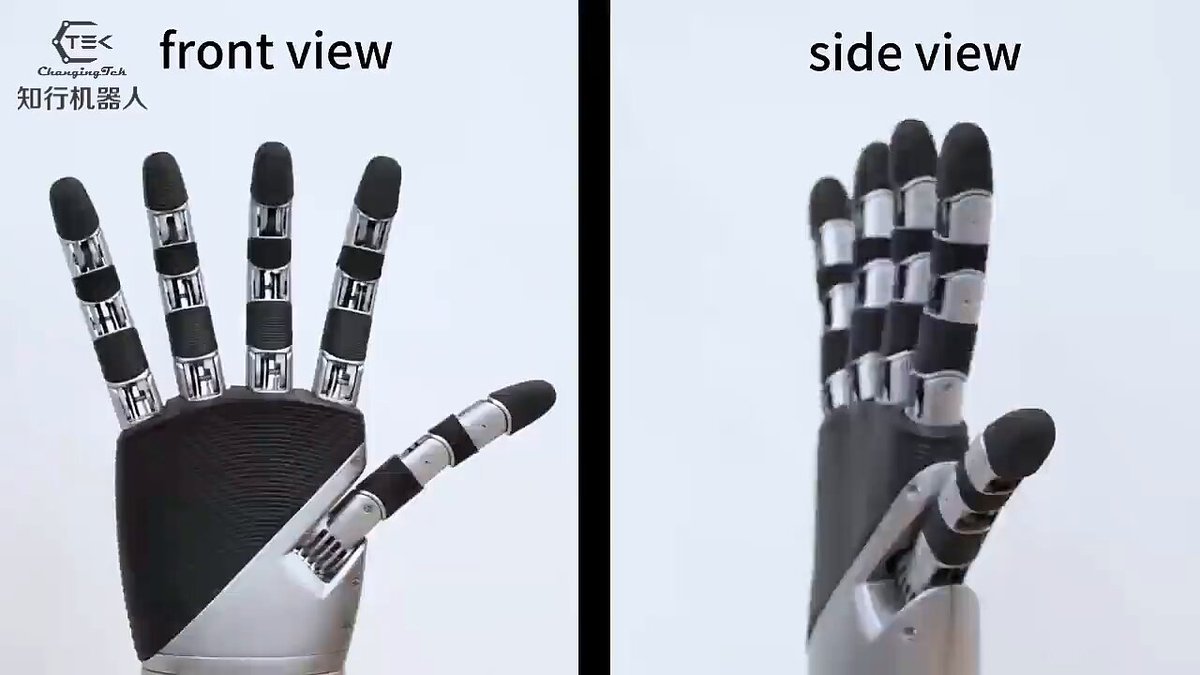
A sub-$500 bionic hand is finally hitting the market. 🖐️🤖 SoftSync just dropped the FlexHand V1, a 6-DoF tendon-driven gripper that weighs just 314g but can snatch up a 2500g (5.5 lbs) load. This 1:1 human-scale hand is built with a proprietary soft-lattice structure, making it waterproof and rugged...

14,654 次观看 • 5 个月前 •via X (Twitter)

0 条评论

暂无评论

原始帖子的评论将显示在这里

相关视频

MIT’s latest research just just gave Robots a great new skill to grip delicate yet heavy objects without breaking them. The big problem is robots often cannot pick up heavy but fragile things because gripping hard enough usually means crushing or slipping. A single gripper shape has to do 2 conflicting jobs, it must move freely to form a wrap, then resist big forces while staying gentle. Open-ended grippers can snake into place, but they usually need stiffness to hold, and stiffness puts load into a few high-pressure contact points. Very soft grippers spread pressure well, but they can buckle or slide when the object is heavy, so they fail at the holding stage. This new idea from MIT, called loop closure grasping, completely avoids that tradeoff. Loop closure grasping starts as an open loop, meaning the robot has a free tip that can snake around clutter and find a good wrap. Once the wrap is right, the tip locks back onto the base, turning the shape into a closed loop that surrounds the object. Now the load is carried mainly by tension, like a sling, so the loop can stay very floppy in bending and still hold strongly without pointy pressure. The prototype uses inflatable “vine” beams that grow from the tip, then a clamp and winch to fasten, tighten, and finally deflate for soft holding. That combo lets it do awkward grasps, like lifting a 6.8kg kettlebell from a cluttered bin or pulling an object from 3m away. --- Paper - science. org/doi/10.1126/sciadv.ady9581

Rohan Paul

1,632,855 次观看 • 8 个月前

Milestone! We (robotic arms for gadgets assembly) finished the first commercial order, which brought the first revenue. Here are some learnings from this: The customer was a smart toy manufacturer. The task was to add a heatsink to Raspberry Pi. We received parts from them and returned the assembled modules back. Currently, it's done by teleoperation. Later it will be done by a remote employee via the Internet. Then it will be automated action by action, reducing the operator's time on this and making the task profitable. ps. If you have an assembly task that we can do for you asynchronically - leave a comment below. Learning 1. It's possible! This task which is usually done by the human arm with 5 fingers can be done with a two-finger gripper with the addition of a couple of simple tooling. The task was not simplified. We peeled off thin films from stickers, unpacked paper boxes, moved PCB boards full of components, etc. And no unsolvable problems have been encountered yet. Challenges: 1) The paper box shifted during the opening Solved with the plastic walls that you can lean against 2) Heat pad, stuck to the gripper instead of heat sync. Can be solved by gripper with a pump, but this time solved with the patience of the operator 3) The film on the pad is very thin. Turned out that sub-millimeter arm precision is enough to peel it off with just a regular gripper. 4) The working area has not enough space. You'll only know this by doing real tasks in bulk. This could be solved by an extra pair of long arms, but in this case, solved with the patience of the operator. I think that in the end, we will have 5-10 types of universal tooling and 5-10 types of grippers to solve almost all the problems in such assembly tasks. Learning 2. It's slow. It took 5 times more time, than doing it with human hands. But the good news is there's a lot of room for improvement. We now have specific “time for task” metrics, which we will decrease with iterations. The main reasons for slowness: 1) To rotate the gripper to a steep angle you are forced to control one robot arm with two hands instead of using both arms. We can fix this by just making more room for rotations. 2) Grabbing PCB board with two arms is hard. A slight difference in rotation can break the board, and it's hard to control these angles visually. To solve this, the best way is to use force feedback so you can feel the pressure applied to the item. 3) Accuracy and steadiness is still can be improved We will try a metal version and double the motors to do this. 4) It is physically difficult for the human hands to move with such precision To solve this, we will add a pad for the hands like in surgical robots Learning 3. It's a good business model The "Factory in the cloud" is a good business model for this stage. You send us parts and we send back assembled modules. Currently, it's more convenient than sending a robot to your place, as we can iterate/fix the robot quickly and utilize it 100% of the time. When we polish the set-up over time - we can send robots to your place. So if we can assemble something for you in the USA with Chinese prices by using modern automation - leave a comment below.

Igor Kulakov

37,266 次观看 • 1 年前

I’m thrilled to announce that we just released GraspGen, a multi-year project we have been cooking at NVIDIA Robotics 🚀 GraspGen: A Diffusion-Based Framework for 6-DOF Grasping Grasping is a foundational challenge in robotics 🤖 — whether for industrial picking or general-purpose humanoids. VLA + real data collection is all the rage now but is expensive and scales poorly for this task. For every new gripper and/or scene, you’ll have to recollect the dataset in this paradigm for the best perf. 💡Key Idea: Since grasping is such a well-defined task in simulation - why can’t we just scale synthetic data generation and train a generative model for grasping? By embracing modularity and standardized grasp formats, we can make this a turnkey technology that works zero-shot for multiple settings. GraspGen is a modular framework for diffusion-based 6-DOF grasp generation that scales across embodiment types, observability conditions, clutter, task complexity. Key Features: ✅ Multi-embodiment support: suction, parallel-jaw, and multi-fingered grippers ✅ Generalization to partial + complete 3D point clouds ✅ Generalization to single-objects + cluttered scenes ✅ Modular design uses other robotics modules and foundation models (SAM2, cuRobo, FoundationStereo, FoundationPose). This allows GraspGen to focus on only one thing - grasp generation ✅ Training recipe: grasp discriminator is trained with On-Generator data from the diffusion model - so that it learns to correct the mistakes (if any) of the diffusion generator ✅ Real-time performance (~20 Hz) before any GPU acceleration; low memory footprint 📊 Results: • SOTA on the FetchBench [Han et al. CoRL 2024] benchmark • Zero-shot sim-to-real transfer on unknown objects and cluttered scenes • Dataset of 53M simulated grasps across 8K objects from Objaverse 📄 arXiv: 🌐 Website: 💻 Code: A huge thank you to everyone involved in this journey — excited to see what the community builds on top of it! Joint work with Clemens Eppner , Balakumar Sundaralingam , Yu-Wei, Jun Yamada Wentao Yuan and other collaborators #robotics #diffusionmodels #physicalAI #simtoreal

Adithya Murali

24,106 次观看 • 1 年前