正在加载视频...

视频加载失败

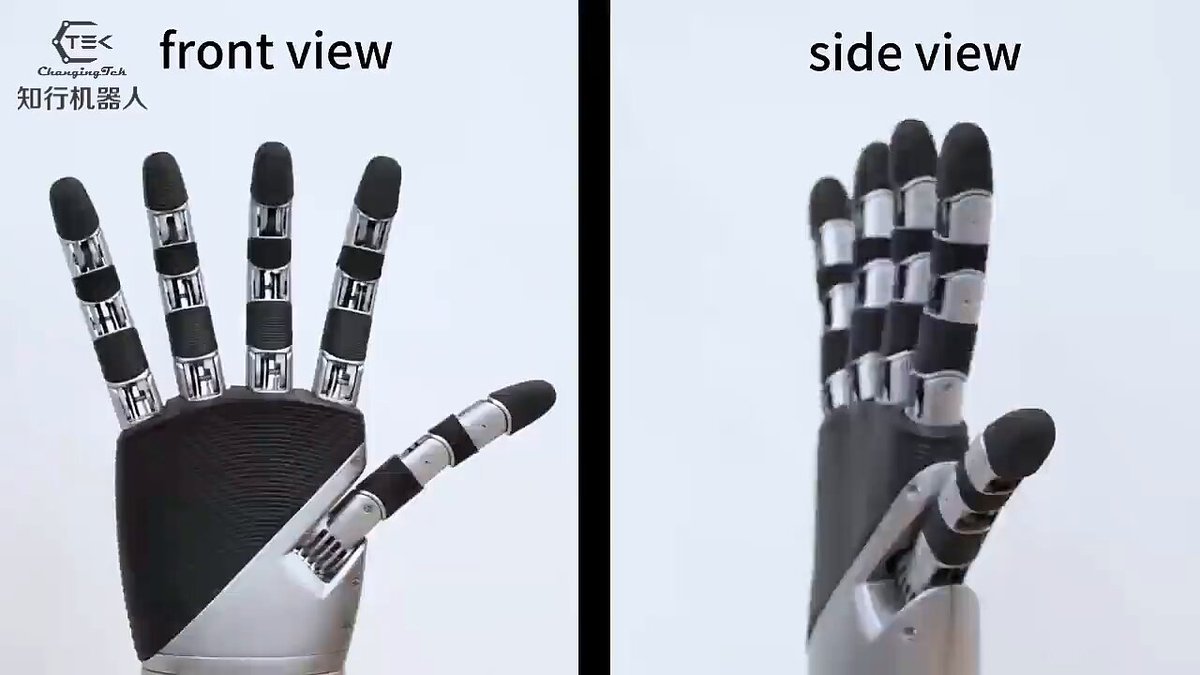
Holy…S😳 Xiaomi's New CyberOne is so human-like Although this update features a bionic hand, I was immediately drawn to it. Let's look at the changes in the hand: It can handle industrial precision tasks like turning screws, plus delicate operations such as pinching feathers and throwing balloons. Behind the...

111,430 次观看 • 5 个月前 •via X (Twitter)

0 条评论

暂无评论

原始帖子的评论将显示在这里

相关视频

AgiBot has formally unveiled its G2 humanoid robot, a system designed to transition into various industries and liberate humans from repetitive labor. G2 features high-performance joints, precision torque sensors, and an advanced spatial perception system, supporting quick deployment and multi-modal voice interaction. ► Factory Floor Performance: The G2 is engineered to industrial standards. In a safety belt lock production line, robots collaborate with human workers, performing tasks like pressing lock cores. The G2 collects production data to continuously train and iterate models (local server deployment ensures data privacy), steadily improving its operational ability. ► Mobility & Safety: The G2 navigates narrow factory aisles using dual LiDAR and full-panorama vision for environment sensing and collision detection. Its chassis is designed to overcome common obstacles (speed bumps, elevator gaps). It supports 24/7 continuous operation via autonomous return-to-charge and battery swapping. ► Humanoid Design Advantage: The G2's design includes a three-degree-of-freedom flexible waist, allowing it to mimic natural human movements like bending and side-leaning. This dramatically expands its operational workspace and enables seamless integration into existing human-centric production lines without costly modifications. ► Advanced Dexterity & Learning (Lab): The new G02 arm is the world's first cross-moment arm, featuring high-precision joint torque sensors that allow it to precisely sense external forces and adjust stiffness, mimicking human hand compliance. Using Real-Machine Reinforcement Learning (RL), the G2 can learn complex, delicate tasks like memory stick insertion in about one hour with minimal human intervention. ► Logistics & Grasping: In logistics sorting, the G2 uses a 19-degree-of-freedom mechanical dexterous hand (20N maximum fingertip force; 35kg capacity for hard objects) equipped with 3D tactile sensors to ensure it grasps securely without damaging items. Its full-body articulation (waist and legs) aids grasping and posture adjustment. ► Model & Data: G2's intelligence is powered by the Go-One Large Embodied Model (VLA architecture: Vision-Language-Latent Action) and the GE-One World Model (vision-centric predictive modeling), trained using the AgiBot Word true-machine dataset (over 500k downloads). ► Service & Interaction: The G2 is deployed as a guide/receptionist in settings like art museums. It uses its high-DOF head, arms, and waist to point to exhibits, maintains eye contact while navigating difficult spaces (chassis walks forward, body faces backward), handles specialized and random queries, and uses proactive safety features (stops movement, issues warnings) when people get too close.

RoboHub🤖

46,733 次观看 • 10 个月前

China unveils humanoid robot with lifelike skin and blinking eyes built for daily life | Prabhat Ranjan Mishra, Interesting Engineering Large Language Models (LLMs) and Vision-Language Models (VLMs) help process and interpret complex data from human interactions. A Shanghai-based company has developed humanoid robots that appear as real as humans. The advanced bionic humanoid robot is integrated with self-supervised AI algorithms. Named Elf V1, the robot can perceive the world, communicate, learn, and interact intelligently with its surroundings. Developed by AheadForm Technology, the robot offers up to 30 degrees of freedom, powered by a precise control system and an advanced AI learning algorithm. Robot offers expressive facial features The robot offers expressive facial features, moving eyes, and synchronized speech. It can also convey emotions and understand human non-verbal cues, making interactions more natural and engaging. The robot has highly interactive capabilities and lifelike appearances. AheadForm expects that its robots could soon seamlessly integrate into daily life, providing assistance, companionship, and support across various industries. “We believe that by developing realistic and expressive robot heads, we can bridge the gap between humans and machines, fostering a new era of interactive and intelligent robotics,” said the company in a statement. Reports revealed that to avoid the “uncanny valley” effect and be able to interact with us, they are given lifelike skin and capabilities to read our emotions and respond appropriately using dynamic expression simulation and emotion generation tech. Bionic skin and high-precision control system The Elf V1 series of humanoids features 30 facial muscles animated by brushless micro-motors and managed by a high-precision control system. Paired with an ability to detect their users’ emotions with low latency and bionic skin, their facial expressions are nearly identical to those of humans, reported CGTN. The company claims it’s pioneering the development of realistic humanoid robots designed to revolutionize human-robot interaction. It’s enhancing sophisticated humanoid robot heads that can express emotions, perceive their environment, and interact seamlessly with humans. By combining cutting-edge AI and advanced robotics, AheadForm aims to bring life to machines and transform how humans engage with technology. AI models boost robots’ responsiveness Seamless integration of Large Language Models (LLMs) and Vision-Language Models (VLMs) into the humanoid robots can help them process and interpret complex data from human interactions, enabling the robot to learn and adapt in real-time, achieving human-level understanding and responsiveness. AheadForm uses Brushless Motors that deliver ultra-quiet operation and high responsiveness, specifically designed for precision facial movements in humanoid robots. With its compact size, lightweight design, and energy efficiency, this motor is the ideal choice for next-generation robots that require precise, subtle facial control to create a truly human-like experience. Previously, the company unveiled the Lan Series that features realistic humanoid robots with soft skin and 10 degrees of freedom, offering a lifelike appearance and intuitive movements. This series is designed for cost-efficiency, for applications prioritizing mobility and manipulation.

Owen Gregorian

179,005 次观看 • 10 个月前

Brett Adcock, Figure CEO joined our 8 hour(!) live stream where a bunch of us were bird dogging and discussing Figure’s own 8 hour livestream showing a F.03 bot doing a logistics task completely autonomously including shift changes between bots. Here’s my summary of Brett’s remarks. The attached video is just the segment with Brett. We were first introduced to F.03 8 months ago, but Figure has been hard at work on their next version, F.04 which has just completed design lock, so expect to see that new bot sometimes this fall. F.04 was co-designed with the latest Figure AI stack called Helix and was built specifically for data. Brett didn’t explain what that meant, but I suspect it means the bot has many more sensors to enable better training and transfer learning. F.04 will be the biggest leap in performance they’ve had between versions so far which is saying something. Brett is a huge proponent of cross training the bots with many different tasks such that seeming unrelated tasks makes all learned tasks better. He gave an example of the fridge loading training which was topping out at 60% reliability until they trained the same model with kitchen shelving tasks, then they saw the fridge tasks jump to 90% accuracy. As such, they spend almost all their time in pre-training the unified Helix model to ensure they get cross training benefits. Figure will have almost completely localized Figure’s supply chain away from China by next quarter. They build almost everything in-house. Figure does not appear eager to get their bots into the workforce. Brett said they could, today, push thousands of bots into customer hands, and I believe him. But their goal is full general robotics where you can describe a brand new task to a robot, maybe do a one time demonstration, just like you would to a human showing them a new task, and then have the robot do the task. This is the holy grail of AI robotics, and Figure is laser focused on that mission. Brett initially said there was a possibility of achieving it this year, but then guided next couple of years, which I think is much more likely. Personally, I think they’ll need at least a new generation of NVIDIA inference chips to make that leap, and a lot more data gathering, training and hardware development. Brett said their goal with the hardware is “Apple” quality. Ie. Something as well designed and made as any Apple product. While the F.03 hand is clearly performant as shown in the 8 hour livestream, they are building a new hand for the F.04 bot which will be even closer to the full functionality of a human hand. Brett fully believes you need a humanoid hand as close as possible in capability to a human hand, if for no other reason that transfer learning from humans works a lot better when you can exactly mimic what a human does. If the bot can’t do something a human demonstrates, then you’ve just polluted your dataset. By now Figure has built more hands than bot versions (5-6 hands). One of the first hands they tried was a tendon driven hand, and without explaining why, Brett said that was a dead end. Their hands now have all actuators in the hand itself, and are clearly already robust. Brett said he just sat through a 100 page powerpoint design review of the latest hand - that’s how complicated it is. Brett’s other AI company, Hark Labs, has developed a conversational voice model which is installed now in the Figure bots roaming the office. Being able to converse back and forth with a Figure bot is now a thing and will get better over time. All in all, I came away from this segment even more bullish on Figure.

Phil Trubey

33,861 次观看 • 3 个月前

This work makes a humanoid robot do simple parkour moves by looking with a depth camera and choosing the right move on the fly. The big deal is that it turns lots of small human moves into long, real-time robot behavior, without hand-coding every transition or retraining for each new course. A humanoid robot is usually good at steady walking, but it often fails when it has to do fast moves like jumping up, vaulting, or rolling, and then keep going to the next obstacle. The hard part is that you cannot easily collect training data for every possible obstacle shape, distance, and mistake, so robots end up learning a few moves that only work in a narrow setup. This work starts from short clips of real human parkour moves, like stepping over, vaulting, climbing, and rolling. It uses motion matching, which is basically a smart “pick the next clip that fits best right now” search, to stitch those short clips into a long, smooth plan that looks like a human doing a whole course. Then it trains a controller with reinforcement learning (RL), which means the robot learns by trial and error to copy that plan while staying balanced and not falling. After training separate expert controllers for different moves, it compresses them into 1 controller that uses only onboard depth sensing and a simple “go this fast in this direction” command. In real tests on a Unitree G1 humanoid, it can clear multiple obstacles in a row, adapt when obstacles get moved, and climb a wall up to 1.25m.

Rohan Paul

37,121 次观看 • 6 个月前

NEWS: Humanoid robotics company Figure has released Helix 02, what they claim in their most capable humanoid model yet. "A single neural system that controls the full body directly from pixels, enabling dexterous, long horizon autonomy across an entire room: • Autonomous, long‑horizon loco-manipulation: Helix 02 unloads and reloads a dishwasher across a full-sized kitchen - a four-minute, end-to-end autonomous task that integrates walking, manipulation, and balance with no resets and no human intervention. We believe this is the longest horizon, most complex task completed autonomously by a humanoid robot to date. • All sensors in. All actuators out: Helix 02 connects every onboard sensor - vision, touch, and proprioception - directly to every actuator through a single unified visuomotor neural network. • Human-like whole body control from human data: All results are enabled by System 0, a learned whole‑body controller trained on over 1,000 hours of human motion data and sim‑to‑real reinforcement learning. System 0 replaces 109,504 lines of hand‑engineered C++ with a single neural prior for stable, natural motion. • New classes of dexterity: With Figure 03’s embedded tactile sensing and palm cameras, Helix 02 performs manipulation that was previously out of reach: extracting individual pills, dispensing precise syringe volumes, and singulating small, irregular objects from clutter despite self‑occlusion. Helix 02 is trained on over 1,000 hours of human motion data and integrates vision, touch, and proprioception."

Sawyer Merritt

624,770 次观看 • 7 个月前