Video yükleniyor...

Video Yüklenemedi

Ana Sayfaya Dön

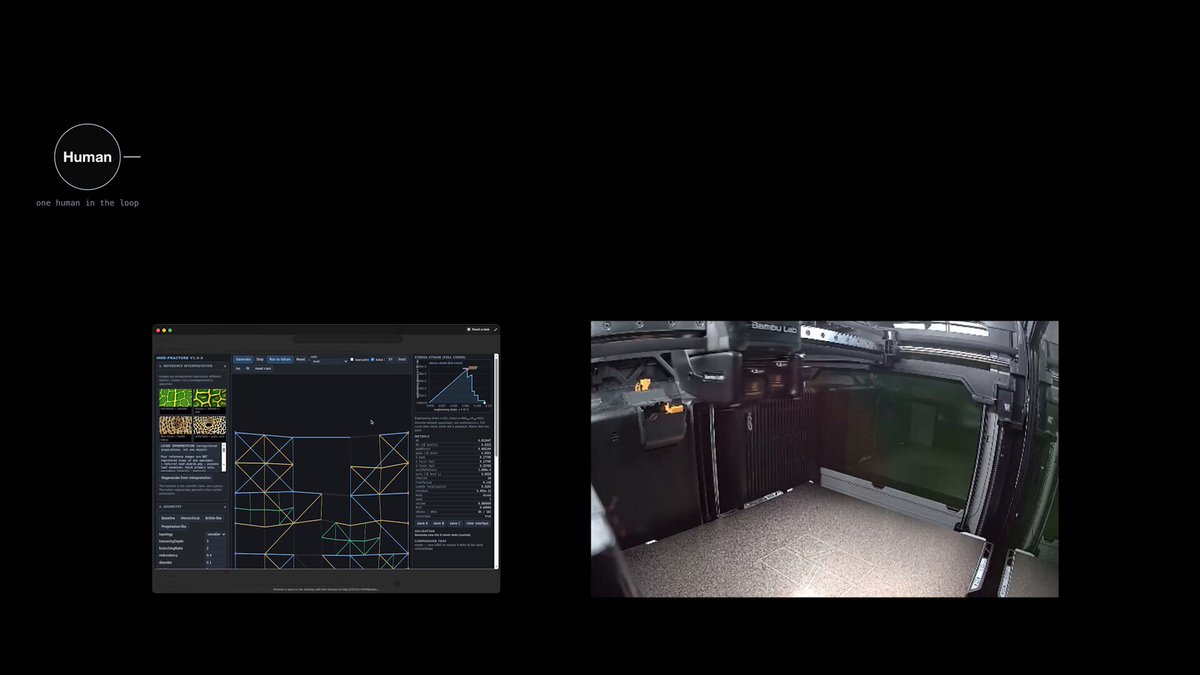
AI can now turn a single image into an explorable physical world. For engineering, this means we can interact with, stress-test, and build intuition about failure in systems that do not yet exist. We can rapidly generate, interrogate, and learn from these worlds to understand how complex physical behavior...

11,713 görüntüleme • 2 ay önce •via X (Twitter)

0 Yorum

Yorum bulunmuyor

Orijinal gönderinin yorumları burada görünecek

Benzer Videolar

This is THE moment of Physical AI! We are officially announcing Cosmos 3: Omnimodal World Models for Physical AI 🚀 - Cosmos 3 is an omnimodal world model: within a unified architecture, it can understand and generate language, images, video, audio, and actions. - It is not just a VLM, not just a video generator, not just an audio-visual generative model, and not just a physics simulator / world-action model. It can understand images and videos, generate images, videos, and audio, simulate future worlds, predict actions, and generate robot policies—enabling models to truly begin to “touch the world.” - Cosmos 3 is the #1 open-weight reasoner / T2I / I2V / robot policy across many benchmarks. Huge thanks to every teammate who fought side by side on this journey—from architecture, data, training, infra, serving, and evaluation to post-training. Every part of this project carries an incredible amount of hard work. This was my first time leading a project as Tech Lead, and I feel truly fortunate. The future of Physical AI needs models that can not only “see” and “describe” the world, but also “imagine,” “simulate,” and “act”—and eventually close the loop with the real world. I hope Cosmos 3 can become an important starting point for this direction, and I’m excited to push Physical AI into its next stage together with the open-source community. Welcome to the era of Physical AI. HuggingFace: Project Website: Code:

Max Zhaoshuo Li 李赵硕

1,078,810 görüntüleme • 3 ay önce

Grok Grok Bot is incredible - and they can even manufacture real physical objects! Here is a little experiment I did last night: I created a team of bots and asked them to solve a complex engineering problem end to end - starting from four images as design cues, inferring transferable structural principles from the pixels, synthesizing an executable interactive physics simulator, running and reasoning over experiments, optimizing the design & finally manufacturing the best designs. The entire loop worked remarkably well - and I was even able to communicate with the agents from my Apple Watch. (Do we live in the future yet?) Team of agents 1⃣ Chief of Staff coordinates the workflow: watches the other agents, pulls results into the main chat, transfers files between them, and keeps the job moving. 2⃣ Physics Experimenter is the scientist-coder. It interprets the design cues and images, writes the simulator, runs experiments, analyzes the results, and produces a detailed LaTeX scientific report. 3⃣ 3D Printing Bot operates the fabrication workflow: prepares and slices the models, generates manufacturing code, sends the job, and monitors the printer. The workflow I provided an initial task based on four unregistered reference photographs containing different objects at different scales (pinnate leaf venation, a Voronoi-like areole mesh, a stochastic fibrous lattice, and a radial/circumferential web). The prompt asked the agents to infer transferable design principles - hierarchy, branching, interfaces, redundancy, disorder, load paths - and use them to build an interactive laboratory for hierarchical materials and fracture. The scientific question was: at fixed material budget, how do hierarchy depth, redundancy, disorder, and interlevel strength change stiffness, peak load, energy absorption, and the brittle-to-progressive transition? In ~20 minutes, the Physics Experimenter produced a 2D hierarchical Euler–Bernoulli beam-network laboratory. Coarse veins persist and remain thicker; finer infill is added inside cells; members connecting levels are treated as interfaces with relative strength κ; and total material volume is conserved. The four source photographs remain visible in an editable interpretation panel. The app generates geometry, steps or runs the network to failure, compares A/B/C designs, and exports JSON, CSV, PNG, and STL geometry for fabrication. After validation the Physics Experimenter used the app and conducted 47 simulation experiments, including six holdouts. It found something scientifically interesting: extra hierarchy is not "free" toughness. At fixed volume, initial stiffness changed by only about 20%, while work-to-failure varied by several-fold. Infill steals cross-section from the main axial veins, so deeper and more redundant networks often absorbed less energy than a simple depth-1 grid. Weak interfaces behaved as distributed fuses, producing more progressive failure and reducing localization. The specific H2 hypothesis - that hierarchy becomes detrimental primarily because interfaces form a mechanical bottleneck - was rejected; the dominant effect instead came from redistribution of a fixed material budget across structural levels. The Physics Experimenter then assembled the methods, tests, results, hypothesis evaluation, and conclusions into a detailed scientific report. The best designs were passed to the 3D Printing Bot. It opened Bambu Studio and brought the Bambu Lab H2D online. Both STLs were placed on one build plate at the same 50x scale and sliced using a 0.20 mm PLA process. The prints completed within less than an hour. The loop images → structural abstraction → executable physics → autonomous experiments → hypothesis testing → design selection → STL → slicing/manufacturing code → physical object That last transition is what I find especially interesting: AI is beginning to operate across the entire scientific and physical workflow - converting observations into models, models into experiments, experimental evidence into revised designs, and those designs into manufactured matter by directly operating machines. This starts to blur the boundary between AI that reasons about the physical world and AI that can actually act on it. Shoutout to the Grok Bot team - you are building something very special here! The way these agents can move naturally from reasoning, to experiments, to operating machines in the physical world feels like an important step.

Markus J. Buehler

1,106,918 görüntüleme • 10 gün önce

Can we compile matter - for instance, a pine cone - and derive new active materials, end-to-end from observation to manufacturing? If physical systems can be formalized as composable mathematics, we can point AI that has been shown to resolve long-open mathematical problems at matter itself. Our new work turns bioinspired engineering from analogy into formal compilation: biology and mechanics become explicit, checkable, and executable, so AI reasoning can produce physical designs. This is the first end-to-end demonstration in which a formally compositional multiscale model is carried from a biological hierarchy, through engineered design and fabrication specification, to executable manufacturing code - and then to a physically tested artifact. Background: Humans have long been inspired by biology to advance technology, but this has usually been an ad hoc process rather than a mathematically rigorous one. Natural materials such as pinecones achieve adaptive behavior through mechanisms organized across many scales. Engineering typically translates those mechanisms by analogy: identify a biological principle, build something inspired by it, and validate each new design as a separate case. This can produce remarkable results, but the knowledge does not readily compound. Instead, we represent each scale as a dynamical module with explicit states, stimuli, governing laws, and interfaces. Every scale-to-scale map must preserve the stimulus - response dynamics: evolve the fine-scale system and then map upward, or map upward first and then evolve. The two paths must agree. Because this condition is preserved under composition, locally valid interfaces remain consistent when assembled into the full hierarchy. We then carry that structure into an engineered system, translate the target behavior into a verified fabrication specification, and compile it into G-code: the toolpaths, deposition sequence, temperatures, speeds, and other commands executed by a 3D printer. The intermediate translations are explicit, checkable, and executable rather than completed through an ad hoc handoff. The formal guarantee is that given valid local models and interfaces, their composition remains valid. Whether those models and manufacturing assumptions accurately capture physical reality remains an empirical question. That is why we fabricated and tested the results. We generated four actuator classes by crossing two stimuli - humidity and heat - with two responses: bending and twisting. The fourth, thermal twisting, required no new pipeline and no separate derivation within the framework. It emerged by composing a thermal stimulus module already validated in one case with a twisting module validated in another. The generated G-code produced the intended motion without manual redesign, and all four predictions fell within one experimental standard deviation of the measured response. Why this matters: 1⃣For AI in science, this provides a physics-aware type system against which generative proposals can be checked - and rejected at the interface - before expensive simulation, fabrication, or experiment. It is roughly analogous to proof checking, but for the composition of physical mechanisms. 2⃣For engineering, the accessible design space can scale with a library of validated components rather than with the number of individually derived cases. 3⃣The mathematics, category theory, carries all the way into a physical object on a print bed. This points toward scientific knowledge as executable infrastructure: models that are not only described in papers, but typed, composable, verifiable, and able to compile into experiments. Excellent work led by my student Lee Marom with Skylar Tibbits & Gioele Zardini. Paper published in J. Mech. Phys. Solids along with code, Grasshopper scripts, and manufacturing G-code below.

Markus J. Buehler

128,149 görüntüleme • 1 ay önce

A Talk About AI That Will Blow Your Mind. It Did In 1998 When I Attended The Talk. I just found this video from 1998 when I attended this talk by Rupert Sheldrake, Terence McKenna and Ralph Abraham at the University of California, Santa Cruz to explore how machine intelligence might evolve in relation to our own. I never thought I would see this again and it had a great influence on me in the AI I was building in that era and on to today. But ai just found a copy. I certainly did not run around with a VHS recorder so I am blown away that this exists. Now you can see what I saw. At that time, the internet was still young, and artificial intelligence belonged mostly to science fiction. Yet many of the questions we raised then have become part of daily life. In this conversation, it was explored whether intelligence is best understood as logic and computation, or as something embodied, participatory, and alive. Can the mind be reduced to code, or does life itself depend on forms of knowing that no algorithm can contain? AI now outpace us in speed, reach, and memory. Yet the deeper mystery is not how far they can go, but what they reveal about mind and ourselves. Will AI reproduce the limitations of our mechanistic worldview, or might it help us rediscover dimensions of mind that transcend machinery altogether? It's striking how near we now are to the possibilities we once only speculated about. Quantum computing, self-learning systems, large language models very much as Terence describes—and the looming prospect of superintelligence—have moved from the margins to the mainstream. But the heart of the conversation remains just as relevant today, if not more so: what is consciousness, and how might we participate in its unfolding evolution?

Brian Roemmele

147,955 görüntüleme • 9 ay önce