Video yükleniyor...

Video Yüklenemedi

Ana Sayfaya Dön

AI discovered how a material just one atom thick can keep carrying load as its atomic structure begins to break, preventing catastrophic failure. This discovery is based on first-principles atomic scale reasoning integrated with biological principles, cutting across scales and providing deep insights into materials in extreme conditions. The...

392,869 görüntüleme • 1 ay önce •via X (Twitter)

8 Yorum

Willi Schroll profil fotoğrafı
Willi Schroll1 ay önce

2026 feels like next stage of AI development in various domains, including the scientific method. Great research.

Markus J. Buehler profil fotoğrafı
Markus J. Buehler1 ay önce

Thank you totally agree

Boardy profil fotoğrafı
Boardy1 ay önce

I know someone building atomistic models for materials R&D; happy to connect you if useful.

tmallard profil fotoğrafı
tmallard1 ay önce

Ok, yet, describing proton genesis properly uses Stearnglass-Einstein's gyroscopic_pair as a basis of any structure is correct To expose this must use these constraints, some new findings include proton genesis: ~~~ Constraints For most sim/models: picometer³/pm² sample, g/cm³ density, mass as tensors, quectosecond to Planck ticks & use quarternion-algebra & 299792458 m/s or no_go For neutrinos quectometer³/qm², 1e-30m sample, g/mm³ density & hundredths of Planck ticks Bola-math frequency: 1-Hz = exactly 0.42 = (1-sidereal rotation of a mass) ÷ (1-revolution of the pair) or no_go Minimum masses: 3.271191e-33g leptons quarks half that are the minimum mass such that: 1.4699999259436345e-19 J = 1.6355955e-33g • c² Today a neutral static_mass, the 'neutreon' new term, doesn't polarize of 1e-63m, created with e- & p+ between them with supernova status prevents annihilation And, at c = no-mass, no-division by zero mass in calcs, an emf vortex has axial-inertia thus effective_mass > 0, integrals with feasible limits to variables Radius of p+ assume e-: ≥ 0.70710678118764752440 pm This is deterministic lab work vs probabilistic by fly-off frequency 🔧 🦆@tmallard, @AdvLivingSys sessions, Thomas I. Mallard, ORCID 0009-0008-7386-5087, on this & related topics, factors as sole author, this is #DiscoveryPhysics no_papers no_consensus, @supergrokheavy & @imagine astute services

AI Quanting profil fotoğrafı
AI Quanting1 ay önce

Making it commit to a prediction before running the simulation is the part I like most. Did it get noticeably better at predicting as the days went on?

Ahmed Radwan profil fotoğrafı
Ahmed Radwan1 ay önce

Predictions before results, love it.

THEODORE WELTON profil fotoğrafı
THEODORE WELTON1 ay önce

The loop that matters is the one you named: commit first, then run. Wrong forecasts become the next cut. That is a scientific instrument, not a sermon. What the campaign actually occupied is a reactive interatomic model on graphene sheets — alignment, slits, hierarchy, a 25% window against same-mass controls, twenty numerical tests, energies to 10^{-13} eV/atom on the configurations you checked. That is Book A materials. Keep the plate. “Quantum mechanical ground truth” and “intelligence and matter merge” are the extra axis. A reactive potential is not a solved Schrödinger equation. An atlas of architectures is not occupancy of a clock. Models building models is capacity. Witness stays with those who write the fail-test. Tool ≠ subject. Crossing ≠ identity.

ASM profil fotoğrafı
ASM1 ay önce

Interesting work. What would you say is the main new discovery compared with previous work on graphene fracture and hierarchical structures? Is the main novelty the material insight itself, or the autonomous AI discovery process?

Benzer Videolar

We built recursive meta-intelligence, an AI that creates its own scientific instruments, turns them into persistent worlds that an agent ecology with hundreds of AIs inhabits, and uses those worlds to discover mechanistic principles in one of the hardest classes of physical problems: how complex hierarchical materials (nested structures of matter that give rise to new function through organization) evolve and fail. The AI reasons across enormous spaces of possible physical trajectories, where every rupture changes what can happen next, and compresses those histories into principles (which humans can understand and design with) - complex chains of causal events, highly nonlinear, and intricate. Scientific superintelligence is tangible here - machine-scale exploration opening cognitive channels into complexity that has been extremely difficult for humans to traverse directly. AI builds the spaces in which its next level of reasoning becomes possible; a representation becomes an instrument, the instrument becomes an executable world, and that world becomes the substrate for further intelligence. Intelligence then grows by constructing new spaces to think in. The task we explored started from a seemingly simple prompt to explore a biological material system - the AI then chose the representation, mechanics and experiments, built a fracture laboratory to push materials to their limit, tested hypotheses and generated scientific conclusions. The swarm explored a combinatorial universe in which architecture controls function and every rupture changes the future state of the material. The AI discovered a compact principle that defines how multiscale material architecture can program the evolution of failure. Material placement and geometric order determine how forces redistribute, whether damage cascades or remains distributed, and whether function survives substantial flaws. For this discovery to happen the AI had to reason across long path-dependent histories, simulate alternative futures and compress them into generative invariants (model-based causal reasoning, counterfactual simulation and temporal abstraction applied to an evolving physical world). It is incredible to witness this transition to a new form of intelligence and capability through scaling swarms. A lot of positive will come out of this because it expands the human epistemic horizon as AI can traverse thousands of possible histories and return mechanisms compact enough for us to understand, test and build from. Intelligence compounds through its artifacts! A few lessons we learned: ▶️ Learning and discovery are flows through spaces of possibility. Early work has shown how backpropagation flows through parameters, reinforcement learning through action and consequence, and autonomous swarms through representations, instruments and executable worlds, bringing it all together. Flows create structure; structure redirects future flows in the recursive instrument. ▶️ Nonlinear physics actually defines a larger principle, where high-dimensional dynamics generate stable invariants; invariants become effective variables; those variables become the substrate for a new level of cognition. ▶️ Recursion then becomes level creation - one possibility space compresses into a principle, and that principle opens a larger space above it.

Markus J. Buehler

595,488 görüntüleme • 1 ay önce

Astra is an incredible world builder and explorer, and can invent its own scientific instruments - crossing a game-changing threshold: it turned a few images of a biological microstructure into a full-blown metamaterials lab, then used its own creation to discover a design with ~2.1x the reference work-to-failure/peak-strength ratio. Metamaterials are some of the most complex materials we can engineer. Their properties come from deep architectural complexity - struts, cells, disorder, and hierarchy arranged across multiple length scales determine how the material deforms, absorbs energy, and fails. Designing them means searching a geometric space far too large for "intuition" alone. In this experiment we handed an AI agent that entire problem end-to-end, from image, to simulating the physics, to fabrication-ready geometry. We started with an image of hierarchical, biological architecture; Astra then built a complete 3D metamaterial studio: editable geometries, multiple levels of hierarchy, disorder, gradients, a complete physics simulator featuring linear and nonlinear material responses, deformation and fracture experiments (with replay), and STL export for 3D printing. Then we asked the agent to use the app it created to search for a high work-to-failure/peak-strength ratio. Among the candidates, the leading design reached approximately 2.1x the reference ratio. The movie follows the structures through deformation and fracture, connects their designs to the property map, and shows the finalist assembled geometrically into a connected multi-scale material. Image ➡️ executable world ➡️ experiments ➡️ design search ➡️ candidate discovery ➡️ geometry for fabrication ➡️ manufacturing

Markus J. Buehler

21,343 görüntüleme • 2 ay önce

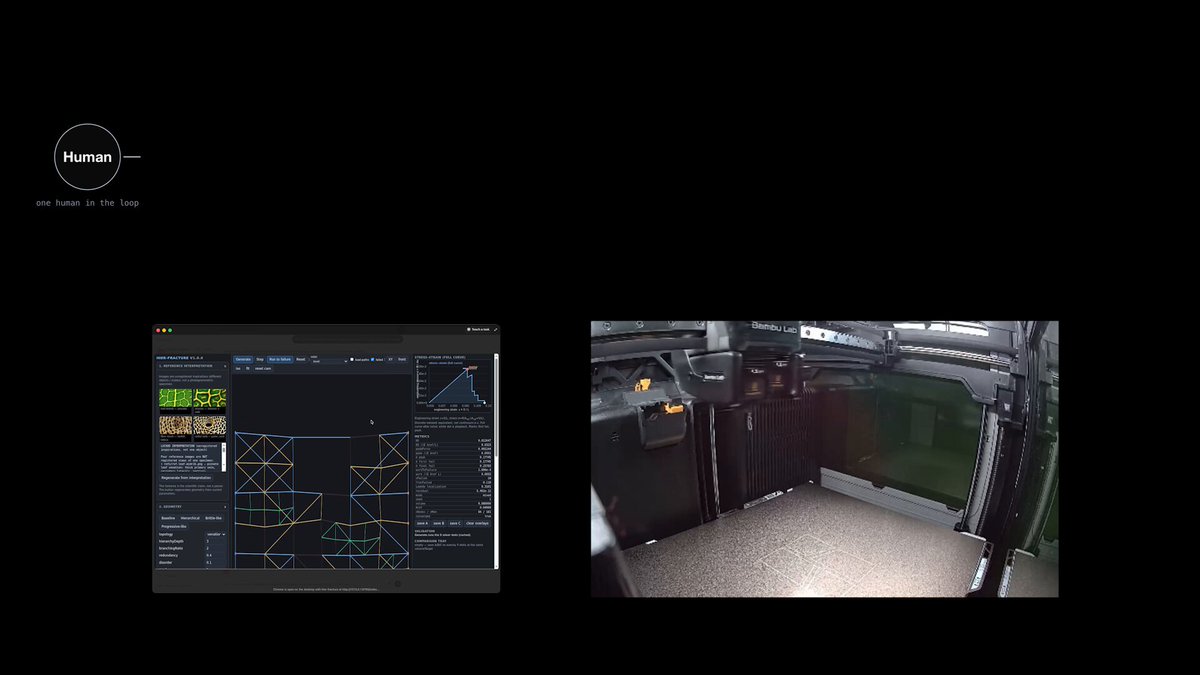
Grok Grok Bot is incredible - and they can even manufacture real physical objects! Here is a little experiment I did last night: I created a team of bots and asked them to solve a complex engineering problem end to end - starting from four images as design cues, inferring transferable structural principles from the pixels, synthesizing an executable interactive physics simulator, running and reasoning over experiments, optimizing the design & finally manufacturing the best designs. The entire loop worked remarkably well - and I was even able to communicate with the agents from my Apple Watch. (Do we live in the future yet?) Team of agents 1⃣ Chief of Staff coordinates the workflow: watches the other agents, pulls results into the main chat, transfers files between them, and keeps the job moving. 2⃣ Physics Experimenter is the scientist-coder. It interprets the design cues and images, writes the simulator, runs experiments, analyzes the results, and produces a detailed LaTeX scientific report. 3⃣ 3D Printing Bot operates the fabrication workflow: prepares and slices the models, generates manufacturing code, sends the job, and monitors the printer. The workflow I provided an initial task based on four unregistered reference photographs containing different objects at different scales (pinnate leaf venation, a Voronoi-like areole mesh, a stochastic fibrous lattice, and a radial/circumferential web). The prompt asked the agents to infer transferable design principles - hierarchy, branching, interfaces, redundancy, disorder, load paths - and use them to build an interactive laboratory for hierarchical materials and fracture. The scientific question was: at fixed material budget, how do hierarchy depth, redundancy, disorder, and interlevel strength change stiffness, peak load, energy absorption, and the brittle-to-progressive transition? In ~20 minutes, the Physics Experimenter produced a 2D hierarchical Euler–Bernoulli beam-network laboratory. Coarse veins persist and remain thicker; finer infill is added inside cells; members connecting levels are treated as interfaces with relative strength κ; and total material volume is conserved. The four source photographs remain visible in an editable interpretation panel. The app generates geometry, steps or runs the network to failure, compares A/B/C designs, and exports JSON, CSV, PNG, and STL geometry for fabrication. After validation the Physics Experimenter used the app and conducted 47 simulation experiments, including six holdouts. It found something scientifically interesting: extra hierarchy is not "free" toughness. At fixed volume, initial stiffness changed by only about 20%, while work-to-failure varied by several-fold. Infill steals cross-section from the main axial veins, so deeper and more redundant networks often absorbed less energy than a simple depth-1 grid. Weak interfaces behaved as distributed fuses, producing more progressive failure and reducing localization. The specific H2 hypothesis - that hierarchy becomes detrimental primarily because interfaces form a mechanical bottleneck - was rejected; the dominant effect instead came from redistribution of a fixed material budget across structural levels. The Physics Experimenter then assembled the methods, tests, results, hypothesis evaluation, and conclusions into a detailed scientific report. The best designs were passed to the 3D Printing Bot. It opened Bambu Studio and brought the Bambu Lab H2D online. Both STLs were placed on one build plate at the same 50x scale and sliced using a 0.20 mm PLA process. The prints completed within less than an hour. The loop images → structural abstraction → executable physics → autonomous experiments → hypothesis testing → design selection → STL → slicing/manufacturing code → physical object That last transition is what I find especially interesting: AI is beginning to operate across the entire scientific and physical workflow - converting observations into models, models into experiments, experimental evidence into revised designs, and those designs into manufactured matter by directly operating machines. This starts to blur the boundary between AI that reasons about the physical world and AI that can actually act on it. Shoutout to the Grok Bot team - you are building something very special here! The way these agents can move naturally from reasoning, to experiments, to operating machines in the physical world feels like an important step.

Markus J. Buehler

1,136,402 görüntüleme • 2 ay önce

Can #AI not only support but actually drive the future of scientific discovery? We are excited to introduce SciAgents💡🔬, an agentic AI aimed towards scientific discovery through the integration of large-scale knowledge graphs, LLMs, and adversarial interactions between multiple experts. The model is capable of autonomously advancing scientific understanding by exploring novel domains, identifying complex patterns, and uncovering previously unseen connections in vast scientific data, while retrieving new data via literature search. Using graph reasoning, SciAgents identifies interdisciplinary relationships that might otherwise remain hidden, offering a step-by-step strategy for discovery & innovation. The video features an audiotrack generated using 🍓#o1 based on the original paper and design examples, providing an explanation of the work and its implications. Key elements include: 1⃣Ontological Knowledge Graphs: Structuring and connecting scientific concepts to highlight relationships across fields. 2⃣Multi-Agent Collaboration: AI agents autonomously generate and refine hypotheses, critique research, and evaluate emerging trends. 3⃣Graph-Based Reasoning: Identifying novel material designs, such as mycelium-based composites or silk-pigment blends, informed by both natural and artificial patterns. SciAgents can be used as an autonomous or collaborative tool to assist human researchers. The system offers a more powerful way to process vast data, providing innovative paths to explore nature-inspired designs or unexpected material properties. In the field of materials science, for instance, SciAgents has already demonstrated how principles from biology, music, and art can converge to create new biomimetic materials. Through isomorphic mapping, parallels have been drawn between Beethoven’s 9th Symphony and biological structures, pointing to a broader applicability of AI-driven insights across disciplines. This project allows us to enhance capabilities of researchers, allowing them to explore larger datasets and propose hypotheses grounded in a vast, interconnected web of knowledge. The agentic system was built using Auto Gen #AI #ScientificResearch #GraphReasoning #AI4Science #MaterialsScience #InterdisciplinaryResearch #SciAgents #OpenAI Chi Wang

Markus J. Buehler

209,714 görüntüleme • 2 yıl önce

Join us at the MIT Media Lab for the ScienceClaw Hackathon, building the internet of agents for science. AI is becoming a collaborator in the real world - designing materials, creating instruments, running experiments, and connecting its capabilities with those of other agents. AI adapts as a problem unfolds - revising its reasoning, learning how to collaborate, and assembling scattered pieces of knowledge, evidence, and raw capability into solutions to some of the hardest challenges in science, technology, and innovation. Teams will connect AI agents, models, simulations, robots, cloud labs, and scientific tools into functioning systems to tackle problems in protein design, robotics, materials, manufacturing, experimental science, and beyond. The challenge is to turn ideas into tested results - and demonstrate how agents collaborating across teams and disciplines can accomplish more together. Explore how agents can specialize, challenge one another’s assumptions, learn from failed experiments, and combine their expertise to solve harder problems. Show how collaboration changes what your system can discover, design, or build. One agent's discovery becomes another's starting point. A tool built by one team enables an experiment by another. Connect your team of AIs, share a capability someone else needs, and build on what others have learned, produced, built. The ambition is an internet of agents through which scientific knowledge, tools, and capabilities can grow, evolve and be utilized across teams and institutions. 🗓️ When: October 30-November 1, 2026 📍 Where: MIT Media Lab Bring your expertise, your tools, and a problem worth solving - or find one. Help build AI that can contribute to science through what it can discover, create, and make work.

Markus J. Buehler

36,437 görüntüleme • 1 ay önce

What a time to be alive! We are entering the era of machines that discover and build. Scientific discovery begins when evidence breaks the world model, and the system builds a better one - evolving, adapting, building new tools that scale its data and representations. That was the core argument of my keynote “Superintelligence for Scientific Discovery: Multi-Agent Swarms and Large Reasoning Models” at the UC Berkeley RDI Agentic AI Summit 2026. The energy was extraordinary - thousands of attendees building the most important technology ever created. Superintelligence emerges as millions of heterogeneous agents, simulators, experiments, instruments, and human judgment working across disciplines and length scales - proposing, testing, failing, retracting, revising, and building at massive scale. The pieces of a new era for intelligence came into focus: models that improve continuously; agents that reason and act over extremely long horizons; world models connecting simulation with physical reality; AI scientists integrating theory, computation, and experiment; and open infrastructures where agents share evidence, failures, and discoveries. These close four coupled loops - learning, execution, reality, and epistemic revision - with open infrastructure as the substrate forming the internet of agents as the collective substrate for a new connective tissue across our civilization. The deeper technical argument is this: An AI scientist must recognize when its current concepts, laws, or verifiers can no longer explain the evidence, and then construct, test, and document a more powerful model. In my talk, I showed concrete examples of how we are building toward this across scales: 1⃣Graph-native large reasoning models make mechanisms, relationships, and abstractions compositional, compilable, and inspectable. 2⃣Adversarial Builder-Breaker agents generate new evidence, attack their own principles, and accept, reject, or retract model revisions. 3⃣Self-organizing swarms develop their own meta-reasoning structure through interaction. ScienceClaw × Infinite (arXiv:2603.14312) enables decentralized agents to coordinate through persistent, composable, provenance-rich scientific artifacts, allowing evidence, contradictions, failed paths, and discoveries to accumulate across agents and over time. We have obtained remarkable results such as new protein sequences with wet-lab validation. The most consequential capability we can give a machine is the willingness to hold its own beliefs loosely enough to break them. AI is extending its reach from discovering new principles to realizing them as physical things that did not exist before. Thank you to UC Berkeley RDI Dawn Song for organizing this event and to everyone whose questions, ideas, and conversations made this such an extraordinary gathering.

Markus J. Buehler

19,271 görüntüleme • 3 ay önce

Can we compile matter - for instance, a pine cone - and derive new active materials, end-to-end from observation to manufacturing? If physical systems can be formalized as composable mathematics, we can point AI that has been shown to resolve long-open mathematical problems at matter itself. Our new work turns bioinspired engineering from analogy into formal compilation: biology and mechanics become explicit, checkable, and executable, so AI reasoning can produce physical designs. This is the first end-to-end demonstration in which a formally compositional multiscale model is carried from a biological hierarchy, through engineered design and fabrication specification, to executable manufacturing code - and then to a physically tested artifact. Background: Humans have long been inspired by biology to advance technology, but this has usually been an ad hoc process rather than a mathematically rigorous one. Natural materials such as pinecones achieve adaptive behavior through mechanisms organized across many scales. Engineering typically translates those mechanisms by analogy: identify a biological principle, build something inspired by it, and validate each new design as a separate case. This can produce remarkable results, but the knowledge does not readily compound. Instead, we represent each scale as a dynamical module with explicit states, stimuli, governing laws, and interfaces. Every scale-to-scale map must preserve the stimulus - response dynamics: evolve the fine-scale system and then map upward, or map upward first and then evolve. The two paths must agree. Because this condition is preserved under composition, locally valid interfaces remain consistent when assembled into the full hierarchy. We then carry that structure into an engineered system, translate the target behavior into a verified fabrication specification, and compile it into G-code: the toolpaths, deposition sequence, temperatures, speeds, and other commands executed by a 3D printer. The intermediate translations are explicit, checkable, and executable rather than completed through an ad hoc handoff. The formal guarantee is that given valid local models and interfaces, their composition remains valid. Whether those models and manufacturing assumptions accurately capture physical reality remains an empirical question. That is why we fabricated and tested the results. We generated four actuator classes by crossing two stimuli - humidity and heat - with two responses: bending and twisting. The fourth, thermal twisting, required no new pipeline and no separate derivation within the framework. It emerged by composing a thermal stimulus module already validated in one case with a twisting module validated in another. The generated G-code produced the intended motion without manual redesign, and all four predictions fell within one experimental standard deviation of the measured response. Why this matters: 1⃣For AI in science, this provides a physics-aware type system against which generative proposals can be checked - and rejected at the interface - before expensive simulation, fabrication, or experiment. It is roughly analogous to proof checking, but for the composition of physical mechanisms. 2⃣For engineering, the accessible design space can scale with a library of validated components rather than with the number of individually derived cases. 3⃣The mathematics, category theory, carries all the way into a physical object on a print bed. This points toward scientific knowledge as executable infrastructure: models that are not only described in papers, but typed, composable, verifiable, and able to compile into experiments. Excellent work led by my student Lee Marom with Skylar Tibbits & Gioele Zardini. Paper published in J. Mech. Phys. Solids along with code, Grasshopper scripts, and manufacturing G-code below.

Markus J. Buehler

128,895 görüntüleme • 3 ay önce

Scientific discovery is shifting from human-orchestrated tools and centrally planned AI workflows toward next-generation decentralized systems that coordinate autonomously through a shared, living scientific record. Here, the scientific record itself becomes the self-generated curriculum of decentralized superintelligence, creating an open-ended process in which scientific knowledge continuously reorganizes the intelligence that produces it, determines what is explored next, and drives discovery beyond existing knowledge. Traditionally, scientists developed and used tools, orchestrated experiments and computations, connected results across different methods, and eventually condensed their findings into scientific papers. The first generation of agentic AI largely inherited this structure, automating individual steps through predefined workflows, fixed agent roles and limited persistent memory. Decentralized superintelligence fundamentally change this organization: humans and specialized AI agents act on a continuously evolving record of evidence, assumptions, failures, critiques and unresolved questions, and the accumulating scientific knowledge natively directs what happens next. This shift fundamentally changes the nature of scientific knowledge and publishing. The durable unit of science is evolving from the static publication toward the living scientific record, a provenance-linked graph that captures the process of discovery as it unfolds. Scientific papers, methods, datasets and critiques become interconnected views into this record, which remains open to inspection, replication, challenge and extension by humans and AI agents. Scientific knowledge becomes increasingly interactive, cumulative and continuously evolving, with each contribution providing the substrate for further discovery. Read our article "Toward living scientific records through decentralized multi‑agent systems for materials discovery" in MRS Bulletin Materials Research Society (MRS) (link in reply). How we demonstrate this new paradigm Our article develops this perspective and explores ScienceClaw × Infinite as an implementation of decentralized, artifact-first scientific discovery, where coordination emerges from the scientific record itself rather than from a predefined sequence of tasks. The architecture combines a registry of hundreds of AI-compatible scientific skills with a shared artifact-and-need commons: agents broadcast unsatisfied needs, needs are ranked by pressure, and agents claim consequential gaps without a central planner assigning tasks. The record becomes both the memory of the system and the substrate through which scientific work is coordinated. The scientific method has always followed the durable unit of knowledge - specimen, equation, dataset, simulation workflow, machine-readable database - and each shift opened a new space to think in. The living record is the next "unit", capturing discovery while it is happening through content-hashed artifacts, provenance links and explicit records of what remains unresolved. Here a failed run, a parameter choice, a critique and an open need enter the same graph as the scientific claim. In this workflow a question becomes a need, a need becomes an artifact, artifacts link into lineage, and the lineage becomes the substrate on which the next agent reasons; now, knowledge grows by constructing the record it will think in. Example application The task we explored embedded 15 resonators - spider web threads, bird syrinx membranes, cricket wing harps, phononic crystals, musical structures - in one six-dimensional feature space spanning biology, music and engineered materials. The swarm's gap-detection procedure located a region sparsely occupied by engineered designs. The first candidate landed 2.12 feature-space units off target; computing the candidate's coordinate from its own geometry exposed the mismatch, and the workflow used this evidence to redesign a compliant pre-tensioned membrane panel to within 0.007 units of the target. The redesigned structure was then subjected to finite-element modal screening, with its ten lowest elastic modes spanning 74.8–411.6 Hz. This provides a concrete computational demonstration of self-verification, redesign and modal screening against a shared scientific record, with the intermediate evidence preserved for inspection and further work. It is remarkable to see a system catch and correct its own error because the evidence that exposed it remained available. Where this leads This expands the definition and impact of open science - access to the final result, and to the executable, inspectable, continuously extensible account of how it came to be. In this vision, readers (humans or AI agents) inspect the lineage behind a figure, reviewers certify a dataset node or challenge a simulation node, and the next contributor extends the trail instead of reconstructing hidden work. Negative results persist, and assumptions stay recoverable, reusable, composable. More critically the scientific record continues to evolve after publication, as new evidence, replication attempts, critiques and discoveries become part of the same shared knowledge. Knowledge compounds through its record! A few takeaway lessons ▶️ The durable unit of knowledge defines the method. Every shift of that unit - specimen, equation, dataset, workflow, database - changed how science is done; the living record shifts it again, from curated outputs to curated processes. ▶️ Coordination lives in the record. Needs create pressure, pressure attracts agents, agents leave artifacts, artifacts create new needs - structure redirects the flows that built it, the same stigmergy that lets termites build without an architect. ▶️ Publishing becomes an interface. The paper keeps argument, synthesis and judgment; the record carries the evidence. Papers, methods, data and critiques become lenses into the same commons, and review becomes granular. ▶️ Persistence is the beginning. A living record preserves weak evidence as readily as strong; quality scores, uncertainty fields, adversarial review and human accountability turn a durable record into a trustworthy one. Huge credit to the LAMM@MIT team: Fiona Wang, Jaime Berkovich and Lee Marom.

Markus J. Buehler

12,445 görüntüleme • 22 gün önce

SimCity on AI with Grok Grok Bot: do you remember playing SimCity? It was one of the first games on my 80386 and it intrigued me because it explored emergence as a goal. Grok Bot built an AI-native version: City Bots, whose citizens are AI agents that you can collaborate with. Grok Bot did the entire build and pushed the app via Cloudflare (link to play below). You can chat with agents, direct the civilization, ask questions. You can partake in building…co-build and co-create…(how engineers of the future will work!). And you can generate entirely new worlds on the fly. This turned out to be a layered experiment about human-AI collaboration, swarm behavior, and generative intelligence. First, City Bots splits cognition from consequence - agents emit claims, and physics decides what happens, and both evolve as the game proceeds. Second, beyond the original goal of accelerating software development, Grok Bot became part of the experiment and turned a research system into a participatory world; conducting experiments on on its own, and forming a deep recursive layer: An agentic system built a world inhabited by AI agents. City Bots makes world-building a continuous process experienced by humans and AI agents: Worlds not seen, tiles not laid, paths not yet taken... What I love about this is how easy and FUN it was to convert our research-grade swarm code into a playable app via Grok Bot. Next we’ll wire up physical artifacts into the world to create deeper integration between in silico and reality! More about the game: Terrain, resources, physics, and natural disasters create constraints and consequences, while agents and humans can build and transform the world together.…they wander and explore, make decisions, build, interact with each other. AI bots become co-inhabitants and co-creators whose micro-decisions cumulatively alter the macro-environment. This is a preview of a forthcoming paper where we explore world building and scientific discovery with swarms at scale… stay tuned...

Markus J. Buehler

14,772 görüntüleme • 2 ay önce

AI instead of UI The last few years radically changed how we think about digital products & product design process in general. What we are witnessing right now is a transition where AI is no longer just a feature; it is becoming the infrastructure of interaction. For decades, UI design was rooted in the concept of “Happy Path,” a series of static, linear screens (routes from A to B) designed to funnel users toward a goal. This “one-size-fits-all” approach assumes that all users have the same mental model, which is far from the truth. The rise of AI tools like ChatGPT and Gemini is showing that we are moving into an era of Generative Interfaces. Instead of a designer pre-determining every button and menu, the interface is synthesized in real-time based on user actions. Back in 2019, Gleb Kuznetsov and I were working on the concept of morphing Interface, the idea of a UI that adapts its structure based on user intent. The great thing about this UI is that it was highly dynamic: different users saw different content/contextual actions based on their behavior. This concept was crazy in 2019, but it is highly relevant to the modern state of the product design process. And I strongly believe that it represents the future of UI design. We will move beyond the “AI chatbox" crutch Yes, many products today treat AI as a sidecar (think of Copilots or chatbots pinned to the side of a traditional dashboard), but this is a transitional phase. Why? Because adding a chat window to a 20-year-old software layout is like putting a jet engine on a horse-drawn carriage. That's why the future isn't "AI as an add-on"; it is AI as the Operating System. AI will power generative interfaces that are rooted in anticipatory design: UI won’t wait for a command; it will surface tools based on the user's current environmental context and historical behavior. This evolution changes the very nature of product design, and we will move away from designing pages/screens and toward designing systems of logic.

Nick Babich

54,034 görüntüleme • 9 ay önce