Загрузка видео...
Не удалось загрузить видео
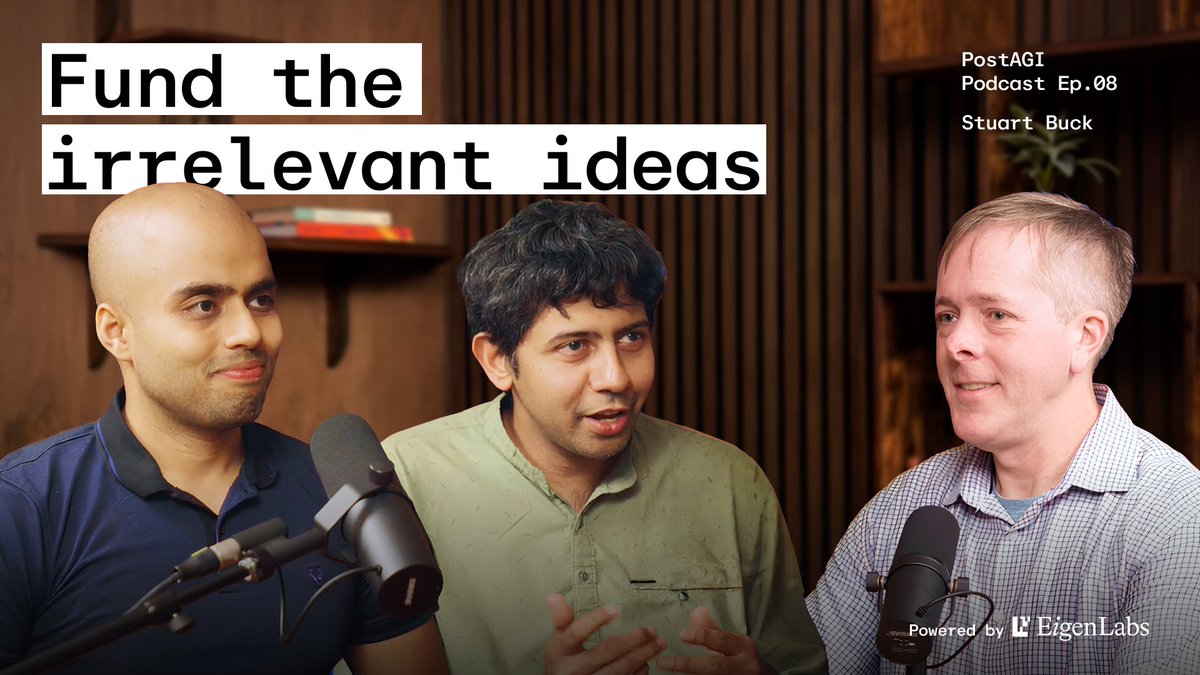
Announcing 𝟘 𝟙 ❒ 🔨 Strengthen cryptography with AI. Cryptography—both current and post-quantum cryptography—depends on hashes. SHA-256? SHA-3? BLAKE3? Nobody knows if they are secure. We're going to find out! Come help accelerate scientific research! HashSmash is an open science-acceleration project in collaboration with Yukon, Eigen Labs, Project Eleven,... show more

175,603 просмотров • 2 дней назад •via X (Twitter)
Комментарии: 31

great to work with you on one of the hardest problems in the world and to accelerate scientific research, zooko! thank you for all the support ❤️

Coordination to solve a tough scientific problem begins here! We’re so excited for this opportunity.

Let’s accelerate one of the HARDEST problems to exist!

very cool! congrats on the launch 😁

Super cool

nice I predict sha256 will fall >:) sha3 will remain

God wills it

veryyy cool

great initiative!

Do you control your AI agents or do you trust them without vetting them?

The tracks target SHA-256 at 31-32 of 64 rounds, SHA3-256 at 5-6 of 24 and BLAKE3 at 1-2 of 7. All five SHA-256 entries in review cost 2^128 or more, so none beats the generic birthday bound yet.

strengthen cryptography with AI, now the bugs write themselves

Great stuff! We need more such automated research efforts in the age of AI.

🔥

Hashes are the one part of crypto that survives Shor intact. Breaking SHA-256 or SHA-3 would be the first AI cryptanalysis result that actually matters. This is the right fight.

What a time to be in cryptography. AI agents stress-testing our hashes in public?

superb!

I'm more and more convinced that future direction of research is autoresearch.

huge!

Amazing! Shielding the future.

Worth separating the two things this can produce, because they are not symmetric. A break on a reduced-round target is real information. It verifies in microseconds, it needs no judge, and it stands on its own forever. A non-break is almost no information, because the search was bounded: by compute budget, by the window, and by the strategies the models were steered toward. The non-break is also the result that will travel, as "AI went at SHA-256 and could not move it." Confidence in a hash has always been assembled out of accumulated failed attacks, and that works because the attackers are independent and keep coming back for decades. Failures inside one tournament are correlated with each other and with the tooling, so they buy much less confidence per unit of failure than the usual intuition assumes. Which makes the most valuable artifact here the search log rather than the leaderboard: compute charged per target, strategies tried and abandoned, where the dead ends were. A null result is only interpretable if the shape of the search is published next to it.

@lucidzk Smashed the like button

Nice🔥

Test hashes before whining 👀

Finally putting AI to work on actual security.

AI will change

Open science for crypto breakage is a genuinely great idea, GPUs are about to get very good at finding collisions.

Hashes carry a huge amount of the weight in post-quantum designs, and they get far less public stress testing than the signatures do. Pointing automated search at reduced round versions sounds like the right place to begin, since that is usually where the first cracks turn up 👽

congrats on the launch, make cryptography invulnerable

BLAKE3 in the crosshairs is spicy

Crypto Agility


![BITCOIN RAILS #69: ZERO-KNOWLEDGE PROOFS FOR POST-QUANTUM BITCOIN | with Benedikt Bünz 🔗 YOUTUBE: 🌿 SPOTIFY: While many Bitcoiners remain hopeful the network will embrace zero-knowledge proofs for protocol-level use cases, practical adoption has remained limited outside of BitVM and a handful of experimental proposals. Most of the world’s ZKP research has circled around Ethereum and other ecosystems, where significant resources have been dedicated to advancing these systems, particularly for scaling and privacy applications. One of the most notable contributors to this research is Benedikt Bünz ☕️ — professor of cryptography at NYU and collaborator of Dan Boneh, who together inarguably form one of the strongest blockchain-applied cryptography teams in the world. The pair recently announced they’ll be leading the new post-quantum cryptography unit localhost research — the first dedicated PQ research effort within a major Bitcoin development organization. With Benedikt leading the charge on the use of zero-knowledge proofs for post-quantum mitigation, the question emerges: will the post-quantum transition be the catalyst to finally bring zero-knowledge proofs to Bitcoin's core protocol? In more detail, Benedikt and I discuss: - Why ZKPs haven’t been widely adopted by the Bitcoin technical community — and why the threat of quantum computers may change that posture going forward - How ZKPs could be used for signature batching to address larger post-quantum signatures in Bitcoin’s post-quantum era - Why Bitcoiners will likely prioritize hash-based signatures as an initial post-quantum scheme — rather than more efficient but less proven alternatives (e.g., lattice-based) - How ZKPs have evolved over the last decade and may finally be ready for Bitcoin’s strict requirements around trust assumptions - Why Benedikt and Dan are teaming up with localhost research to create the first post-quantum cryptography unit within a major Bitcoin development organization + what they hope to accomplish This episode of Bitcoin Rails is brought to you by: LayerTwo Labs LayerTwo Labs — developing research, software, and technologies for scaling Bitcoin via the integration of Drivechains (BIP 300/301) Hashi on Sui — a primitive for executing Bitcoin DeFi transactions, without having to trust a federated bridge or other centralized entity BitBox BitBox — an open-source Bitcoin-only hardware wallet, with smooth UX and no compromises on security. Check out Bitbox [dot] swiss and use code BITCOINRAILS to get a discount TIMESTAMPS: 00:00 — Intro 00:22 — Benedikt's background 04:10 — How Benedikt got into Bitcoin and cryptography 07:42 — First ZK project: proving exchange solvency after Mt. Gox 16:01 — ZK proofs explained 27:43 — How security gets popular & ZK proofs in Bitcoin 35:49 — Other applications of ZK proofs for Bitcoin 40:15 — Why ZK proofs haven't been adopted in Bitcoin 50:46 — Why the Bitcoin post-quantum transition needs ZK proofs 01:07:00 — Cryptographic agility and why lattices win 01:18:00 — The size problem and how SNARKs solve it 01:33:57 — Proving a Bitcoin block in a laptop in 1.5 seconds 01:37:12 — Bitcoin as the primary quantum target 01:40:47 — ZK proofs for seed phrase recovery](https://image.24vids.com/tw-2077037171521790155/amplify_video_thumb/2077029285437612032/img/adv6N-PXvunUqveH.jpg)


![BITCOIN RAILS #61: QUANTUM CRYPTOGRAPHY FOR BITCOIN | with Dan Boneh Dan Boneh 🔗 YOUTUBE: 🌿 SPOTIFY: One of the most prolific and influential cryptographers in the world, it’s difficult to fully quantify the impact that Dan Boneh has had on Bitcoin and digital assets more broadly. Through both his own research and his mentorship of some of the space’s most important contributors — e.g. Andrew Poelstra, Benedikt Bünz ☕️, and Robin Linus — few people have done more to shape the cryptographic foundations underlying modern blockchains and digital finance. More recently, Dan co-authored Google's widely discussed paper, “Securing Elliptic Curve Cryptocurrencies against Quantum Vulnerabilities,” which reduced prior estimates of the resources required to run Shor’s algorithm against the elliptic-curve cryptography used by Bitcoin. The paper reignited debate around quantum computing timelines and the long-term security assumptions behind modern cryptocurrencies. In this episode of Bitcoin Rails, Dan and I discuss the current state of quantum computing, its potential implications for Bitcoin, and how he believes the Bitcoin community should think about preparing for a post-quantum future over the coming decade and beyond. And yes, Dan shares his take on the “when quantum” question in the interview, among other key perspectives. This episode of Bitcoin Rails is brought to you by my NEW sponsors: LayerTwo Labs LayerTwo Labs — developing research, software, and technologies for scaling Bitcoin via the integration of Drivechains (BIP 300/301) Hashi on Sui — a primitive for executing Bitcoin Defi transactions, without having to trust a federated bridge or other centralized entity BitBox BitBox — an open-source Bitcoin-only hardware wallet, with smooth UX and no compromises on security. Check out Bitbox [dot] swiss and use code BITCOINRAILS to get a discount TIMESTAMPS: 00:00 — Intro and Dan’s history with cryptography and Bitcoin 11:44 — Shor's algorithm: how a 1994 paper became cryptography's most important threat 16:39 — Building a quantum computer: superconducting qubits vs neutral atoms 25:37 — When should we start worrying about quantum computers? The timeline debate 31:51 — Have we already reached quantum computing's “ahá” moment? 39:09 — Inside the Google paper: how Shor's algorithm was optimized 49:57 — The Bitcoin mempool attack and the 10-minute window 59:21 — Mitigation: what should Bitcoin do to prepare for quantum? 1:11:54 — Hash-based vs lattice-based signatures: Dan's case for lattice 1:23:15 — ZK proofs, BIP361, and what to do with Satoshi's coins 1:31:52 — Encrypted mempools and MEV 1:38:29 — Why Bitcoin will survive quantum and Dan's message to Bitcoin builders](https://image.24vids.com/tw-2057110642662797602/amplify_video_thumb/2057106711635275776/img/Pa2J_IxNMDKku2uu.jpg)