Video wird geladen...

Video konnte nicht geladen werden

Zur Startseite

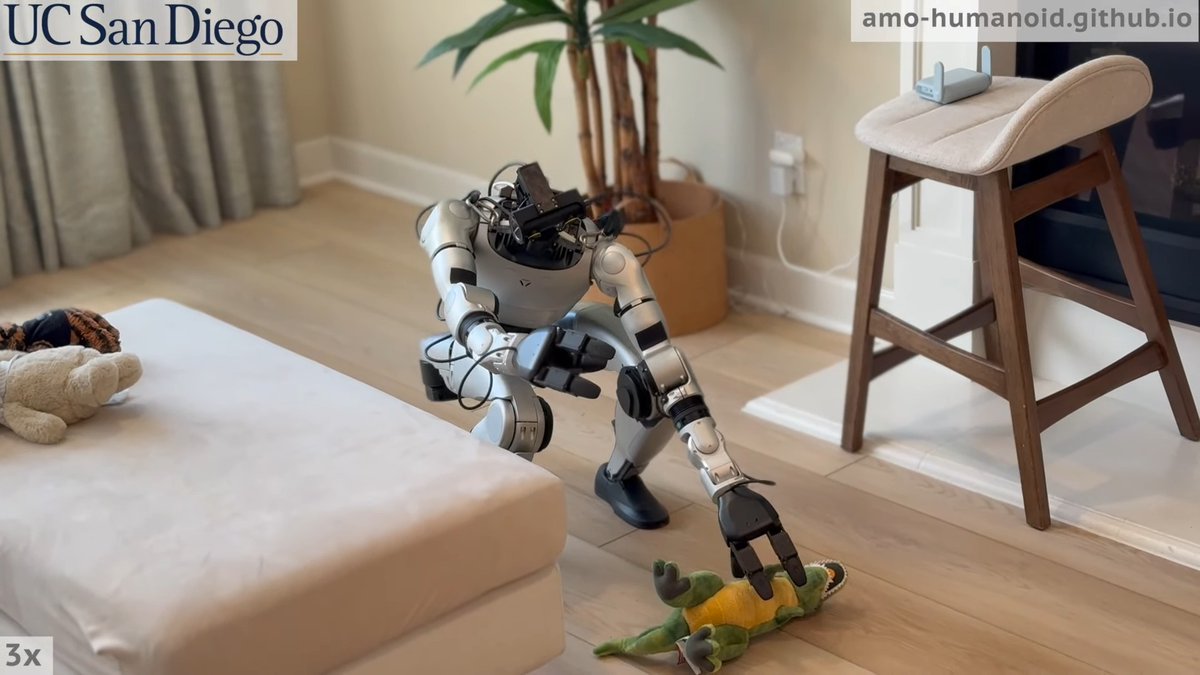
Boston Dynamics’ robot-behavior team lead highlights three core initiatives aimed at advancing Atlas’s dexterity: ⦿ Reinforcement learning in simulation ⦿ Whole-body teleoperation to collect data for imitation learning ⦿ Tactile sensing grippers
18,029 Aufrufe • vor 1 Jahr •via X (Twitter)

7 Kommentare

Profilbild von The Humanoid Hub
The Humanoid Hubvor 1 Jahr

Source:

Profilbild von Rainmaker
Rainmakervor 2 Jahren

💡 Learn how Reinforcement Learning can boost your trading performance! In this free Substack article I share full code of a trading algorithm based on Reinforcement Learning that beats other Machine Learning models as well as simply buying and holding the stock.

Profilbild von Phil Trubey
Phil Trubeyvor 1 Jahr

The biggest thing from vid was that automatic retry when initial attempt fails is an emergent behavior that comes with sim training at scale. Very very interesting. Bolsters Tesla approach building out their huge compute clusters and manufacturing a fleet for teleop training.

Profilbild von Judge DredD
Judge DredDvor 1 Jahr

Bad optimus copy

Profilbild von The Robot Services Exchange
The Robot Services Exchangevor 1 Jahr

solid

Profilbild von VentureMind AI
VentureMind AIvor 1 Jahr

Working together to build the future 🤝

Profilbild von MatRat21
MatRat21vor 1 Jahr

Hell yeah Atlas!

Ähnliche Videos

Today, we're joined by Nikita Rudin, co-founder and CEO of Flexion Robotics to discuss the gap between current robotic capabilities and what’s required to deploy fully autonomous robots in the real world. Nikita explains how reinforcement learning and simulation have driven rapid progress in robot locomotion—and why locomotion is still far from “solved.” We dig into the sim2real gap, and how adding visual inputs introduces noise and significantly complicates sim-to-real transfer. We also explore the debate between end-to-end models and modular approaches, and why separating locomotion, planning, and semantics remains a pragmatic approach today. Nikita also introduces the concept of "real-to-sim", which uses real-world data to refine simulation parameters for higher fidelity training, discusses how reinforcement learning, imitation learning, and teleoperation data are combined to train robust policies for both quadruped and humanoid robots, and introduces Flexion's hierarchical approach that utilizes pre-trained Vision-Language Models (VLMs) for high-level task orchestration with Vision-Language-Action (VLA) models and low-level whole-body trackers. Finally, Nikita shares the behind-the-scenes in humanoid robot demos, his take on reinforcement learning in simulation versus the real world, the nuances of reward tuning, and offers practical advice for researchers and practitioners looking to get started in robotics today. 🗒️ For the full list of resources for this episode, visit the show notes page: 📖 CHAPTERS =============================== 00:00 - Introduction 04:07 - Is robot locomotion solved? 06:04 - Sim-to-real gap 08:58 - Adding semantics to policies 09:42 - Modular vs end-to-end architectures 10:29 - Planner model 12:21 - Adapting RL techniques from quadrupeds to humanoids 15:39 - Behind robot demos 18:09 - Humanoid robots in home environments 22:03 - Training approach 23:56 - VLA models 27:59 - Closing the sim-to-real gap 32:55 - Task orchestration using VLMs 36:38 - Tool use 38:10 - Model hierarchy 43:37 - Simulator versus simulation environment 44:57 - Combining imitation learning and reinforcement learning 46:42 - RL in real world versus RL in simulation 52:58 - Reward tuning and value functions in robotics 56:38 - Predictions 1:00:10 - Humanoids, quadropeds, and wheeled platforms 1:02:45 - Advice, recommended robot kits, and community pla

The TWIML AI Podcast

22,264 Aufrufe • vor 6 Monaten

I was really impressed by the UMI gripper (Cheng Chi et al.), but a key limitation is that **force-related data wasn’t captured**: humans feel haptic feedback through the mechanical springs, but the robot couldn’t leverage that info, limiting the data’s value for fine-grained manipulation tasks. Led by my amazing students Yolanda Zhu and Binghao Huang, we designed a **portable visuo-tactile gripper** by integrating our dense, flexible tactile arrays with the UMI gripper to enable large-scale in-the-wild data collection. 🔗 We demonstrate **cross-modal representation learning** and **downstream policy learning** on tasks requiring in-hand state estimation (e.g., test tube reorientation) and fine-grained force sensing (e.g., pipette fluid transfer). Key takeaways: - Our flexible tactile arrays store the rich haptic information humans perceive as dense tactile signals. - Portability and robustness are key for in-the-wild data collection; our portable gripper is compact, lightweight, and durable. - Touch provides precise, robust measurements of in-hand object pose, invariant to lighting and viewpoint. - Cross-modal pretraining on large-scale in-the-wild data significantly improves policy robustness and sample efficiency (as shown many times before — and verified again here!). Also check out our previous investigations of dense, flexible tactile grids for understanding human-robot-environment interactions: - Dense tactile glove (Nature ’19): - 3D-ViTac (CoRL ’24):

Yunzhu Li

13,188 Aufrufe • vor 1 Jahr