正在加载视频...
视频加载失败
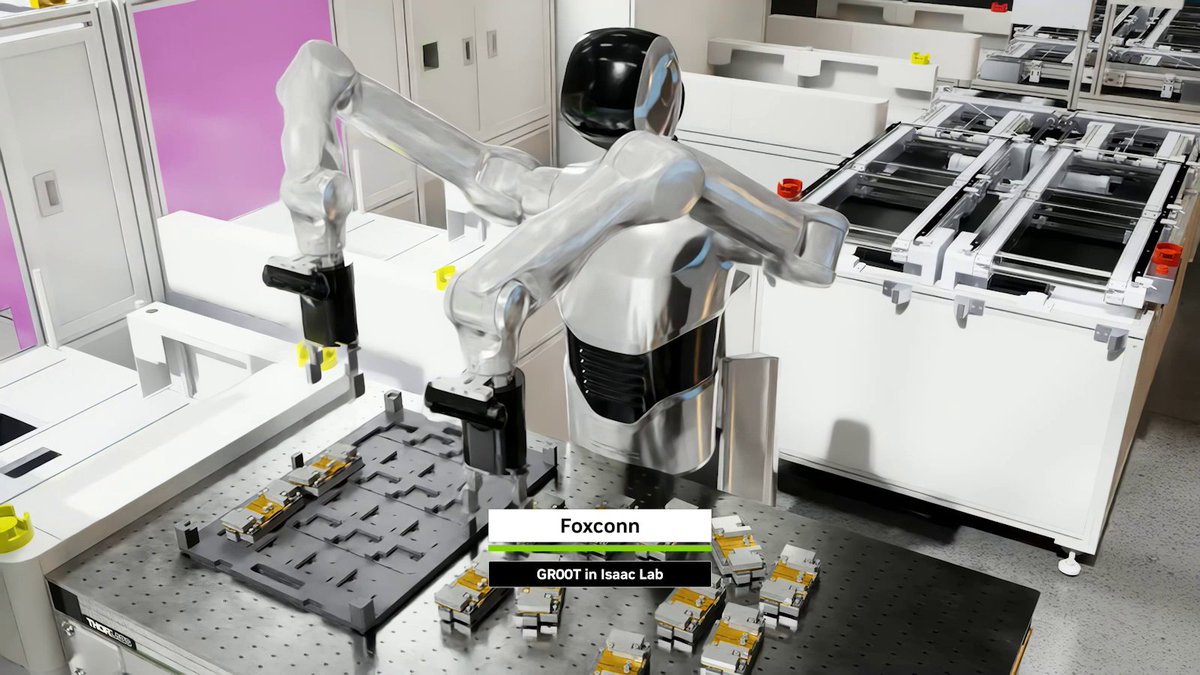
Real-world robot data is expensive and slow to collect, creating a major challenge for humanoid development. 🤖 The NVIDIA GR00T N1.6 open vision language action model is pre-trained on a diverse mix of data, including thousands of hours of Stanford Vision and Learning Lab’s BEHAVIOR simulation data, which covers... show more
13,535 次观看 • 8 个月前 •via X (Twitter)
6 条评论

Developers can download and experiment with a BEHAVIOR-1K–post-trained GR00T N1.6 model to achieve stronger performance on BEHAVIOR benchmark tasks. 👉

@StanfordSVL Would be nice if the Unitree G1 real-world policy deployment code is open sourced as well 😊

"Impressive progress in VLA, but we must ask. Are we just scaling 'Acquisition' or aiming for true 'Mastery'? Current data-heavy approaches are inevitably slow and costly. We need to move beyond brute-force learning towards a Hierarchical Interpretive Architecture. Instead of teaching a robot 1,000 ways to pick up an apple, we should equip it with a 'Constitutional Reasoning Engine' that interprets physical causality in real-time. The future of robotics isn't just about more data—it's about the hierarchy of interpretation."

@StanfordSVL the interesting question is how much domain randomization you need to make sim hours actually transfer. otherwise you're just training on fake data that doesn't generalize

@StanfordSVL

@StanfordSVL Simulated data is the scaffolding of modern robotics, but the real test is the transfer gap. GR00T’s scale is impressive, yet the subtle chaos of physical reality always finds holes in even the fattest datasets.