Video wird geladen...

Video konnte nicht geladen werden

Zur Startseite

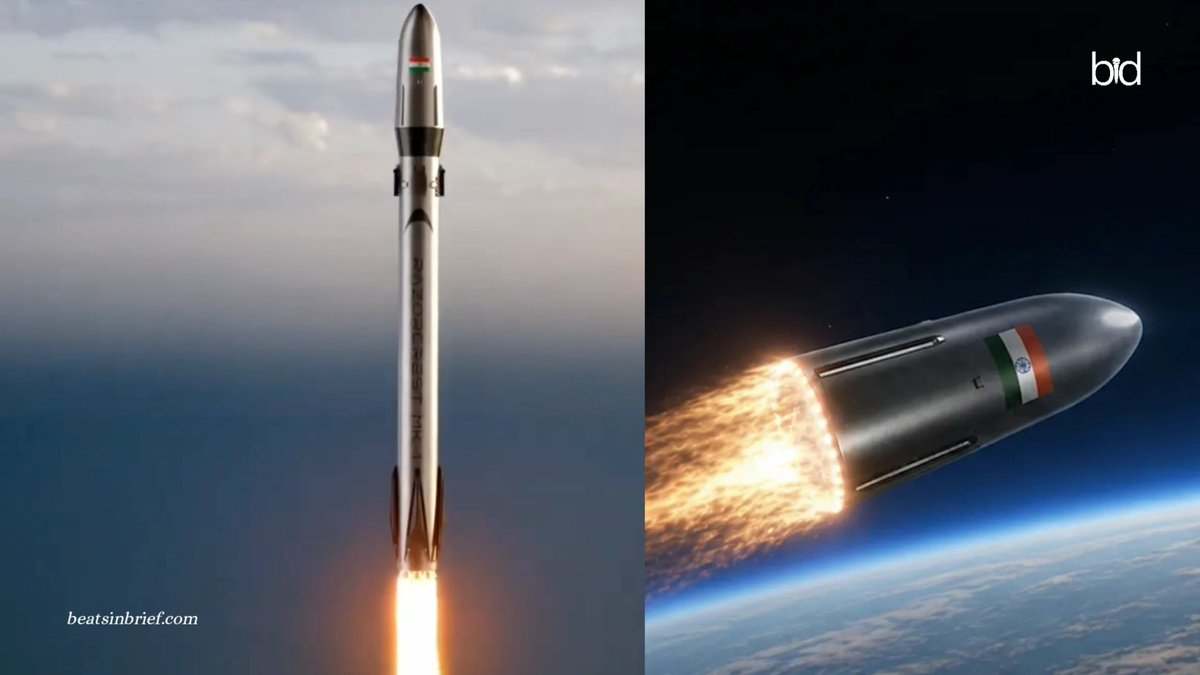
🚨 BREAKING: 🇮🇳 India’s first ‘SpaceX-level’ rocket engine unveiled by Bengaluru startup Bengaluru startup Astrobase Space has unveiled EVEREST, India’s first fully integrated 80-tonne (800 kN) full-flow staged combustion engine running on liquid oxygen and methane. In this rare design, every drop of fuel and oxidiser powers the pumps...

50,830 Aufrufe • vor 1 Monat •via X (Twitter)

11 Kommentare

Profilbild von आकाश 🚩ॐ 🇮🇳
आकाश 🚩ॐ 🇮🇳vor 1 Monat

Why EVEREST matters Most rockets are used once. EVEREST uses a full-flow staged combustion engine—one of the world's hardest rocket technologies making future rockets more efficient and reusable. If hotfire tests succeed, India joins an elite club building next-gen rocket engines

Profilbild von Sheavy
Sheavyvor 1 Monat

The headline is about a rocket engine. The bigger story is the manufacturing behind it. Designing, testing and building complex turbomachinery and 3D-printed engine components entirely in India is the kind of capability that quietly changes an ecosystem.

Profilbild von Blood Evolver
Blood Evolvervor 1 Monat

First build it then make it look cool 😎

Profilbild von Aditya 𝕏 🐦
Aditya 𝕏 🐦vor 1 Monat

@grok how it compares against SpaceX raptor engines?

Profilbild von Akshay B
Akshay Bvor 1 Monat

Wow!! What @isro has been struggling for so many years & still only 88% capacity achieved, these newcomers have achieved in their 1st shot. At 800KN, it’s equivalent of SpaceX’s Merlin engine used in Falcon9

Profilbild von karupaiahr
karupaiahrvor 1 Monat

👍🙏

Profilbild von Akshay Lingwal
Akshay Lingwalvor 1 Monat

The shift to Full-Flow Staged Combustion is the real technical hurdle here. Engineering turbopumps that can survive hot, high-pressure, oxygen-rich gas without melting is why only a handful of players globally have pulled it off at scale. Massive milestone for India’s private space sector. 🚀

Profilbild von Vivek Saxena
Vivek Saxenavor 1 Monat

Good but far from spaceX

Profilbild von Halal Hindu Akhilesh
Halal Hindu Akhileshvor 1 Monat

Wow 🔥🔥 @astrobase_space

Profilbild von Albish Daimari
Albish Daimarivor 1 Monat

Don't do it. What did you even mean by SpaceX level? Indian Engineers are doing great but iska matlab yeh nhi kuch v bol do. SpaceX has many Rocket Engines which one are you talking about? V1, V2, V3 which one?

Profilbild von Jayaram S
Jayaram Svor 1 Monat

@grok what technology does China and Japan’s reusable rocket engines under development use ?

Ähnliche Videos

Canada's first orbital-class rocket engine is now being manufactured! Our patent pending Hadfield-150 engine is the largest and most powerful rocket engine ever built in Canada, and the first known Canadian orbital-class engine to make it to this stage. The Hadfield-150 builds on everything we learned after years of painstakingly designing, manufacturing, and testing the Hadfield-10 series, our first regeneratively cooled and additively manufactured liquid rocket engine. Every engine test, both successful and unsuccessful on our Darkhorse test stand at Area 66, retired risk that's now carried straight into Hadfield-150 and sovereign orbital launch for Canada. A few details about the Hadfield-150 engine series: ✅ Designed to power Tundra and Tundra+, our light and medium-lift launch vehicles, and built to scale to Tempest, our larger reusable medium lift vehicle ✅ Manufactured entirely in-house, from design to print to test, for true sovereign launch capability ✅ Produced at Rocket Factory 1, on our expanding fleet of metal additive manufacturing systems at the AMA Lab, including the largest known metal 3D printer in Canada ✅ Designed for reusability and medium-lift scale from the outset, and built to significantly cut the time, infrastructure, manufacturing and cost iterative engine testing usually requires, with room to scale to even larger engines by leveraging the same design ✅ Capable of engine-out functionality, so losing one on an early flight doesn't have to mean losing the mission ✅ Optimized for Canada's Launch the North initiative, to deliver sovereign operational capability in a time and cost efficient manner Initial testing starts later this year at our new Blackhawk orbital engine test cell at Area 66, our private test range in Ontario. Stacked, integrated vehicle testing comes later at the Atlantic Spaceport Complex, our spaceport in Newfoundland and Labrador. Stay tuned for some exciting and fiery milestones ahead! 🚀🇨🇦 National Defence Defence Research and Development Canada Canadian Space Agency Transport Canada NGen Canada

NordSpace 🇨🇦

27,777 Aufrufe • vor 2 Monaten

Humbled to announce the successful firing of our single piece Agnite engine. Agnite engines power Agnibaan’s booster stage. These engine chambers are a full meter long, fully 3d printed as a single piece of hardware and made of Inconel. Agnite engines are driven by pumps that are controlled and operated by electric motors. Thanks to ISRO & IN-SPACe for their constant support and to IIT Madras for being our home turf from which this kind of technology is built. This Agnite engine was printed, depowdered and post processed in the same machines that we inaugurated as a part of our Large Format Additive Metal Manufacturing facility (LFAMM) towards the end of last year. This milestone is also significant for us because it completes one end-to-end cycle of design, manufacturing, assembly and testing of our larger engines, in-house. Amazing work by the team in pulling off a few world firsts here. - world’s first single piece engine of this size being fired - world’s largest inconel only engine - world’s only electric motor fed, semi cryo engine of this size and the list continues. However, this is not a race to be the world's first, it is a race to be the world's best & to be the world's most useful technology for launching small satellites to orbit. This comes right after firing a cluster of 3 semi cryogenic engines that happened last month. Honoured to be working with a team that truly believes in building world class, original space technology for the world, from India. Srinath Ravichandran MOIN SPM Satyanarayanan Chakravarthy IIT Madras IITMRP IIT Madras Incubation Cell Technology Development Board DSTIndia Anusandhan National Research Foundation TIDCO Startup India StartupTN Guidance Tamil Nadu Kerala Startup Mission ISRO IN-SPACe #agnibaan #agnite #singlepiecerocketEngine #3dprintedrocketengines #madeinIndiafortheworld #designedInIndiaFortheWorld #Agnikul

AgniKul Cosmos

64,829 Aufrufe • vor 6 Monaten

That’s a wrap! NordSpace has successfully completed an intense month long campaign to qualify and test the limits of our Hadfield Mk III liquid rocket engine - metal 3D printed, regen cooled, and Earth-shakingly powerful. Next up is our first flight, scheduled for this summer, which will make Canadian history as the nation’s first commercial launch from a commercial spaceport 🇨🇦 Assured access to space will completely reshape Canada’s sovereignty, security, and economy. NordSpace is working around the clock to ensure this future for our nation by building an end-to-end space missions company backed by a launch and propulsion architecture designed to be competitive in the modern launch era: ✅ Scalable to medium lift (~5 tonnes to orbit) to address the most profitable and critical commercial and defence markets ✅ Rapidly reusable to drastically reduce cost and increase launch cadence ✅ Highly portable for tactical responsive launch and low operational overhead Our Hadfield Mk III engine was our most successful iteration yet. We achieved many new feats: ➡️ 24-hour turnaround and rapid refurbishment of the engine after multiple tests, developing our pipeline for future rapid reusability ➡️ Perfect operation of our new Darkhorse engine test cell, built to support tests of our orbital Hadfield and Garneau engines and turbopump systems ➡️ Reduced time between engine tests to 20 minutes, allowing for countless back-to-back firings ➡️ Significant technology upgrades to boost personnel safety and efficiency including NordLink to allow for full automation and remote management of engine tests Stay tuned for some major updates about our launch, satellite, spaceport, and defence programs ranging from the Atlantic all the way to the Arctic!

NordSpace 🇨🇦

16,604 Aufrufe • vor 1 Jahr

Humbled to share that we successfully test fired 4 semi-cryogenic rocket engines simultaneously, as a cluster. All the 4 engines are 3d printed as single pieces of hardware - designed and manufactured in-house at AgniKul Cosmos Rocket Factory - 1. As with all our propulsion systems, these 4 engines are also powered by electric motor driven pumps. This test involved calibrating 8 pumps, 8 motors and tuning 8 speed control algorithms to work together in perfect sync to achieve uniform startup, steady state and shutdown performance across the entire system. As with the last cluster test, to the best of our knowledge, this is the first time such a test has been performed in India with semi cryogenic engines. We are extremely grateful to have the opportunity to be building world class, original space technology from India, for the world with the support of IIT Madras ISRO and IN-SPACe From here on, the addition of engines to our clusters will likely increase non-linearly. #Agnibaan #RocketEngineCluster #ElectricPumpFedEngines #Agnilet #SinglePieceEngine #3dprinting #RocketEngineTest #AdditiveManufacturing #Agnikul #AgnikulCosmos #StartupIndia #MakeinIndia #madeinIndiaForTheWorld Srinath Ravichandran MOIN SPM Satyanarayanan Chakravarthy IIT Madras IITMRP IIT Madras Incubation Cell Technology Development Board DSTIndia Anusandhan National Research Foundation TIDCO Startup India StartupTN Guidance Tamil Nadu Kerala Startup Mission SIPCOT

AgniKul Cosmos

119,806 Aufrufe • vor 4 Monaten

After years of development, testing and refinement, we are printing one of our last Hadfield-10 rocket engines, a bittersweet moment 🫡 More of our team is transitioning toward getting our much larger orbital-class Hadfield-100 engine ready for the test stand, and getting Canada to orbit for the first time with our Tundra rocket. The pressure-fed Hadfield-10 series has been the backbone of NordSpace's propulsion program since our earliest days. It's the engine that proved we could design, manufacture, test and fly liquid rocket engines from scratch, entirely in-house, at the pace necessary to reach orbit. It powered our first successful hot-fire tests, survived our most demanding qualification campaigns, and gave our team the hard-won knowledge that no textbook or simulation could provide. It also powers our Taiga sub-orbital vehicle, which is taking flight in a few weeks. Every experimental lesson learned in its development from combustion stability, regenerative cooling, additive manufacturing, and test operations lives on in what comes next. That knowledge now flows directly into our turbopump fed Hadfield-100 engine, the most powerful rocket engine in Canadian history. Designed to power our orbital Tundra rocket to deliver 500+ kg to LEO and scaling further to 1,100 kg LEO in the Tundra+ configuration. Architected from day one to grow to the thrust levels required for our reusable Titan medium-lift vehicle targeting 5,000+ kg to LEO while striking the right balance between performance, scalability, heritage, and speed of development to meet the Government of Canada's targets. The Hadfield-10's design will also form the foundation of our SHARP Sabre hypersonic rocket's M2S-HyRock engine. The full shift to the Hadfield-100 is a major milestone for us, and it's not just about more powerful engines. The infrastructure we're developing from moving to a much larger facility, acquiring much larger metal 3D printers, developing new test cells, and pursuing rigorous standards all feed in to this next phase of growth for our program. To everyone on the NordSpace team who designed, printed, tested, and refined these engines across so many late nights, early mornings and weekends, thank you. This chapter made everything that follows possible, and the next one starts now. Ad astra per aspera 🚀🇨🇦 National Defence Canadian Space Agency Defence Research and Development Canada Canadian Armed Forces Transport Canada

NordSpace 🇨🇦

42,533 Aufrufe • vor 6 Monaten

We’re proud to reveal our powerful new in-house 3D printed Hadfield Engine Mk III - 100% designed, manufactured, tested and flown in Canada by NordSpace. With this new version, we are bringing massive improvements to thrust and regenerative cooling as we prepare for our first flight this year and make Canadian history. Seeing this engine come to life after months of painstaking design, analysis, testing, and refinement was a breathtaking moment for the entire NordSpace team. This version of the Hadfield Engine also marks our first engine designed to transition NordSpace from pressure fed systems to turbo pump fed cycles (currently under active development) and very long duration burns. These would be massive leaps forward for Canada’s orbital space launch ambitions and sovereign assured access to space. Our team has developed unique mastery over metal 3D printing complex aerospace components to produce flawless prints like this engine with challenging internal geometries, angles, and features. As for next steps, this engine will be post processed, inspected, and heat treated all in-house, then shipped to our new Darkhorse propulsion test cell at our Canadian Space Research Range. Keep an eye out for some epic hotfire footage coming soon as we turn up the heat and accelerate our pace of development at NordSpace. We’re just getting started! We will have our three generations of the Hadfield Engine and more on display at the inaugural Canadian Space Launch Conference on April 29th in Ottawa. With only a week left to register, join nearly 200 people all playing a role to bring sovereign space launch capabilities to Canada

NordSpace 🇨🇦

19,655 Aufrufe • vor 1 Jahr

BREAKING: Inside Rocket Lab's ( $RKLB ) Engine Development Center How Archimedes & Rutherford are made FACTORY TOUR (Part III) Sir Peter Beck walks us through Rocket Lab's engine factory in Long Beach, CA. It used to be Sir Richard Branson's $1.2B Virgin Orbit's facility. When it went bankrupt, Rocket Lab bought the building & every machine in it for $16M against over $100M of assets. I asked if he keeps a list of which companies might d*e next.. he said yes. Roughly 10 people now run one of the largest 3D print shops in the industry, turning out a Rutherford engine every day and an Archimedes every 8 days. We cover: › Buying a competitor's factory for 16 cents on the dollar › Why space companies are almost impossible to k*ll › Why Archimedes was designed to be the most boring engine possible › Why it qualifies on 1 hour of runtime & Rutherford on 5 minutes › The hot fire that ate its own injector and kept running Plus: whether investors are any good at space diligence, methane vs kerosene & the soot problem, the machine arriving next year that prints a whole engine in one go, & Beck's hot take on where the industry actually is. Rocket Lab Week: › Part I: Full interview w/ Sir Peter Beck › Part II / Tour 01: Rocket Lab HQ, Mission Control & Satellite Manufacturing › Part III / Tour 02: Rocket Lab’s Engine Development Center, Rutherford & Archimedes 𝐓𝐈𝐌𝐄𝐒𝐓𝐀𝐌𝐏𝐒 (00:00) Sir Peter Beck, Founder & CEO at Rocket Lab (00:48) Buying a $100M building for $16M (02:30) Why Space companies never die (04:15) Where Rocket Lab's engines actually get built (06:55) Biggest differences: Archimedes & Rutherford (07:56) This is where Rocket Lab actually tests its Engines (10:01) How 12 lasers print a Rocket engine part (15:04) A full walkthrough of the Electron Rocket (16:29) Why Iridium was just the beginning (18:35) Methane vs. Kerosene: why it matters (19:28) Why Reusability creates its own set of problems (24:17) What makes a Vacuum Engine different (26:39) The future of Space

Molly O’Shea

445,911 Aufrufe • vor 27 Tagen

This is the most powerful commercial jet engine currently flying on an operational airliner. The GE90-115B was built by GE Aerospace specifically for the Boeing 777-300ER. It weighs around 8.3 tonnes, has a 3.25 metre wide fan and produces up to 512 kN (115,000 lbf) of thrust from a single engine. To understand the sheer scale of that output, it produces roughly 2.7 times the thrust of the F135 jet engine powering the F-35, the most powerful fighter engine currently in service. The enormous fan at the front uses just 22 carbon fibre composite blades with titanium leading edges. At maximum thrust, it pulls in roughly 1.4 tonnes of air every second, with nearly 90% bypassing the core rather than passing through the combustor. At around 150 knots during takeoff, its 512 kn of thrust corresponds to roughly 39.5 MW of propulsive power, or in automotive terms around 53,000 hp from one engine. And it burns roughly 4-5 kg of jet fuel every second at maximum power conditions. Two of these engines are enough to power a fully loaded 777-300ER weighing more than 350 tonnes. Even if one engine fails after the critical point during takeoff, the aircraft is certified to continue the takeoff and climb on the remaining one GE90 engine. Each engine costs around $35-40 million. More than 2,500, GE90s engines have been built, and the GE90 family has accumulated nearly 130 million flight hours. And this is precisely why companies like GE Aerospace remain so difficult to displace in jet engines. There is never one breakthrough. GE spent roughly $2+ billion developing the GE90, chasing small gains across hundreds of systems, efficiency, materials, reliability and component life.

Ammanichanda

53,005 Aufrufe • vor 27 Tagen