Video yükleniyor...

Video Yüklenemedi

Ana Sayfaya Dön

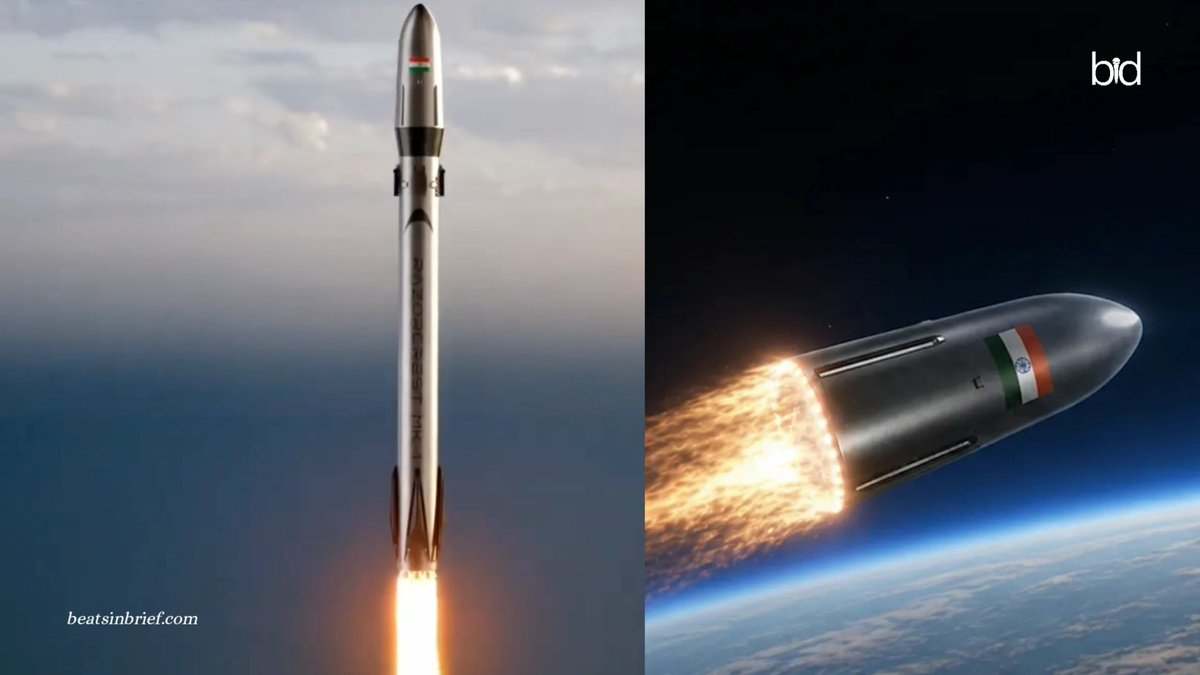
🚨 BREAKING: 🇮🇳 India’s first ‘SpaceX-level’ rocket engine unveiled by Bengaluru startup Bengaluru startup Astrobase Space has unveiled EVEREST, India’s first fully integrated 80-tonne (800 kN) full-flow staged combustion engine running on liquid oxygen and methane. In this rare design, every drop of fuel and oxidiser powers the pumps...

49,139 görüntüleme • 2 gün önce •via X (Twitter)

0 Yorum

Yorum bulunmuyor

Orijinal gönderinin yorumları burada görünecek

Benzer Videolar

Canada's first orbital-class rocket engine is now being manufactured! Our patent pending Hadfield-150 engine is the largest and most powerful rocket engine ever built in Canada, and the first known Canadian orbital-class engine to make it to this stage. The Hadfield-150 builds on everything we learned after years of painstakingly designing, manufacturing, and testing the Hadfield-10 series, our first regeneratively cooled and additively manufactured liquid rocket engine. Every engine test, both successful and unsuccessful on our Darkhorse test stand at Area 66, retired risk that's now carried straight into Hadfield-150 and sovereign orbital launch for Canada. A few details about the Hadfield-150 engine series: ✅ Designed to power Tundra and Tundra+, our light and medium-lift launch vehicles, and built to scale to Tempest, our larger reusable medium lift vehicle ✅ Manufactured entirely in-house, from design to print to test, for true sovereign launch capability ✅ Produced at Rocket Factory 1, on our expanding fleet of metal additive manufacturing systems at the AMA Lab, including the largest known metal 3D printer in Canada ✅ Designed for reusability and medium-lift scale from the outset, and built to significantly cut the time, infrastructure, manufacturing and cost iterative engine testing usually requires, with room to scale to even larger engines by leveraging the same design ✅ Capable of engine-out functionality, so losing one on an early flight doesn't have to mean losing the mission ✅ Optimized for Canada's Launch the North initiative, to deliver sovereign operational capability in a time and cost efficient manner Initial testing starts later this year at our new Blackhawk orbital engine test cell at Area 66, our private test range in Ontario. Stacked, integrated vehicle testing comes later at the Atlantic Spaceport Complex, our spaceport in Newfoundland and Labrador. Stay tuned for some exciting and fiery milestones ahead! 🚀🇨🇦 National Defence Defence Research and Development Canada Canadian Space Agency Transport Canada NGen Canada

NordSpace 🇨🇦

27,202 görüntüleme • 1 ay önce

Humbled to announce the successful firing of our single piece Agnite engine. Agnite engines power Agnibaan’s booster stage. These engine chambers are a full meter long, fully 3d printed as a single piece of hardware and made of Inconel. Agnite engines are driven by pumps that are controlled and operated by electric motors. Thanks to ISRO & IN-SPACe for their constant support and to IIT Madras for being our home turf from which this kind of technology is built. This Agnite engine was printed, depowdered and post processed in the same machines that we inaugurated as a part of our Large Format Additive Metal Manufacturing facility (LFAMM) towards the end of last year. This milestone is also significant for us because it completes one end-to-end cycle of design, manufacturing, assembly and testing of our larger engines, in-house. Amazing work by the team in pulling off a few world firsts here. - world’s first single piece engine of this size being fired - world’s largest inconel only engine - world’s only electric motor fed, semi cryo engine of this size and the list continues. However, this is not a race to be the world's first, it is a race to be the world's best & to be the world's most useful technology for launching small satellites to orbit. This comes right after firing a cluster of 3 semi cryogenic engines that happened last month. Honoured to be working with a team that truly believes in building world class, original space technology for the world, from India. Srinath Ravichandran MOIN SPM Satyanarayanan Chakravarthy IIT Madras IITMRP IIT Madras Incubation Cell Technology Development Board DSTIndia Anusandhan National Research Foundation TIDCO Startup India StartupTN Guidance Tamil Nadu Kerala Startup Mission ISRO IN-SPACe #agnibaan #agnite #singlepiecerocketEngine #3dprintedrocketengines #madeinIndiafortheworld #designedInIndiaFortheWorld #Agnikul

AgniKul Cosmos

64,829 görüntüleme • 4 ay önce

That’s a wrap! NordSpace has successfully completed an intense month long campaign to qualify and test the limits of our Hadfield Mk III liquid rocket engine - metal 3D printed, regen cooled, and Earth-shakingly powerful. Next up is our first flight, scheduled for this summer, which will make Canadian history as the nation’s first commercial launch from a commercial spaceport 🇨🇦 Assured access to space will completely reshape Canada’s sovereignty, security, and economy. NordSpace is working around the clock to ensure this future for our nation by building an end-to-end space missions company backed by a launch and propulsion architecture designed to be competitive in the modern launch era: ✅ Scalable to medium lift (~5 tonnes to orbit) to address the most profitable and critical commercial and defence markets ✅ Rapidly reusable to drastically reduce cost and increase launch cadence ✅ Highly portable for tactical responsive launch and low operational overhead Our Hadfield Mk III engine was our most successful iteration yet. We achieved many new feats: ➡️ 24-hour turnaround and rapid refurbishment of the engine after multiple tests, developing our pipeline for future rapid reusability ➡️ Perfect operation of our new Darkhorse engine test cell, built to support tests of our orbital Hadfield and Garneau engines and turbopump systems ➡️ Reduced time between engine tests to 20 minutes, allowing for countless back-to-back firings ➡️ Significant technology upgrades to boost personnel safety and efficiency including NordLink to allow for full automation and remote management of engine tests Stay tuned for some major updates about our launch, satellite, spaceport, and defence programs ranging from the Atlantic all the way to the Arctic!

NordSpace 🇨🇦

16,440 görüntüleme • 1 yıl önce

Humbled to share that we successfully test fired 4 semi-cryogenic rocket engines simultaneously, as a cluster. All the 4 engines are 3d printed as single pieces of hardware - designed and manufactured in-house at AgniKul Cosmos Rocket Factory - 1. As with all our propulsion systems, these 4 engines are also powered by electric motor driven pumps. This test involved calibrating 8 pumps, 8 motors and tuning 8 speed control algorithms to work together in perfect sync to achieve uniform startup, steady state and shutdown performance across the entire system. As with the last cluster test, to the best of our knowledge, this is the first time such a test has been performed in India with semi cryogenic engines. We are extremely grateful to have the opportunity to be building world class, original space technology from India, for the world with the support of IIT Madras ISRO and IN-SPACe From here on, the addition of engines to our clusters will likely increase non-linearly. #Agnibaan #RocketEngineCluster #ElectricPumpFedEngines #Agnilet #SinglePieceEngine #3dprinting #RocketEngineTest #AdditiveManufacturing #Agnikul #AgnikulCosmos #StartupIndia #MakeinIndia #madeinIndiaForTheWorld Srinath Ravichandran MOIN SPM Satyanarayanan Chakravarthy IIT Madras IITMRP IIT Madras Incubation Cell Technology Development Board DSTIndia Anusandhan National Research Foundation TIDCO Startup India StartupTN Guidance Tamil Nadu Kerala Startup Mission SIPCOT

AgniKul Cosmos

118,928 görüntüleme • 2 ay önce

After years of development, testing and refinement, we are printing one of our last Hadfield-10 rocket engines, a bittersweet moment 🫡 More of our team is transitioning toward getting our much larger orbital-class Hadfield-100 engine ready for the test stand, and getting Canada to orbit for the first time with our Tundra rocket. The pressure-fed Hadfield-10 series has been the backbone of NordSpace's propulsion program since our earliest days. It's the engine that proved we could design, manufacture, test and fly liquid rocket engines from scratch, entirely in-house, at the pace necessary to reach orbit. It powered our first successful hot-fire tests, survived our most demanding qualification campaigns, and gave our team the hard-won knowledge that no textbook or simulation could provide. It also powers our Taiga sub-orbital vehicle, which is taking flight in a few weeks. Every experimental lesson learned in its development from combustion stability, regenerative cooling, additive manufacturing, and test operations lives on in what comes next. That knowledge now flows directly into our turbopump fed Hadfield-100 engine, the most powerful rocket engine in Canadian history. Designed to power our orbital Tundra rocket to deliver 500+ kg to LEO and scaling further to 1,100 kg LEO in the Tundra+ configuration. Architected from day one to grow to the thrust levels required for our reusable Titan medium-lift vehicle targeting 5,000+ kg to LEO while striking the right balance between performance, scalability, heritage, and speed of development to meet the Government of Canada's targets. The Hadfield-10's design will also form the foundation of our SHARP Sabre hypersonic rocket's M2S-HyRock engine. The full shift to the Hadfield-100 is a major milestone for us, and it's not just about more powerful engines. The infrastructure we're developing from moving to a much larger facility, acquiring much larger metal 3D printers, developing new test cells, and pursuing rigorous standards all feed in to this next phase of growth for our program. To everyone on the NordSpace team who designed, printed, tested, and refined these engines across so many late nights, early mornings and weekends, thank you. This chapter made everything that follows possible, and the next one starts now. Ad astra per aspera 🚀🇨🇦 National Defence Canadian Space Agency Defence Research and Development Canada Canadian Armed Forces Transport Canada

NordSpace 🇨🇦

42,533 görüntüleme • 5 ay önce

We’re proud to reveal our powerful new in-house 3D printed Hadfield Engine Mk III - 100% designed, manufactured, tested and flown in Canada by NordSpace. With this new version, we are bringing massive improvements to thrust and regenerative cooling as we prepare for our first flight this year and make Canadian history. Seeing this engine come to life after months of painstaking design, analysis, testing, and refinement was a breathtaking moment for the entire NordSpace team. This version of the Hadfield Engine also marks our first engine designed to transition NordSpace from pressure fed systems to turbo pump fed cycles (currently under active development) and very long duration burns. These would be massive leaps forward for Canada’s orbital space launch ambitions and sovereign assured access to space. Our team has developed unique mastery over metal 3D printing complex aerospace components to produce flawless prints like this engine with challenging internal geometries, angles, and features. As for next steps, this engine will be post processed, inspected, and heat treated all in-house, then shipped to our new Darkhorse propulsion test cell at our Canadian Space Research Range. Keep an eye out for some epic hotfire footage coming soon as we turn up the heat and accelerate our pace of development at NordSpace. We’re just getting started! We will have our three generations of the Hadfield Engine and more on display at the inaugural Canadian Space Launch Conference on April 29th in Ottawa. With only a week left to register, join nearly 200 people all playing a role to bring sovereign space launch capabilities to Canada

NordSpace 🇨🇦

19,655 görüntüleme • 1 yıl önce

Success! 🚀 🇨🇦 At 3:45 PM EDT on Friday May 16th, 2025, we successfully tested both our new orbital Darkhorse engine test cell and our new third generation 3D printed Hadfield liquid rocket engine for the first time, marking a significant step towards Canada’s first commercial space launch. The test ran for 7 seconds at our propulsion test range, a company-owned secure site in Northeastern Ontario, successfully delivering nominal thrust, active cooling, and impulse results. This major test of the Darkhorse test cell and Hadfield Mk III engine lays the groundwork for NordSpace's Tundra orbital rocket, as the test cell is specifically designed to integrate with our turbo pump assembly in the next phase of propulsion development. Long duration tests are scheduled for the coming days, along with refinements to fuel mixture ratios and higher-pressure scenarios to test the limits of Darkhorse and our new engines. Minor upgrades and fixes to address a harmless leak in the cryogenic liquid oxygen line and design changes to our experimental control rods have already been made. Hot on the heels of our successful integrated test of our Taiga sub-orbital launch vehicle back in January, rapid developments and approvals at our spaceport in Newfoundland and Labrador, announcement of the SHARP (Supersonics and Hypersonics Applications Research Program), hosting the inaugural Canadian Space Launch Conference in Ottawa, and more - NordSpace is strengthening its position every day to ensure sovereign space launch is not just possible, but probable for Canada. Our historic first experimental flight is scheduled for 2025 from our spaceport, Spaceport Canada. NordSpace's CEO and founder, Rahul Goel, said “This successful test is not only a testament to NordSpace’s unmatched technical competency, but also to the success of our new project management framework, design philosophy, and engineering mindset used to deliver results for complex projects on time and within budget. Success on the first try with countless potential sources of failure is not common in the development of complex rocket systems, but our team succeeded by prioritizing first principles engineering. This test confirmed that we do have the right stuff, and that we will deliver this incredibly important sovereign launch capability for all Canadians. Like the land, air, and sea, space is no longer some final frontier for Canada. Space is an essential domain we must unlock, and launch a capability we must own. Without it, we are jeopardizing not only our security, sovereignty and economy, but are also relegating Canada to a participatory instead of a leadership role on the world stage. We must not let this happen.”

NordSpace 🇨🇦

50,877 görüntüleme • 1 yıl önce

For years, NordSpace has been building towards one goal: launching Canadian payloads on Canadian rockets from Canadian soil in a way that’s technologically scalable and commercially sustainable through painstaking vertical integration. Today, that vision is rapidly taking shape and we are pleased to share this inspiring video preview of what Canada’s historic first sovereign orbital space launch will look like. Enjoy! Tundra is NordSpace’s domestically designed, built, and operated light-lift responsive orbital rocket. It can carry up to 1,100 kg fully optimized to Low Earth Orbit (LEO) powered by our proprietary Hadfield rocket engines that are 3D-printed, regeneratively cooled, and pump fed representing the most powerful orbital-class propulsion system in Canada. The modular architecture means the same engine powers both the multi-engine first stage and the vacuum-optimized second stage, reducing complexity while creating a direct scaling path toward our future reusable Titan medium-lift vehicle, capable of 5,000+ kg to LEO. The Atlantic Spaceport Complex (ASX), under construction in Newfoundland and Labrador, is positioned at 46 degrees latitude providing launch access to polar, sun-synchronous, and mid-inclination orbits with the widest range of nominal launch inclinations of any Canadian spaceport. It’s the only fully Canadian-owned and purpose-built commercial orbital launch facility in the country with the highest approved launch cadence and safety distances allowing us to maximize the efficiency, reliability, scalability, and unit economics of our entire launch program. What distinguishes NordSpace is our commitment to vertical integration and first principles approach to business and technology. Rockets, spaceport, and spacecraft are all designed, manufactured, and operated in Canada by one streamlined team. We have already demonstrated flight-ready propulsion, completed integrated rocket tests, and have our first pathfinder satellite, Terra Nova, manifested for launch in 2026 with our edge-AI imaging payload (Chronos) for space domain awareness nd our electric propulsion system (Zephyr-EP). With recently announced $8.3 million in Phase 1 federal funding through the Department of National Defence’s Launch the North initiative, NordSpace is targeting Initial Operational Capability by 2028. Canada is about to become a true spacefaring nation, and our future on Earth and in space will never be the same. Let’s give’r! 🇨🇦🚀 National Defence Defence Research and Development Canada Canadian Space Agency

NordSpace 🇨🇦

15,258 görüntüleme • 4 ay önce

Bharat Innovates 2026 showcases Green Aero Propulsion Pvt. Ltd., a pioneering deep-tech startup transforming the future of aerospace through sustainable propulsion technologies. Incubated at IIT Delhi, the company is developing next-generation hydrogen-powered and multi-fuel aero engines aimed at decarbonizing aviation and reducing dependence on fossil fuels. With a strong focus on indigenous innovation, Green Aero is building high efficiency propulsion systems for both civilian and defence applications, including drones, aircraft, and advanced mobility platforms. Green Aero Propulsion Pvt. Ltd is also part of an elite group of deep-tech startups selected for the prestigious Bharat Innovates 2026 program by the Ministry of Education, Government of India, to be showcased from 14–16 June 2026 in Nice, France. With breakthrough milestones such as the successful test-firing of India’s hydrogen powered aero engine core, the startup is positioning itself at the forefront of clean aviation technology. By combining fuel flexibility, advanced turbine design, and waste-heat recovery systems, Green Aero is enabling more efficient and environmentally friendly flight solutions. As part of Bharat Innovates 2026, the startup represents India’s growing leadership in deep-tech and sustainable aerospace innovation driving a greener and self-reliant future. Narendra Modi PMO India Ministry of Education Dharmendra Pradhan Principal Scientific Adviser, Govt. of India Vineet Joshi Sanjay Kumar DSTIndia AICTE UGC Payscale PIBIndia DD News All India Radio News Office of Dr. S. Jaishankar Chaitanya K Prasad Ministry of External Affairs Bharat India in Portugal India in France Consulate General of India, Marseille India in Germany India in Ireland (Embassy of India, Dublin) India in the UK IIT Bombay SINE IITB Pan IIT Alumni India #BharatInnovates2026 #DeepTechIndia #CleanEnergy #SustainableAviation #madeinindia

Bharat Innovates 2026

84,434 görüntüleme • 3 ay önce

French beauty 1939 Delahaye Type 165 Cabriolet Coachwork by Figoni & Falaschi - Delahaye only built six 12-cylinder Type 165 models in the late 1930s, as production variants of the successful Type 145 competition car. This stunning Figoni et Falaschi-bodied cabriolet was built to represent France at the 1939 New York World’s Fair, an exposition promoted with the slogan “Dawn of a New Day”. While the engine was not completed in time for its display, the modernity and sublime beauty of this car’s flowing styling drew throngs of admirers from the press and public alike. Emile Delahaye was born in Tours, France in 1843. He studied engineering in Angers, France. In 1869 he began work with his engineering degree in applied arts and crafts. Emile Delahaye began business in Tours, France in the middle of 19th Century for the purpose of constructing engines for the ceramic industry. The company branched out and began constructing mechanical appliances such as pumps and engines. In 1888, Delahaye designed an internal combustion engine for the shipping industry. It was not until 1896 that Automobile production began for Delahaye. His first automobiles produced were powered by belt-driven single and twin cylinder engines. Emile used motor racing to promote his vehicles. In 1896, Emile Delahaye entered the Paris-Marseilles race. Not only did he enter a vehicle his company had created, but he entered as the driver. The results were astounding, which truly speaks highly of the caliber and quality of the automobile. The demand for the vehicles began pouring-in and a second factory was opened. After the racing success of its Type 145, Delahaye created the production version, the 12-cylinder Type 165. Two Type 165s were built, and the first was shown in October 1939 at the Paris Auto Salon, the last salon before the war. The second 165 – this cabriolet, with body by Figoni and Falaschi, was so emblematic of 1930s French design that it represented the nation at the 1939 New York World’s Fair. Shipped without an engine because it could not be built in time for the show, an engine sheel, without internals was used instead. The engine-less body was impounded by US Customs when Europe became embroiled in WWII. With Europe engulfed by war by the World’s Fair’s close in 1940, the U.S. Custom’s impounded the Delahaye in New York for the duration of the conflicts. In 1946 Beverly Hills car dealer Roger Barlow purchased the car at public auction, and later that year the Type 165 was fitted with a tuned Cadillac engine. Following his death, it was abandoned by his widow in the 1970s and sold to a tow-truck driver for $1200. After three decades of trading hands at a public auction and receiving a Cadillac engine, it eventually wound up at a used car lot in Honolulu until it was bought by a US military serviceman. It took four years of negotiation, but Peter Mullin and Jim Hull eventually purchased the car in 1985 and spearheaded its restoration. The original engine sheel was tracked back to Count Hubertus von Doenhoff and bought. New engine internals were created from original drawings to finally give the 165 the fully-working engine it was intended to have. This car is now owned by Peter and Merle Mullin and the Peter Mullin Automotive Museum Foundation, where is its displayed in Oxnard, California. © Cars & Motorbikes Stars of the Golden Era #archaeohistories

Archaeo - Histories

17,557 görüntüleme • 1 ay önce