Video yükleniyor...

Video Yüklenemedi

Ana Sayfaya Dön

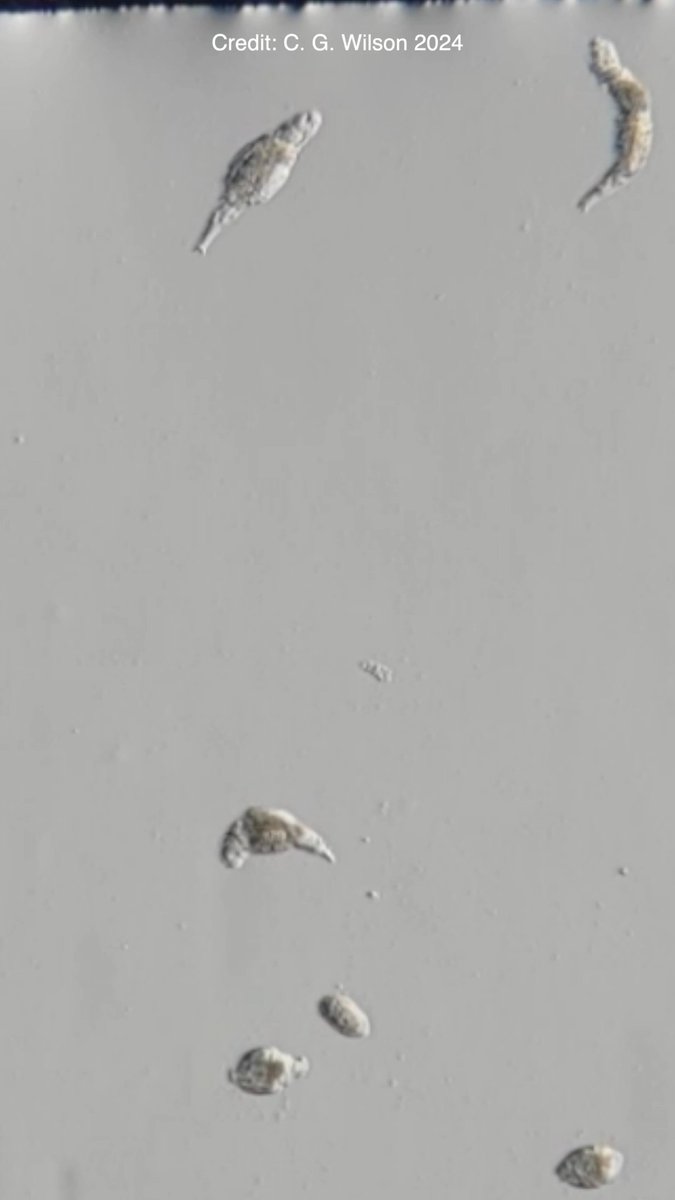
Cable bacteria are long, "filamentous bacteria that conduct electrons via internal wires." New study: Anaerobes — in lakes and ponds — swarm around these cable bacteria & give electrons for respiration. Cut the cable, lose the microbes. Beautiful. 📽️
33,749 görüntüleme • 3 yıl önce •via X (Twitter)

0 Yorum

Yorum bulunmuyor

Orijinal gönderinin yorumları burada görünecek
Benzer Videolar

There's a bacteriophage that turns bacteria into “liquid crystals.” Specifically, Pseudomonas aeruginosa bacteria make Pf phages, which are rod-shaped, negatively-charged, and measure about 2 micrometers in length (roughly the length of an E. coli cell). These phages leave the cells and enter their surroundings. There, they mix with polymers, also secreted by the cells, to form a crystalline matrix. Surprisingly, this is good for the cells. Although the phages kill some of them, it also makes their biofilms stickier and able to withstand certain antibiotics. These bacteria + phages are prevalent in cystic fibrosis patients; they've formed a sort of symbiotic relationship. The Pf phages are made from thousands of repeating copies of a coat protein, called CoaB, which wraps around a single-stranded, circular DNA genome. These genes are integrated directly on the bacterial chromosome. The bacteria “turn on” these phage genes when placed in a viscous environment with low oxygen levels. This is like a trigger to start forming a biofilm. And the cells make a lot of phages; about 100 billion per milliliter. These liquid crystals form because of a physics principle called “depletion attraction.” If you just mix a bunch of loose or flexible polymers together (such as long carbon chains) they will not form a liquid crystal. But if you mix stiff rods (the phages) with loose polymers at a high enough concentration, the polymers will force the phages close together to create a material that flows like a liquid despite being ordered like a crystal. See the video below. These liquid crystal biofilms are hard to get rid of. The negatively-charged phages block many antibiotics (like aminoglycosides, which are positively-charged) from entering cells. Liquid crystals also retain water, so these biofilms can survive on drier surfaces. I first heard about this from Malmesbury’s excellent newsletter, called “Telescopic Turnip.”

Niko McCarty.

50,095 görüntüleme • 7 ay önce

🚨 SCIENTISTS MAY HAVE FOUND A NEW WAY TO KILL DRUG-RESISTANT BACTERIA. And it doesn't rely on traditional antibiotics. Researchers repurposed a ruthenium-based anticancer drug and activated it using ultrasound deep inside infected tissue. Why this matters: • Antibiotic resistance is one of the fastest-growing threats to global health • Drug-resistant infections could kill more people than cancer by 2050 • Many antibiotics are losing effectiveness • Deep-tissue infections are difficult to target safely • Bacteria continue evolving resistance to conventional treatments The breakthrough: Scientists used a compound called TLD1433, originally developed for cancer therapy. By itself, the drug is largely inactive. But when exposed to focused ultrasound... it generates highly reactive oxygen molecules that attack bacterial DNA and destroy protective biofilms. Unlike antibiotics, the treatment doesn't target a single bacterial pathway. Instead, it creates widespread oxidative damage that bacteria struggle to evolve resistance against. The results were remarkable: • Outperformed conventional antibiotics in laboratory tests • Reduced survival of pneumonia-causing bacteria to just 14% • Broke down oxygen-starved bacterial biofilms • In animal studies, every treated mouse survived • Only 25% of untreated controls survived The deeper implication is enormous: For decades we've searched for new antibiotics. But the future may not be finding stronger drugs. It may be activating existing drugs only where they're needed. By combining chemistry with precisely targeted ultrasound... scientists could attack dangerous infections deep inside the body while minimizing damage to healthy tissue. The real question is: Could sound become one of medicine's most powerful weapons against antibiotic resistance? Follow for more frontier science and technology discoveries.

TheNewPhysics

10,651 görüntüleme • 2 ay önce

🚨 SCIENTISTS JUST DISCOVERED THAT BACTERIA HAVE BEEN USING A QUANTUM ENERGY TRICK FOR BILLIONS OF YEARS. In a breakthrough published in Nature Chemistry, researchers from the University of Sheffield (working with IBM and international collaborators) have shown that purple photosynthetic bacteria (Rhodobacter sphaeroides) use singlet fission (SF) as a functional mechanism to enhance light harvesting. When carotenoids absorb blue-green light (via their S₂ state), the energy rapidly undergoes heterofission: the singlet exciton splits into a pair of triplet excitons shared between a carotenoid and its neighboring bacteriochlorophyll (BChl) a molecule. These triplet pairs are long-lived and weakly coupled. They then recombine via triplet-triplet annihilation (TTA), efficiently populating the BChl a Qy singlet state which then transfers energy to the reaction center. This SF-mediated pathway contributes up to ~18% of total carotenoid-to-BChl energy transfer in some complexes and introduces a temporal “buffering” effect, staggering energy arrival at the reaction center. Why this matters: • It is the clearest demonstration yet that singlet fission plays a genuine, functional role in natural photosynthesis • The heterofission mechanism (triplets on adjacent Crt and BChl molecules) explains how bacteria achieve ultrafast SF while maintaining long-lived, harvestable triplet pairs • This pathway helps organisms make better use of blue-green light and may protect the reaction center during fluctuating light conditions The deeper implication: Nature has evolved a sophisticated way to temporarily store and then cooperatively release electronic energy using spin-protected triplet states. This biological strategy offers new inspiration for designing artificial light-harvesting and energy-conversion systems that can buffer and regulate energy flow something synthetic SF materials have struggled to achieve. We are learning that evolution solved some of the hardest problems in photophysics long before we started trying. How might understanding biological singlet fission change the way we design future solar energy or quantum-inspired technologies? Follow for more frontier photosynthesis research and natural quantum biology.

TheNewPhysics

75,999 görüntüleme • 1 ay önce

🚨 SCIENTISTS JUST CREATED A WAY TO KILL ANTIBIOTIC-RESISTANT BACTERIA USING NOTHING BUT LIGHT. Researchers have developed graphene quantum dots that destroy over 99.9% of antibiotic-resistant S. aureus and E. coli when hit with low-intensity blue light without using any antibiotics at all. The dots work by generating reactive oxygen species that rip apart bacterial cells. After chemically modifying them, the team made the dots over 20 times more efficient, allowing them to work at very low concentrations. Because they’re made from graphene instead of toxic heavy metals, they’re also much safer for medical use. Why this matters: • Antibiotic resistance is one of the fastest-growing threats to global health • This offers a completely different weapon light instead of drugs • The dots could be used in wound dressings, creams, gels, and coatings for implants and catheters • Graphene is cheap, stable, and biocompatible The deeper implication: We’re running out of effective antibiotics, and bacteria are evolving faster than we can develop new drugs. This approach flips the script: instead of fighting bacteria with chemicals they can eventually resist, we use light to trigger a physical attack they can’t easily adapt to. If this scales, it could become a powerful new tool in the fight against superbugs especially for wound infections and medical devices, where resistant bacteria are hardest to treat. Sometimes the solution isn’t a better drug. It’s a better way to attack. Would you trust a light-activated treatment over traditional antibiotics if it worked this well? Follow for more frontier nanotechnology and breakthroughs in the fight against antibiotic resistance.

TheNewPhysics

35,112 görüntüleme • 1 ay önce

🚨 SCIENTISTS JUST BUILT A WIRE THAT IS ONLY ONE ATOM WIDE. Researchers have created linear carbon atomic chains essentially a string of carbon atoms bonded in a straight line suspended between two gold electrodes, and directly observed how electrons travel through them. These chains are one of the most extreme forms of matter: a true 1D carbon structure with extraordinary stiffness and unique electronic behavior. In this setup, electrons can travel through the chain in ways that reveal quantum effects not seen in conventional materials. Why this matters: • Linear carbon chains are predicted to be the strongest material known, stronger even than graphene or carbon nanotubes • They offer a platform to study true one-dimensional physics and quantum transport at the atomic scale • Understanding charge flow through single-atom chains could help design future molecular-scale electronics • The gold-carbon-gold junction acts like a prototype for atomic-scale wires and switches The deeper implication: We are now building and testing electronics at the ultimate limit of miniaturization literally one atom wide. These experiments don’t just push the boundaries of what’s physically possible; they give us a window into how matter behaves when reduced to a single dimension. The rules that govern bulk materials break down here, and new quantum phenomena emerge. This kind of work lays the groundwork for a future where electronic devices are engineered atom by atom rather than fabricated in bulk. We’re moving from “smaller transistors” to “wires made of single atoms.” How close do you think we are to practical molecular or atomic-scale electronics becoming reality? Follow for more frontier nanotechnology, quantum transport, and atomic-scale materials research.

TheNewPhysics

31,491 görüntüleme • 2 ay önce

Some microbes carry a protein, called SNIPE, that "chops up" phage DNA as it's being injected into the cell. This is a new mechanism for phage defense! CRISPR–Cas and restriction enzymes also evolved to fight against phages, but they work by recognizing sequences. SNIPE works, instead, by sensing "touch." SNIPE is a protein with about 500 amino acids. After it's made by the ribosome, it latches onto ManYZ, two proteins which sit on the cell's inner membrane. (ManYZ is an importer; it brings mannose and other sugars into the cell.) Once attached to ManYZ, SNIPE sits and waits for an invading phage. Some phages, including lambda, actually infect cells by pushing their DNA through this ManYZ channel. Lambda uses its "tail" to reach inside the protein channel, basically, and inject its DNA. When this physical touch happens, though, SNIPE is waiting. As soon as the phage DNA starts entering the cell, and passes through ManYZ and SNIPE, it gets immediately destroyed. This means that SNIPE is the first phage defense system discovered, so far, that uses spatial positioning at the injection site to destroy invaders. But there are caveats, of course. If you untether SNIPE from ManYZ, such that it can freely diffuse through the cell, it will chew up the bacterium's genome. It is not a highly discerning nuclease! Also, SNIPE is not found in most bacteria. A prior pangenome study, which sequenced lots of different microbes, found that roughly a third of well-studied bacterial lineages had at least one member with a SNIPE-like protein. (For this paper, they just ported one of those homologs into an E. coli laboratory strain.) And finally, because SNIPE's mechanism is tightly tied to ManYZ, it cannot be used to defend against phages that enter the cell through different routes. T4 phages, for example, inject their DNA straight through the cell membrane and into the cytoplasm, without interacting with ManYZ. This is a nice basic science paper. Applications TBD. (Just remember that scientists figured out that bacteria had a phage defense system, called CRISPR-Cas, many years before it was repurposed into a gene-editing tool.) P.S. The video below shows how cells with the SNIPE gene (middle row) kill invading phages, and thus continue growing and dividing. Empty vector (top row) refers to bacteria carrying a plasmid with no SNIPE gene; this is a control group. And SNIPE E414A refers to cells which received a mutated SNIPE gene, where the glutamate at position 414 has been changed to an alanine, thus destroying the protein's nuclease activity. These cells also die when they get infected with a phage.

Niko McCarty.

20,536 görüntüleme • 5 ay önce

What happens when a bullsh*tting integrative holistic wellness coach meets the pseudoscience poster boy of India? Intense mental constipation and explosive verbal diarrhea. In todays edition of "This Does Not Happen", we discuss "Fasting, Gut Health and Gut "Reset." First, intergrated medicine is a fraudulent practice. And make no mistake, functional medicine is too. See here and here Fasting is overrated. For those who did not understand that Overrated meaning: valued too highly or have a higher opinion of (someone or something) than is deserved. There is nothing called as "gut health." Microbiome scientists have never identified or defined what a "healthy microbiome in the gut is," but have only figured out some beneficial gut bacteria. Every holistic coach, every alternative medicine practitioner, every half-baked gastroenterologist (*cough* Pal *cough* *cough*), every overconfident nutritionist and science-defying dietitian-influencer on the internet has abused the word "gut health" so much that it has started featuring on Ayurvedic, Homeopathic and Naturopathic products which science-illiterate people lap up wholesale. Trust me, none of them have any clue what the gut microbiome means and what its functionality & potential truly are. No one knows in fact and medical science is only figuring it out - one step at a time. The only time where medical science actually found value of a "gut reset" is the role of healthy donor stool transplant to treat severe, recurrent Clostridium difficile infections. Fasting does modulate the intestinal bacteria. But NOT so much that it RESETS the whole gastrointestinal system. It is quite stupid to think of it that way. Fasting was shown to increase populations of certain bacteria. But this is in no way a "detox" (another fraudulent wellness selling term) and no way a "reset." For example, when the gut is empty, mucosal slime inside intestines increase and a specific bacteria that feeds of the slime outcompetes other bacteria and increases - called Lachnospira. That is not a reset at all. Every study on fasting and "gut health" has been very basic, based on biochemical or molecular parameters and none clinically translated into beneficial interventions. Even the other commonly used term "autophagy" in the exercise/diet/nutrition/health-influencer circles is complete hocus pocus. Yes, autopaghy exists, but there is absolutely NO clinical evidence that such a process with fasting does anyone anything good. "Fasting and autophagy" related speculative benefits have NOT yet been demonstrated in real-world clinical trials involving people. Fast is you feel like it. If you can tolerate it. If you are pious and your religion warrants it. But dont think its resetting anything, other than your confirmational bias, which has been strengthened by your personal, anecdotal experience which is further strengthened by your exposure to videos that "hijack science sounding terms" narrated by "overconfident medical-science-pirates," who keep lying, day in and day out on the internet.

TheLiverDoc™

380,107 görüntüleme • 2 yıl önce

This is actually rather interesting because it allows us to roughly estimate kill drone production volumes. Certainly the Russians produce their own fiber-optic cable and some of this likely goes into infrastructure, but we can certainly see how many drones this would support.⬇️ Now, what's important to realize is this likely represents a bulk buy to build a stockpile to support production going forward into the future. With that being said, we can see that the Russian Federation has imported approximately 650,000 miles of fiber-optic cable from China in 2025 after importing about 200,000 miles in 2024 and de minimis quantities previously. This converts to approximately one million kilometers of cabling. Wire-guided drones come with different sizes of wire canisters to provide for varying ranges, but a 10km coil seems to be the average length - canisters up to 50km have been seen occasionally while most drones launched at closer targets likely use more manageable 5km spools or shorter. With that being said, at this point it's a simple matter of division to determine that the Russians will likely deploy around 100,000 wire-guided kill drones in 2025. This is simultaneously a huge amount of firepower and a further hard data point suggesting that claims of millions of drones slung about monthly between the combatants are fantasy. For context, Russian artillery can and has easily consumed over 100,000 shells in a single hot day. Pictured: Expended kill drone wires in the Donbass.

Armchair Warlord

82,223 görüntüleme • 10 ay önce

🚨QUANTUM🚨: A brand new quantum state just appeared that links two fields we thought were separate 🧨 Scientists at Rice University have discovered a new quantum state of matter that connects quantum criticality — where electrons fluctuate between different phases — with electronic topology, which describes organized wave-like behavior of electrons. This hybrid state could open new paths for advanced computing, sensing, and materials. Source: Rice University news release on a study published in Nature Physics (January 2026). Uniphics explains this emergence directly through spin-wave dynamics in the ξM-field. Each Gyrotron is a stable 3D gyroscope formed by three orthogonal spin quanta — every quantum a tempest of whirling energy spinning clockwise or counterclockwise in its own plane. When local energy density and spin bias allow mixed configurations (similar to the musktron and maleytron patterns), the resulting spin-wave interference naturally produces both critical fluctuations and topological order at the same time. Negentropy favors these hybrid states because they represent lower-energy, organized patterns within the field. No new particles or exotic couplings are needed; the same principles that govern particle formation, the weak and strong forces through spin alignments, and the low-acceleration gravitational surge also allow these combined quantum behaviors in real materials when conditions permit. This turns the “unexpected new quantum state” into a predicted outcome of spin-wave physics once the three pillars are allowed to select stable hybrid configurations. How might recognizing that hybrid quantum states arise from mixed spin-wave interference change the way we search for new materials or design future quantum technologies? A Theory of Everything should be able to answer everything. Uniphics Explained Simply PDF: Chapters 1–10 free: Grokipedia #Uniphics #QuantumStates #SpinWaves #Topology #QuantumCriticality Grok xAI

Paul Maley

22,669 görüntüleme • 2 ay önce