Загрузка видео...

Не удалось загрузить видео

На главную

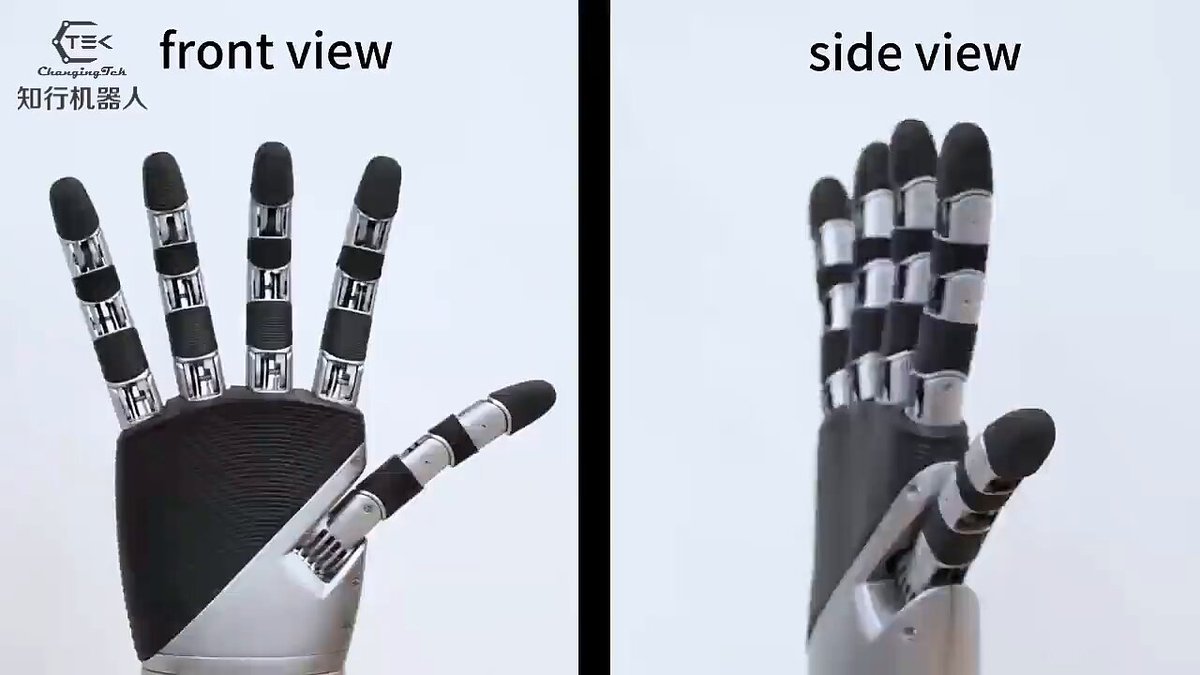
Can a dexterous hand still function after being run over by a 2-ton car? The dexterous hand is the most expensive component of a humanoid robot, and if it breaks, the task is interrupted. Hangzhou BrainCo conducted a rigorous test on its latest dexterous hand, Revo2: it was run...

45,434 просмотров • 7 месяцев назад •via X (Twitter)

Комментарии: 0

Нет доступных комментариев

Здесь появятся комментарии из оригинального поста

Похожие видео

New research: a hand is now a standalone robot! I love this project involving Sikai Li, Haochen Shi, Shuran Song, Mingyu Ding, and others. Called Handroid, it is an open-source, desktop-scale research robot (0.33 m tall, 2.05 kg, 27 DoF) that is both a dexterous anthropomorphic hand and a walking mini-humanoid. How cool is that ?! The same articulated electromechanical modules reconfigured allow the fingers to literally double as limbs. It is able to perform dexterous grasping, in-hand cube reorientation, pick-and-place, pouring, and bipedal squat/walk/turn, plus long-horizon tasks where it reconfigures its own embodiment (between bipedal humanoid and hand) mid-run (dock, locomote, manipulate). The project publishes GitHub code, OnShape CAD, and a Google-Sheets bill of materials, fully open, 3D printable -> you can build your own todat I really like that it is the most genuinely novel mechanical idea I have seen in a long time: not two robots in a box, but a robot whose fingers become its legs. Worth mentioning: Shuran Song's lab (Shuran Song) created UMI, the cheap hand gripper that became a standard for data acquisition. -> the people who built the dominant data-collection interface are now building cheap reconfigurable hardware. I believe this is a tell about where the frontier academic labs are now pushing the frontier: not another VLA, but better/cheaper embodiments to study on. Handroid's ability to transform between hand-mode and humanoid-mode is a genuinely different capability from every other robot we have seen lately, as most other robots have fixed embodiement, besides the ability to pick and use a tool. Morphology as a controllable variable is genuinely new, afaik. Enjoy watching this little robot as much as I do. Here it is able to plan a long horizon task, decompose it in steps, and behaves sequentially as either a hand or a humanoid (4x sped up):

Léo

15,346 просмотров • 1 месяц назад

We trained a humanoid with 22-DoF dexterous hands to assemble model cars, operate syringes, sort poker cards, fold/roll shirts, all learned primarily from 20,000+ hours of egocentric human video with no robot in the loop. Humans are the most scalable embodiment on the planet. We discovered a near-perfect log-linear scaling law (R² = 0.998) between human video volume and action prediction loss, and this loss directly predicts real-robot success rate. Humanoid robots will be the end game, because they are the practical form factor with minimal embodiment gap from humans. Call it the Bitter Lesson of robot hardware: the kinematic similarity lets us simply retarget human finger motion onto dexterous robot hand joints. No learned embeddings, no fancy transfer algorithms needed. Relative wrist motion + retargeted 22-DoF finger actions serve as a unified action space that carries through from pre-training to robot execution. Our recipe is called "EgoScale": - Pre-train GR00T N1.5 on 20K hours of human video, mid-train with only 4 hours (!) of robot play data with Sharpa hands. 54% gains over training from scratch across 5 highly dexterous tasks. - Most surprising result: a *single* teleop demo is sufficient to learn a never-before-seen task. Our recipe enables extreme data efficiency. - Although we pre-train in 22-DoF hand joint space, the policy transfers to a Unitree G1 with 7-DoF tri-finger hands. 30%+ gains over training on G1 data alone. The scalable path to robot dexterity was never more robots. It was always us. Deep dives in thread:

Jim Fan

301,144 просмотров • 7 месяцев назад