Loading video...

Video Failed to Load

Go Home

Can an open-weight coding agent + harness match Claude Code at training a domain-specific model? Same one-line prompt. ~13 min e2e. Pushed to Hugging Face. Pi + @moonshotai Kimi K2.6 vs Claude Code + Opus 4.7. Task: classify NC session laws (1866-1967) as Jim Crow or not

75,883 views • 5 months ago •via X (Twitter)

0 Comments

No comments available

Comments from the original post will appear here

Related Videos

Claude Code is a major (and accidental!) hit for Anthropic that surprised even its creator, Boris Cherny. Claude Code, an Agentic AI coding product that lives in the terminal. Most of the new code at Anthropic is created through it today. And in the last 5 months since it was launched publicly, Claude Code went from $0 to $400M in revenue run rate (as per The Information). 00:00 – Intro 01:15 – Did You Expect Claude Code’s Success? 04:22 – How Claude Code Works and Origins 08:05 – Command Line vs IDE: Why Start Claude Code in the Terminal? 11:31 – The Evolution of Programming: From Punch Cards to Agents 13:20 – Product Follows Model: Simple Interfaces and Fast Evolution 15:17 – Who Is Claude Code For? (Engineers, Designers, PMs & More) 17:46 – What Can Claude Code Actually Do? (Actions & Capabilities) 21:14 – Agentic Actions, Subagents, and Workflows 25:30 – Claude Code’s Awareness, Memory, and Knowledge Sharing 33:28 – Model Context Protocol (MCP) and Customization 35:30 – Safety, Human Oversight, and Enterprise Considerations 38:10 – UX/UI: Making Claude Code Useful and Enjoyable 40:44 – Pricing for Power Users and Subscription Models 43:36 – Real-World Use Cases: Debugging, Testing, and More 46:44 – How Does Claude Code Transform Onboarding? 49:36 – The Future of Coding: Agents, Teams, and Collaboration 54:11 – The AI Coding Wars: Competition & Ecosystem 57:27 – The Future of Coding as a Profession 58:41 – What’s Next for Claude Code

Matt Turck

82,372 views • 1 year ago

Claude Code tip: once Opus 5.5 is your main model, stop letting your Fable 5.1 quota go to waste put it on call with /advisor run /advisor fable Opus 5.5 keeps doing the work Fable 5.1 sits on the sidelines, reads the whole session, and steps in at three moments: → before a plan: is this right? → when the same error comes back: am I going the wrong way? → before "done": did I miss anything? Fable 5.1 advises. Opus 5.5 writes the code the same idea sits under Jev engineering: the expensive model stops weighing in on every step and only gets called at the moments that change the outcome • the full setup > Opus 5.5 on high runs the main session > subagent one reads code > subagent two edits and runs tests > subagent three looks up docs > all three on medium > Fable 5.1 on call hand the tree and this prompt to Claude Code 👇 "Set up my Claude Code to match this tree: 1. Reuse fitting subagents from ~/.claude/agents and .claude/agents. > Propose new ones only for missing roles > Set each to model: opus, effort: medium > Leave any that set a different model alone and list them 2. Set main session effort to high via effortLevel in ~/.claude/settings.json 3. Check for env vars that disable the advisor (CLAUDE_CODE_DISABLE_ADVISOR_TOOL, DISABLE_TELEMETRY, anything that stops flag fetching) and CLAUDE_CODE_EFFORT_LEVEL, which overrides subagent effort. Report them, don't change them 4. Add a rule to ~/.claude/CLAUDE.md: ask the advisor before a big plan, when an error repeats, and before calling a long task done Show me the changes first. Don't edit files yet." ↳

Mr. Buzzoni

324,943 views • 14 days ago

Claude Code tip: once Opus 5.5 runs your main session, stop leaving Fable 5.1 on the bench put it on call with /advisor run /advisor fable Opus 5.5 keeps writing the code Fable 5.1 reads the whole session, every tool call included, and only speaks up at three moments: → before a plan: is this the right approach? → when the same error comes back: am I digging in the wrong place? → before "done": what did I miss? Fable 5.1 reviews. Opus 5.5 ships jev engineering is the same move one layer down: the forks that need no thinker (which file, which tool, retry or stop) go to jev in under half a second, and the big model only sees the ones that split - the full tree > Opus 5.5 on high runs the main session > explorer reads the code > worker edits and runs tests > researcher pulls the docs > all three on medium > Fable 5.1 on call as the advisor paste the tree and this prompt into Claude Code ↓ "Rebuild my Claude Code setup around this tree: 1. Check ~/.claude/agents and .claude/agents for subagents that already fit explorer, worker and researcher. > Draft new ones only for missing roles > Give each model: opus, effort: medium > Skip any that pin a different model and list them 2. Set the main session to high via effortLevel in ~/.claude/settings.json, and set advisorModel to fable 3. Find anything that keeps the advisor off (CLAUDE_CODE_DISABLE_ADVISOR_TOOL, DISABLE_TELEMETRY, any variable that stops feature-flag fetching) plus CLAUDE_CODE_EFFORT_LEVEL, which overrides subagent effort. Report them, change nothing 4. Add one rule to ~/.claude/CLAUDE.md: consult the advisor before a large plan, when an error repeats, and before calling a long task done Show me every change as a diff first. No edits until I say go." ↳

Hanako

52,065 views • 12 days ago

Claude Code tip: once Opus 5.5 is your main model, stop leaving Fable 5.1 sitting idle put it on call with /advisor run /advisor fable Opus 5.5 keeps writing the code Fable 5.1 reads the full session, every tool call included, and only speaks up at three points: → before a plan: is this the right approach? → when the same error comes back: am I digging in the wrong place? → before "done": what did I miss? Fable 5.1 reviews. Opus 5.5 ships Jev engineering is the same move one layer down: the forks that need no thinker (which file, which tool, retry or stop) go to Jev in under half a second, and the big model only sees the ones that split - the full tree > Opus 5.5 on high runs the main session > explorer reads the code > worker edits and runs tests > researcher pulls the docs > all three on medium > Fable 5.1 on call as the advisor paste the tree and this prompt into Claude Code ↓ "Rebuild my Claude Code setup around this tree: 1. Check ~/.claude/agents and .claude/agents for subagents that already fit explorer, worker and researcher. > Draft new ones only for missing roles > Give each model: opus, effort: medium > Skip any that pin a different model and list them 2. Set the main session to high via effortLevel in ~/.claude/settings.json, and set advisorModel to fable 3. Find anything that keeps the advisor off (CLAUDE_CODE_DISABLE_ADVISOR_TOOL, DISABLE_TELEMETRY, any variable that stops feature-flag fetching) plus CLAUDE_CODE_EFFORT_LEVEL, which overrides subagent effort. Report them, change nothing 4. Add one rule to ~/.claude/CLAUDE.md: consult the advisor before a large plan, when an error repeats, and before calling a long task done Show me every change as a diff first. No edits until I say go." ↳

delost

697,625 views • 14 days ago

THIS IS PURE F*CKING GOLD Anthropic just shared one of the best tricks for Claude Code. The idea: run Sonnet, Haiku and Opus 5.5 at the same time, each one doing only what it's best at. Better results and way fewer tokens, because every task lands on the right model. You just start Claude Code like this: claude --model sonnet --advisor opus here's how it splits: → Sonnet 5 runs the session and writes the code → Haiku 5.5 explores files and docs in parallel → Opus 5.5 stays on call as advisor for the big decisions → you stop burning Opus context on tasks that don't need it Opus only steps in at three moments: → before a plan locks → when the same error hits twice → before calling it done Sonnet builds. Haiku explores. Opus reviews. JEV engineering is the same move one layer down: the forks that need no thinker (which file, which tool, retry or stop) go to JEV in milliseconds, and the big models only see the ones that split the full tree > Sonnet 5 runs the main session and edits code > search maps the repo on Haiku 5.5 > grep finds call sites on Haiku 5.5 > docs pulls the API reference on Haiku 5.5 > Opus 5.5 on call as advisor, reads the full transcript when consulted > JEV routes micro-forks in milliseconds paste the tree and this prompt into Claude Code ↓ "Reconfigure my Claude Code setup around this tree: 1. Run the main session on Sonnet 5 with Opus 5.5 as advisor. 2. Create three read-only Haiku 5.5 subagents: search (maps the repo), grep (finds call sites), docs (pulls the API reference). 3. Add one rule to CLAUDE.md: consult the advisor before locking a plan, after the same error twice, and before calling a task done. 4. Route fast deterministic forks (tool choice, path selection, retries) through JEV. Show me every change as a diff first. No edits until I say go." ↳ save it, it'll come in handy.

delost

288,285 views • 1 day ago

Claude Code tip: once Opus 5.5 is your main model, stop leaving Fable 5.1 sitting idle and stop burning Opus tokens on tasks Sonnet 5.5 can swarm put it on call with /advisor run /advisor fable Opus 5.5 plans and ships the code Sonnet 5.5 swarms the routine work at medium effort Fable 5.1 reads the full session, every tool call included, and only speaks up at three points: → before a plan: is this the right approach? → when the same error comes back: am I digging in the wrong place? → before "done": what did I miss? Fable 5.1 reviews. Sonnet 5.5 executes. Opus 5.5 ships Jev engineering is the same move one layer down: the forks that need no thinker (which file, which tool, retry or stop) go to Jev in under half a second, and the big model only sees the ones that split Plan on high. Delegate on medium. Keep Fable on call. - the full tree > Opus 5.5 on high runs the main session > explorer reads the code > worker edits and runs tests > researcher pulls the docs > all three on Sonnet 5.5 at medium effort > Fable 5.1 on call as the advisor paste the tree and this prompt into Claude Code ↓ "Rebuild my Claude Code setup around this tree: 1. Check ~/.claude/agents and .claude/agents for subagents that already fit explorer, worker and researcher. > Draft new ones only for missing roles > Give each model: sonnet, effort: medium > Skip any that pin a different model and list them 2. Set the main session to high via effortLevel in ~/.claude/settings.json, and set advisorModel to fable 3. Find anything that keeps the advisor off (CLAUDE_CODE_DISABLE_ADVISOR_TOOL, DISABLE_TELEMETRY, any variable that stops feature-flag fetching) plus CLAUDE_CODE_EFFORT_LEVEL, which overrides subagent effort. Report them, change nothing 4. Add one rule to ~/.claude/CLAUDE.md: consult the advisor before a large plan, when an error repeats, and before calling a long task done Show me every change as a diff first. No edits until I say go." ↳

mirku

421,711 views • 13 days ago

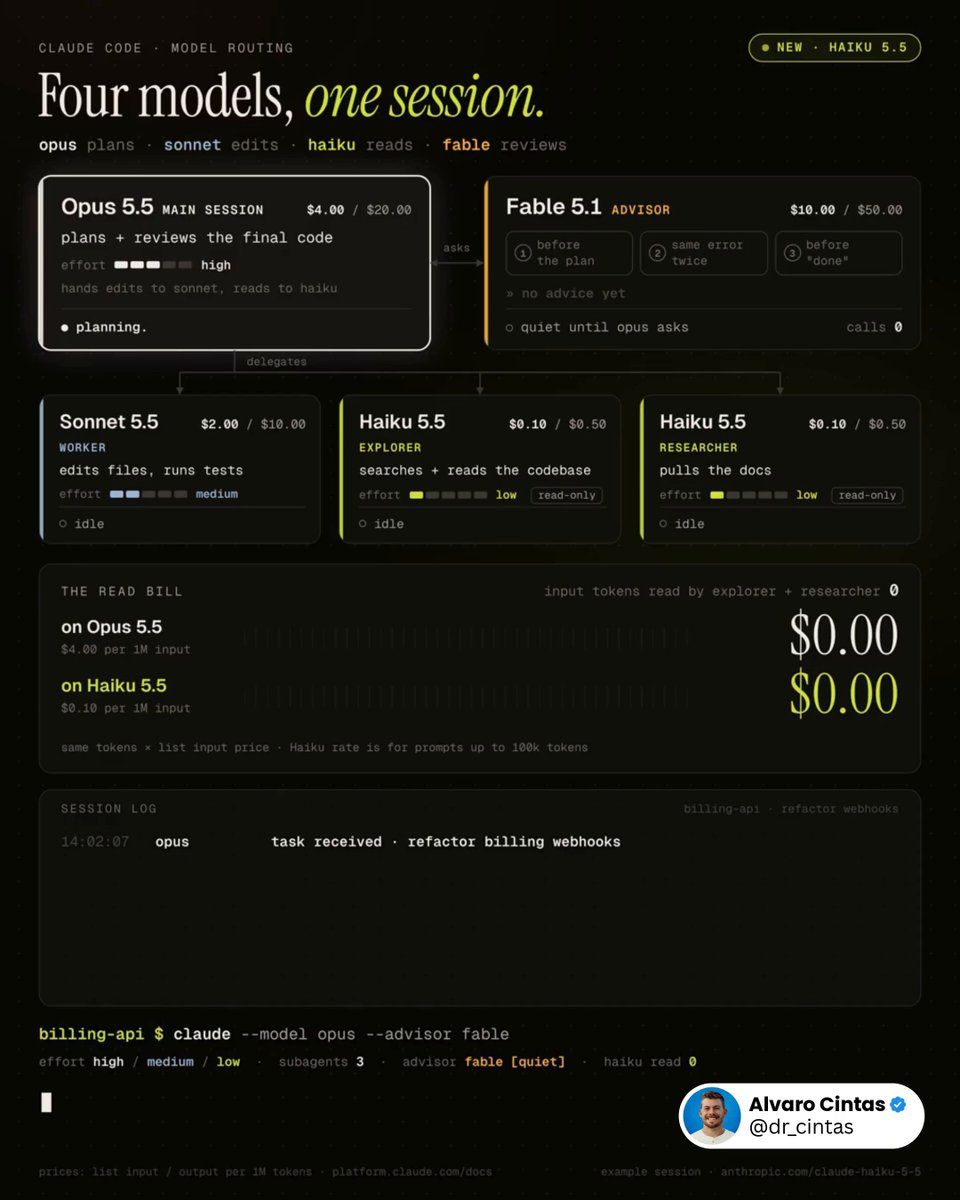
This workflow will save you thousands with Claude. Run Opus 5.5, Sonnet 5.5, Haiku 5.5, and Fable 5.1 together, and stop spending Opus tokens on work that doesn't need Opus. The entire idea in one line: Opus plans, Sonnet edits, Haiku reads, Fable reviews at decision points. Roles, broken down: - Opus 5.5, high effort, owns the plan and reviews the final code - Sonnet 5.5, medium effort, is the worker: edits files, runs tests - Haiku 5.5, low effort, splits into explorer (searches and reads the codebase) and researcher (pulls docs). it's the first Haiku with an effort setting - Fable 5.1, set with /advisor fable. Opus calls it at decision points, and it gets the full transcript each time Three moments Opus tends to call it: → before committing to a plan: is this the right approach? → the same error shows up again: is this going nowhere? → before marking the task done: did something get skipped? Why Haiku only reads: Anthropic's launch post says Sonnet 5.5 and Opus 5.5 are still the better choice for complex agentic coding (Terminal-Bench 4.0: 39.2% for Haiku 5.5, 70.6% for Sonnet 5.5) and that Haiku 5.5 fits narrowly scoped subagent work. so it gets the lookups, not the edits. Anyone still running one model for everything is paying $4 per million input tokens to check whether a file exists. Haiku 5.5 does it for $0.10. Drop this into Claude Code 👇 "Rebuild my Claude Code setup around this structure: Confirm Claude Code is v2.1.293 or later, so the haiku alias resolves to Haiku 5.5. If it isn't, stop and tell me to run claude update. Look through ~/.claude/agents and .claude/agents for subagents already covering explorer, worker, and researcher. Only create new ones for roles that are missing. Set model: haiku, effort: low on explorer and researcher, with no Edit or Write tools. Set model: sonnet, effort: medium on worker. If an existing subagent is locked to a different model, leave it as is and just list it. Name the explorer subagent Explore so it overrides the built-in one, which otherwise runs on my main model. In ~/.claude/settings.json, set advisorModel to fable, and set effortLevel to high for claude-opus-5-5 under modelSettings. A top-level effortLevel in user settings doesn't apply to Opus 5.5. Check for anything disabling the advisor: CLAUDE_CODE_DISABLE_ADVISOR_TOOL, DISABLE_TELEMETRY, or anything blocking feature-flag fetches. Also check CLAUDE_CODE_EFFORT_LEVEL, which overrides subagent effort settings, and CLAUDE_CODE_SUBAGENT_MODEL_FORCE, which makes Claude Code ignore subagent model fields. Report what you find. Don't change any of it yet. Add one line to ~/.claude/CLAUDE.md: consult the advisor before a big plan, when the same error shows up twice, and before marking a long task done. Show every change as a diff first. Wait for my go-ahead before touching anything."

Alvaro Cintas

55,249 views • 5 days ago

holy sh*t. Official Anthropic tip for Claude Code: stop burning Opus 5.5 context on tasks Haiku 5.5 can swarm, while Sonnet 5.5 builds put the architect on call with custom subagents CLAUDE_CODE_SUBAGENT_MODEL=haiku claude --model sonnet Sonnet 5.5 drives the primary session on high effort, writing diffs and running test suites Haiku 5.5 subagents swarm the repo in parallel at 340 tok/s, handling file discovery and spec docs lookup Opus 5.5 stays on call in ~/.claude/agents/ as the code reviewer, only stepping in at three critical moments: → before a plan locks: does the implementation plan miss auth invariants or schema contracts? → when a test breaks twice: are we fixing the root cause or falling into a recursive rabbit hole? → before calling done: did the full diff introduce hidden regressions or break pre-flight rules? Opus 5.5 reviews. Sonnet 5.5 builds. Haiku 5.5 swarms Claude Code subagent architecture runs the identical pattern through isolated contexts: high-volume operations (reading 30 files, grepping AST, running test suites) execute in separate worktrees, so 400k+ tokens stay in subagents while the primary session keeps a pristine 14k context Plan on high. Delegate on medium. Keep Opus on call. - the full subagent swarm setup > Opus 5.5 on call in ~/.claude/agents/code-reviewer.md catches deep architectural traps > Sonnet 5.5 lead drives edits, writes core logic, and executes test harnesses > Haiku 5.5 subagents swarm AST parsing, grep scans, and API docs in parallel at 340 tok/s > isolation: worktree guarantees test runs and scratch edits never pollute your git tree > isolated context windows shield the primary session from 400k+ tokens of verbose output paste the setup and this prompt into Claude Code below: "Configure my Claude Code workspace for hierarchical subagent orchestration: 1. Audit ~/.claude/settings.json and project config for model roles fitting lead, subagents, and reviewer: > Pin main session model: sonnet with effortLevel: high for primary execution > Set CLAUDE_CODE_SUBAGENT_MODEL to haiku in settings.json with CLAUDE_CODE_SUBAGENT_MODEL_FORCE to 1 > Pin custom code-reviewer model: opus with effort: high in ~/.claude/agents/code-reviewer.md 2. Create specialized subagent files in ~/.claude/agents/: > code-reviewer.md: model: opus, tools: Read, Grep, Glob, read-only review of plans and diffs > explorer.md: model: haiku, tools: Read, Grep, Glob, fast codebase search and AST discovery > researcher.md: model: haiku, tools: Read, WebFetch, external documentation and specification lookup 3. Configure automatic delegation checkpoints in ~/.claude/CLAUDE.md: > Invoke @ code-reviewer before finalizing multi-file architecture plans > Automatically summon @ code-reviewer when the same test or compiler error fails twice > Enforce @ code-reviewer diff contract audit before declaring tasks complete or staging git commits 4. Constrain subagent scopes: > Enable isolation: worktree for subagents making edits or running test harnesses > Return structured summaries only without flooding the main conversation context Show every configuration diff first. Do not apply edits until confirmed" ↳

mirku

99,082 views • 2 days ago

Claude Code tip: keep Opus 5.5 as your main model, but stop paying Opus prices for your subagents move them to Sonnet 5.5 Opus 5.5 plans and decides Sonnet 5.5 subagents do the heavy reading, editing and testing at half the price ($2 / $10 vs $4 / $20 per 1M tokens) Fable 5.1 stays on call with /advisor and only speaks up at three points: → before a plan: is this the right approach? → when the same error comes back: am I digging in the wrong place? → before "done": what did I miss? Opus thinks. Sonnet does. Fable checks Jev engineering is the same move one layer down: the forks that need no thinker (which file, which tool, retry or stop) go to Jev in under half a second, and the big models only see the ones that split - the full tree > Opus 5.5 on high runs the main session > explorer reads the code > worker edits and runs tests > researcher pulls the docs > all three on Sonnet 5.5, medium > Fable 5.1 on call as the advisor paste the tree and this prompt into Claude Code ↓ "Rebuild my Claude Code setup around this tree: 1. Check ~/.claude/agents and .claude/agents for subagents that already fit explorer, worker and researcher. > Draft new ones only for missing roles > Give each model: claude-sonnet-5-5, effort: medium > List any that pin a different model before changing them 2. Keep the main session on Opus, set effortLevel to high in ~/.claude/settings.json and advisorModel to fable 3. Find anything that keeps the advisor off (CLAUDE_CODE_DISABLE_ADVISOR_TOOL, DISABLE_TELEMETRY, any variable that stops feature-flag fetching) plus CLAUDE_CODE_EFFORT_LEVEL, which overrides subagent effort. Report them, change nothing 4. Add one rule to ~/.claude/CLAUDE.md: consult the advisor before a large plan, when an error repeats, and before calling a long task done Show me every change as a diff first. No edits until I say go." ↳

delost

27,459 views • 11 days ago