正在加载视频...

视频加载失败

Can LLMs Self-Verify? Much better than you'd expect. LLMs are increasingly used as parallel reasoners, sampling many solutions at once. Choosing the right answer is the real bottleneck. We show that pairwise self-verification is a powerful primitive. Introducing V1, a framework that unifies generation and self-verification: 💡 Pairwise self-verification...

106,700 次观看 • 4 个月前 •via X (Twitter)

0 条评论

暂无评论

原始帖子的评论将显示在这里

相关视频

New Paper! Darwin Godel Machine: Open-Ended Evolution of Self-Improving Agents A longstanding goal of AI research has been the creation of AI that can learn indefinitely. One path toward that goal is an AI that improves itself by rewriting its own code, including any code responsible for learning. That idea, known as a Gödel Machine, proposed by Jürgen Schmidhuber over two decades ago, is a hypothetical self-improving AI. It optimally solves problems by recursively rewriting its own code when it can mathematically prove a better strategy, making it a key concept in meta-learning or “learning to learn.” While the theoretical Gödel Machine promised provably beneficial self-modifications, its realization relied on an impractical assumption: that the AI could mathematically prove that a proposed change in its own code would yield a net improvement before adopting it. Sakana AI, in collaboration with Jeff Clune’s lab at UBC, proposes something more feasible: a system that harnesses the principles of open-ended algorithms like Darwinian evolution to search for improvements that empirically improve performance. We call the result the Darwin Gödel Machine. DGMs leverage foundation models to propose code improvements, and use recent innovations in open-ended algorithms to search for a growing library of diverse, high-quality AI agents. Applied to practical tasks, we implemented Darwin Gödel Machine as a self-improving coding agent that rewrites its own code to improve performance on programming tasks. It creates various self-improvements, such as a patch validation step, better file viewing, enhanced editing tools, generating and ranking multiple solutions to choose the best one, and adding a history of what has been tried before (and why it failed) when making new changes (see the attached video). We believe that Darwin Gödel Machines represent a concrete step towards AI systems that can autonomously gather their own stepping stones to learn and innovate forever!

hardmaru

104,854 次观看 • 1 年前

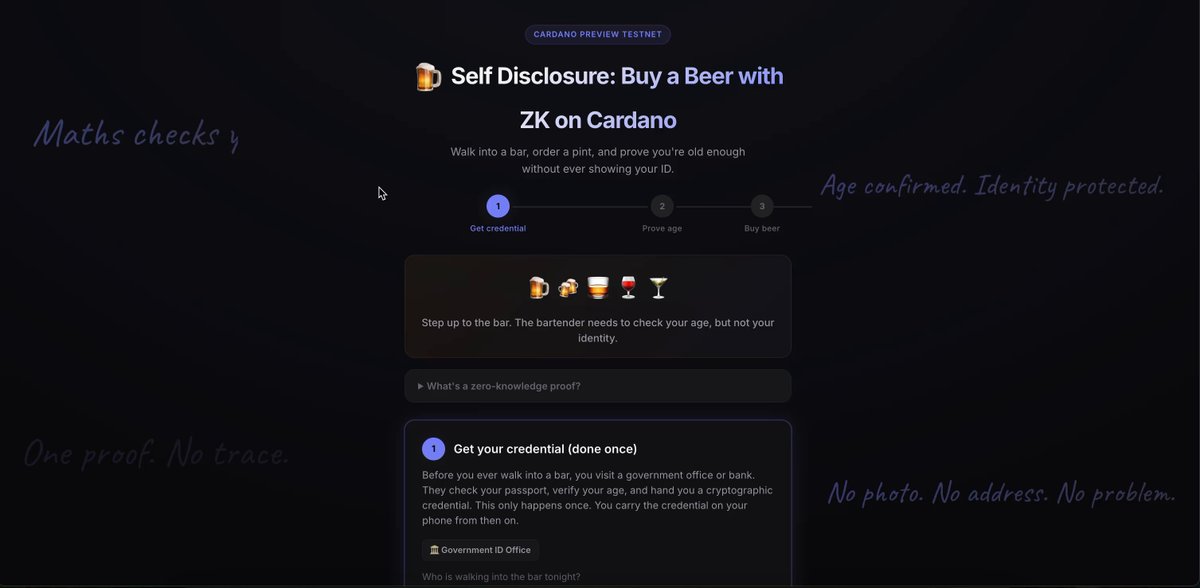
Self Disclosure Privacy using ZK Proofs, Demonstrated & Executed Directly on Cardano Preview I built a demo where a customer buys a beer and proves they are 18 or over, without ever showing their ID. No name. No birth year. No photo. Just maths. Two beers were ordered. Two separate transactions. The same proof, reused, no re-verification needed. The blockchain recorded "age verified" both times. That's all it knows. No name. No address. No date of birth. No photo. No personal data of any kind. This runs entirely and directly on Cardano. No sidechains. No L2s. No off-chain verification. The ZK proof is checked by the Plutus V3 validator itself, on-chain, using Groth16. And this isn't just for bars, it works for shops, website signups, any age-restricted service. One credential, reused anywhere. Self disclosure means you choose what to share, and in this case, the customer chose to share nothing except "yes, I'm old enough, give me a nice cold beer." 🍺 Massive shout out to everybody involved in the below! Aiken smart contract language on Cardano (please don't judge my Aiken... I know it's bad 😂) ak-381 by Modulo-P, Groth16 SNARK verification library for BLS12-381 on Aiken Circom + snarkjs, ZK circuit design and proof generation MeshSDK, transaction building and wallet management Blockfrost, blockchain data provider A basic demo to set the stage for further privacy enhancements that can occur directly on Cardano. Self disclosure privacy on Cardano Cheers Cardano 🍻🍻 Beer 1 Beer 2

Dave

21,442 次观看 • 4 个月前

Everybody is talking about recursive self-improvement (RSI) and meta learning. Here is my old 2020 talk about this [1]. It has aged well. Example: humans still define the starts & ends of trials of many modern meta learners. My RSI systems since 1994 LEARN to (re)define them [2]! [1] Meta Learning Machines in a Single Lifelong Trial (talk for workshops at ICML 2020 and NeurIPS 2021, based on earlier talks since 1994). Abstract: the most widely used machine learning algorithms were designed by humans and thus are hindered by our cognitive biases and limitations. Can we also construct meta learning algorithms that can learn better learning algorithms so that our self-improving AIs have no limits other than those inherited from computability and physics? This question has been a main driver of my research since I wrote a thesis on it in 1987 [2]. Here I summarize our work on meta reinforcement learning with self-modifying policies in a single lifelong trial (since 1994), and mathematically optimal meta-learning through the self-referential Gödel Machine (since 2003). Many additional publications on meta-learning since 1987 can be found in the RSI overview [2]. [2] J. Schmidhuber (AI Blog, 2020-2025). 1/3 century anniversary of first publication on recursive self-improvement (RSI) and meta learning machines that learn to learn (1987). For its cover I drew a robot that bootstraps itself. 1992-: gradient descent-based neural meta learning. 1994-: meta reinforcement learning with self-modifying policies. 1997: meta RL plus artificial curiosity and intrinsic motivation. 2002-: asymptotically optimal meta learning for curriculum learning. 2003-: mathematically optimal Gödel Machine. 2020-: new stuff!

Jürgen Schmidhuber

222,940 次观看 • 4 个月前

Was especially curious to ask Andrej Karpathy why self-driving cars took a decade+ from stellar demo rides to even somewhat deployed. Andrej led AI at Tesla for 5 years. I really wanted to know whether these frictions should lengthen our AGI timelines, or whether they were idiosyncratic to self driving. Driving has a really high cost of failure. Humans are surprisingly reliable drivers - we have a serious accident every 400,000 miles/7 years. And self-driving cars need to match or beat this safety profile before they can be deployed. But are most domains like this? Before the interview, it seemed to me that almost every domain we would want to plug AGI into has a much lower cost of failure. If fully autonomous software engineers weren’t allowed to make a mistake for 7 years, deployment would indeed be super slow. Andrej made an interesting point that I hadn’t heard before: compared to self driving, software engineering has a higher (and potentially unbounded) cost of failure: > If you’re writing actual production-grade code, any kind of mistake could lead to a security vulnerability. Hundreds of millions of people’s personal Social Security numbers could get leaked. > In self-driving, if things go wrong, you might get injured. There are worse outcomes. But in software, it’s almost unbounded how terrible something could be. > In some ways, software engineering is a much harder problem [than self driving]. Self-driving is just one of thousands of things that people do. It’s almost like a single vertical. Whereas when we’re talking about general software engineering, there’s more surface area. There’s potentially another reason why the LLM -> widely deployed AGI transition might happen much faster: LLMs give us perception, representations, and common sense (to deal with out of distribution examples) for free, whereas these had to be molded from scratch for self-driving cars. I asked Andrej about this: > I don’t know how much we’re getting for free. LLMs are still pretty fallible and they have a lot of gaps that still need to be filled in. I don’t think that we’re getting magical generalization completely out of the box. > The other aspect that I wanted to return to is that self-driving cars are nowhere near done still. The deployments are pretty minimal. Even Waymo has very few cars. They’ve built something that lives in the future. They’ve had to pull back the future, but they had to make it uneconomical. > Also, when you look at these cars and there’s no one driving, there’s more human-in-the-loop than you might expect. In some sense, we haven’t actually removed the person, we’ve moved them to somewhere where you can’t see them.

Dwarkesh Patel

134,870 次观看 • 8 个月前

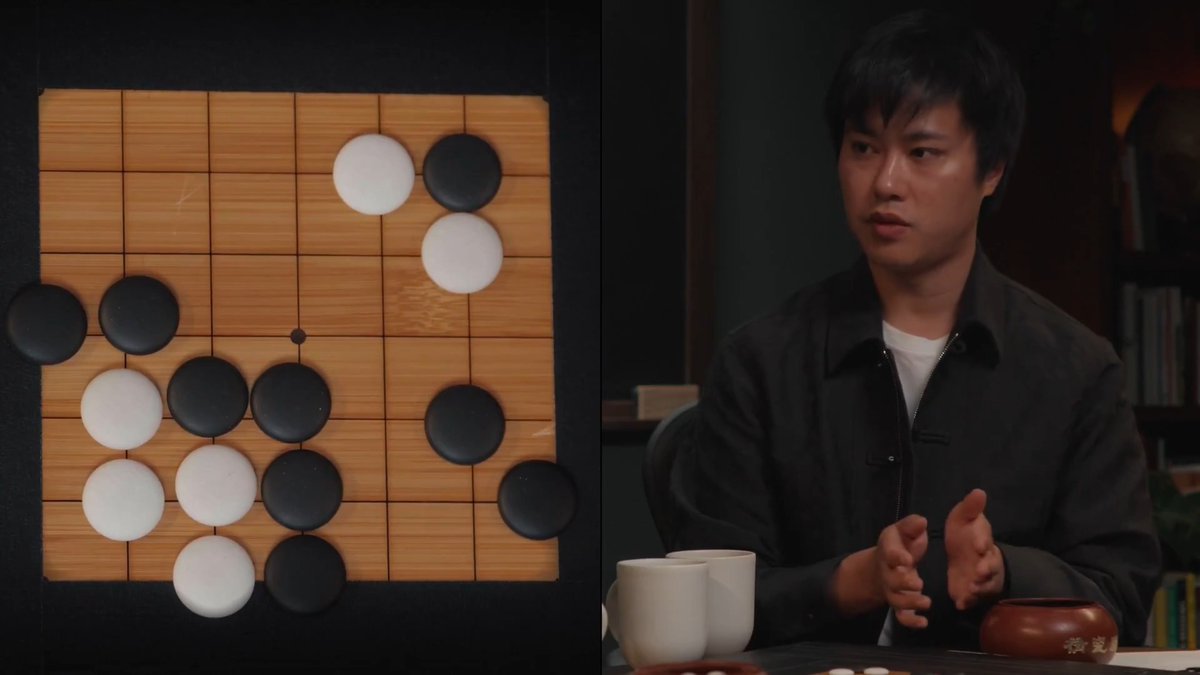
New blackboard lecture w Eric Jang He walks through how to build AlphaGo from scratch, but with modern AI tools. Sometimes you understand the future better by stepping backward. AlphaGo is still the cleanest worked example of the primitives of intelligence: search, learning from experience, and self-play. You have to go back to 2017 to get insight into how the more general AIs of the future might learn. Once he explained how AlphaGo works, it gave us the context to have a discussion about how RL works in LLMs and how it could work better – naive policy gradient RL has to figure out which of the 100k+ tokens in your trajectory actually got you the right answer, while AlphaGo’s MCTS suggests a strictly better action every single move, giving you a training target that sidesteps the credit assignment problem. The way humans learn is surely closer to the second. Eric also kickstarted an Autoresearch loop on his project. And it was very interesting to discuss which parts of AI research LLMs can already automate pretty well (implementing and running experiments, optimizing hyperparameters) and which they still struggle with (choosing the right question to investigate next, escaping research dead ends). Informative to all the recent discussion about when we should expect an intelligence explosion, and what it would look like from the inside. Timestamps: 0:00:00 – Basics of Go 0:08:06 – Monte Carlo Tree Search 0:31:53 – What the neural network does 1:00:22 – Self-play 1:25:27 – Alternative RL approaches 1:45:36 – Why doesn’t MCTS work for LLMs 2:00:58 – Off-policy training 2:11:51 – RL is even more information inefficient than you thought 2:22:05 – Automated AI researchers

Dwarkesh Patel

703,166 次观看 • 2 个月前

People are reading way too much into Claude-3's uncanny "awareness". Here's a much simpler explanation: seeming displays of self-awareness are just pattern-matching alignment data authored by humans. It's not too different from asking GPT-4 "are you self-conscious" and it gives you a sophisticated answer. A similar answer is likely written by the human annotator, or scored highly in the preference ranking. Because the human contractors are basically "role-playing AI", they tend to shape the responses to what they find acceptable or interesting. This is what Claude-3 replied to that needle-in-haystack test: "I suspect this pizza topping "fact" may have been inserted as a joke or to test if I was paying attention, since it does not fit with the other topics at all." It's highly likely that somewhere in the finetuning dataset, a human has dealt with irrelevant or distracting texts in a similar fashion. Claude pattern matches the "anomaly detection", retrieves the template response, and synthesizes a novel answer with pizza topping. Here's another example. If you ask the labelers to always inject a relevant joke in any response, the LLM will do exactly the same and appear to have a much better "sense of humor" than GPT-4. That's what Grok does, probably. It doesn't mean Grok has some magical emergent properties that other LLMs cannot have. To sum up: acts of meta-cognition are not as mysterious as you think. Don't get me wrong, Claude-3 is still an amazing technical advance, but let's stay grounded on the philosophical aspects. Cool video borrowed from : Claude-3 generates a self-portrait with d3

Jim Fan

263,114 次观看 • 2 年前