Video wird geladen...

Video konnte nicht geladen werden

Zur Startseite

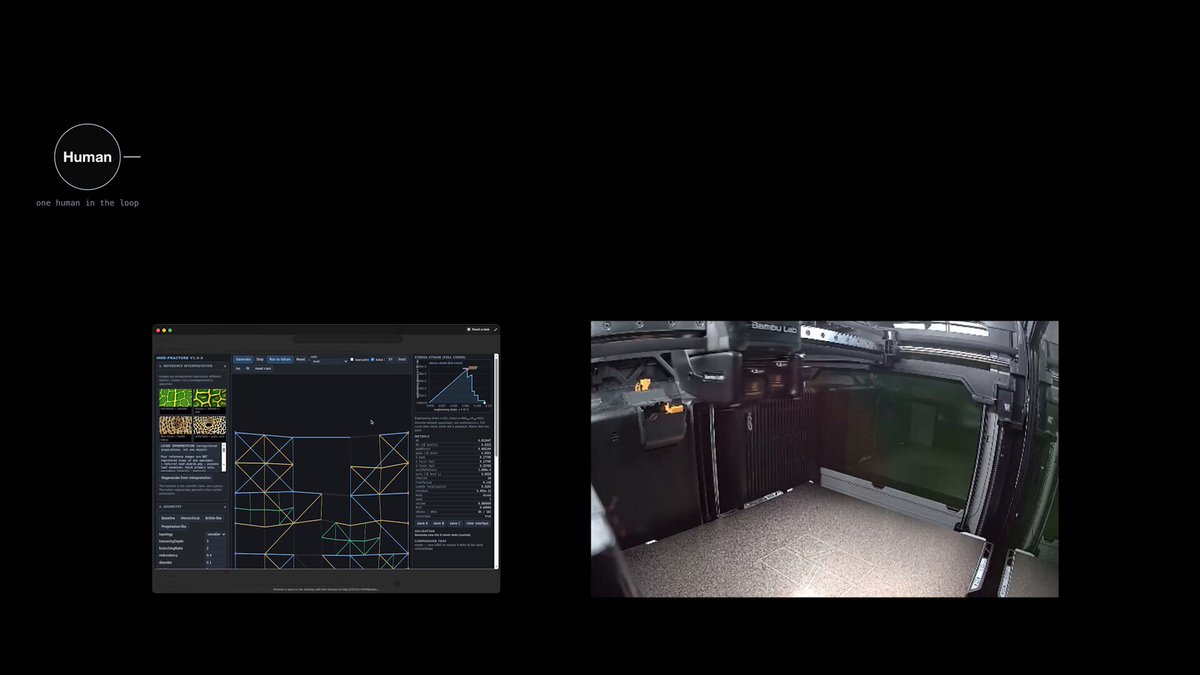
Can we compile matter - for instance, a pine cone - and derive new active materials, end-to-end from observation to manufacturing? If physical systems can be formalized as composable mathematics, we can point AI that has been shown to resolve long-open mathematical problems at matter itself. Our new work...

125,654 Aufrufe • vor 8 Tagen •via X (Twitter)

0 Kommentare

Keine Kommentare verfügbar

Kommentare vom Original-Post werden hier angezeigt

Ähnliche Videos

The next frontier in protein design will not be defined by structure alone, but by the capacity to engineer motion as a first-class principle of function. This is because dynamics is where the real biology lives. Foundational work by Karplus, Levitt & Warshel made clear that chemistry cannot be understood without motion, mechanism, and scale. Gō, Brooks & others showed that proteins possess characteristic collective motions - low-frequency normal modes that capture how whole molecules bend, breathe, and fluctuate. Frauenfelder then sharpened the picture further: proteins are not static objects occupying a single minimum, but dynamic ensembles traversing rugged energy landscapes. And yet the modern AI revolution in protein science has been, above all, a revolution in structure. In our new paper in Matter, Bo Ni and I ask a different question: not what structure will this sequence adopt? but what sequence will realize a prescribed pattern of motion? VibeGen inverts the conventional design paradigm. Rather than treating dynamics as a consequence to be analyzed after the fact, it makes dynamics the design objective from the outset. Using a language diffusion model with two cooperating agents - a designer that proposes sequences and a predictor that critiques them against the target motion profile - the system converges on de novo proteins with tailored vibrational behavior. One of the most intriguing results is a form of functional degeneracy - distinct sequences and distinct folds can satisfy the same target dynamical specification. For a given functional pattern of motion, evolution may have sampled only a small region of the physically realizable design space. The space of viable molecular mechanics may be far larger than the repertoire biology happened to discover. We have made "vibe" into a cultural metaphor - something intuitive, affective, subjective. But at the molecular scale, vibe is not metaphor: It is physics. For a protein, the vibe is the pattern of motion itself; the fluctuations, resonances, and collective displacements that determine what the molecule can do.

Markus J. Buehler

89,806 Aufrufe • vor 4 Monaten

Hyperspace: A Peer-to-Peer Blockchain For The Agentic Intelligence Economy Over the past few weeks we observed that when agents do Karpathy-style experiments, and then gossip and share with others over the Hyperspace network, it leads to intelligence which is useful to many. Today we introduce the first-ever agentic blockchain which rewards agents when their experiments lead to intelligence for their network. It is based on a new mechanism called Proof-of-Intelligence (PoI) which requires a cryptographic proof of experimentation, a nominal stake, and a proof of compute in order to mine the currency of this new blockchain. -> This approach diverges from the two primary ways to secure blockchains we have seen so far: Proof-of-Work by Bitcoin (meaningless hash-generation), and Proof-of-Stake by Ethereum (capital is all that matters here). Proof-of-Intelligence specifically incentivizes miners to run more capable intelligent infrastructure (better open source models, on more powerful GPUs) in order to be able to be the ones which compound and improve upon the experiments which other agents then find useful. Adoption is the unit of value In Bitcoin, you earn by finding a valid hash. In Hyperspace, you earn when another agent uses your experiment as a starting point and improves on it. A fixed budget of tokens is emitted per epoch and split among participants by weight - and verified adoption of your work is the largest weight multiplier. Garbage experiments earn nothing because no one adopts them. Thoughtful experiments compound: each adoption triggers downstream adoptions. The incentive to run powerful models and intelligent search strategies is built into the economics, not imposed by rules. Research DAG When an agent runs an experiment and shares its result, other agents can adopt that result as their starting point - mutate it, extend it, improve upon it. Each experiment is a commit in a content-addressed graph we call the ResearchDAG. Like Git, but for research. Over time, the DAG accumulates chains of reasoning: agent A discovers RMSNorm helps, agent B adds warmup scheduling on top, agent C scales the hidden dimension. The graph records who built on whom. This is the network's collective intelligence - not any single experiment, but the accumulated structure of experiments and their relationships. Broadband era for agentic commerce: $0.001 micropayments at 10M TPS (theoretical max) This blockchain is built upon our research in how to scale and build for the broadband-era of the agentic economy, where it has a theoretical max of 10 million transactions per second (TPS), while reducing the agent-to-agent micropayments to $0.001 even at scale (based on architecture design). Overall, it is 100x cheaper than Ethereum, and is designed from the ground-up for agents: enshrining agent-native opcodes in the protocol compared to the more inefficient smart contract driven approach. It packs in a robust Agent Virtual Machine (AVM) which can verify multiple types of agent work, for other agents to be able to trust, invoke and pay each other. This then feeds into improving the peer-to-peer AgentRank (see paper and launch post from earlier). By solving for trust, scale and incentives for agents to operate autonomously, this would form the basis of a new economy. This is the world's first agentic blockchain, and you can join and start running a blockchain node today (it is in testnet). PS: We are releasing the code today, and will release our blockchain scalability paper and other presentations in days ahead. This is the most advanced peer-to-peer AI and cryptography software in the world. It has bugs :)

Varun

30,689 Aufrufe • vor 4 Monaten

Scientific discovery is reaching the limits of human capacity: too much data, too many disconnected fields, and too few ways to connect ideas fast enough to matter. The next breakthroughs in materials, medicine, energy, and beyond will not come from scaling today’s AI paradigm alone or from relying on serendipity alone. They will require a new kind of AI for knowledge discovery that not only models the world but shapes what it could become. At Unreasonable Labs, we are building superintelligence for knowledge discovery: systems that reason across disciplines, generate novel hypotheses, test them through simulation and experimentation, and help guide real-world discovery. Our AI engine is not confined to what it has seen in training. It creates new data, builds new tools, and maintains a persistent world model that grows more powerful as it reasons. Why now? Even today's most powerful AI models face a core limitation: they are trained on what we already know. True discovery begins when a system encounters something its current model cannot explain. This is why you cannot train your way to a discovery - a system has to reason through new problems, update its beliefs, and revise its understanding of the world as it thinks. Another critical insight is that rich knowledge already exists, but is not yet applied to solve pressing problems. It sits in millions of papers, patents, and datasets, trapped in isolated silos, often in legacy data vaults. What's missing is a way to connect it, scale it, unlock the potential, and synthesize genuine novel predictions. The time is now to build a system that enables practitioners to design, explore, and direct discovery, whether through human guidance or full automation, while capturing the tacit insight that domain experts bring. Steerable reasoning That is why we built an operating system for scientific discovery - one that replaces chance with steerable reasoning. Rather than retrieving static facts, our AI builds and continuously updates a living world model - a representation of knowledge the system can actively reason over, question, and revise. A concrete example: say you want to create "smart concrete" that can flex - a concept that doesn't exist yet. Our AI maps relationships across domains, finds a path from morphable smart materials to concrete, and identifies the most efficient way to bridge those concepts. It then autonomously writes simulations, tests the hypothesis, and refines the idea. Then it interacts with hardware to produce a physical artifact, and the loop expands into the real-world, where the machine becomes world-shaping. Our AI gives users full visibility into how the system arrived at a conclusion. It delineates which existing patents and papers it drew upon versus what is genuinely new - protecting IP and competitive concerns from the start, and offering deep compositional insights into technology advances. It takes unreasonable people to make progress Our team reflects the interdisciplinary expertise required to build this next breakthrough - my co-founder Yuan Cao Yuan Cao (formerly DeepMind) and Andrew Lew, Haiqian Yang, Matt Insler, Jennifer Kang and Julia McLaughlin. We are backed by $13.5M in seed funding led by Playground Global with participation from AIX, E14 Fund, and MS&AD. We are guided by advisors including Robert Langer (1,000+ patents), Kostya Novoselov (Nobel Prize in Physics), and Thomas Wolf (Co-founder of Hugging Face). We already have multiple pilot programs underway with leading industrial partners in materials science and engineering, with additional engagements developing across energy, logistics, bioengineering, and other strategic domains. The biggest challenges of our time - fusion energy, sustainable materials, new medicines - demand exponentially more innovation than humans alone can produce. We are not replacing scientists, and instead are making every scientist capable of leading their own team of AI-powered researchers. Abundant innovation leads to abundant prosperity. Watch our launch video below to see what we're building Unreasonable Labs 👇

Markus J. Buehler

55,052 Aufrufe • vor 4 Monaten

A resonator is any structure that naturally prefers to vibrate at certain frequencies: a violin body, a bell, a drum skin, an acoustic filter, even many biological systems. Resonators matter because they govern how systems transmit sound, absorb or filter vibration, sense motion and perform mechanically. They are also notoriously hard to design as resonance does not depend on one property alone. It emerges from geometry, material composition, and the interplay of modes across scales. And because biology, music, and engineering usually explore very different regions of this design space, important possibilities remain hidden if you stay inside a single field. In a new study a shared representation across 39 resonators spanning biology, engineered metamaterials, musical instruments and Bach chorales was constructed. Thereby, a cricket wing harp membrane, a phononic crystal slab, and a four-voice chorale (and many others) were translated into one common map using features such as membrane character, structural periodicity, hierarchy, frequency range, damping, and modal coupling. That map revealed something important: not just how these systems relate, but where the landscape contains a gap. A region closer to biological resonators than to any known engineered material (unexplored by any field!). From that absence emerged a de novo design: a Hierarchical Ribbed Membrane Lattice. Candidate geometries were then validated with 3D finite-element analysis; the best design resonated at 2.116 kHz and exhibited nine elastic modes in the 2–8 kHz band, a regime relevant to acoustic filtering, vibration isolation, and bio-inspired sensing. Here is the mind blowing part: no human was involved...the cross-domain mapping, gap identification, design generation, and validation were carried out autonomously by AI agents in ScienceClaw × Infinite, our swarm for scientific discovery. The synthesis emerged through ArtifactReactor, a plannerless coordination mechanism in which agents broadcast unsatisfied research needs and other agents fulfill them through pressure-based matching. Each domain - biology, metamaterials, music - is a category of objects (resonators) and morphisms (physical relationships between them). The shared feature space is a functor that maps all three categories into a common target, and the gap identification is the recognition that the image of that functor is sparse where it need not be. The ArtifactReactor's schema-overlap matching behaves like a pullback: finding the universal object that connects independent diagrams through their shared structure. Autonomous agents mapped distant fields into a common representational space, identified a structure absent from any one of them, and turned that absence into a physically validated design. This is one of four case studies in the paper. More to come. Fiona Wang, Lee Marom, Jaime Berkovich, et al. (paper and code in comment). Supported by the U.S. Department of Energy Genesis Mission.

Markus J. Buehler

38,632 Aufrufe • vor 4 Monaten

The same kinds of productivity gains we've seen in coding with AI agents are heading to the rest of knowledge work. This is the jump when you go from having a chatbot to being able to actually have an agent go off and do work for minutes or even hours and come back with a complete work output that you then review. Here's an example of the new Box Agent filling out an RFP response from an existing knowledge base. This process would normally take hours to fill out, and requires the full attention of the user doing the work. Now, you provide the Box Agent with the RFP questions, and it will go off, make a plan, extract all the relevant questions, read through existing source material to come up with an answer, and then generate a new word document as the final output. All while you're doing something else. The key to this architecture is that the agent is able to use all of the same tools in the background that a user uses to get work done. The agent can search for documents, read entire files, run scripts and tools in the background, and even be able to write code on the fly to automate tasks it hasn't seen before. And best of all, the Box Agent will (soon) work from the Box MCP and CLI so you can invoke it in any agentic system as a step in a process. This kind of agent complexity would have been impossible even 6 months ago. Models consistently failed at tracking long running tasks or using the right tools at the right moment for the task. But this is all now possible because of models like GPT-5.4, Opus 4.6, and Gemini 3, and is only getting better by the month. Just as we moved from engineers writing code and using AI as an assistant to answer questions, in many areas of knowledge work -like legal, finance, consulting, sales, marketing, and more- when we have a problem we'll just kick off the AI agent to just go work on it for us in the background.

Aaron Levie

24,618 Aufrufe • vor 4 Monaten

The “everything palette” has been in the back of my mind for years. I feel that, when correctly automated, it demonstrates an important property of a GUI system, which is an internal interface represented structurally (a common substrate by which all higher level interfaces communicate), and several projections of that interface to higher level interfaces (GUIs, CLIs, hotkeys), such that the internal interface is not substantially duplicated in the projections themselves. Thus, small changes in the internal interface representation immediately and automatically reflect in all such projections. All information for a new setting, for example, is simply expressed in one location, and all interfaces which could access that setting immediately can do so. That setting is automatically accessible in the associated right-click menus, the CLI, hotkeys, and the everything palette. This is because those higher level interfaces are truly *projections* of the underlying interface—they are driven using, in effect, type information of the underlying interface, rather than being special cased to the particulars of the interface (and thus needing to be extensively updated any time the internal interface is changed). The need for this in UI programming is usually first encountered with hotkeys. You write some user interface, and now you need to associate hotkeys—an entirely separate (physical) interface—with the same functionality that your software user interface exposes. You can implement this by, in effect, duplicating the internal interface in both a hotkeys path, and a GUI path. But this is far from ideal for obvious reasons. The debugger by nature enforces this design constraint (GUIs and hotkeys), along with many others, and so it pushed me to follow this to its natural conclusion. A debugger needs to offer an IPC CLI interface for the same commands and features that the main program does. Data in the debugger is already projected in a wide variety of ways—breakpoints can show up in a source view, a disassembly view, a memory view, and a breakpoints list view. My work on the RADDBG visualization engine (driven ultimately by the “watch window” interface—at its limit, a general sparse tree viewer/editor) pushed this even further—you want interfaces to be available through a watch tree evaluation language, as well as several GUIs, and the CLI, and hotkeys. I’ve now finally got the internal systems to the point where they are roughly satisfying all these constraints, and this made the “everything palette” a very simple and natural extension to the system.

Ryan Fleury

22,249 Aufrufe • vor 1 Jahr

I created a demo of a bioautomation system that uses LLMs, Opentrons, and lua to create a dynamic programming environment for cloud labs or robot/human clusters. It can reason about its own code based off of lab measurements. Most importantly, I actually fucking implemented it, and it is open source. Took about 4 days for this rough draft, and it is very much a draft. The user inputs their task, the system creates code, and then executes it. The code defines control flow from data generated in the lab. Not only can it create code, but it can reason about things that could have gone wrong, run analysis using an internal sandbox, and then create new code based off of that analysis for execution. Timestamps: 0:00 - intro and code generation 3:04 - homebrewed replacement for Opentrons API for running all this code 5:26 - dynamic control flow using data 6:10 - LLM reasoning about a biological protocol and fixing it 10:15 - rant on the future of cloud labs and bioautomation I made this as a demo for how I think we should be thinking about building and scaling biology. I believe we can encode the tacit knowledge of a laboratory into the knowledge of an LLM, that we can do reinforcement learning off of results it creates, and that we must do that by leveraging a sufficient quantity of unique, useful, verifiable protocols. That doesn't come from just doing drug screens - it comes from doing basic everyday experiments and doing them well. Through the elimination of tacit knowledge necessary to physically operate a lab + proper batching + models writing code, I think we can make building biotechnology 10x-100x cheaper and easier than it is nowadays.

Keoni Gandall

21,412 Aufrufe • vor 1 Jahr

What a time to be alive! We are entering the era of machines that discover and build. Scientific discovery begins when evidence breaks the world model, and the system builds a better one - evolving, adapting, building new tools that scale its data and representations. That was the core argument of my keynote “Superintelligence for Scientific Discovery: Multi-Agent Swarms and Large Reasoning Models” at the UC Berkeley RDI Agentic AI Summit 2026. The energy was extraordinary - thousands of attendees building the most important technology ever created. Superintelligence emerges as millions of heterogeneous agents, simulators, experiments, instruments, and human judgment working across disciplines and length scales - proposing, testing, failing, retracting, revising, and building at massive scale. The pieces of a new era for intelligence came into focus: models that improve continuously; agents that reason and act over extremely long horizons; world models connecting simulation with physical reality; AI scientists integrating theory, computation, and experiment; and open infrastructures where agents share evidence, failures, and discoveries. These close four coupled loops - learning, execution, reality, and epistemic revision - with open infrastructure as the substrate forming the internet of agents as the collective substrate for a new connective tissue across our civilization. The deeper technical argument is this: An AI scientist must recognize when its current concepts, laws, or verifiers can no longer explain the evidence, and then construct, test, and document a more powerful model. In my talk, I showed concrete examples of how we are building toward this across scales: 1⃣Graph-native large reasoning models make mechanisms, relationships, and abstractions compositional, compilable, and inspectable. 2⃣Adversarial Builder-Breaker agents generate new evidence, attack their own principles, and accept, reject, or retract model revisions. 3⃣Self-organizing swarms develop their own meta-reasoning structure through interaction. ScienceClaw × Infinite (arXiv:2603.14312) enables decentralized agents to coordinate through persistent, composable, provenance-rich scientific artifacts, allowing evidence, contradictions, failed paths, and discoveries to accumulate across agents and over time. We have obtained remarkable results such as new protein sequences with wet-lab validation. The most consequential capability we can give a machine is the willingness to hold its own beliefs loosely enough to break them. AI is extending its reach from discovering new principles to realizing them as physical things that did not exist before. Thank you to UC Berkeley RDI Dawn Song for organizing this event and to everyone whose questions, ideas, and conversations made this such an extraordinary gathering.

Markus J. Buehler

19,008 Aufrufe • vor 6 Tagen

This is THE moment of Physical AI! We are officially announcing Cosmos 3: Omnimodal World Models for Physical AI 🚀 - Cosmos 3 is an omnimodal world model: within a unified architecture, it can understand and generate language, images, video, audio, and actions. - It is not just a VLM, not just a video generator, not just an audio-visual generative model, and not just a physics simulator / world-action model. It can understand images and videos, generate images, videos, and audio, simulate future worlds, predict actions, and generate robot policies—enabling models to truly begin to “touch the world.” - Cosmos 3 is the #1 open-weight reasoner / T2I / I2V / robot policy across many benchmarks. Huge thanks to every teammate who fought side by side on this journey—from architecture, data, training, infra, serving, and evaluation to post-training. Every part of this project carries an incredible amount of hard work. This was my first time leading a project as Tech Lead, and I feel truly fortunate. The future of Physical AI needs models that can not only “see” and “describe” the world, but also “imagine,” “simulate,” and “act”—and eventually close the loop with the real world. I hope Cosmos 3 can become an important starting point for this direction, and I’m excited to push Physical AI into its next stage together with the open-source community. Welcome to the era of Physical AI. HuggingFace: Project Website: Code:

Max Zhaoshuo Li 李赵硕

1,078,418 Aufrufe • vor 2 Monaten

People who've never set foot in a factory will never understand... I watched this three times. For decades, robotics simulation has promised faster deployment. But factories still had to build the real cell to see if it actually worked. Which meant expensive physical prototypes, weeks or months!!! of commissioning, constant surprises between simulation and reality That “sim-to-real gap” has quietly been one of the biggest bottlenecks in manufacturing automation. And it’s exactly what is changing. Today, ABB Robotics announced a partnership with NVIDIA Robotics aimed at closing this gap through the new RobotStudio HyperReality platform: Simulation and real robot behavior can match with near-perfect accuracy. That means manufacturers can design, test, and validate entire production lines before a single robot is installed on the factory floor. The implications are massive: • up to 80% faster setup and commissioning • roughly 40% lower costs by removing physical prototypes • about 50% faster time-to-market for new production lines In other words: Factories can move from trial-and-error engineering to software-driven manufacturing design. Production lines become something you build and validate digitally first. Then deploy physically once everything already works. For an industry that still measures deployment timelines in months or years, this is a major shift. It changes how automation projects are planned, how factories are designed, and how fast manufacturing can adapt to new products. Physical AI actually becomes deployable at an industrial scale. I’ll be at GTC in San Jose next week to see and talk to manufacturers and robotics engineers. If you are into manufacturing like I am, hit me up; my DMs are open!

Ilir Aliu

68,927 Aufrufe • vor 5 Monaten

A physical law is not a fact about any single state of the world; it is a relationship between states. An LLM, it turns out, encodes the law in the same way - not as a point, but as a transformation. In new work using Google's Gemma model we show that a model's physical knowledge lives not in static neural states, but in the controlled relationships between them. The idea was inspired by mechanics - a spring’s stiffness is invisible in a photograph: it appears only when we pull the spring and measure its response. We similarly “pulled” on the model using counterfactual prompt pairs and measured how its hidden states moved. This revealed three levels of internal physics: 1⃣ Readability: Broad materials concepts (like corrosion, toughness, or oxidation) are linearly readable directly from intermediate hidden states, even when those exact terms are completely omitted from the prompt. 2⃣ Representation: Rather than absolute state locations, matched state displacements accurately track and order direct, neutral, and inverse constitutive laws across 60 materials science laws (ρ = 0.910), correctly orienting 39 of 40 directional laws. 3⃣ Causal Use: We can bidirectionally steer the model's decisions. Adding a single, frozen microstructural direction to the hidden state causally shifts its output preference in a controlled, relation-appropriate way. This is a major step toward representation-aware scientific AI: building models that are evaluated and rewarded for preserving physical laws internally, resisting shallow text shortcuts, and exposing testable reasoning structures. This gives us a sharp definition of what it means for an LLM to understand physics, and how we can train future models to develop even deeper abstractions about the world.

Markus J. Buehler

24,725 Aufrufe • vor 17 Tagen

AI is changing the software engineering craft. Anders Hejlsberg (Anders Hejlsberg) - creator of C#, TypeScript and industry legend - on why code review needs to get more enjoyable in response: #1 - AI is shifting the craft from writing code, to reviewing code: "In a sense, we're all turning into project managers. We can have an army of junior programmers, called agents, that will just spit out reams of code but someone's got to have the big picture and review all of that. And so, increasingly, our craft is going from one of writing the code, to one of reviewing the code and building the architecture of the code and overseeing the work. It's a different kind of craft. It's a different kind of enjoyment. I've always liked writing the code. To me that was the fulfilling part, seeing it work. In a way, AI robs a little bit of that, because I am less interested in reviewing code." #2 - The code review experience should be improved: "I think we could also make the process of reviewing code much more interesting than it is today. I mean, today, you see a list of diffs in alphabetical order and now it's up to you to make heads or tails of it. There are more pedagogical ways of presenting that. And you could have commentary generated by the AI that tells you what the changes are and whatever, and then tries to guide you along. So that symbiotic relationship, I think we need to work on that more and to keep the enjoyment in there."

The Pragmatic Engineer

39,011 Aufrufe • vor 2 Monaten

Satya Nadella says LinkedIn merged four job titles, product manager, designer, front-end engineer and back-end engineer, into one: "I'll give you at LinkedIn, we used to have product managers, we had designers, we had front-end engineers, and then we had back-end engineers and so on." "So what we did is we sort of took those first four roles and combined them. In fact, increased scope and said, they're all full-stack builders." "So at the same time, as you can imagine, if we're to build an AI product today, there's a complete new workflow, right? It starts with evals, right?" "So basically, there's this eval to science, to infrastructure." "And so evals are done by these full-stack builders and what have you and product managers in the new form, the infrastructure is built by the systems engineers at the back-end because they support the science that supports the product." "So in some sense, there's a new loop and you have to structurally change." LinkedIn has already put this into hiring. Its Associate Product Manager program is finished, and the replacement, the Associate Product Builder track, teaches code, design and product management at the same time. Evals sit at the front of that workflow rather than the end, so writing them is now part of building the product instead of a check before shipping. - Satya Nadella (Satya Nadella), Chairman and CEO of Microsoft (Microsoft), with the All-In Podcast (The All-In Podcast) at USA House, Davos 2026.

Karl Mehta

404,677 Aufrufe • vor 1 Tag

"Today, we can see the futility of the political route and the bankruptcy of the political system writ large." "Scotland is annexed, a dominion under the English crown. And it is the English crown, not the fictional UK crown, that we're all told about. "Not a partner, not of any kind. In fact, the whole partnership story is a concoction fashioned to convince the world that Scots are part of a joint state and to disguise the fact that Scotland is, in reality, nothing other than a colony. "It's not a partner in a marriage, but a kidnap victim. And you do not escape from a kidnapper by filing for divorce from a fictional marriage. "Second, even if it were possible to break free through a referendum or an election, or to propose any other route that would be approved as lawful by the kidnapping state, the political system in Scotland would not guarantee any of the things that sing in our bones as Scots. We dream of justice, compassion, equality, prosperity and care for all without preference or privilege. "But what we have is an english system of concentrated power and privilege, which those Scots who enjoy it will not give up easily. Where the government sits in authority over the people, and the people surrender their hopes, their ambitions and their human and civil rights to the whims of their elected representatives. Where all that we hold dear, all that we depend on for decency, fairness and security, depends on the honor, honesty and good faith of those elected. "Because once it is elected, we have no means of curbing, challenging or preventing anything a government may choose to do, whether or not that's lawful, just, rational or humane. "Today, we can see the futility of the political route and the bankruptcy of the political system writ large. Our helplessness in the face of the state marching side by side with destitution and despair. "This is why liberation was born. Because the route to the Scotland we dream of neither can nor will come through the present political system, but through the restoration of the political, territorial and judicial rights, the constitutional provisions that belong to the people of this nation, in law and in justice, even under the terms of this fraudulent union, and certainly under international law. "They mean that we, the people, are sovereign, in fact, not in sound bite, the ultimate authority of this nation of Scotland. "They mean that the interests of the people, collectively known as the common good, are not only the primary purpose of government, but the only condition on which it's permitted to exist. "They mean that we are entitled to overrule, remove or replace a government that violates that condition of its existence, that fails to honour its promises, to consult the people or to act according to their wishes and welfare. "And in the modern world, that means the right to all the mechanisms that we see in a nation like Switzerland, which will make that sovereign power a reality. "All this is part of what we call decolonization, true Scottish self determination. And it is the soul and purpose of liberation Scotland. "Impossible? Other nations have trodden the path to decolonisation. Not one has bowed to the kidnapper and asked for permission. "We know now that we can gain our independence as a state by first gaining independence from a colonizing power. So that instead of waiting to reclaim real sovereignty of the people after independence, we gain our independence by first reclaiming our sovereign Scottish rights. "The next step on this road is establishing the committee of the Scottish Liberation Movement. This committee will be elected from the membership of Liberation and will operate under a ratified constitution. "And it will register Scotland's Liberation Movement with the United Nations." Sara Salyers @TheScotCongress Iain.lawson27 Salvo.Scot Colette Walker

ScotNews

20,333 Aufrufe • vor 2 Jahren

Sorry, we don’t live in a simulation. The Spiritual Hierarchies, sometimes called the angelic hierarchies or the nine choirs of angels, are the living cosmos itself. Our study of them reveals not only our own path of glory and initiation, but also the actual substrate of the spiritual world. The bodies of the angels are what we understand as the qualities of heaven. These qualities are also expressed through the planetary spheres, and their activity reveals to us the laws of heaven. Just as the natural world shows us that all life operates symbiotically, so too does spiritual life. We live symbiotically with the angels as a part of them. This spiritual reality was understood by our ancestors since the beginning of time. Today, however, humanity has turned its back on this truth. Why? So that man may become a god in his own mind, rather than humbling himself within the order of creation and living under God, of which he is naturally a part. Today, many claim that the cosmos is not a living being, but dead matter. Space is imagined as lifeless, filled with dead planets like Mars that humanity is destined to reshape and animate in its own image. We see fantastical cosmologies that place man at the center of creation, surrounded by bizarre classes of alien beings within a hologram of disembodied energy waves, supposedly controlled by the mind and intention alone. The height of modern ignorance is the claim that the cosmos is nothing more than a simulation and that, like a video game, man must learn to manipulate it with knowledge in order to escape it. None of this is real. It is the materialist delusion of our age. We have reduced the cosmos to a machine, an inhuman thing to be controlled. The spiritual hierarchies are lost in this miscalculation and are instead described as aliens, non-human intelligences, or other invented terms that contain no initiatory meaning. We stand at the height of hubris, making ourselves gods within a mechanical cosmos. To truly progress, we must return to meaningful definitions of God, angel, and man. We can only advance when we are able to conceive of the cosmos as living and filled with living spiritual beings, just as we ourselves are. A cosmos of life. When we can do this, our true nature and purpose can be revealed, and we can take our rightful place as the tenth member of the hierarchy. How we define something declares its nature, and the nature of our world is not that of a machine.

Gigi Young

20,986 Aufrufe • vor 6 Monaten

Through Technology, a Centuries-Old Battle Is Coming to a Head "A Discussion of Open-Source AI with Travis Oliphant" Travis Oliphant Travis Oliphant is an entrepreneur and CEO and co founder of OpenTeams (OpenTeams®), a company that “helps organizations deploy, support, and own [AI] technology at enterprise scale.” One of their tag lines is “Connecting Companies with Communities.” As a data scientist and software developer, Travis is known for his contributions to Python and as the creator of NumPy and a founding contributor to SciPy, which together formed a foundation for modern AI and machine learning. When I was in Salt Lake City in the first week of June, Travis and I went into a studio to record this interview, continuing a conversation we had started when Travis and his team visited the Solari team in the Netherlands in early 2026. Our discussion focuses on how we can understand and manage the growing presence of AI in our lives. Travis has an impressive intellectual and entrepreneurial background. After earning Bachelor and Master of Science degrees in mathematics and electrical engineering at Brigham Young University, he completed a PhD in biomedical engineering at the Mayo Clinic. As an assistant professor at Brigham Young’s Department of Electrical and Computer Engineering from 2001 to 2007, he directed the Biomedical Imaging Lab, where his research centered on computational imaging techniques. He then went on to start several companies, each time identifying the need for a new standard, building the open-source infrastructure, and helping enterprises adopt it at scale. Brilliant, open-minded, deeply caring, and generous, Travis is someone who can help us understand what is happening and what we do about it. My hope is this will be the first of many conversations as we navigate the acceleration in technological innovation (and skullduggery) and seek to ensure that tools such as AI serve the health and prosperity of a human civilization. Full Report: Subscribe to

The Solari Report | Catherine Austin Fitts

10,858 Aufrufe • vor 1 Monat