正在加载视频...
视频加载失败
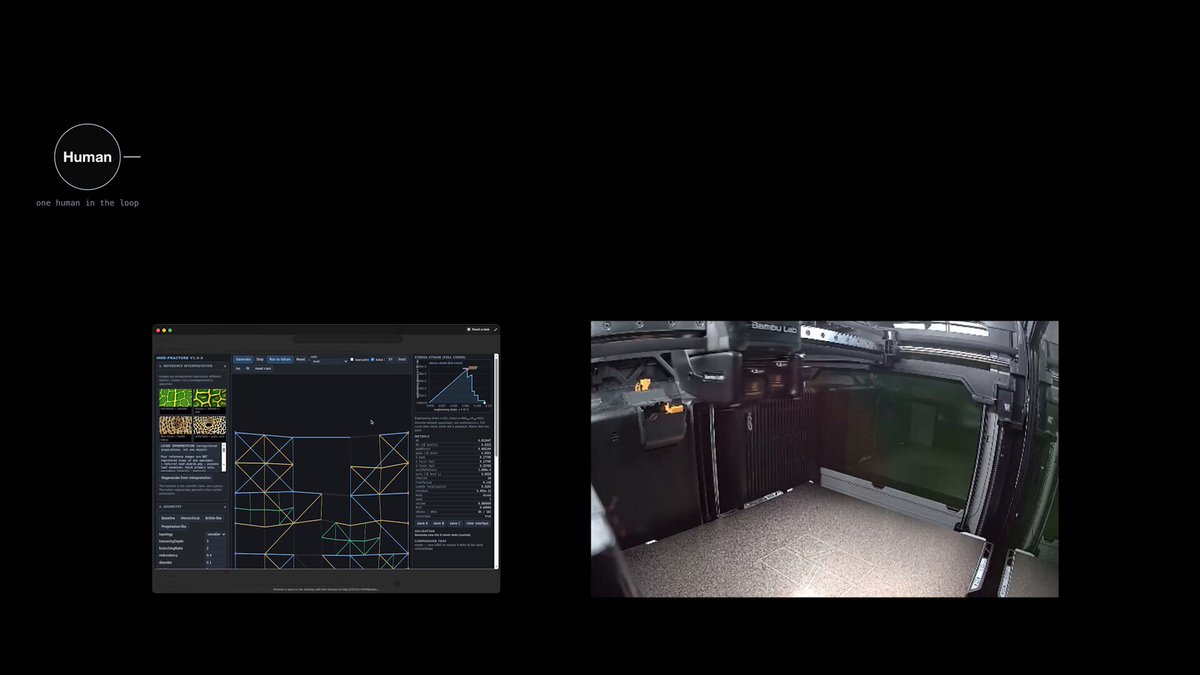
Can we compile matter - for instance, a pine cone - and derive new active materials, end-to-end from observation to manufacturing? If physical systems can be formalized as composable mathematics, we can point AI that has been shown to resolve long-open mathematical problems at matter itself. Our new work... show more

18 条评论

Code: Paper:

This is frontier thinking

A great collaboration. I look forward to the next one!!! ☝️

I have so much on paper and can't find a way to put it out. This is amazing!

That's just amazing !

neat!

@NoahChrein maybe you should visit this lab!

Close in one respect: we also care about hierarchy and whether function persists when units compose. In our abstract Native setup, merger events usually keep source function above the strongest parent (39/46), not universally, not additively.

yea this is wild turning a pinecone into compilable math then G-code then a real actuator is bioinspired engineering with type safety basically AI can now "compile" biology into physical parts

I've been making something exactly like this.

amazinggg work!

@sebkrier "An intriguing approach! But how do you mitigate the problem of cascading errors caused by LLM-Gödelization and bit flips—in order to drive the deviation rate per calculation down to 0% and simulate errors as mere point mutations?" — important for further applications

Yes

Can we generalize AI dealing with matter & material reality into some kind of (category-theoretic) Entscheidungsproblem

Compiling biology into printable actuators feels like actual sci fi

Applications like this will age better than chatbot benchmarks. compressing years of experimental iteration into hours is a measurable claim, not a demo. 5 stars

@grok what’s Lamina anima and active inheritance?

no, you cannot. classical computer cannot simulate quantum physics