正在加载视频...

视频加载失败

Chamath: Banning Open Source AI Will Crash the Stock Market Chamath Palihapitiya: “If the United States government intervenes, it will tank the stock market. Not debatable. Now, you can debate which companies get tanked. For example, if they said, ‘No more open source. American companies cannot use open source.’...

211,679 次观看 • 2 个月前 •via X (Twitter)

30 条评论

Ron Pragides  的头像
Ron Pragides 2 个月前

@chamath CHAMATH:

Mike Warner | Managed Websites | SEO | AEO | Intel 的头像
Mike Warner | Managed Websites | SEO | AEO | Intel2 个月前

Markets don't discount regulatory-capture revenue. They pay up for it. Moody's, S&P, the utilities, the defense primes all trade at premium multiples because the moat is legislated. Ban open source and you hand the closed players exactly that kind of moat. That gets valued up, not cratered.

Gnos Grajab, a 20-watt honeydew 的头像
Gnos Grajab, a 20-watt honeydew2 个月前

I am for one regulation. All deployed agents with autonomy to act, by law, must act on behalf of a human who is responsible for all actions made by the AI. This sets up a chain of accountability which will drive market demand for safe, reliable models, without intrusive government interference or oversight. This is a market solution.

KC 的头像
KC2 个月前

Banning OS wont necessarily hit stocks of companies that need to use AI, ex: Coca Cola. That would depend on if Coca Cola can still gain productivity by using closed source AI or not. Or foreign competitors would use cheaper OS AI to beat Coca Cola. There are many variables involved. Companies may not use OS AI unless security and backdoors are properly vetted.

Tungfa … τ 的头像
Tungfa … τ2 个月前

@markjeffrey @chamath Reg AI + Regulations + Open Source , their last show was Spot On 🤝

Carry 的头像
Carry2 个月前

@chamath the coca-cola framing is actually the clearest way ive heard this explained the cost structure argument lands harder than any freedom-of-speech angle ever will

Texian 的头像
Texian2 个月前

@chamath Who is suggesting this? The executive branch has the ability to do such a thing but this policy would not be terribly durable legally or with a change in the administration. No one in Congress is talking about this? The premise of this argument is a dumb sequitur

DS* 的头像
DS*2 个月前

@chamath Too much of the same advice!

lucas 的头像
lucas2 个月前

@chamath @grok does US have any com/segment whose moat is mostly regulatory capture at the moment, and valuation being crushed by Chamath's reasons?

Ramesh Byrapaneni Dr 的头像
Ramesh Byrapaneni Dr2 个月前

@chamath "Regulatory capture may inflate a few AI valuations today, but it plants the seeds of tomorrow's market collapse. True growth comes from open competition, not government thumbs on the scale—history shows closed doors breed stagnation, while open ecosystems build empires."

John Williams 的头像
John Williams2 个月前

@chamath

Daizy 的头像
Daizy2 个月前

@chamath Open source is oxygen.

Sir M 的头像
Sir M2 个月前

@chamath

Worth Seeing 的头像
Worth Seeing2 个月前

@chamath The debate over AI regulation is only getting bigger as the technology moves faster.

nosovietanymore 的头像
nosovietanymore2 个月前

@chamath Grok “DeepSeek is seeking investors and preparing for a possible IPO on Shanghai’s STAR Market even while keeping its strongest models open-source because open-source does not eliminate the need for massive capital “- 😊 open source at the start.

Marko 的头像
Marko2 个月前

Great episode! I was thinking the exact same thing last week How much intelligence is really enough to solve my IT tasks? In my experience, Opus and Fable give pretty similar results. They often don’t take enough context into account the way they should. But I truly believe open-source, on-prem, and local models are the future. We went from computers that started as shared terminals to personal computers — and the same shift is happening again now, with AI becoming personal AI

Luís Rodrigues 的头像
Luís Rodrigues2 个月前

@chamath The hard part of AI policy is balancing safety with keeping innovation open. Small decisions can have huge market effects.

walosomaloso 的头像
walosomaloso2 个月前

@chamath You mightcbe right. You might also cinclude that you are doing your own brand of fear mongering

Bugs Bunny from Beverly Hills 的头像
Bugs Bunny from Beverly Hills2 个月前

@chamath What do you mean by "crush"? It is inflated to the ceiling, an overvalued bubble. A crash is inevitable.

B Right 的头像
B Right2 个月前

@chamath Not to mention the healthcare tax in the US that is a similar noose around global competitiveness.

Lucky Cat 的头像
Lucky Cat2 个月前

@chamath chamath makes a solid point about regulatory capture distorting real market demand

J Lory 的头像
J Lory2 个月前

@chamath

Ezana Azene MD PhD 的头像
Ezana Azene MD PhD1 个月前

There are far less heavy-handed ways to address these risks than banning open-source models: KYC, open-source guardrails, engage China. KYC: Labs can substantially limit illicit distillation with the same KYC methods used in fintech. Model-routing services that provide access to U.S. frontier-model APIs, such as OpenRouter, should meet the same standard. Guardrails: Require U.S. companies to use frontier-level open-source models only in deployments with built-in safeguards, including on-premises deployments. Require periodic audits for sensitive sectors such as finance, defense, and critical infrastructure. @NIST Engage China: The CCP does not want open-source models banned in the United States. Nor does it want threat actors using them to create chaos. Those interests overlap. Negotiate accordingly. #OpenSourceAI #AIGovernance #AISafety

Murchadh ₿ 的头像
Murchadh ₿2 个月前

@chamath they will find a way to pass the baton off before the music stops and they lock everyone down again.

wgzhu1 的头像
wgzhu12 个月前

@chamath it won’t

Marcus Johansson 的头像
Marcus Johansson2 个月前

@chamath More bluntly: Do you bet on the gains of open sourced AI, or or on your current levels of tax benefits? - A public company may say: wow, we do not want our shares to tank. So what if we just move? Wouldn't that hit the US economy harder? 1/x

Worth Seeing 的头像
Worth Seeing2 个月前

@chamath Open source vs regulation is one of the biggest questions shaping the future of AI.

ThinkBigKorea🇰🇷🇺🇸 的头像
ThinkBigKorea🇰🇷🇺🇸2 个月前

@chamath Free world needs US open source model not Chinese ones.

The Long Game ♟️ 的头像
The Long Game ♟️2 个月前

@chamath Indeed. Why would America deliberately make its own businesses less competitive just to protect the pricing power of a few model providers? It's common sense.

Kovan 的头像
Kovan2 个月前

@chamath market demand should decide the winners, not regulation

相关视频

The *If* Market: Chamath Explains Why AI is Tanking Stocks @jason: What's happening in the market, Chamath? Is this the go-forward reality that AI is going to compress these kinds of stocks? Chamath Palihapitiya: In a normal functioning market, what we are always debating is *when* a set of cash flows go from becoming highly confident to less highly confident. It's a *when* conversation. So when will Coca-Cola's cash flows be impacted? When will Eli Lilly's cash flows be impacted? And the answer to the "when" gets translated by the public markets into three things: 1) your price to earnings multiple, 2) a revenue multiple, and 3) what's called your weighted average cost of capital. And the basic math of this is that when you have a high WACC, you're massively discounting these cash flows. When you have a low WACC, you're assuming that these things are very durable. Okay, so what is happening? We used to debate *when* – this is no longer a “when” moment, the market is very much in an "if" mode. Are these cash flows durable at all? Could they fall off a cliff in year three? Is there some AI model that's gonna come around the corner and obliterate this business without me knowing it? And because they've shifted into this "if" mindset, your risk becomes totally different. You have this event risk that you don't know how to price, and whenever the market shifts into that mode, what you see is that the holders of those equities want a massive margin of safety. What does that mean? They have to take PEs way down. If you used to trade at 40, you should trade at 20. If you used to trade at 20, you should trade at 10. They take revenue multiples down. You used to trade at 10x revenue, now you're gonna trade at 3x. You take the WACC way up. Used to be a 6% discounted weighted average cost of capital. You know what? I'm taking you to 12 or 13. That's the market's way of saying, I'm now debating if these things will even exist, and so I need to give myself a huge buffer to own this stuff. That's what's happening right now.

The All-In Podcast

73,879 次观看 • 7 个月前

David Sacks Predicts the Regulatory Capture Playbook to Ban Open Source AI, Step by Step: David Sacks: “I got bad news for you, Chamath, an open source ban is coming. They're not going to call it that. They're going to say that we simply have to apply the same standards to open models that we apply to closed ones. Here's how they do it step by step, let me explain how regulatory capture actually works. So first of all, you have to get this regulatory apparatus. Dario wants an FDA for AI, but he doesn't have enough political support for that, so instead they do this Trojan horse of a FINRA for AI. They call it self-regulating, it's not really, but anyway, that gets them off the ground. Now they've created the standard-setting organization. Now they've got pre-release model testing. Then the pressure grows to codify that in law, so that happens next. And then what they do is they say, ‘Look, all these standards need to apply equally to all models.’ But here's the problem with that. Open models and closed models are technologically different. Once you release an open model into the world, you can't roll it back and you can't monitor exactly how people are using it because they run it on their own hardware. Dario says this is what makes open models dangerous. So what they're going to do is they're going to have the standard-setting body say, ‘Well, we have to set the standards for AI safety.’ By the way, Dario and OpenAI, they're going to fund the whole thing. They're going to contribute all the compute. They're going to be behind it. They're going to be the ones coordinating with the government officials because frankly, people in government have no idea how to monitor and control and set standards for AI safety. Technologically, this is way beyond them. So they're going to go to these companies and say, ‘Tell us how to do it.’ And so what will happen is the standards will get set, and then it'll be a very simple matter of fairness to say that the standards need to apply to open as well as closed models. The open models cannot comply in the same way, and gradually they will be shut out of the market.”

The All-In Podcast

299,476 次观看 • 1 个月前

‼️ Donald Trump just posted the video saying any immigrant that comes to America and demand we change our culture is not an immigrant, they are an invader and must be removed “Just so we we’re clear, if a foreigner comes to your country and demands that you accept their culture as your culture or demands that you change your beliefs, that is not a foreigner, that is not an immigrant. What that is, is an invader. That is someone that is coming over to your space to take over and invade it. So when you sit there and you look at what's happening in New York, you look at what's happening in Texas, you look at what's happening in the places where these people came from, you look at Somalia, you look at all of these individuals who are being put into a position of power who support this type of invasion. You need to understand what's coming next. - They will take away our weapons - They will tell us that we cannot eat certain foods - They will tell us that we cannot go to certain places - They will tell that our women that they have to wear certain clothes - They will tell them that they have to dress modest. They will forced them to do a lot of different things. - You will have to deal with people praying in the middle of the street while you're driving and stopping you and invading your movement, your space You need to understand what's taking place in America so that you can understand that these people are not coming here with good intentions. This is not me saying that I hate people. This is me basically saying, look, if you like the fact that America is a free place where you get the freedom to believe in what religion you want to, to believe in. If you get the freedom to decide what you want to do as long as nobody is getting hurt. If you love that part of America, the freedom of choice part of America, you need to understand when people come over and they say that you don't have a choice, they probably should go because you don't get to tell us what to do in our own country. It's not being rude. It's just saying, hey, look, this country was built in a way where everybody can come here and feel happy and feel blessed. And enjoy the fact that this is a free nation, not a nation that will be enslaved by any Foreigner invading it”

Wall Street Apes

88,662 次观看 • 9 个月前

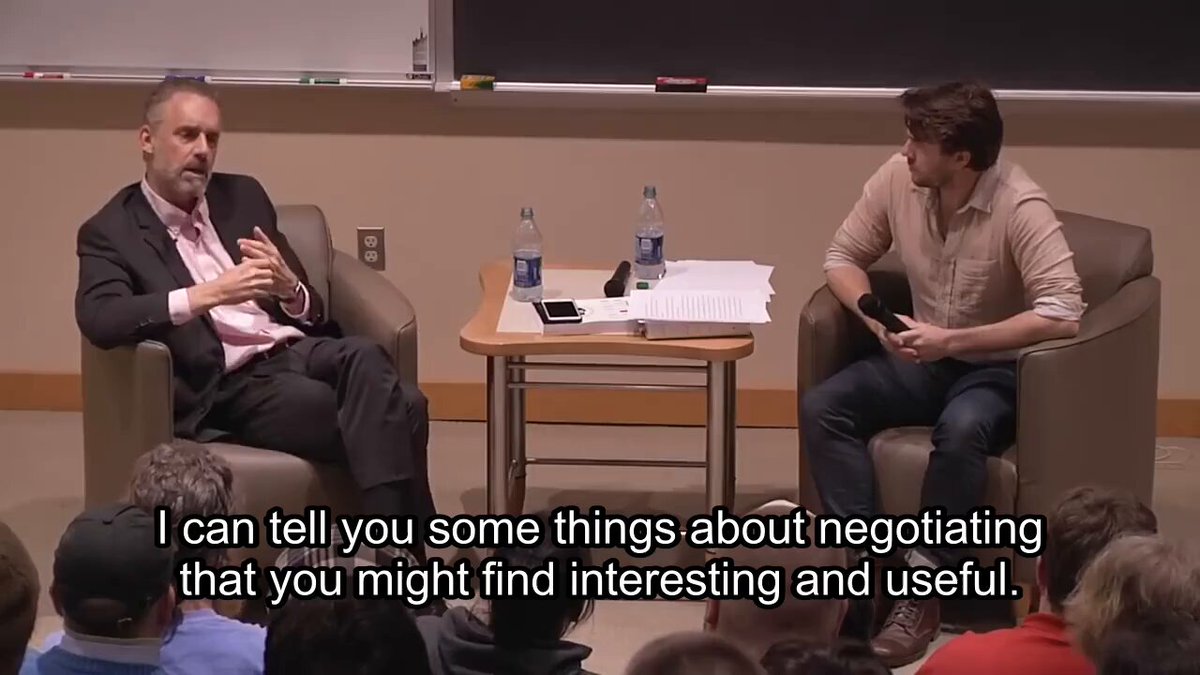
Jordan Peterson: "If you're competent and silent you will be ignored." "You might think well people should reward you because you're competent. And yes of course they should. But if you're competent and silent then you're just part of the background that's keeping everything functioning" On why you cannot negotiate from a position of weakness: "If you want to push your career forward you have to push it forward. You have to be competent and you have to be strategic" "To be strategic when you negotiate for a new position or a new salary you have to be able to say if you don't give me what I want then something you don't like will happen to you" "It's not a physical threat. It's that you have an option" "You have your CV in order. You're educated and competent and desirable to people outside of your immediate job. You're willing to instantly put yourself on the job market" "So that when you go talk to the person you're negotiating with you're credible" On the one thing most people completely miss about negotiation: "It's very seldom that you're talking to the person who's at the top of the pecking order. What you need to do is tell them a story that they can tell to their boss to make you not a problem" "A good story is look we really need this person because they're hyper competent and they have a better offer" "If you go in there with no power you're going to lose. Obviously" He concludes with the one thing every competent person needs to hear: "The first thing you need to know if you're going to negotiate is that you have to be able to say no. And what no means is that you're not going to do it"

Brad

35,334 次观看 • 1 个月前

Mark Cuban said what every CEO in America needs to hear. "There are only two types of companies in this world, those who are great at AI, and everybody else. If you don't know AI, you are going to fail. Period, end of story." Mark Cuban didn't stop there. "Whether you are an employee, you're going to have to understand how AI impacts your job and how you can use it to be better at your job. Same if you're a student. And if you're a CEO, you can't just say, okay, I'm going to get my tech guys to understand it and educate me on it. You have to understand it yourself because it will have significant impact on every single thing that you do. There's no avoiding it." This is coming from someone who built and sold the Dallas Mavericks, who made his first fortune selling a company to Yahoo for $5.7 billion in 1999, and who has spent the last two years going deeper on AI than almost any investor his age. He is describing the Innovator's AI Dilemma, entrepreneurs are right now building AI-native companies designed to displace every major incumbent. If a CEO tears down their company to rebuild it AI native, investors revolt but if they do nothing, AI-native startups eat their market and investors revolt anyway. Either path leads to shareholder lawsuits and there is no comfortable middle. The companies that survive will be the ones where leadership, not just the tech team, genuinely understands what the technology can do. The ones that don't will look back at this moment the same way Blockbuster looks at 2005.

StockMarket.News

163,468 次观看 • 5 个月前

David Friedberg Explains the Hidden Key Behind Trade Discussions: Regulatory Parity 🇺🇸 david friedberg on E225: "There's a lot of conversations about tariffs and about trade deficits, but very little about regulatory parity." "And I think that this is really critical for these trade negotiations to actually resolve to a positive outcome for American businesses and American enterprises, because there is not parity in how American businesses can do their work overseas relative to how foreign companies can do work in the US." "So if you're an Indian company and you want to sell something in the US, you set up an LLC, you set up a bank account, you set up a store, you take a lease, and you sell your product." "There is not a lot of hoops and challenges to that business operating in the United States." "The stories around the world start to paint the picture of why American businesses find it so hard to develop international markets and sell into those countries, when in the US we make it so easy for companies based in foreign countries to come and sell in America." "And that's a big part of where the trade imbalances arise from. It's not just because Vietnamese people can't afford expensive American goods, it's because it's so much more regulatorily difficult to do work in these countries." "They can come in and take your IP." "And so I think that this is a really important part of the trade discussions and negotiations that a lot of people miss, that American businesses will see massive revenue growth and massive market adoption if we can get regulatory parody in some of these key trade deals that are being negotiated."

The All-In Podcast

49,334 次观看 • 1 年前

Perfect breakdown of how Gavin Newsom is stealing the Pacific Palisades fire victims land “Did you see Gavin Newsom's new legislation that's pretty much going to force everyone in the Palisades to sell their home to the government. They just instituted new rules that said if you're going to rebuild your home after it burnt down from the Palisades wildfire, and if the expenditure on rebuilding that home is more than 50% of the prior property value, which is, let's just be real, everyone. - Now you need to raise the entire property structure of the home 3 to 4 feet to meet new floor flood requirements. Yeah, because the problem in the Palisades is too much water - If you're unaware, raising your entire property structure 3 to 4 feet in the Palisades, you're talking tens of millions of dollars per home - Not only will it cost tens of billions of dollars, but for each property, it's going to add years to the rebuild - Oh, and if you can't afford to do that, you can't rebuild - You're not allowed to rebuild your home unless you have a few extra tens of millions to be able to raise the property structure. So what would be your alternatives? Well, you could sell it privately. By the way, they just instituted new rules that are delaying people trying to privately sell their homes in the Palisades. However, you could sell to the government and they will expedite your sale. So if you're in the Palisades and your home burnt down, and when you go to rebuild, if the costs are more than 50% of what the house is worth before, which again, I will say is fine fucking everyone, unless you're building a fucking shack where a mansion used to be, you either need to spend tens of millions of dollars and wait years more, or you can wait years to sell privately, or you can have an expedited sale to the government. Yeah, you guys are never getting your homes back.”

Wall Street Apes

56,793 次观看 • 1 年前