Video wird geladen...

Video konnte nicht geladen werden

Zur Startseite

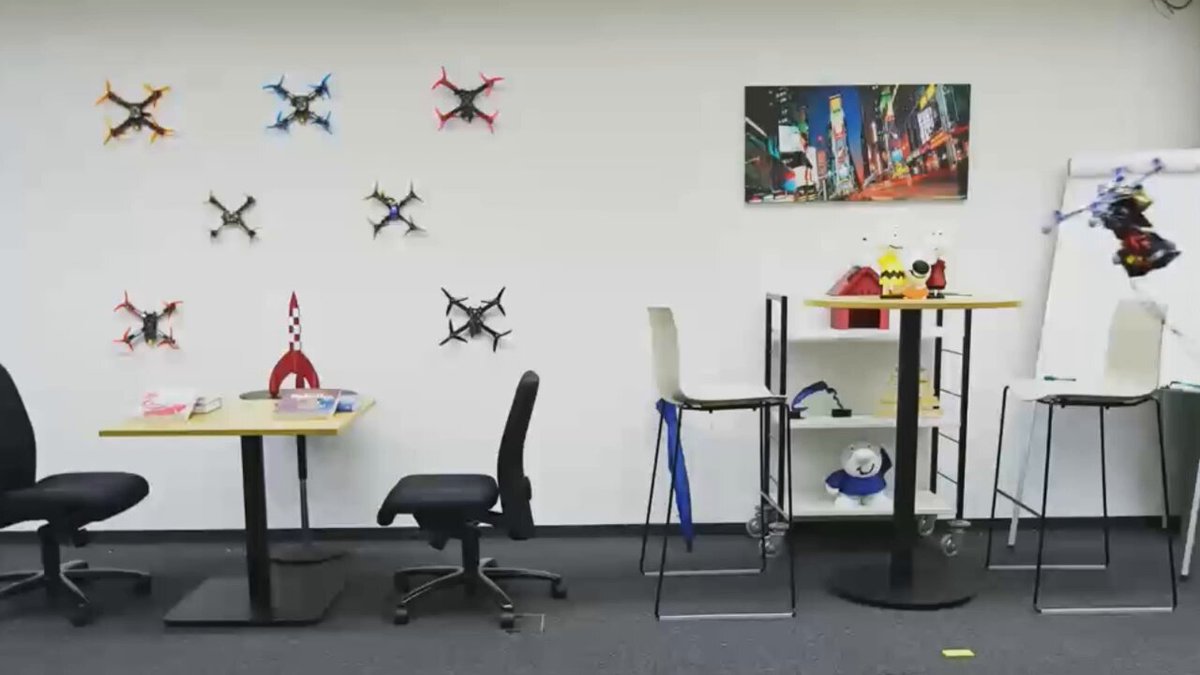
Check out our #RSS2024 paper "#MPCC++: Model Predictive Contouring Control for Time-Optimal Flight with Safety Constraints." Model Predictive Contouring Control (MPCC) has shown promising results for agile robotics applications, including car and drone racing. Existing approaches struggle to introduce safety considerations, often resulting in crashes. What does it take...

17,903 Aufrufe • vor 2 Jahren •via X (Twitter)

3 Kommentare

Profilbild von Julian Fried
Julian Friedvor 2 Jahren

Very cool

Profilbild von Charles Zhang
Charles Zhangvor 2 Jahren

cool

Profilbild von Senish Khadka
Senish Khadkavor 2 Jahren

Damn, but how did you localize the drones position? Imu?

Ähnliche Videos

Check out our latest work, "Actor-Critic Model Predictive Control: Differentiable Optimization meets Reinforcement Learning for Agile Flight," published in the IEEE Transactions on Robotics, where we reconcile #OptimalControl and #ReinforcementLearning, achieving the same super-human performance, but with superior generalizability, as our previous model-free deep RL! Code released! PDF: Code: Full Video: Model-free #ReinforcementLearning (RL) is known for its strong task performance and flexibility in optimizing general reward formulations. On the other hand, #ModelPredictiveControl (MPC) provides robustness, constraint handling, and powerful online replanning capabilities. In this work, we extend our previous AC-MPC paper (Romero, ICRA'24) by taking a deeper look at how both approaches can be unified. We introduce and extend Actor-Critic Model Predictive Control (AC-MPC), a framework that embeds a differentiable MPC inside an Actor-Critic RL architecture. This integration allows the MPC-based actor to perform short-term predictive optimization, while the critic facilitates long-horizon learning and exploration. We conduct a comprehensive study that highlights AC-MPC’s key advantages: - Better out-of-distribution generalization, both against unknown disturbances and changes in the quadrotor dynamics - Improved sample efficiency - A novel empirical analysis uncovering a relationship between the critic’s value function and the MPC cost function, providing deeper insight into their interplay. We validate our method in simulation and the real world on a quadcopter flying at superhuman speeds of up to 21 m/s, matching state-of-the-art model-free RL performance, and retaining the predictive structure of MPC for more reliable out-of-distribution behavior. Reference: Actor-Critic Model Predictive Control: Differentiable Optimization meets Reinforcement Learning for Agile Flight IEEE Transactions on Robotics (T-RO), 2025 PDF: Full Video: Code: Kudos to Ángel Romero, Elie Aljalbout, Yunlong Song! University of Zurich UZH Science UZH Space Hub AUTOASSESS European Research Council (ERC) UZHai

Davide Scaramuzza

27,279 Aufrufe • vor 8 Monaten

We are thrilled to share our breakthrough research on "Agile Flight from Pixels without State Estimation," to be presented and live-demonstrated at #RSS2024 next week! You heard well: no state estimation means no explicit visual localization, no SLAM, no VIO, and no IMU! Paper: Video (Narrated): Last year, we demonstrated that #ReinforcementLearning (RL) policies could outperform world-champion drone-racing pilots using the same quadrotor hardware; however, unlike human pilots, these policies continuously estimated an explicit state from known gate positions, the camera feed, and inertial measurements (IMU). In this new work, we tackle the challenge of learning vision-based drone racing using an end-to-end reinforcement learning approach that eliminates the need for IMU data or explicit state estimation. Like professional pilots, we go directly from images to control commands. The training is facilitated by an asymmetric actor-critic with access to privileged information. To overcome the computational complexity during image-based RL training, we use an appropriate sensor representation, which can be efficiently simulated during training without rendering images. We achieve agile flight at speeds up to 40 km/h with accelerations up to 2 g's. Although our demonstration focuses on drone racing, we believe that our method has an impact beyond drone racing and can serve as a foundation for future research into real-world applications in structured environments. Besides the paper presentation, we will also give a live demo next Tuesday and Wednesday between and hrs at TU Delft: Reference: Ismail Geles*, Leonard Bauersfeld*, Angel Romero, Jiaxu Xing, Davide Scaramuzza "Demonstrating Agile Flight from Pixels without State Estimation" Robotics: Science and Systems (RSS), 2024. Kudos to Ismail Geles Leonard Bauersfeld Ángel Romero Jiaxu Xing! University of Zurich UZH Science UZH Space Hub Aerial Core AUTOASSESS European Research Council (ERC)

Davide Scaramuzza

27,959 Aufrufe • vor 2 Jahren

We are excited to share our latest work, "Superhuman Safe and Agile Racing through Multi-Agent Reinforcement Learning," done in collaboration with Google DeepMind . Autonomous drones have reached superhuman speed in isolation, but what happens when multiple agents share the same airspace? Paper: Website: Video: Using league-based self-play, we train #ReinforcementLearning agents that race against a diverse, evolving population of opponents. Through this competitive training, sophisticated behaviors emerge without explicit programming: strategic overtaking, proactive collision avoidance, and even awareness of aerodynamic downwash from nearby drones. In real-world multi-player races at speeds exceeding 80kph (50 mph) and accelerations up to 7g, our agents outperform a five-time Swiss national drone racing champion while reducing collision rates by 50% compared to single-agent baselines. Crucially, training against diverse artificial opponents enables zero-shot generalization to human pilots, achieving over 90% race completion in mixed human-AI races with up to four competitors. A key insight: human pilots adopt riskier strategies when trailing, leading to more crashes under competitive pressure. Our learned policies, by contrast, maintain consistent safety margins regardless of race standing, a property essential for deploying autonomous systems alongside humans. Also, the multi-agent self-play policies are more robust than those trained independently, suggesting that training in competitive environments is not only key to winning races but also to learning safer, more reliable autonomy for real-world multi-robot systems. Kudos to Ismail Geles, Leonard Bauersfeld, Markus Wulfmeier! Ismail Geles Leonard Bauersfeld Markus Wulfmeier European Research Council (ERC) UZH IfI University of Zurich UZH Science UZH Space Hub Swiss Robotics NCCR Robotics

Davide Scaramuzza

14,713 Aufrufe • vor 3 Monaten

Can an inexpensive, off-the-shelf IMU be the only sensor to estimate the full state (position, velocity, orientation) of a quadrotor flying through a track at high speed and even be on-pair with vision-based localization? The answer is yes, within certain limitations! In this #RAL2023 paper, we propose a learning-based odometry algorithm that couples a model-based filter driven by the inertial measurements with a learning-based module with access to the control commands. Our system outperforms by a large margin the state-of-the-art visual-inertial odometry (#VIO) algorithms and the state-of-the-art learned-inertial odometry algorithm, #TLIO, for the task of drone racing. Additionally, we show that our system is as accurate as a VIO algorithm that uses a camera to localize to a known map of the racing track. The main limitation of our approach is that it cannot generalize to trajectories that have not been seen at training time. However, in drone racing competitions, the track is known beforehand. Human pilots spend hours or even days of practice on the race track before the competition. Similarly, our system can be trained with the data collected during practice time and deployed during the competition. Future work will investigate how to generalize to trajectories not seen at training time. The code is released! Paper: Video: Code: Kudos to Giovanni Cioffi Leonard Bauersfeld Elia Kaufmann European Research Council (ERC) University of Zurich UZH Science UZH Space Hub NCCR Robotics Aerial Core #RAL2023 #IROS2023 #SLAM

Davide Scaramuzza

37,061 Aufrufe • vor 3 Jahren

We are excited to share our work “Event-Aided Sharp Radiance Field Reconstruction for Fast-Flying Drones” published in IEEE Transactions on Robotics IEEE Transactions on Robotics (T-RO), which tackles sharp radiance field reconstruction under agile drone motion, where RGB frames are heavily motion-blurred and pose priors become unreliable! 4 years in the making! Code & dataset released! PDF: Code & Dataset: Full Narrated Video: High-speed flight is essential for time- and battery-constrained missions (e.g., inspection, exploration, search & rescue). However, fast motion corrupts visual data with severe motion blur and introduces drift/noise in visual-inertial odometry, making NeRF-based 3D reconstruction particularly brittle. We propose a unified framework that leverages asynchronous #EventCamera streams together with motion-blurred frames to reconstruct high-fidelity radiance fields from agile drone flights. Our key idea is to embed event-image fusion directly into radiance field optimization while jointly refining a shared, continuous-time camera trajectory initialized from event-based VIO. This enables us to recover sharp radiance fields and accurate trajectories without ground-truth supervision during training. We validate our method on synthetic data and on real sequences captured by a drone flying up to 2 m/s. Despite severe blur and noisy pose priors, our method preserves fine scene details and achieves a performance gain of over 50% on real-world data compared to state-of-the-art methods. Kudos to Rong Zou and Marco Cannici! Marco Cannici Reference: Rong Zou*, Marco Cannici*, Davide Scaramuzza Event-Aided Sharp Radiance Field Reconstruction for Fast-Flying Drones IEEE Transactions on Robotics (T-RO), 2026 NCCR Robotics European Research Council (ERC) AUTOASSESS UZH IfI University of Zurich UZH Science Prophesee SynSense UZH Space Hub

Davide Scaramuzza

12,028 Aufrufe • vor 6 Monaten

France Minister of Transportation on Tesla's FSD in new video: "The safety trade-offs are not yet sufficient to authorize it as it currently stands. All the more so since this system is not a self-driving system; So what are our concerns? Without going into overly technical detail, there are several. First example: we've found that the system allows for speeding. Another example: according to the data we have, the system doesn't guarantee an optimal level of driver attention in urban settings and during the most complex maneuvers, such as lane changes, intersections, or roundabouts. So what are the next steps? We're currently continuing our technical discussions with the Netherlands, other European states, and Tesla to refine our analysis. Last week, a representative from the Ministry of Transport's services traveled to the Netherlands. I want to emphasize this: France supports these technologies, and their deployment must happen within a framework of trust that allows us to evaluate the systems and determine what adjustments FSD needs to guarantee a high level of safety. This autumn, I will also be bringing together the French autonomous vehicle ecosystem to present the levers that will accelerate the deployment of this technology and to set a direction for the coming years. In France, we're fortunate to have world-class automakers and automotive suppliers, as well as some of the best engineers in the world in artificial intelligence and digital technology. We have real cards to play, and we're ready to play them — but never at the expense of safety on our roads."

Sawyer Merritt

710,900 Aufrufe • vor 2 Monaten

Check out our #PAMI paper with code "Dense Continuous-Time Optical Flow from Event Cameras," where we show how to regress *continuous-time* trajectories of every pixel from event cameras alone or events plus frames! The key idea is to iteratively estimate per-pixel polynomials using a recurrent lookup and update scheme. Paper: Code: DOI: We present a method for estimating dense continuous-time optical flow from event data. Traditional dense optical flow methods compute the pixel displacement between two images. Due to missing information, these approaches cannot recover the pixel trajectories in the blind time between two images. We show that it is possible to compute per-pixel, continuous-time optical flow using events from an event camera. Events provide temporally fine-grained information about movement in pixel space due to their asynchronous nature and microsecond response time. We leverage these benefits to predict pixel trajectories densely in continuous time via parameterized Bézier curves. To achieve this, we build a neural network with strong inductive biases for this task: First, we build multiple sequential correlation volumes in time using event data. Second, we use Bézier curves to index these correlation volumes at multiple timestamps along the trajectory. Third, we use the retrieved correlation to update the Bézier curve representations iteratively. Our method can optionally include image pairs to boost performance further. To train and evaluate our model, we introduce a synthetic dataset (MultiFlow) that features moving objects and ground truth trajectories for every pixel. Our quantitative experiments suggest that our method successfully predicts pixel trajectories in continuous time and is competitive in the traditional two-view pixel displacement metric on MultiFlow and DSEC-Flow. Open source code and datasets are released to the public. Kudos to Mathias Gehrig Manasi Muglikar

Davide Scaramuzza

12,682 Aufrufe • vor 2 Jahren

Check out our #ECCV2026 paper "Low-latency Event-based Object Detection with Spatially-Sparse Linear Attention", where we make linear attention sparse in space, recurrent in time, and parallel in training, enabling the first purely-linear-attention-based neural network for asynchronous object detection with #EventCameras, outperforming the previous best asynchronous method with 20x less computation with truly event-by-event inference on CPU! Code released! Paper: Code: Video: Event cameras promise extremely low-latency vision, but to fully exploit them, the neural network must be low-latency too. We introduce #SpatiallySparseLinearAttention (#SSLA) for asynchronous object detection directly from raw events. Linear attention is particularly appealing for event cameras: it can be trained efficiently in parallel on long event sequences, while at inference it operates recurrently, updating its prediction every time a new event arrives. The problem is that conventional linear attention updates its entire state for every event. For object detection, where fine spatial resolution matters, this quickly becomes expensive. Our key idea is simple: an event only carries information about a small spatial region, so why update the entire spatial state? SSLA updates only the relevant parts of the state, enabling fine-grained spatial representations while keeping per-event computation low. We achieve: - >20× lower per-event computation than the strongest prior asynchronous baseline - State-of-the-art accuracy among asynchronous object detection methods - Truly event-by-event inference on CPU, designed to preserve the latency advantage of event cameras Come to our poster on Friday September 11, 2026 from 4-6pm at ExHall #389 Reference: Haiqing Hao, Zhipeng Sui, Rong Zou, Zijia Dai, Nikola Zubić, Davide Scaramuzza, Wenhui Wang Low-latency Event-based Object Detection with Spatially-Sparse Linear Attention ECCV, 2026 Prophesee SynSense University of Zurich UZH Science European Research Council (ERC) UZHai UZH IfI Tesla BYD #EventCameras #ComputerVision #Robotics #DeepLearning #NeuromorphicVision #AI

Davide Scaramuzza

52,650 Aufrufe • vor 27 Tagen

InstantDrag Improving Interactivity in Drag-based Image Editing discuss: Drag-based image editing has recently gained popularity for its interactivity and precision. However, despite the ability of text-to-image models to generate samples within a second, drag editing still lags behind due to the challenge of accurately reflecting user interaction while maintaining image content. Some existing approaches rely on computationally intensive per-image optimization or intricate guidance-based methods, requiring additional inputs such as masks for movable regions and text prompts, thereby compromising the interactivity of the editing process. We introduce InstantDrag, an optimization-free pipeline that enhances interactivity and speed, requiring only an image and a drag instruction as input. InstantDrag consists of two carefully designed networks: a drag-conditioned optical flow generator (FlowGen) and an optical flow-conditioned diffusion model (FlowDiffusion). InstantDrag learns motion dynamics for drag-based image editing in real-world video datasets by decomposing the task into motion generation and motion-conditioned image generation. We demonstrate InstantDrag's capability to perform fast, photo-realistic edits without masks or text prompts through experiments on facial video datasets and general scenes. These results highlight the efficiency of our approach in handling drag-based image editing, making it a promising solution for interactive, real-time applications.

AK

71,232 Aufrufe • vor 2 Jahren

🚨 The Silvia team just announced our latest engineering advancement. Every business wants access to the highest level of intelligence, but at the lowest cost possible. The rise of LLMs has made intelligence abundant, yet one of the hardest problems across startups and corporate America is predicting the compute cost associated with this intelligence. I have been dealing with this personally as we build Silvia and the problem comes up in almost every conversation I have with CEOs, founders, and executives. Every business embraced AI about 18 months ago and things seemed great until the compute bills started to show up. The bills for internal compute usage were difficult to swallow, but things got outrageous if you had an AI product that allowed your users to consume compute without limits. I know this problem intimately because that is the situation that Silvia was in. Every question that was asked meant higher compute costs for our company. But we didn’t want to limit usage because users were getting genuine value out of the product. This challenge sent our team down a deep rabbit hole of cutting costs, while improving the experience for users. The second part was really important: we did not want to degrade the user experience by simply taking away access to the highest quality models. Thankfully, resource constraints breed innovation. We aren’t the biggest company, nor do we have the largest balance sheet, but we came up with a very novel solution that we are announcing today. The Silvia engineering team built a model router that cut costs by up to 29%, decreased latency, and improved the quality of answers for users. Trifecta! The way we do this is by reading the first 500 characters of a query and then predicting the level of effort that will be needed by a model to answer the query. The highest effort needs are routed to the most powerful models. The lowest effort needs are routed to different, better models for the query. A good example of this would be “what is the date?” You don’t need to use the latest Anthropic model to answer this query. In fact, sending a simple query like this to the most powerful model will make your compute costs increase and will actually increase the latency, which means a worse user experience for the Silvia user. By implementing the model router, the user gets a better experience and we get lower costs. Win-win. One of the interesting aspects of the implementation is that our model router runs on CPUs instead of GPUs. This allows us to read the query and predict the level of effort needed in less than 1 millisecond. This CPU implementation is why latency is not affected, nor is cost significantly increased by any potential additional GPU consumption. Another important point is that many of you have probably seen the news that OpenRouter is being purchased by Stripe for around $7 billion. This is a great outcome from what appears to be a very smart, capable team. Their model routing API is related (their product and our internal implementation both touch model routing), but you should think of OpenRouter as making it possible to do model routing for companies, while Silvia’s model router is a custom, intelligent system that specifically routes Silvia queries to the right model. They give access to the functionality of model routing to many companies, while our internal product does the real decision-making specific to our use case. Lastly, our implementation of a model router is a strategic bet that will allow us to become model-agnostic over time. We don’t care who created the different models, we just want to route a query to the model best positioned to answer. The large model labs will never allow their users to be model agnostic, but that would require the lab to potentially route a query to a competitor’s model. No bueno in their eyes. Instead, Silvia being an independent AI research lab gives us the power of being agnostic. We simply want the best experience for our users. Last week we announced that Silvia is now the most accurate AI tax product on the market, including beating OpenAI, Anthropic, Google, and xAI. Today we are announcing a custom, in-house model router that rivals the best technology anyone else has built. There will be many more engineering announcements to come. I truly believe we have assembled one of the best AI teams and we are currently the best AI research lab in finance. If you are interested in learning more about the technical details of the model router, you can read the engineering blog post here: Everyone wants the best intelligence and the lowest cost. Silvia just showed the world what is possible in this pursuit. I anticipate many other companies will build this custom solutions to achieve the same benefits.

Anthony Pompliano 🌪

76,176 Aufrufe • vor 1 Monat