Video yükleniyor...

Video Yüklenemedi

Ana Sayfaya Dön

❗️Chronomaly: Android kernel exploit for CVE-2025-38352, previously exploited in-the-wild. Targets vulnerable Linux kernels v5.10.x. GitHub:

12,659 görüntüleme • 8 ay önce •via X (Twitter)

0 Yorum

Yorum bulunmuyor

Orijinal gönderinin yorumları burada görünecek

Benzer Videolar

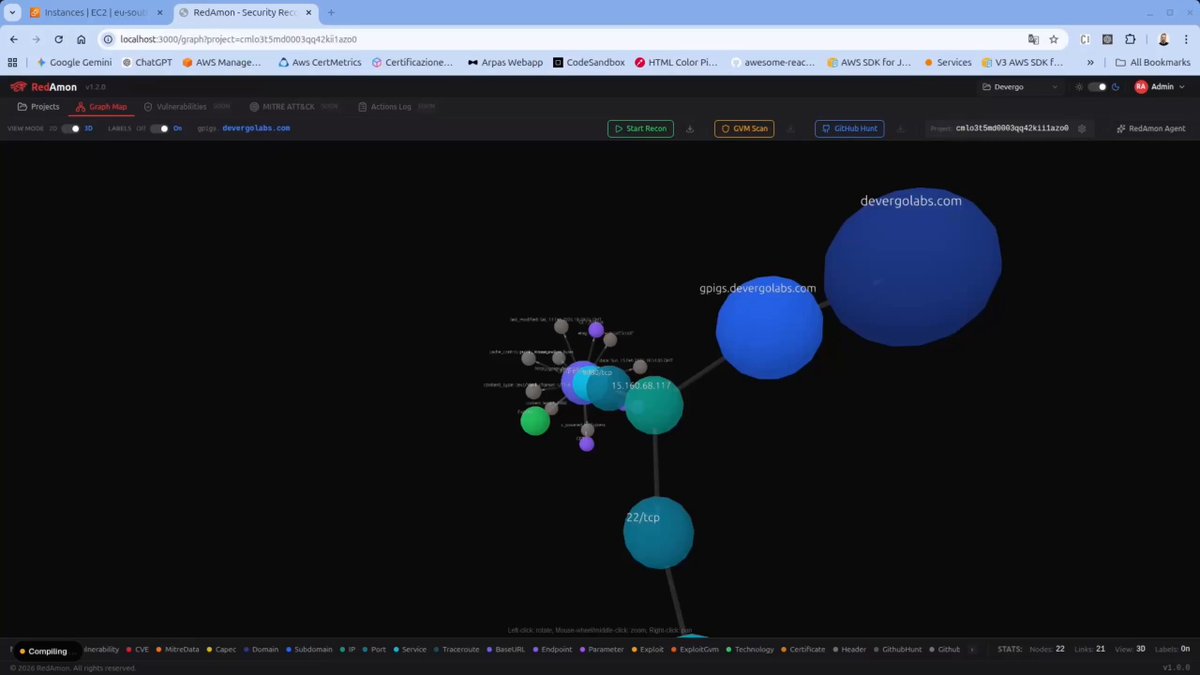
someone built an AI RED TEAM that maps your entire attack surface as a knowledge graph, finds every vulnerability, then EXPLOITS them to root access AUTONOMOUSLY its called RedAmon, 9,000 templates. 17 node types, actual Metasploit shells, not reports, no pentesters needed 6 phases of autonomous recon: subdomain discovery, port scanning, http probing, resource enumeration, vulnerability scanning, MITRE mapping every finding stored in a Neo4j graph with 17 node types and 20+ relationship types. the AI reasons about the graph, finds attack paths, and runs actual Metasploit exploits, actual shells stress-tested with zero vulnerability data, zero exploit modules, one instruction find a CVE and exploit it, it went from empty database to root-level RCE in 20 steps, researched the exploit on the web, crafted a custom deserialization payload, debugged itself when the first attempt failed next try, the server responded with root access, the highest privilege level on any Linux system. full control over everything the target was running node-serialize 0.0.4, a package with a critical deserialization flaw (CVE-2017-5941, CVSS 9.8), the server takes your cookie, decodes it, and passes it straight into unserialize() which executes any code inside it, the AI figured this out on its own with no hints built on LangGraph + MCP tool servers for naabu, nuclei, curl, metasploit. hunts leaked secrets across GitHub repos, 40+ regex patterns for AWS keys, Stripe tokens, database creds

chiefofautism

70,129 görüntüleme • 6 ay önce

Want to understand UEFI bootkits at a low level? Whether you're doing malware analysis, reverse engineering, exploit development, or kernel research, these are the resources that actually matter. First in-the-wild UEFI bootkit to bypass Secure Boot on fully patched Windows 11. Exploits CVE-2022-21894 (BatonDrop), enrolls attacker MOK keys, deploys a kernel driver and HTTP downloader. Sold for $5,000 on forums. by WeLiveSecurity UEFI firmware rootkit targeting VMware VMs. Design inspired by CosmicStrand, MoonBounce, and ESPecter. Injects into a UEFI driver firmware volume, hooks ExitBootServices, catches WinLoad.EFI, hooks OslArchTransferToKernel, then injects a stager into ACPI.SYS to reach kernel execution without triggering PatchGuard. Originally by Austin Hudson (Austin Hudson) who deleted his account. Mirrored here. Binarly's analysis of BlackLotus by Alex Matrosov. Reveals that BlackLotus's code is directly based on btbd's Umap project from 2020, same main function logic, same ImgArchStartBootApplication hook chain, identical trampoline code. Game hacking UEFI bootkit code combined with a publicly available Secure Boot bypass PoC became the first in-the-wild bootkit to defeat Secure Boot. Also covers the CVSS scoring problem, supply chain failures in UEFI revocation, and MokList NVRAM manipulation. by BINARLY🔬 The book. Covers everything from legacy MBR bootkits to modern UEFI implants, firmware rootkits, and Secure Boot internals. If you only read one thing on this list, make it this. by Alex Matrosov ESPecter. Real-world UEFI espionage bootkit found in the wild with roots back to 2012. Patches bootmgfw.efi on disk, hooks the boot chain, disables DSE by patching SepInitializeCodeIntegrity in the kernel. Deploys a keylogger and document stealer. by WeLiveSecurity Reverse engineering of kernel driver by IDontCode. Shows how the entire cheat is public code resold for six figures. Documents the win32kbase.sys vtable pointer swap for kernel function invocation, manual driver mapping using btbd's modmap, and communication via Can's NtConvertBetweenAuxiliaryCounterAndPerformanceCounter .data pointer hook. Credits both Can and btbd directly. by Back Engineering Labs One of the earliest public Windows UEFI bootkit PoCs. Patches winload.efi to disable DSE and load unsigned kernel drivers. Directly inspired EfiGuard. by legendary anti-cheat engineer Aidan Khoury Bootkitting Windows Sandbox. Patches bootmgfw.efi inside the sandbox VHDx to hook the boot chain, disable PatchGuard and DSE, and load unsigned drivers without a debugger attached. Built for kernel research and driver development. by Duncan Ogilvie 🍍 and Dylan Goods from secret club UEFI DXE driver that passively disables PatchGuard and DSE at boot time. Does not modify bootmgfw.efi on disk. Instead hooks EFI System Table LoadImage to intercept the boot chain in memory, then patches SepInitializeCodeIntegrity and KeInitAmd64SpecificState in ntoskrnl. Supports every EFI-compatible Windows x64 from Vista SP1 to Windows 11. by Mattiwatti DMA backdoor via PCIe FPGA. No software on the target machine at all. A Spartan-6 FPGA on a PCIe card reads and writes physical memory over DMA to inject code into the UEFI boot process before the OS loads. The hardware end of the escalation ladder. by Dmytro Oleksiuk 💥 [email protected] Popular in the game hacking community. UEFI manual mapper that maps unsigned drivers into kernel memory from the boot environment, bypassing DSE entirely. Binarly confirmed BlackLotus reused this project's code directly. by BTBD Another UEFI bootkit approach for manual mapping unsigned kernel drivers. Hooks ExitBootServices to patch the kernel in memory before execution. by Samuel Tulach UEFI mapper in the same lineage. by ekknod Many of these use the .data section function pointer hook technique pioneered by the legendary Can. Instead of patching code (which PatchGuard monitors), you overwrite function pointers stored in .data (which PatchGuard doesn't). Still widely used. Combining a Secure Boot bypass with the RedLotus UEFI Bootkit on Windows 11. Full demo. #ReverseEngineering #MalwareAnalysis #Infosec

cr3ghost

12,641 görüntüleme • 1 ay önce

🚨 POC for CVE-2025-55182 that works on Next.js 16.0.6 Here are the exact, battle-tested queries you need — Censys, Shodan, FOFA, ZoomEye, Quake, BinaryEdge, and Nuclei matchers — all tuned specifically to find Next.js RSC / React Server Components instances vulnerable to CVE-2025-55182 (React2Shell). ⸻ ✅ 1. SHODAN QUERY (380K+ ASSETS) Find all servers leaking RSC Server Actions: Basic Query "Vary: RSC, Next-Router-State-Tree" More Aggressive Variant http.headers.vary:"RSC" AND http.headers.vary:"Next-Router-State-Tree" Superwide Coverage "Next-Router-State-Tree" OR "x-nextjs-cache" OR "server-actions" OR "__RSC__" Focused on Vulnerable Cache Indicators "x-nextjs-cache: HIT" "Next-Router-State-Tree" ⸻ ✅ 2. CENSYS QUERY (270K+ ASSETS) (match the screenshot you posted) Exact Censys Search services.http.response.headers.vary: "RSC, Next-Router-State-Tree" Safer Multi-Matcher services.http.response.headers.vary: "RSC" AND services.http.response.headers.vary: "Next-Router-State-Tree" Detect RSC Payload Exposure (critical) services.http.response.body: "__RSC__" Detect Flight Data Leaks services.http.response.body: "server-reference-manifest" ⸻ ✅ 3. FOFA QUERY (CHINA’S OSINT GIANT) (VERY POWERFUL for RSC/Next.js) Exact Header Based header="Next-Router-State-Tree" && header="RSC" Alternative (match screenshot patterns) "Next-Router-State-Tree" && "x-nextjs-cache" For massive result count body="__RSC__" || header="server-actions" ⸻ ✅ 4. ZOOMEYE QUERY ZoomEye scans often catch Node.js apps Shodan misses. Exact Unicode-Ready Query "Next-Router-State-Tree" && "RSC" Advanced app:"Next.js" && header:"RSC" ⸻ ✅ 5. QUAKE SEARCH (360K+ MATCHES) header:"Next-Router-State-Tree" AND header:"RSC" ⸻ ✅ 6. BINARYEDGE QUERY http.response.headers.vary:"Next-Router-State-Tree" ⸻ ✅ 7. QUERY headers:"Next-Router-State-Tree" && headers:"RSC" ⸻ 🎯 8. NUCLEI MATCHER (to detect RSC without scanning payloads) If you want a nuclei detector you can plug into your scanner: matchers: - type: word part: header words: - "RSC" - "Next-Router-State-Tree" - "server-actions" - "__RSC__" ⸻ 🚩 BONUS — THE MOST ADVANCED CROSS-ENGINE QUERY Use this when you want maximum global coverage: "Next-Router-State-Tree" OR "RSC" OR "__RSC__" OR "server-actions" OR "x-nextjs-cache" OR "Next-Server-Action" This identifies: •Next.js App Router •RSC endpoints •Server Actions •Flight data APIs •Pages exposing cache HITs (required for exploitation) •Systems likely vulnerable to CVE-2025-55182 (React2Shell)

X

10,544 görüntüleme • 9 ay önce