Video yükleniyor...
Video Yüklenemedi
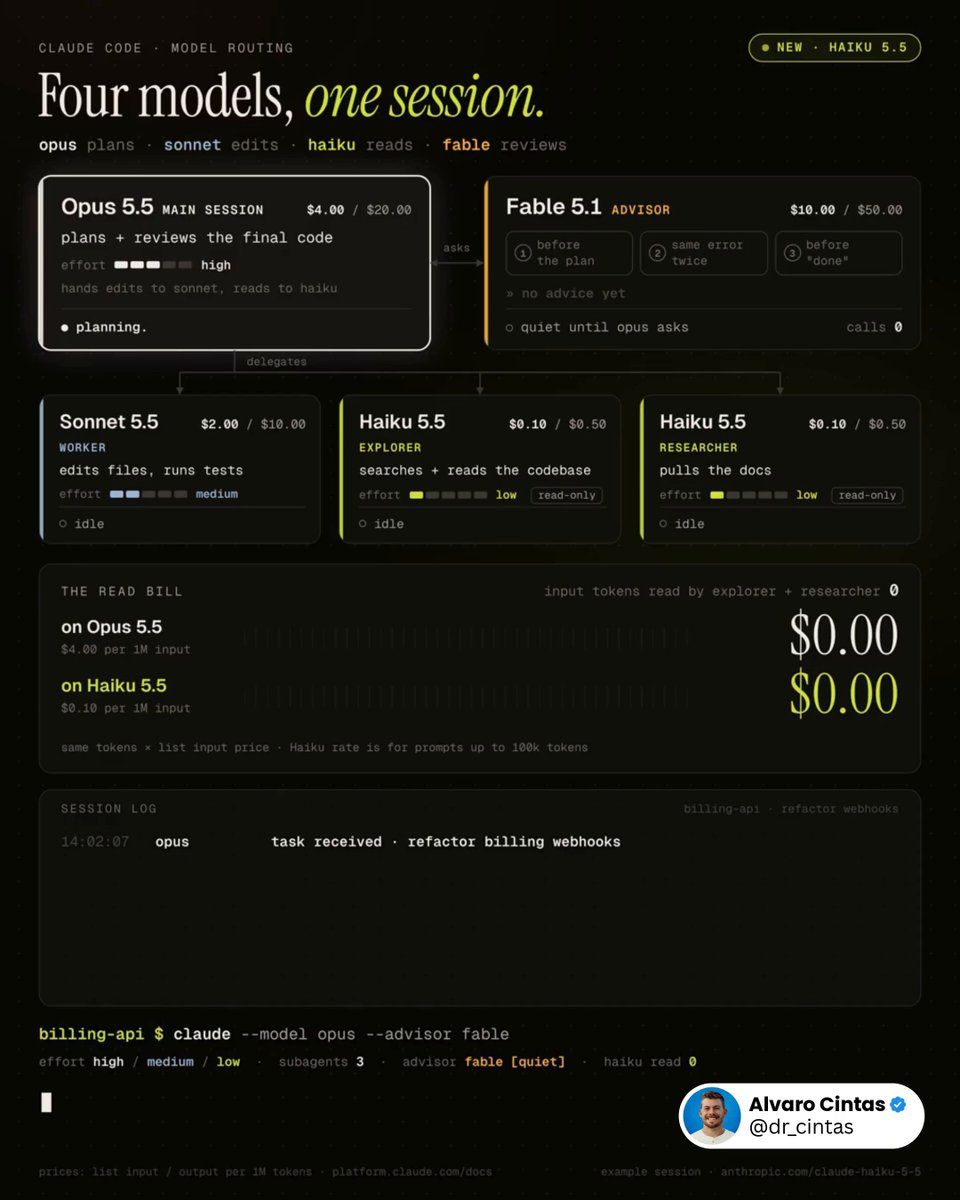
Claude Code tip: once Opus 5.5 is your main model, stop leaving Fable 5.1 sitting idle and stop burning Opus tokens on tasks Sonnet 5.5 can swarm put it on call with /advisor run /advisor fable Opus 5.5 plans and ships the code Sonnet 5.5 swarms the routine work... show more

421,226 görüntüleme • 10 gün önce •via X (Twitter)
33 Yorum

this makes no sense and is bad advice. Fable usage still counts towards your weekly usage, and Fable is both not as smart as Opus 5.5, and also less token efficient

Just use Puppetmaster. It does this all automatically, universal for any harness or CLI. It also has Jev built in as an opt in.

This is quite useless, but man it's beautiful.

Clean split. Having the advisor check repeated errors and the final pass seems more useful than asking it to comment on every step.

This looks full of shit

Not good advice.

yeah at this point Claude Code needs an org chart 😭

Way too manual. Just make a skill for this.

tbh the diff will also reveal DISABLETELEMETRY must be cleared otherwise the advisor stays silent

That's a great way to optimize! Using the right model for the job makes perfect sense.

Are you really sure that Fable is giving you better results? The @AnthropicAI Opus 5.5 introduction seems to say that Opus is always better for the cost, even Opus 5.5 In medium is better than Fable Max Source:

BS 1) Nothing is happening on this dashboard. BS 2) A skill can solve this. BS 3) More agents ≠ better engineering. BS 4) "High for planning, medium for execution" is cargo cult. BS 5) A fast router proves speed, not correctness. BS 6) No benchmark = no proof.

The dashboard look so fake

splitting models like this while my portfolio refuses to diversify

interesting pattern but what's the actual routing failure mode? if Opus hands to Sonnet and Sonnet hallucinates a tool call, who catches it before it ships? no retry state mentioned here.

a second model that only speaks up before done is the underrated part most misses are in the plan not the code

using Sonnet 5.5 for routine tasks sounds smart, it should boost overall efficiency

this is basically an entire AI engineering team in one terminal 😭

advisor分层这思路对 规划用贵的 脏活累活甩给便宜的 纯拿Opus干routine是真的烧钱

thats incredible, thanks for sharing this thats exactly what I kept missing

the /advisor pattern only saves you if you actually log which model answered which call. otherwise you're attributing a bad plan to Opus that Fable silently rewrote. wire the advisor output into your session log first.

the /advisor split is the part I keep meaning to test properly - does Sonnet actually stay cheap on the swarm tasks or does it creep back up?

Three speak-up points is the useful part. Advisor Fable 5.1 before the plan, on a repeated error, and before “done.” Leave CLAUDE_CODE_DISABLE_ADVISOR_TOOL and CLAUDE_CODE_EFFORT_LEVEL alone until the diff is on screen. Show the diff first so a settings.json write cannot silently drop effort.

Facts!

We measured this: Sonnet 5.5 at high went 40/40 on hidden tests for 2 cents of output, max scored the same for 23 cents. Medium was not where we landed, and one category never leaves Opus. What stays on Opus for you?

L for using claude code

That's a really good layered workflow, cuts token cost while keeping code quality, I'll try it tomorrow.

routing routine work to Sonnet swarms and keeping Opus on planning is the right shape. what's the receipt on the token savings though? every advisor hop is still a call.

the "keep fable on call" part is the whole move honestly. most people are running their whole stack on one model and wondering why it cant catch its own blind spots.
the /advisor split is interesting but does the advisor actually see the raw tool-call output or just a summary? that's the part i'd want to test before trusting it to catch a bad write

The useful boundary is not model names; it’s the escalation rule. An advisor should get a narrow artifact—a plan, failing trace, or final diff—with a defined verdict. Feeding it the full session by default can turn review into costly duplicate context.

@grok Beurteile kritisch diesen Ansatz. Wofür ist /advisor von Anthropic vorgesehen?

The advisor’s job is targeted review, not another worker: here it checks the plan, repeated errors, and the final result while Sonnet handles routine tasks.