正在加载视频...

视频加载失败

DeWorldSG: Depth-Aware 3D Semantic Scene Graph Generation via World-Model Priors ECCV 2026 TL; DR DeWorldSG generates spatio-temporally consistent 3D semantic scene graphs from RGB-D sequences by combining depth-aware probabilistic object modeling with world-model-guided relation reasoning.

31,089 次观看 • 1 个月前 •via X (Twitter)

6 条评论

Ryohei Sasaki@engineer 的头像
Ryohei Sasaki@engineer1 个月前

Linkedin Gihub io

VAI 的头像
VAI1 个月前

The tldr is longer than the initial explanation 😆

Matt Radford 的头像
Matt Radford1 个月前

Realtime?

Pathetic Brook 的头像
Pathetic Brook1 个月前

I could’ve used this 2 days ago 😭

qiuwei001 的头像
qiuwei0011 个月前

可交互吗

Turner NextGen AI 的头像
Turner NextGen AI1 个月前

Sometimes a lower-level measurement is useful because it helps explain a higher-level organizational problem. But it should be requested because it matters to the function, not collected automatically because the system knows how to measure it. Measure what the reasoning requires. Do not force the reasoning to follow whatever you happened to measure.

相关视频

DreamCraft3D: Hierarchical 3D Generation with Bootstrapped Diffusion Prior paper page: present DreamCraft3D, a hierarchical 3D content generation method that produces high-fidelity and coherent 3D objects. We tackle the problem by leveraging a 2D reference image to guide the stages of geometry sculpting and texture boosting. A central focus of this work is to address the consistency issue that existing works encounter. To sculpt geometries that render coherently, we perform score distillation sampling via a view-dependent diffusion model. This 3D prior, alongside several training strategies, prioritizes the geometry consistency but compromises the texture fidelity. We further propose Bootstrapped Score Distillation to specifically boost the texture. We train a personalized diffusion model, Dreambooth, on the augmented renderings of the scene, imbuing it with 3D knowledge of the scene being optimized. The score distillation from this 3D-aware diffusion prior provides view-consistent guidance for the scene. Notably, through an alternating optimization of the diffusion prior and 3D scene representation, we achieve mutually reinforcing improvements: the optimized 3D scene aids in training the scene-specific diffusion model, which offers increasingly view-consistent guidance for 3D optimization. The optimization is thus bootstrapped and leads to substantial texture boosting. With tailored 3D priors throughout the hierarchical generation, DreamCraft3D generates coherent 3D objects with photorealistic renderings, advancing the state-of-the-art in 3D content generation.

AK

161,530 次观看 • 2 年前

LayerPano3D Layered 3D Panorama for Hyper-Immersive Scene Generation discuss: 3D immersive scene generation is a challenging yet critical task in computer vision and graphics. A desired virtual 3D scene should 1) exhibit omnidirectional view consistency, and 2) allow for free exploration in complex scene hierarchies. Existing methods either rely on successive scene expansion via inpainting or employ panorama representation to represent large FOV scene environments. However, the generated scene suffers from semantic drift during expansion and is unable to handle occlusion among scene hierarchies. To tackle these challenges, we introduce LayerPano3D, a novel framework for full-view, explorable panoramic 3D scene generation from a single text prompt. Our key insight is to decompose a reference 2D panorama into multiple layers at different depth levels, where each layer reveals the unseen space from the reference views via diffusion prior. LayerPano3D comprises multiple dedicated designs: 1) we introduce a novel text-guided anchor view synthesis pipeline for high-quality, consistent panorama generation. 2) We pioneer the Layered 3D Panorama as underlying representation to manage complex scene hierarchies and lift it into 3D Gaussians to splat detailed 360-degree omnidirectional scenes with unconstrained viewing paths. Extensive experiments demonstrate that our framework generates state-of-the-art 3D panoramic scene in both full view consistency and immersive exploratory experience. We believe that LayerPano3D holds promise for advancing 3D panoramic scene creation with numerous applications.

AK

41,891 次观看 • 2 年前

MAGS-SLAM: Monocular Multi-Agent Gaussian Splatting SLAM for Geometrically and Photometrically Consistent Reconstruction TL;DR: The first RGB-only multi-agent 3D Gaussian Splatting SLAM for collaborative photorealistic scene reconstruction. Contributions: (1) We propose the first monocular RGB-only multi-agent 3D Gaussian Splatting SLAM system. It integrates Gaussian front-ends, compact submap summaries, inter-agent verification, Sim(3) submap pose graph, and occupancy-aware fusion into a unified framework, achieving accurate tracking and photorealistic reconstruction without depth sensors. (2) We propose a Pose-Graph Bundle Adjustment (PGBA)-consistent Sim(3) loop closure mechanism for multi-agent systems, which jointly resolves intra- and inter-agent scale drift through a submap-level Sim(3) pose graph coupling geometric and photometric residuals. Robustness is ensured by a spatial-extent gate that rejects degenerate loops and an adaptive edge invalidation scheme consistent with evolving PGBA corrections. (3) We propose an occupancy-aware fusion framework for coherent multi-agent Gaussian maps. It combines occupancy-grid deduplication, decoupled coordinator, and joint pose-Gaussian photometric refinement to eliminate duplicated Gaussians, residual misalignment, and photometric seams across agents. (4) We introduce ReplicaMultiagent Plus dataset. While existing multi-agent datasets are typically limited to 2-3 agents with short trajectories, our dataset scales to 4 agents with long-horizon trajectories. In addition, we provide ground-truth geometry and semantic annotations, supporting the evaluation of monocular, RGB-D, and semantic multi-agent SLAM for collaborative dense reconstruction.

MrNeRF

19,518 次观看 • 4 个月前

Blended-NeRF: Zero-Shot Object Generation and Blending in Existing Neural Radiance Fields paper page: Editing a local region or a specific object in a 3D scene represented by a NeRF is challenging, mainly due to the implicit nature of the scene representation. Consistently blending a new realistic object into the scene adds an additional level of difficulty. We present Blended-NeRF, a robust and flexible framework for editing a specific region of interest in an existing NeRF scene, based on text prompts or image patches, along with a 3D ROI box. Our method leverages a pretrained language-image model to steer the synthesis towards a user-provided text prompt or image patch, along with a 3D MLP model initialized on an existing NeRF scene to generate the object and blend it into a specified region in the original scene. We allow local editing by localizing a 3D ROI box in the input scene, and seamlessly blend the content synthesized inside the ROI with the existing scene using a novel volumetric blending technique. To obtain natural looking and view-consistent results, we leverage existing and new geometric priors and 3D augmentations for improving the visual fidelity of the final result. We test our framework both qualitatively and quantitatively on a variety of real 3D scenes and text prompts, demonstrating realistic multi-view consistent results with much flexibility and diversity compared to the baselines. Finally, we show the applicability of our framework for several 3D editing applications, including adding new objects to a scene, removing/replacing/altering existing objects, and texture conversion.

AK

62,768 次观看 • 3 年前

🚀 Announcing Echo — our new frontier model for 3D world generation. Echo turns a simple text prompt or image into a fully explorable, 3D-consistent world. Instead of disconnected views, the result is a single, coherent spatial representation you can move through freely. This is part of a bigger shift in AI: from generating pixels and tokens to generating spaces. Echo predicts a geometry-grounded 3D scene at metric scale, meaning every novel view, depth map, and interaction comes from the same underlying world — not independent hallucinations. Once generated, the world is interactive in real time. You control the camera, explore from any angle, and render instantly — even on low-end hardware, directly in the browser. High-quality 3D world exploration is no longer gated by expensive equipment. Under the hood, Echo infers a physically grounded 3D representation and converts it into a renderable format. For our web demo, we use 3D Gaussian Splatting (3DGS) for fast, GPU-friendly rendering — but the representation itself is flexible and can be easily adapted. Why this matters: consistent 3D worlds unlock real workflows — digital twins, 3D design, game environments, robotics simulation, and more. From a single photo or a line of text, Echo builds worlds that are reliable, editable, and spatially faithful. Echo also enables scene editing and restyling. Change materials, remove or add objects, explore design variations — all while preserving global 3D consistency. Editing no longer breaks the world. This is only the beginning. Echo is the foundation for future world models with dynamics, physical reasoning, and richer interaction — environments that don’t just look right, but behave right. Explore the generated worlds on our website and sign up for the closed beta. The era of spatial intelligence starts here. 🌍 #Echo #WorldModels #SpatialAI #3DFoundationModels Check it out:

SpAItial AI

177,073 次观看 • 9 个月前

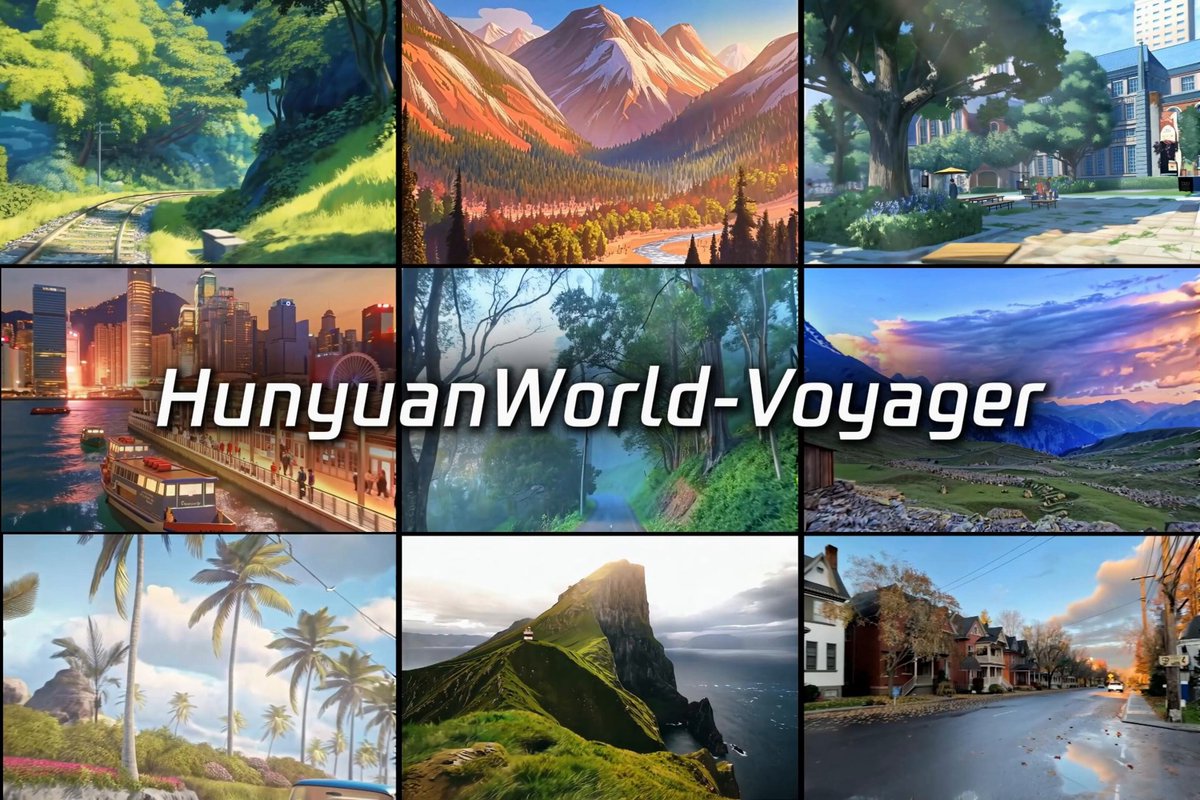
World Model is trending— let's revisit our HunyuanWorld journey. We’ve been pioneering open-source 3D world generation in the past two months, and this ride’s only getting started. 🌍 📅 July: HunyuanWorld 1.0 📌 First open-source 3D world model compatible with CG pipelines (Unity/Unreal/Blender) 📌 Hit 2K+ GitHub stars in just two months ⭐—thank you for the love! 📅 August: 1.0-Lite 📌Same top-tier quality, running on consumer GPUs! 📅 September: 1.0-Voyager 📌 Direct 3D output + world memory—taking exploration further! Seamlessly integrated into CG pipelines with layered 3D modeling (assets, terrain, skybox) and fully open-sourced.. we’re fully committed to building open-source spatial intelligence for all! 🚀 💡 Why it matters? ✅ Seamless CG Pipeline Integration: Export generated 3D scenes as standard mesh formats, effortlessly integrating into industry-standard tools like Blender, Unity, and Unreal Engine for direct editing, animation, and physical simulation. ✅ Hierarchical Scene Editing: Deconstruct scenes into semantic layers (sky, background, foreground objects) via instance recognition and layer decomposition, allowing for atomic-level control—independently modify, relocate, or replace objects without rebuilding the entire world. Project page: Github: Amazing creations by Stijn Spanhove camenduru GENEL | AIを用いた動画制作 apolinario 🌐 とりにく Directive Creator 🪥 👇 #AI #3DGeneration #OpenSource #WorldModels #Hunyuan3D #HunyuanWorld

Tencent HY

20,178 次观看 • 1 年前

Alibaba presents MIMO Controllable Character Video Synthesis with Spatial Decomposed Modeling Character video synthesis aims to produce realistic videos of animatable characters within lifelike scenes. As a fundamental problem in the computer vision and graphics community, 3D works typically require multi-view captures for per-case training, which severely limits their applicability of modeling arbitrary characters in a short time. Recent 2D methods break this limitation via pre-trained diffusion models, but they struggle for pose generality and scene interaction. To this end, we propose MIMO, a novel framework which can not only synthesize character videos with controllable attributes (i.e., character, motion and scene) provided by simple user inputs, but also simultaneously achieve advanced scalability to arbitrary characters, generality to novel 3D motions, and applicability to interactive real-world scenes in a unified framework. The core idea is to encode the 2D video to compact spatial codes, considering the inherent 3D nature of video occurrence. Concretely, we lift the 2D frame pixels into 3D using monocular depth estimators, and decompose the video clip to three spatial components (i.e., main human, underlying scene, and floating occlusion) in hierarchical layers based on the 3D depth. These components are further encoded to canonical identity code, structured motion code and full scene code, which are utilized as control signals of synthesis process. The design of spatial decomposed modeling enables flexible user control, complex motion expression, as well as 3D-aware synthesis for scene interactions. Experimental results demonstrate effectiveness and robustness of the proposed method.

AK

149,079 次观看 • 2 年前

Chinese robotics company Astribot released their latest World-Action Model (WAM), Lumo-2. Technical breakdown: - based on a frozen 🥶 Qwen-3.5 4B VLM - trained in 3 progressive stages: 1. Action is aligned with latent world dynamics (an abstract representation of action). Real-world actions are anchored to physical constraints, while the latent space is guided to focus on motion-relevant changes. This bidirectional relationship makes the model physically grounded -> critical for a world model. 2. Action is aligned with vision and language. Reusing the vision backbone and action encoder from the frozen VLM, the authors add a custom vocabulary (for new actions), a semantic module, an action decoder, and an action projector. This aligns the (new) action representations with the (existing) vision-language semantic space. Most importantly: it builds a direct mapping from natural-language instructions to motor execution. 3. End-to-end training on language, video, and robot data. Only the new modules (everything outside the frozen backbone) are trained end-to-end across temporal reasoning, physical understanding, long-horizon, and dexterous manipulation. At the end of the day, Lumo-2 is not the best on benchmarks, but that's not the point. What's genuinely new: - a way to combine latent world modeling and action generation through progressive alignment - a physically-grounded latent dynamics space - it lifts performance on unseen objects using un-annotated human egocentric video + Vision Pro captures, no special transfer algorithm needed Why it matters: - the whole model is thin trainable adapters (semantic module, action decoder/projector) on a frozen 4B backbone (cheap) - that scale is suited for real-time embedded inference (~2.71× decode speedup, no accuracy loss) - its real moat is long-horizon execution, where the added temporal memory pays off far more than on any other task As a result, this robot can now make your latte (5x sped up video):

Léo

32,513 次观看 • 2 个月前