Video wird geladen...

Video konnte nicht geladen werden

Zur Startseite

Dylan Patel, founder of SemiAnalysis, on why GitHub keeps breaking: "The entire cloud market ran out of CPUs. Microsoft sold all their spare ones to Anthropic and OpenAI. They have none left." That GitHub instability you keep hitting isn't a bug. It's the AI labs eating the world's compute....

82,561 Aufrufe • vor 1 Monat •via X (Twitter)

0 Kommentare

Keine Kommentare verfügbar

Kommentare vom Original-Post werden hier angezeigt

Ähnliche Videos

Microsoft sold every spare CPU it had to Anthropic and OpenAI. Amazon tripled its CPU buys year over year and still can't keep up. Two of AWS's biggest customers asked Andy Jassy if they could buy the entire 2026 production run of Graviton chips. He said no. The ratio inside an AI datacenter used to be 100 megawatts of GPUs to 1 megawatt of CPUs. CPUs handled storage, checkpointing, pre-processing. Light work. GPUs did the actual training and inference. Then OpenAI shipped o1-preview in September 2024. RL post-training went from "check the model output with a regex" to "run classifiers" to "compile the code and run the unit tests" to "spin up a sandbox, call three databases, run a physics simulation, verify the answer." Every rollout now needs a CPU-backed environment to verify against. Codex 5.4 runs agentically for 6-7 hours at a time. Each database call, each cron job, each scraped URL is CPU work. Coding agent revenue went from a couple billion to north of $10B in six months. That compute is sitting on CPUs. The CPU to GPU ratio is now approaching 1:1. The entire global cloud was built for 1:8. That's why GitHub has been unstable for weeks. Nvidia and Arm both announced they're entering the server CPU market in March. TSMC will only meet 80% of server CPU wafer demand this year. High-end server CPU prices are already up 50%. When the GPU king and the IP licensor both pivot to CPUs in the same month, the boring chip isn't boring anymore.

Aakash Gupta

290,593 Aufrufe • vor 2 Monaten

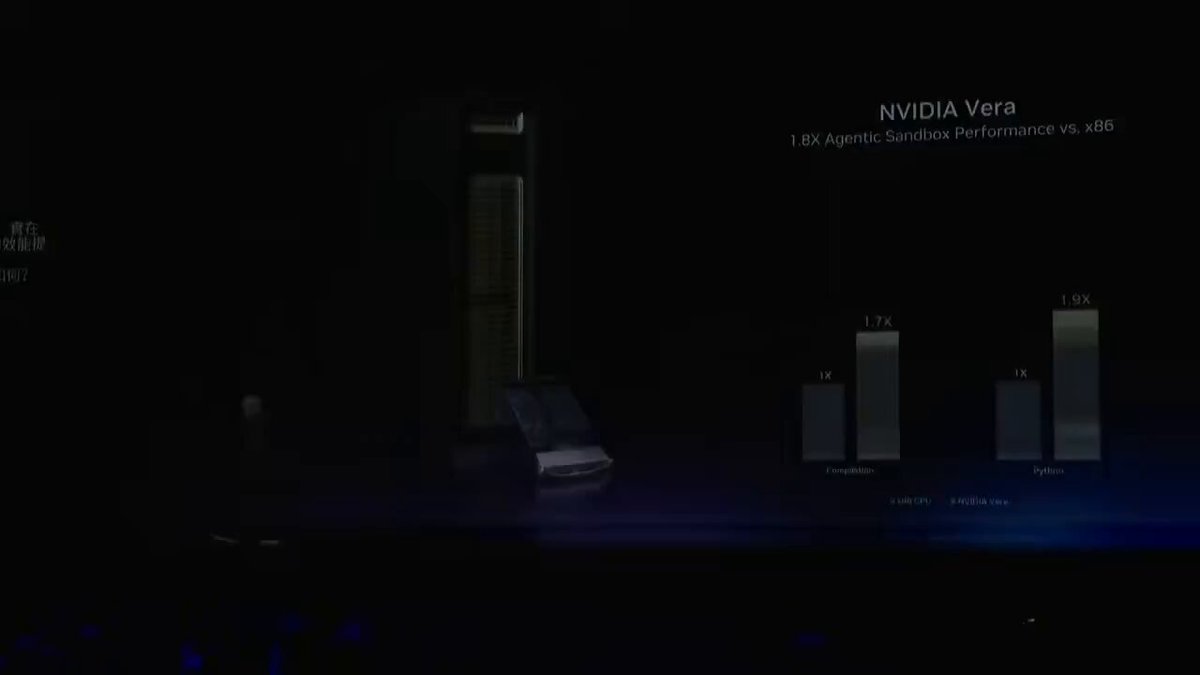
Jensen Huang just identified the next $200 billion market (Save this). The shift starts with a observation about agentic AI that changes everything about infrastructure. In the era of training and inference, the GPU was everything while CPU was a traffic cop, scheduling work, managing memory, dispatching tasks while the GPU did the heavy lifting. Agentic AI breaks that model entirely. An AI agent does not just run a single inference pass but rather it plans, calls tools, executes code in sandboxes, retrieves data from multiple sources and loops through complex multi-step reasoning sequences often thousands of times per second at scale. Every one of those operations runs through the CPU and the GPU sits idle waiting for the CPU to prepare the next task, supply the right context and execute the retrieval and tool calling logic fast enough to keep the accelerators fed. The CPU is now the conductor and the GPU is the orchestra and the bottleneck is the conductor falling behind. This is showing up in production AI factory utilization right now, which is exactly why Jensen built Vera from scratch rather than licensing x86. Vera achieves 40% lower peak memory latency than x86, 50% faster core to core communication, and 1.8 times the agentic sandbox performance of current x86 processors on a purpose-built architecture designed around the agentic loop. Now here is where the investment thesis gets interesting. The obvious beneficiary is Nvidia itself, and that thesis is real. Nvidia's CFO has guided for nearly $20 billion in Vera CPU revenue this fiscal year alone, a market Nvidia had zero presence in just three years ago. Intel held 60% of server CPU market share as recently as Q4 2025 and that transition is now happening at a pace Intel structurally cannot respond to. But the deeper question is, what architecture is Vera actually built on? Vera's Olympus cores are ARM compatible and every single Vera CPU deployed in every Vera Rubin rack in every data center in the world runs on ARM architecture. And ARM Holdings collects a royalty on every one of them. ARM does not make chips but rather licenses the instruction set architecture and CPU core designs that others build on top of. Every time Nvidia ships a Vera CPU, every time a hyperscaler deploys a Vera Rubin rack, every time an enterprise qualifies Vera for their AI factory, ARM earns a royalty. The secular tailwind here is almost perfectly constructed for ARM's business model. Amazon's Graviton, Microsoft's Cobalt, Google's Axion, Apple's silicon stack, and Qualcomm's data center push all run on ARM. And now Nvidia's Vera, which is projected to displace Intel as the largest server CPU supplier by revenue in a single fiscal year, is ARM. ARM's royalty rate on high end server chips is estimated at roughly 1 to 2% of chip selling price. At $5,000 per Vera CPU and 4 million units projected for FY2027, that is a royalty line growing from near zero to potentially $400 million to $800 million annually from Nvidia's data center CPU business alone before counting Amazon, Microsoft, Google, Apple, and Qualcomm. The total ARM addressable royalty base across all the silicon it already licenses is compounding at a rate that the current $130 billion market cap does not fully reflect. Jensen's CPU thesis is the most underappreciated catalyst in ARM's fundamental story, and the royalty compounding has barely started. Come join Milk Road Pro and get our full ARM royalty model and our entire AI trade thesis. Link below!

Milk Road AI

11,819 Aufrufe • vor 1 Monat

Microsoft just betrayed OpenAI and Anthropic, the two companies it helped build. And it could break the entire AI trade... Here's what happened: Inside Excel and Outlook, two of the most used business apps on Earth, Microsoft has started routing tens of thousands of AI requests every week to its own in-house models instead of OpenAI and Anthropic. Microsoft's own AI chief, Mustafa Suleyman, said himself: "We pay a lot of money to Anthropic, so our goal is to reduce and ultimately ELIMINATE that cost." This is the company that poured $13 billion into OpenAI and effectively created the modern AI industry, and it just decided the most advanced models on the market are NOT worth paying for. And here's the thing... Microsoft is not just ripping out OpenAI everywhere - it is being surgical about it. The hardest and rarest tasks can still go to OpenAI or Anthropic. What Microsoft is taking back is the boring, high-volume work, like the email replies, the thread summaries, and the simple spreadsheet formulas. Why does that matter so much? Because that boring, repetitive work is where the actual money lives. The frontier labs assumed businesses would push BILLIONS of these tiny requests through expensive models forever. That endless river of tokens is the entire reason OpenAI and Anthropic are valued in the hundreds of billions of dollars. Microsoft looked at that river, decided it was massively overpaying, and rerouted it to models it owns outright. So the single biggest customer in the industry just walked off with the most profitable part of the business. And it is not only Microsoft: That same week, CNBC reported that American companies have been escaping to Chinese AI models to dodge rising US prices. Chinese models now handle more than 30% of US companies' AI usage on one major platform, peaking at 46%, up from an average of 11% a year earlier. They cost 60 to 90% less, and on some benchmarks they land within a single point of the best American model. One US startup moved ALL of its AI traffic off Claude and onto China's DeepSeek, and expects to save millions. Meanwhile Meta just admitted it has "excess" AI compute it wants to sell, becoming the first giant to concede it built far too much. Do you see the pattern forming? For two years, the entire AI story rested on one assumption: Every company on Earth would happily pay premium prices for the best model, forever. That assumption literally died in a single week. And the market noticed. More than a trillion dollars has been wiped off AI and chip stocks in a matter of days, as Wall Street finally started asking whether all of this spending will ever pay for itself. What this means for OpenAI and Anthropic: Their models are extraordinary, and it may not matter because their own biggest customers have decided they do not NEED the best model in the world to answer an email, and "good enough" now costs a fraction of the price. When even Microsoft refuses to pay full price for AI, the real question becomes who exactly IS left to pay it. What do you think?

Ricardo

92,690 Aufrufe • vor 7 Tagen