Loading video...

Video Failed to Load

Go Home

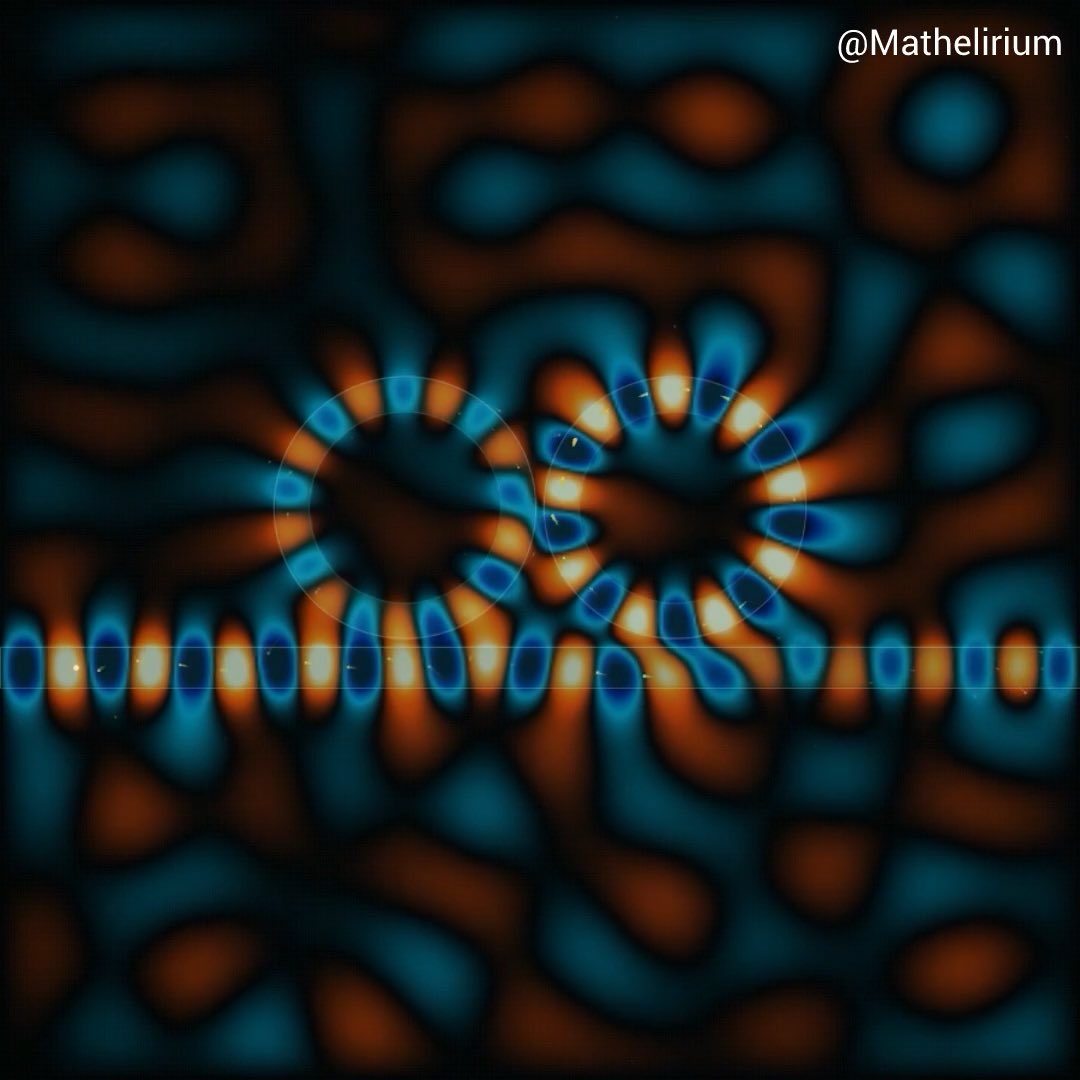
Finite Element Methods use fine meshes only where greater detail is needed, allowing the focusing behavior of a convex lens to be simulated accurately without the cost of refining the entire domain.

16,128 views • 2 months ago •via X (Twitter)

0 Comments

No comments available

Comments from the original post will appear here

Related Videos

Do you actually know what convex optimization is in the geometric, guarantee-theoretic sense or have you only met it through solvers and loss curves? Convexity is rare comfort in optimization...there are no spurious local minima, no surprise traps, and inequalities you can use like tools instead of prayers. So, what is this convexity? Let x = (x₁, x₂) and let f(x) be convex. Plot the surface z = f(x). Pick a contact point x₀. The local slope is the gradient p = ∇f(x₀). That p is exactly the data that defines the supporting plane: z = f(x₀) + p · (x − x₀). Thus, f is said to be convex because for every x, f(x) ≥ f(x₀) + p · (x − x₀). So the plane at x₀ can slide under the surface, but it never slices through it. Not near the point...everywhere. Now for here is the interesting part: The slope becomes a coordinate system! Rewrite the same plane as z = p · x − b, where b is the offset. Because the plane passes through (x₀, f(x₀)), the offset is forced to be b = p · x₀ − f(x₀). And that number isn’t just geometry trivia. It’s the convex conjugate: f*(p) = sup over x ( p · x − f(x) ). At a differentiable contact point, the supporting plane touches f tightly enough that the supremum is achieved at x₀, giving the identity f*(p) = p · x₀ − f(x₀) when p = ∇f(x₀). So one moving contact point gives two linked readouts: primal position x₀ dual position (slope) p = ∇f(x₀) dual offset f*(p) One surface. Two worlds. #ConvexOptimization #Optimization #MachineLearning #SignalProcessing #AppliedMath #Engineering

Mathelirium

38,506 views • 7 months ago

Ask anyone who’s taken a course in Ordinary Differential Equations (ODEs) what a solution to an ODE represents geometrically, and most of them won’t have a clean answer. When I first took ordinary differential equations, the pattern was always the same. Early on it turns into a speedrun of methods: separation of variables, integrating factors, variation of parameters, Bernoulli, exact equations. Then pretty quickly the course slides into hammer-picking. Spot the form, apply the recipe, move on. Too mechanical! And the real problem is what you don’t walk away with. You leave with a toolkit, but without a feel for what a differential equation even is, especially geometrically. That matters because in real modeling the equations you meet are rarely nice enough to reward memorised recipes. So you get trained to solve toy forms, while the actual subject stays blurry. The behavior. The flow. The shape of solutions. It wasn't until I watched the first lecture of Professor Arthur Mattuck that I realized I didn’t actually know what a solution to a differential equation represents geometrically. His point is almost embarrassingly simple. A first-order ODE is a slope field, and a solution is a curve that stays tangent to that field everywhere. The math breakdown: Write the ODE as dy/dx = f(x,y). At each point (x,y), attach a tiny line segment with slope f(x,y). A function y = y₁(x) is a solution exactly when its graph follows those slopes. At every x, the slope of the curve equals the slope prescribed by the field at the point on the curve. That’s the one line that ties both viewpoints together: y₁′(x) = f(x, y₁(x)). So solving the ODE and drawing an integral curve are the same statement in two languages. Once you see that, you stop obsessing over whether you can write y(x) in closed form. You start asking the questions that actually matter. Where do solutions flow. Where do they get trapped. Where do they blow up. Where does existence or uniqueness fail because the field isn’t even defined? That’s the perspective shift I wish every ODE course forces early. It’s also why I keep pairing math with animation. #DifferentialEquations #ODEs #VectorFields #AppliedMathematics #Mathematics #

Mathelirium

40,841 views • 6 months ago