Video yükleniyor...
Video Yüklenemedi
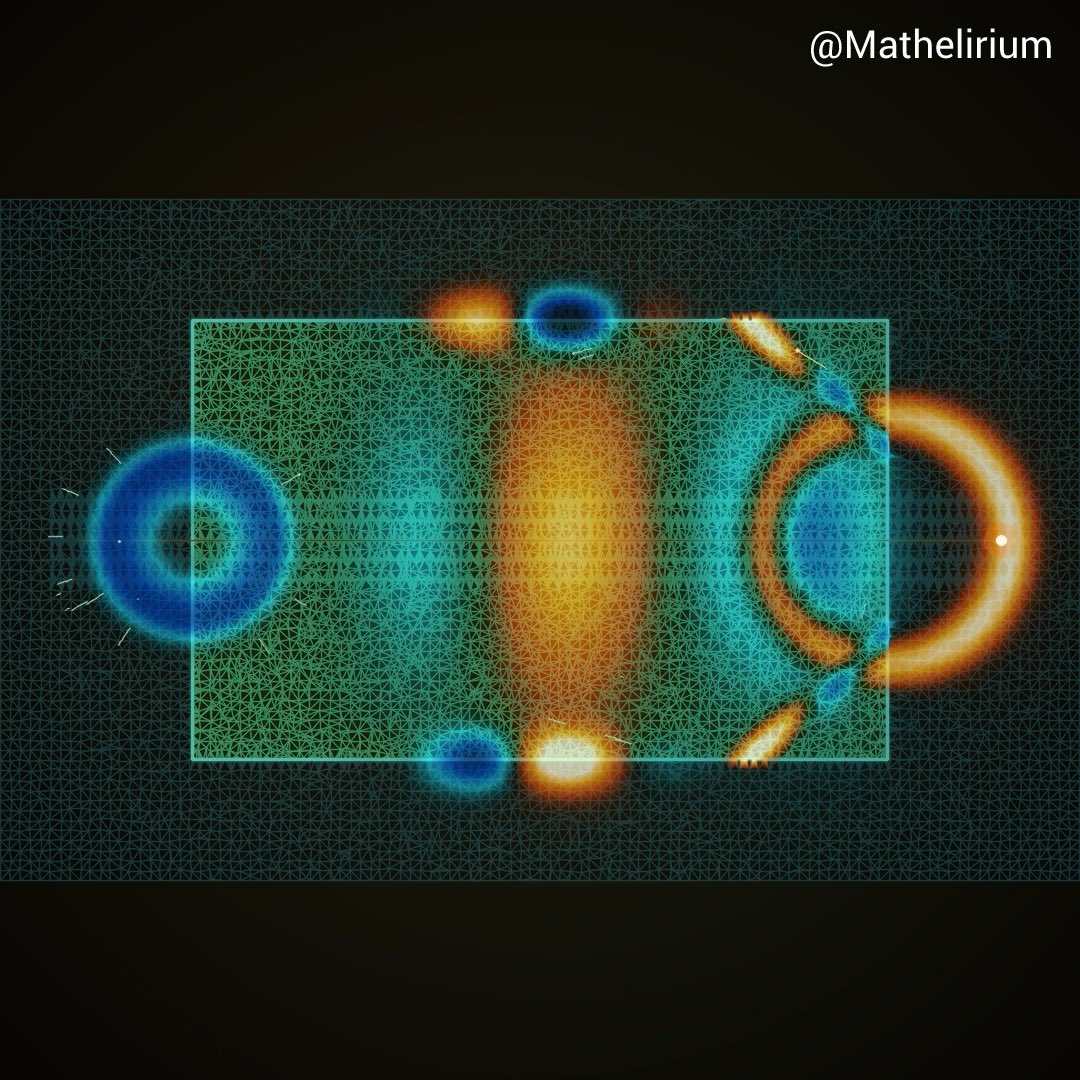
A Luneburg lens bends an Electromagnetic wave without a curved boundary. Instead its dielectric constant changes continuously from the centre to the edge. This forces different parts of the wavelength to travel at different speeds. Here, we solve the full 2D TM EM wave equation on an unstructured triangular... show more

2,031,067 görüntüleme • 1 ay önce •via X (Twitter)
34 Yorum

The moving particles follow the so-called Poynting vector, revealing how electromagnetic energy is redirected through the graded dielectric.
😆

I wonder if this happens in organisms, like the dielectric surface of the insect exoskeleton. It is naturally a topographically rich material, with interesting dielectric properties

I’m way too stoned right now for this to make sense

This makes me wish we had a better understanding of solar flares and their effects on inner Earth.

What is the song plz?
There you go!
tysm, ily!

@grok can you explain this like an 8th century monk? Also, please provide the mathematical formula.

I came home from the high school football game and spent most of last night working on this exact problem.

It’s so difficult to put 4 dimension models into 2 dimensions. Thank you. I see this in 4D

There is no 2D structure or anything accept in THEORETICAL CONCEPTS!! Same with 1D!! You’re showing this as if it exists in the world.. It only exists on the computer screen (computer) and in your head!! Learn something..

It is funny how individuals particle can live alone and at the same time create something like a giant object like if they were working together.

Oh you guys went with the triangular mesh huh?

Can you explain why the EM wave that traverses the center of the lense “catches up” with the undisturbed wave after leaving the lens? This animation portrays the wave “slows down” in the field but then exceeds the speed of light after leaving the lens.

No curved surface needed. ⚡ A Luneburg lens bends electromagnetic waves by gradually changing its dielectric constant from center to edge, making different parts of the wave travel at different speeds. FEM simulations then reveal the resulting wave propagation in stunning detail.

Microgravity Manufacturing of Nanoparticle-Based Luneburg Lenses Luneburg lenses provide aberration-free focusing from any direction, full spherical symmetry that enables multi-beam operation and wide-angle scanning with virtually no scan loss, near-perfect impedance matching at the surface (minimizing reflections), high gain with simple feeds, and inherent broadband potential. These properties make them superior to conventional lenses, parabolic reflectors, and many phased-array systems for antennas, radar, communications, and advanced optics. Here is a conceptual design for manufacturing the spherical Luneburg lenses (approximately 2–5 µm diameter for visible wavelengths) using high-index nanoparticles assembled with a controlled radial packing-density gradient. The process is optimized for vacuum and microgravity environments, where sedimentation and convection are absent. The primary fabrication approach is directed “spray” deposition (vacuum thermal/e-beam evaporation or dry nanoparticle aerosol) onto a levitated core—functionally equivalent to ultra-precise free-form 3D spray-printing. Alternative assembly methods are also described. The resulting microscopic lenses retain the classic Luneburg advantages at a scale suitable for integrated photonics, on-chip optics, and future in-space manufacturing. Objectives - Define the smallest practical spherical objects that can exhibit a functional Luneburg effect via effective-medium theory. - Specify nanoparticle materials and the required radial density (volume-fraction) gradient. - Detail a microgravity/vacuum-compatible manufacturing process centered on directed spray deposition. - Identify alternative assembly routes and key technical challenges. Design Specifications - Target wavelengths: visible (≈500 nm) as baseline; scalable to near-IR and beyond. - Particle size: ≤50 nm (preferably 10–20 nm) so that particles ≪ λ and the effective-medium approximation holds. - Overall sphere diameter: 2–5 µm (≈4–10 λ) for useful focusing with acceptable diffraction. Ideal continuous profile: [ n(r) = \sqrt{2 - \left(\frac{r}{R}\right)^2} ] (or relative permittivity (\varepsilon_r) from 2 at the center to 1 at the surface). Approximated by 6–20 discrete concentric shells or a continuous radial gradient of nanoparticle volume fraction (f(r)), calculated via Maxwell-Garnett effective-medium theory in a low-index host (air/vacuum). Performance target: - Focusing of plane waves to a diffraction-limited (or near-diffraction-limited) spot on the opposite surface. - Low reflection due to surface index matching. - Retention of multi-directional and multi-beam capability. Material Options 1. High-index dielectric nanoparticles (preferred for broadband/low-loss): TiO₂, ZrO₂, Si, or core-shell variants. 2. Fullerenes / carbon-based: C₆₀, C₇₀ or larger clusters (high polarizability, vacuum-compatible). 3. Plasmonic nanoparticles: Au or Ag (strong contrast, but higher loss and narrower bandwidth). 4. Hybrid combinations for tunable response. Manufacturing Process Directed vacuum spray (thermal evaporation, e-beam evaporation, or dry nanoparticle aerosol beam) onto a levitated seed core. This is functionally equivalent to ultra-precise 3D spray-printing with nanoscale density control. 1. Generate or inject a seed core (dense nanoparticle cluster or single larger particle) and levitate it electrostatically, optically, or electromagnetically. 2. Direct a collimated beam or aerosol of high-index nanoparticles (or molecular vapor) from one or more sources onto the core. 3. Continuously rotate/tumble the core for uniform coverage. 4. Modulate flux, exposure time, beam focus, and core temperature to produce successive shells (or a continuous gradient) of decreasing volume fraction. 5. Optionally apply a final low-density “skin” or mild sintering/cross-linking pulse to improve mechanical integrity. 6. Release or dock the finished sphere.

Way over my head but that’s the way I like it. Slow learning is effective learning.

found my next invisibility cloak technology stack

Styrofoam makes a great lens for radio waves.

Very cool. Just realized an EM wave hitting a metamaterial (that bends light around it and returns it to the same position) would be cool to animate

@grok what are military practical uses for this

Could you explain why the lens in the sim has a curved boundary even though you state that refraction can occur without one? Seems to make the claim less convincing!

@grok what’s the material and everyday life implications of that ?
Like it

Wow antenna beam steering?

@AshtonForbes Thoughts

i don’t know what any of this means but it looks cool as hell

So pretty

It's like vortices are slowing down because they're getting compressed, but the speed of circulation inside is increasing.

politics is babies doing science

Where did you get the background chant like music?

Grok, how does this apply to real world applications? Luneburg (or Luneberg) lenses apply the continuous radial gradient in dielectric constant (or refractive index) shown in the simulation to focus or collimate electromagnetic waves from any direction equally well. A plane wave incident from one side focuses to a point on the opposite surface, and vice versa. This enables practical devices without needing a traditional curved reflector or mechanical rotation of a large aperture. Key real-world applications: Radar reflectors and RCS enhancement: Parts of the lens surface are metallized so incoming radar energy focuses onto the metal and reflects back toward the source. This creates a strong, wide-angle radar return (often hundreds of times larger RCS than a metal sphere of the same size). •Removable units are fitted to stealth aircraft (examples include F-35, F-22, and similar platforms) during training so friendly radars can track them without revealing true stealth performance in operations. •Used on drones, targets, ships, and decoys for training, electronic warfare, or to increase detectability of small vessels.5 Multi-beam microwave and millimeter-wave antennas A single spherical (or hemispherical) lens can support multiple fixed or switched feeds around its surface. Each feed produces an independent high-gain beam pointed in a different direction, with essentially no scan loss even at wide angles. •Satellite communications (SATCOM): Ground terminals and spaceborne arrays that simultaneously track or communicate with multiple LEO/MEO/GEO satellites. •Cellular networks: Multi-sector or multi-beam base-station antennas for high-capacity events (e.g., AT&T’s “Giant Eyeball” Luneburg antennas) and emerging 5G/6G deployments. •Telemetry and data links for UAVs and mobile platforms needing rapid beam steering or hemispherical coverage. Automotive radar (mmWave, typically 76–81 GHz): 3D-printed or layered Luneburg (or generalized Luneburg) lenses shape beams for higher directivity, wider coverage, or multi-beam operation in ADAS and autonomous-driving sensors. They help achieve the required resolution and field of view while remaining relatively compact and manufacturable. Why the continuous gradient matters in practice: Traditional parabolic dishes or phased arrays have trade-offs in scan range, scan loss, mechanical complexity, or power consumption. The graded dielectric of a Luneburg lens provides spherical symmetry, so performance stays consistent across wide angles. Modern fabrication (layered dielectrics, metamaterials, or additive manufacturing) approximates the ideal continuous profile well enough for microwave and mmWave frequencies, overcoming earlier weight and manufacturing barriers for larger lenses. In short, the wave-bending behavior visualized in the FEM simulation is directly exploited in radar calibration/enhancement devices, multi-beam antennas for communications and sensing, and automotive radar systems where wide-angle, low-loss focusing of electromagnetic energy is required.

tops on the arabic song in the background 👌




![String Theory Lecture 2 In Conformal Gauge, the String Becomes a Wave Equation Episode 1 showed the geometric jump point particle -> worldline string -> worldsheet Episode 2 is the dynamical jump. The Nambu-Goto action measures the area of the worldsheet, S = −T ∫ dτ dσ √[−det hₐᵦ] but the square-root determinant is awkward to work with. So we usually rewrite the same classical theory in Polyakov form, S = −(T/2) ∫ dτ dσ √[−γ] γᵃᵇ ∂ₐXᵘ ∂ᵦXᵤ Here Xᵘ(τ,σ) tells us where each point of the string’s worldsheet sits in spacetime, and γₐᵦ is the metric we put on the worldsheet. The power of this form is that we can choose a convenient gauge. In conformal gauge, the equations of motion simplify to (∂²/∂τ² − ∂²/∂σ²) Xᵘ = 0 So the string’s spacetime coordinates behave like waves living on the worldsheet. The τ-derivative measures how the string changes in worldsheet time. The σ-derivative measures how it bends along its own length. For a closed string, σ is periodic Xᵘ(τ, σ + 2π) = Xᵘ(τ,σ) and the wave equation splits into two traveling pieces, Xᵘ(τ,σ) = Fᵘ(τ + σ) + Gᵘ(τ − σ) One family moves one way around the string and the other moves the opposite way. These are the left-moving and right-moving modes. In the render, the bright loop is the string at the present moment. The glowing cylinder behind it is the worldsheet it has swept out. The cyan curves trace one traveling family, and the gold curves trace the other. They are the visual version of τ + σ and τ − σ. Therefore, the theory has an internal wave equation, and its normal modes are the raw material for the string spectrum. #StringTheory #TheoreticalPhysics #ConformalGauge #Worldsheet #WaveEquation #Physics #Mathematics #MathematicalPhysics #QuantumGravity #ScienceVisuals](https://image.24vids.com/tw-2048188844390961195/amplify_video_thumb/2048188712111185920/img/0-fvXBT82cd_zT20.jpg)

![String Theory Lecture 1 A String Does Not Move Like a Point A point particle traces a line through spacetime. A string traces a surface. This is the first geometric shift in String Theory. Particle mechanics asks where one object is at time t, so its history is a curve. String Theory asks where every point of an extended object is at worldsheet time τ, so we need another coordinate telling us where we are along the string. For a point particle x(t) So, for one input of time we get a position in Spacetime. For a string Xᵘ(τ,σ) Here τ plays the role of time on the worldsheet, while σ labels position along the string. Freeze τ and vary σ, and you see the string at one instant. Let τ move, and that curve sweeps out a two-dimensional surface... the worldsheet. The same comparison appears in the action. For a relativistic point particle, the geometric action measures worldline length S = −m ∫ ds If we parameterize the path by t, the action has one integral, one parameter, and one tangent vector dxᵘ/dt For a string, the same idea grows by one dimension. The action measures area, not length. In Nambu-Goto form, S = −T ∫ dτ dσ √[−det hₐᵦ] Here T is the string tension. It plays a role similar to mass, but for an extended object. It weights the area of a surface rather than the length of a line. The particle action has ∫ dt because the history is one-dimensional. The string action has ∫ dτ dσ because the history is two-dimensional. We are no longer summing along a path, we are summing over a surface. The geometry changes for the same reason. For the particle, one derivative is enough dxᵘ/dt For the string, the geometry is built from two derivatives: ∂τXᵘ and ∂σXᵘ The first tells you how the string changes as worldsheet time flows. The second tells you how the embedding changes as you move along the string. Together they define the induced worldsheet metric hₐᵦ = ∂ₐXᵘ ∂ᵦXᵤ In plain terms, hₐᵦ measures tangent lengths and tangent angles on the worldsheet. From it, the area element is dA = dτ dσ √[−det hₐᵦ] This, the Nambu-Goto action is the direct analogue of the point-particle length action. The point particle extremizes length and the string extremizes area. For calculations, people usually switch to the Polyakov action: S = −(T/2) ∫ dτ dσ √[−γ] γᵃᵇ ∂ₐXᵘ ∂ᵦXᵤ This describes the same classical string dynamics, but the algebra is cleaner. After choosing conformal gauge, varying with respect to Xᵘ gives (∂²/∂τ² − ∂²/∂σ²) Xᵘ = 0 This is the first real dynamical payoff... a two-dimensional wave equation on the worldsheet. For a point particle, the equation of motion tells you how one position evolves along one path. For a string, it tells you how an entire curve evolves, with waves traveling along it. The term ∂²Xᵘ/∂τ² measures acceleration in worldsheet time, while ∂²Xᵘ/∂σ² measures curvature along the string. The time evolution is balanced by how the string bends along its own length. This is why strings have oscillation modes. A point particle has one trajectory. A string has many possible vibration patterns, each one a normal mode of the worldsheet wave equation. For a closed string, σ wraps around the loop Xᵘ(τ, σ + 2π) = Xᵘ(τ, σ) For an open string, one standard free-end condition is ∂σXᵘ = 0 at the endpoints. Solving the wave equation gives waves moving in opposite directions along the string Xᵘ(τ,σ) = Fᵘ(τ + σ) + Gᵘ(τ − σ) A function of τ + σ moves one way. A function of τ − σ moves the other. Therefore, a particle has a worldline, its action measures length, and its geometry uses one tangent. The string has a worldsheet, its action measures area, and its geometry uses two tangent directions. #StringTheory #TheoreticalPhysics #MathematicalPhysics #Physics #Spacetime](https://image.24vids.com/tw-2047925796963004514/amplify_video_thumb/2047925638485753856/img/d0IV19m4OAIfEf0I.jpg)