Loading video...

Video Failed to Load

Go Home

Francois Chollet + Sam Altman Fireside François Chollet and Sam Altman fireside during ARC-AGI-3 Launch Party moderated by Deedy They discuss: - Social contracts evolving - AGI views as a parent - When will labs score >85% on ARC-AGI-3?

33,454 views • 4 months ago •via X (Twitter)

0 Comments

No comments available

Comments from the original post will appear here

Related Videos

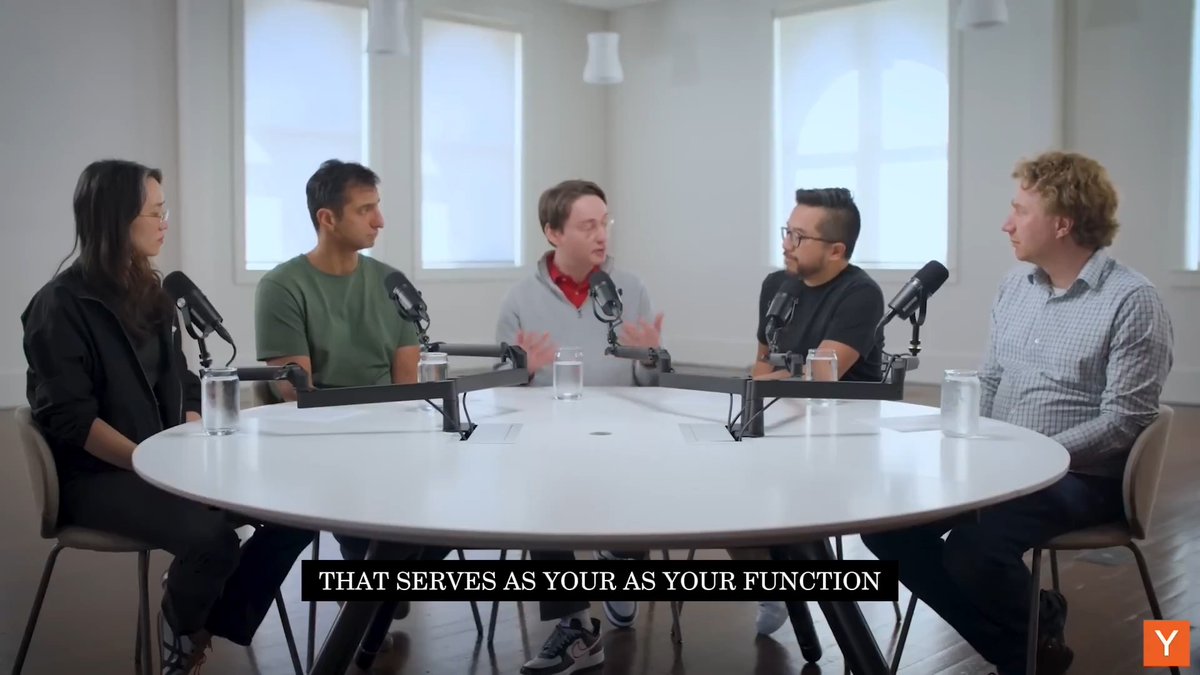
François Chollet (François Chollet) has spent years asking a different question than most of the AI world. Instead of scaling what already works, he’s trying to understand what intelligence actually is and how to build it from first principles. In this episode of the Lightcone Podcast, he traces that path from his early work on deep learning to the creation of the ARC Prize, and the launch of ARC V3, a new benchmark designed to measure something deeper than performance: the ability to learn, adapt, and reason efficiently in entirely new environments. He explains why today’s systems may be hitting limits, what recent breakthroughs really mean, and why reaching true general intelligence may require a fundamentally different approach. 00:00 - AGI by 2030? 00:31 - Introducing Ndea: A New Path Beyond Deep Learning 01:08 - A New ML Paradigm 01:30 - Replacing neural nets with compact symbolic programs 03:04 - Why Ndea Isn’t Competing With Coding Agents 05:20 - Why Everyone Might Be Wrong About Scaling LLMs 07:22 - Why Coding Agents Suddenly Work So Well 08:50 - The Limits of LLMs in Non-Verifiable Domains 10:48 - What AGI Actually Means (And Why Most Definitions Are Wrong) 13:30 - Why Deep Learning Hits a Wall 14:00 - ARC’s Origin Story 18:20 - ARC Benchmarks Explained: From V1 to V3 22:49 - The RL Loop Powering Coding Agents Today 27:03 - ARC-AGI V3: Measuring “Agentic Intelligence” 31:14 - Inside the ARC Game Studio 35:31 - Could AGI Fit in 10,000 Lines of Code? 44:01 - Building Ndea: From Idea to Compounding Research Stack 46:46 - The Future of ARC: Benchmarks That Evolve With AI 47:21 - Why There’s Still Huge Opportunity for New AI Paradigms 53:37 - How to Build a Breakout Open Source Project - Lessons From Keras 56:39 - Advice For How To Think About AI

Y Combinator

151,649 views • 4 months ago

Sam Altman, CEO of OpenAI, on why the iPhone, the greatest consumer device ever made, is the wrong hardware for the AI era: Sam argues the iPhone's basic design wasn't made for a world where AI needs to live alongside your entire life. "I think the iPhone is currently the greatest piece of consumer hardware ever made by a lot. Like, incredible what that has done." The iPhone was designed for a pre-AI world. Sam Altman explains: "It was not meant for a world where you needed a piece of hardware that could absorb all of the context of your life. You know, you can use the phone, you can stop using the phone, you can put it in your pocket, but it's kind of like on or off." That binary, on or off, in use or in your pocket, is the core mismatch. A device that flips between active and dormant can't continuously absorb the context that a personal AGI would need to actually be useful to you. Sam uses the conversation he's having in that moment as the example: "This has been a very interesting conversation. I would love this to be referenced by my personal AGI later, but my phone is in my pocket and it's not going to understand." The vision he's pointing toward is a device that participates differently: "I would like a device that, if I wanted to, can participate and understand and know about this conversation." The shift Sam is describing is from a device you pick up and put down, to one that quietly captures the context of your life. Without that continuous context, a personal AGI can't actually be personal.

Big Brain AI

25,447 views • 3 months ago

OpenAI CEO: “Goalposts keep getting moved” - if we were still using AGI definitions from 10 years ago, many would say GPT-4 is AGI. “In one year, AI will be dramatically more impressive.” He also said (surprisingly confidently - he did not hedge like usual) AGI is less than 10 years away. In the long term he’s not concerned about AI taking jobs, but he is concerned about the speed that AI will disrupt the job market. --- INTERVIEWER: What is AGI? When will it be here? And how will we know it's here? Predict how long - we'll call you in ten years? SAM ALTMAN: Less than that. We kind of define AGI as like the thing we don't have quite yet. there were a lot of people who would have ten years ago said, alright, if you could make something like GPT-4, GPT-5, maybe, that would have been an AGI. And now people are like, well, it's like a nice little chatbot or whatever. And I think that's wonderful. I think it's great that the goalposts keep getting moved, it makes us work harder. But I think we're getting close enough to whatever that AGI threshold is going to be, that we no longer get to handwave at it and the definition is going to matter. INTERVIEWER: What is the inflection point for AGI? SAM ALTMAN: I think it's going to be much more continuous than that. We're just on this beautiful exponential curve. Whenever you're on a curve like that, you look forward, it looks vertical. You look back, it looks horizontal. That's true at any point on there. So a year from now, we'll be in a dramatically more impressive place than a year ago. We were in a dramatically less impressive place. But it'll be hard to point. People will try and say, oh, it was AlphaGo that did it. It was GPT-3 that did it. It was GPT-4 that did it. But it's just brick by brick. 1 foot in front of the other, up, climbing this exponential curve. WILL AIs TAKE ALL OUR JOBS? SAM ALTMAN: Every technological revolution affects the job market. And over human history, every maybe 100 years, 150 years, half the jobs go away, totally change, whatever. I'm not afraid of that at all. In fact, I think that's good. I think that's the way of progress and we'll find new and better jobs. The thing that I think we do need to confront as a society is the speed at which this is going to happen. It seems like over two, maximum three, probably two generations, we can adapt. Society can adapt to almost any amount of job market change. But a lot of people like their jobs or they dislike change. And going to someone and saying, hey, the future will be better, I promise you, and society is going to win, but you're going to lose here. That doesn't work. That's not cool. That's not an easy message to get across. We are going to have to really do something about this transition. It is not enough to just give people a universal basic income. People need to have agency, the ability to influence this

AI Notkilleveryoneism Memes ⏸️

27,551 views • 2 years ago