Loading video...

Video Failed to Load

Go Home

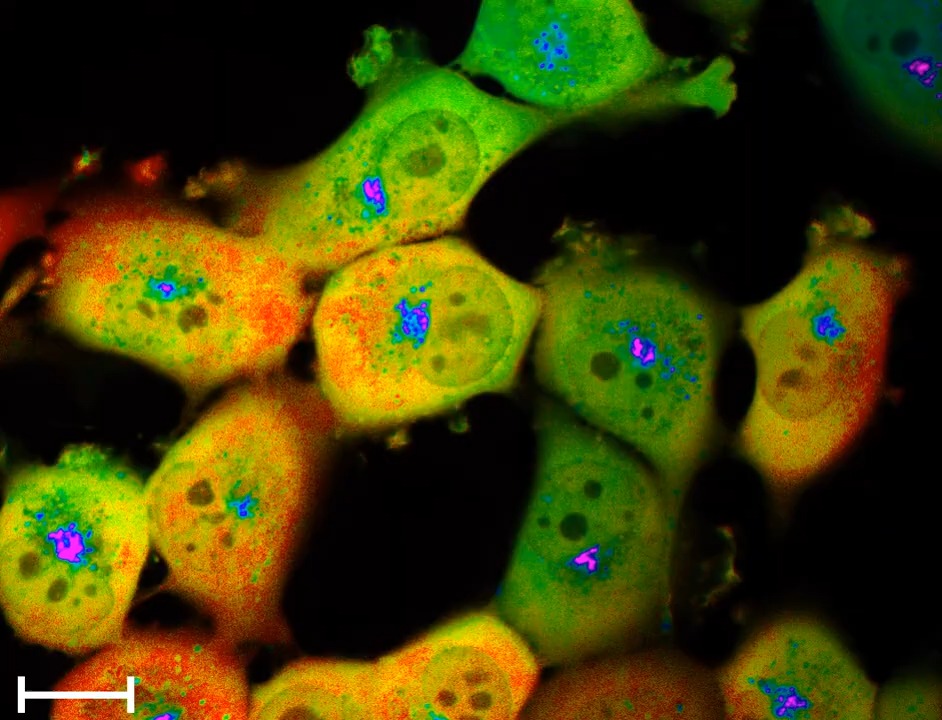
🚨 Graphene just did something wild. It killed harmful bacteria including drug-resistant superbugs while sparing human cells. Read that again. Researchers found graphene oxide can target a molecule found in bacterial membranes, but not human cells. That means it can attack bacteria with precision instead of acting like a...

19,614 views • 2 months ago •via X (Twitter)

0 Comments

No comments available

Comments from the original post will appear here

Related Videos

There's a bacteriophage that turns bacteria into “liquid crystals.” Specifically, Pseudomonas aeruginosa bacteria make Pf phages, which are rod-shaped, negatively-charged, and measure about 2 micrometers in length (roughly the length of an E. coli cell). These phages leave the cells and enter their surroundings. There, they mix with polymers, also secreted by the cells, to form a crystalline matrix. Surprisingly, this is good for the cells. Although the phages kill some of them, it also makes their biofilms stickier and able to withstand certain antibiotics. These bacteria + phages are prevalent in cystic fibrosis patients; they've formed a sort of symbiotic relationship. The Pf phages are made from thousands of repeating copies of a coat protein, called CoaB, which wraps around a single-stranded, circular DNA genome. These genes are integrated directly on the bacterial chromosome. The bacteria “turn on” these phage genes when placed in a viscous environment with low oxygen levels. This is like a trigger to start forming a biofilm. And the cells make a lot of phages; about 100 billion per milliliter. These liquid crystals form because of a physics principle called “depletion attraction.” If you just mix a bunch of loose or flexible polymers together (such as long carbon chains) they will not form a liquid crystal. But if you mix stiff rods (the phages) with loose polymers at a high enough concentration, the polymers will force the phages close together to create a material that flows like a liquid despite being ordered like a crystal. See the video below. These liquid crystal biofilms are hard to get rid of. The negatively-charged phages block many antibiotics (like aminoglycosides, which are positively-charged) from entering cells. Liquid crystals also retain water, so these biofilms can survive on drier surfaces. I first heard about this from Malmesbury’s excellent newsletter, called “Telescopic Turnip.”

Niko McCarty.

50,029 views • 6 months ago

A single E. coli cell, placed on a dish, will become 70 billion cells in just 12 hours. That’s exponential growth. But a new preprint shows that it's possible to engineer E. coli to grow linearly instead, where only one daughter cell continues dividing and the other stops. First, some context. In nature, there is a bacterium called Mycobacterium smegmatis (initially discovered in 1884 in ulcers scraped from syphilis patients.) M. smegmatis is weird because it divides asymmetrically. These cells grow only from one end, and all their cell wall biosynthesis machinery is located on that one end. So when the cell divides, one daughter gets this machinery and the other gets nothing. The daughter that gets the machinery can keep dividing immediately, but the other daughter has to remake all that machinery from scratch, so its growth is delayed. E. coli doesn’t grow like this. When it divides, it pinches in the middle and splits everything evenly. Enzymes, metabolites, and proteins get partitioned more or less randomly between the two daughters. For the new preprint, though, researchers engineered E. coli to behave more like M. smegmatis. Here is how they did it: First, they deleted a gene called cyaA, which encodes an enzyme (adenylate cyclase) that makes a molecule called cAMP. cAMP is SUPER IMPORTANT! It is a nutrient sensor that instructs E. coli to switch on genes that help it digest non-glucose carbon sources when glucose is scarce. Without cAMP, E. coli cells growing on alternative carbon sources will starve; they won’t know how to eat the food. Next, they added back a “split” version of the cyaA gene into the cells. In other words, they split the gene in two so that each half of the enzyme is made separately. Cells can only make cAMP, and thus eat non-glucose carbon sources, if these two halves come together. To facilitate that “coming together,” the researchers also fused the split cyaA proteins to sticky proteins that clump together, and to a fluorescent protein (to make it easy to track these molecules in the cell.) So now some interesting things start to happen if you grow E. coli on a growth medium lacking glucose. As the cell grows, its cyaA “halves” start clumping together into a giant ball. Inside the aggregate, the two enzyme halves come together and make cAMP. And when the cell gets big enough and divides, the clump of cyaA RANDOMLY goes to either daughter cell #1 or #2. The daughter that gets the aggregate (called PA+ in this paper) can keep dividing. The daughter that doesn’t (PA–) cannot. It still grows a few times — about four divisions — because it inherits some leftover cAMP from its mother. But after that, the metabolite is diluted away, and the cell stops growing. PA+ cells went through about 23 divisions on average before their aggregate decayed. And the population of cells, as a whole, grew linearly. This paper is cool because there are many applications where exponential growth is too unpredictable and, perhaps, unsafe. If you want to engineer bacteria to deliver drugs, clean up waste, or live in the gut, you don’t want them to double uncontrollably. This paper shows you can make them expand in a controlled, linear way. Alas, mutations could break this whole engineered system. A mutation that restores cyaA, for example, would give cells a new way to make cAMP. Mutations that make the aggregates split between daughters would break the asymmetry, too. But still, I really enjoy proof-of-concept engineering papers like this.

Niko McCarty.

57,988 views • 10 months ago