Loading video...

Video Failed to Load

Go Home

I built a robot that scans Kraków’s streets for graffiti using Mapillary’s imagery. It processes 3,500 frames across eight districts by: - Fetching data: Pulling Kraków images and GPS/timestamps via Mapillary’s Graph API. - Segmenting: Running Meta’s SAM 3 model on Apple Silicon via MLX to identify graffiti candidates....

27,236 views • 2 months ago •via X (Twitter)

0 Comments

No comments available

Comments from the original post will appear here

Related Videos

BREAKING: Claude Opus 5 is OUT NOW! And…it’s a hard model to love. We’ve spent the last week Every 🧱 testing it across coding, writing, knowledge work, and our internal agent. It argued with instructions, stopped before the work was finished, and generally didn’t play well with our existing skills and plugins like Compound Engineering. Our first reaction was: What have they done to my boy? Then we deleted our existing skills and started from scratch. Without the elaborate workflows we had built for earlier models, Opus 5 got dramatically better, and even showed flashes of brilliance. Here’s our Day 0 vibe check: - It’s a poor man’s Fable. It has many of Fable’s personality quirks without Fable’s genius. - It breaks backward compatibility. If you’re using it with existing skills and workflows, watch out. It will often stop early or otherwise miss your instructions. - If you start from scratch, you’ll have better results. Kieran Klaassen figured out that if he just started from scratch without his existing skills, he could get dramatically better results. This is a model that takes some time to rebuild your workflows around—but if you do, there’s a payoff waiting. - Medium or low effort works better. @KieranKlassenn also found better results using Opus 5 on lower thinking levels. It seems that the more time you give it to think, the more likely it is to do the more annoying behaviors. Don’t just switch to Sonnet for a faster response! Try low thinking. I have two slots in my workflow: 1. The genius model I use for my biggest hardest tasks, currently Fable. 2. The smart, fast generalist I use for everything else, currently GPT-5.6. Opus 5 has the personality of the genius, but doesn’t have its top end. So that puts it in a strange middle ground that doesn’t really have a home in my day to day. I think I’ll use it mostly when I run out of Fable tokens. full vibe check on Every 🧱 in the next tweet 👇

Dan Shipper 📧

750,546 views • 14 days ago

Pylon's 𝗺𝗼𝘀𝘁 𝗵𝗮𝘁𝗲𝗱 𝗳𝗲𝗮𝘁𝘂𝗿𝗲 is our Analytics. That ends today. We've completely rebuilt our Analytics from scratch. Here's what we tried, what we screwed up, and what's coming. 𝗩𝗲𝗿𝘀𝗶𝗼𝗻 𝟭, The Basics (Nov 2023) Our first attempt at analytics was quite loved by customers. At the time our customers were mostly small startups with simple needs. We built an out-of-the-box set of dashboards that covered the common use cases of support analytics (SLA-tracking, CSAT, TTFR, TTR, basic filtering...). As we moved upmarket... 1/ Everyone was requesting custom metrics 2/ Queries were becoming inefficient and slow We needed an upgrade. 𝗩𝗲𝗿𝘀𝗶𝗼𝗻 𝟮, Advanced Reporting (June 2024) We knew custom reporting was going to be blackhole of work that long-term led to fully customer-customizable dashboards. We had four choices: 1/ Do nothing for now 2/ Do custom work per customer 3/ Build full custom reporting in-house 4/ Use an embeddable analytics vendor At the time Pylon was under 10 people total and we had no capacity to do the frontend work so we chose Option 4 (use a vendor). This was the first time we chose to not build a core feature like this in-house as we ultimately want full control of the end-user experience. We built out the new reporting with the chosen vendor over ~3 weeks. On the surface the new reporting looked really good (not visually, but in terms of functionality). You could add custom charts of any type, create custom formulas, label the Y and X axis, and effectively build most of what you would want. It was really great for demos. But in practice it was incredibly hard to use, lacked core capabilities (like the ability to filter off of dynamic custom fields), and visually looked not stylized to the rest of the product. We started to discover some of these issues during the implementation, but it still felt like there was more upside than downside so we released it. Feedback was not great but we hoped our vendor would fix changes quickly. Unfortunately they weren't fast enough and we lost confidence that they would be a good long-term solution. As a stop-gap we also built out a data warehouse integration so customers could export their data back to Snowflake or BigQuery to use with their own BI tools. Finally, a few months ago the vendor told us they were being acquired. That was the final straw. We needed to move off ASAP. 𝗩𝗲𝗿𝘀𝗶𝗼𝗻 𝟯, New Reporting (Today) Today's release is back to being built entirely in-house. It's been rolled out in beta to all customers with an option to flip back to old analytics until we plug some custom reporting gaps. This time we have the capacity to do it right between Wendy (prev product design at Amplitude), Matt, and Tom. We've managed to greatly improve: 1/ Desired filter options (custom field support) 2/ Performance 3/ Setup UX 4/ Style (looks native) Early feedback has been really positive so far and as we bring it out of beta we're thinking about how to make the best natively-offered reporting of any support platform. 𝗩𝗲𝗿𝘀𝗶𝗼𝗻 𝟰 (What's coming soon) To get to first-class reporting, we need to study not only our learnings, but also what the incumbents have screwed up as well. Funny enough, Zendesk's analytics have similar complaints to our v2, and for the exact same reason as we did: they integrated an external tool. In 2015 they bought a company called BIME Analytics which they became Zendesk Explore. The complaints they have to this day are similar to our v2: 1/ Steep learning curve 2/ Advanced, yet still not enough flexibility 3/ Random feature gaps 4/ Data accuracy and reliability concerns 5/ Performance issues 6/ Complicated UX v4 will follow three core principals: Offer a simple default setup. We want to continue being startup friendly and we'll feature gate custom reporting and data exports by tier in the product. Offer maximal configuration, with AI-assisted setup. As we go upmarket, customers will want to Explore (pun intended) data in every single direction. We need to allow them to do that. For those more complicated use cases we think AI will be the Ultimate (also pun intended) way to reduce setup friction. Build it all in-house. Although using a 3rd party embedded analytics provider didn't work for us, we don't think that is the case for everyone. It's just in customer support, reporting is REALLY important. They are probably some of the highest-complexity reporting of most SaaS vendors (maybe second to marketing products). So... we have to do it right. And since this is end-user facing, we have to own every detail of it. If you got this far, thank you for reading. See our new Analytics at

Marty Kausas

115,123 views • 1 year ago

Anonymous cash for Bitcoin Lightning at nearly all Polish ATMs. And that’s not all—you can pay with Bitcoin Lightning literally everywhere in Poland! No KYC, no registration, via the Nostr provider. I love it when I come across new technology that gives (European) bureaucrats the middle finger, especially in a situation where they want to spy on and regulate you across the board. Most recently, I was this excited about a non-KYC project for exchanging stablecoins for fiat via which bypasses the dystopian centralized exchanges that have to do massive reporting due to EU regulations like DAC-8 and MiCA. In the case of BITBLIK, just like with you’re doing decentralized P2P trading, so I assume no regulation applies to you (it doesn’t go through any intermediary). Today I came across a great Polish app called BITBLIK which connects the widely available BLIK system in Poland with Bitcoin Lightning. With Bitcoin Lightning, you can pay anonymously anywhere in Poland, withdraw cash anonymously from an ATM (which I just did!), or make online payments on Polish websites. BLIK is widely accepted (it’s supported by a network of over 13,000 ATMs across Poland and hundreds of thousands of merchants; according to AI, there are 87,000 of them). Install the app, launch it—no registration required, no KYC—enter an offer for how much you want to pay in PLN or how much you want to withdraw from an ATM. You’ll make a Bitcoin Lightning payment, which will be locked. Wait a minute or two until someone accepts your offer (the other party who has BLIK and wants Bitcoin Lightning). As soon as they do, a BLIK code will appear. It’s valid for about two minutes, so enter it at an ATM or at a terminal in a store or restaurant. After a successful payment, you confirm that you used the BLIK code, and the Lightning payment is credited to the recipient. Limits for BLIK payments vary by Polish ATM. ING Bank Śląski has the highest limit: 10,000 PLN per day (2,356 EUR), while mBank has a limit of 5,000 PLN per day (1,178 EUR). PKO BP allows BLIK transactions up to 1,500 PLN, but you can make up to 20,000 PLN (4,722 EUR) worth of transactions per day. And of course, those limits apply to the merchant. When various merchants accept your Lightning payments, you effectively have no limits—you’re only limited by the counterparty’s liquidity. BLIK is 100% open-source, so it can’t be banned! You can fork it and use it within your own closed community.

Pavol Lupták

66,789 views • 2 months ago

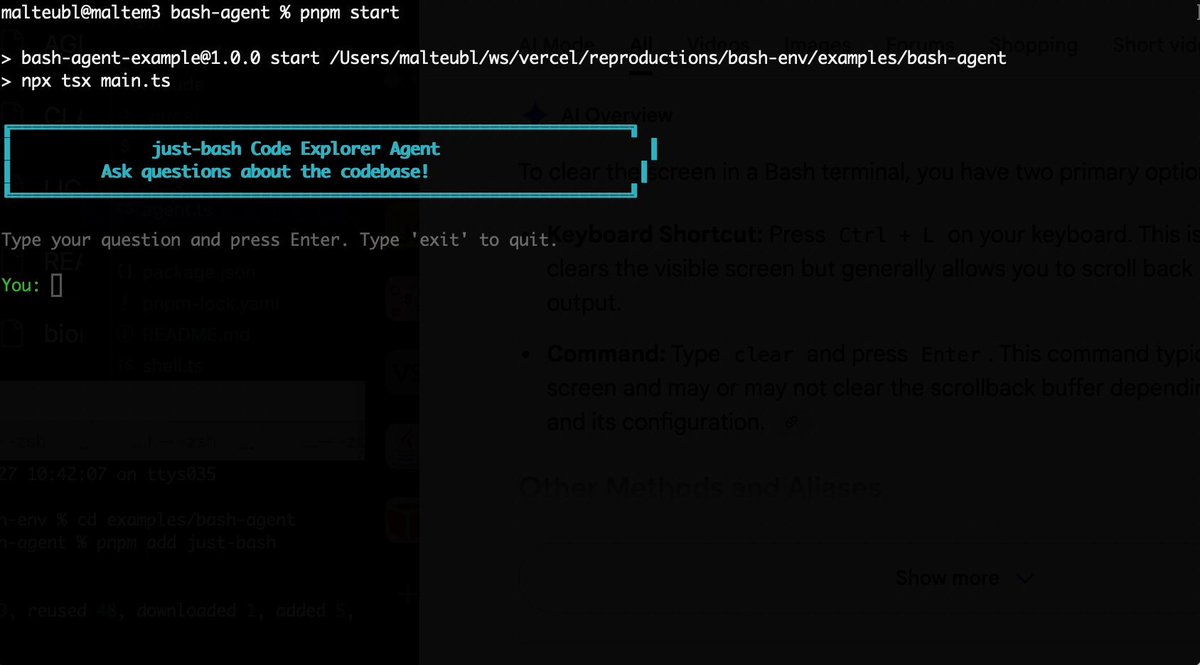
Bash is all you need! Which is why I'm introducing my holiday project: just-bash just-bash is a pretty complete implementation of bash in TypeScript designed to be used as a bash tool by AI agents. Because it turns out agents love exploring data via shell scripts, even beyond coding. It comes with grep, sed, awk and the 99th percentile features that an agent like Claude Code or Cursor would use. In fact, Claude Code can use it for secure bash execution. In the package - A bash-tool for AI SDK - A binary for use by yourself or your coding agents - An overlay filesystem to feed files to your agent securely - A Vercel Sandbox compatible API, so you can quickly upgrade to a real VM if you need to run binaries - An example AI agent that explores the just-bash code base using just-bash - I imported the Oils shell bash compatibility suite and just-bash passes a very good chunk What is interesting about this codebase: It was essentially entirely written by Opus 4.5. Coding agents love bash and they are good at reproducing it. They are also great at text-book recursive descent parsers and AST tweet-walk interpreters. That said, it is, like, a lot of code and I didn't read it all 😅. This is very much a hack, but it also seems to be _really_ useful. I haven't really found anything agents want to use that it doesn't support and it's fast and secure (caveats apply). It doesn't have write access to your computer and the filesystem is given a root that the agent cannot escape from. Find it at Related: Our recent blog post how we migrated our data analysis agent to bash tools and achieved incredible quality improvements The video shows the example agent investigating the just-bash code base

Malte Ubl

125,326 views • 7 months ago

Here's a devlog made by an anonymous Chinese fan replicating the surprisingly brand new technique that I developed for detecting asteroids which wound up being so powerful that it can easily track Stealth Fighters from over 100km away even when it’s only using three $30 webcams as sensors meaning it easily outperforms all modern stealth tracking techniques in precision, range and cost. And while this demo is using optical light, this same technique which I call pixel motion to voxel projection, can be used interchangeably with thermal infrared cameras to work at night and also majorly boosts the effectiveness of radar allowing you to track fighters much more effectively through clouds and over the horizon. This technique will also always eventually give the exact location of the target even if the image is blurry as those blurs will always average out from the different perspectives into revealing the precise location of the target in the voxel grid. There is definitely a Mandela effect with this technique as it feels as though it should already exist, especially because at first as it sounds like it is performing triangulation (which has existed for years and is what we do for mocap and tennis ball tracking). But triangulation is entirely separate to this as triangulations only works if you have already identified where the ball is in a 2D image because you’re able to rely on being able to use at least 2 separate high quality cameras which are much closer to the ball making the ball’s apparent size much much bigger and therefore gives you hundreds of pixels to work with which makes it much easier to use object recognition techniques to recognize where it is in the image aka in 2D and then you’re just using the other cameras view to project out lines which intersect in 3D to find out where the ball is in 3D. The major difference is that pixel motion to voxel projection allows you to find where the object is in 3D without having already found it in 2D which is an unbelievable difference as it allows you to use much lower quality cameras together to accumulate data together into 3D space. If this seem like it doesn’t mean much then what it actually means is that you don’t understand what I’m saying as what I’m saying means a LOT in practical terms as it means you go from having to use an imaging system that has to be able to image the object to the point that it is over a hundred total pixels in surface area to have enough data to recognize it to instead be able to use something that is only images the object to be 1 pixel in surface area and only changes the brightness value by 1 value every now and then. I’d recommend an amazing video by DST studios called “Lowlight cameras can’t defeat stealth” if you want a great video which goes over the difficulty of even using telescopes to recognize stealth fighters and why this is so impressive compared to other techniques and ironically it is what inspired me to realize the asteroid tracker I was working on actually could do this. Which brings me to the point that if this wasn’t a new technique then not only would there be at least one example of an asteroid survey that points distant telescopes at the same place at the same time in order to be able to add the light together to detect asteroids which as I was shocked to learn isn’t a thing despite the fact that it would make detecting asteroids trivial by comparison to modern 2D imaging while also having no impact on the normal scientific operations of those surveys other than small changes to scheduling. But there would also be an example of a drone tracker that uses this instead of using the aforementioned high quality zoomable telescope which has to be able to zoom in close enough to be able to recognize a drone. If you want to tell me that this is something that already exists give me an exact example of a product that uses it, not the general outline of a concept that you think it is, the actual product and then also tell me the asteroid survey that uses distant telescopes that point at the exact same place at the exact same time because I can guarantee that if you google what you think uses this you won’t even find the steps of subtracting the images from each other to get motion and will definitely not get the added step of projecting that motion into a voxel grid (It would blow your mind if you found out how Xbox kinect cameras work.) Also I want to make it clear, I’m not saying you should just use web cams to do this, I’m just using them as an example to show you the power of this in reality you would probably want to use 5 high quality zoomable thermal cameras which pan across the sky in sync with each other which due to using lower frequency are much less prone to the Rayleigh scattering that scatters visible light at 150 or so km away and again, you can also use this to majorly upgrade radar. Pretty much all of the problems you could think of for this are incredibly easy to overcome if you apply even a small amount of brainpower into fixing the problem. And yes, this gives you the exact location down to the meter of whatever you are tracking even if the image is blurry as those blurs will always average out to the exact location down to the meter in the voxel grid. Which is what makes this technique so powerful since the cost of adding each camera to The network grows linearly while the rate at which each camera gives more information grows exponentially due to the increasing unlikeliness of all of them having more movement in the same place. And given the size of the cameras it really wouldn’t be that hard to hide and network these cameras together in other countries and on sea buoys to know where planes are everywhere in the world. Which brings me to the point that I personally really don’t care about the military uses of this technology, if all it could do is precisely track stealth fighters then I wouldn’t have cared enough to work on it, I could have used any of the many other life saving techniques as the subject of the video, stealth fighters just sounds the most clickable and the scale of the problem is more intuitive to most people and if I did use any of those as subjects for the demo it would inevitably result in the stealth fighter technique being figured out anyway and all of the other uses are so useful that I don't think anyone would reasonably complain about the upside. The real purpose of this video is that since this is a new technique that hasn’t been used to detect stealth fighters despite the billions we have spent on that, then what else can you apply this to that could go on to improve billions of people’s lives that you or others are working on. For example this also allows you to majorly improve the effectiveness of cryo electron microscopy and CT scanners. This part also is kind of hard to explain as it also sounds like it exists but again, when you look through all of the places where you think it is being used you will find that it wasn’t. What I’m saying here isn’t that this is a Radon transform or gaussian splat or whatever, I’m saying that this is able to get new information that wasn’t being accessed before due to the added information about depth you get from the correlation of movement between each perspective which adds to the information that you already have. This allows you to directly subtract foreground and background objects as well as noise faster than you would be able to before and works better than super resolution for your images since super resolution won’t remove foreground and background objects like this does and instead just scales up target, foreground and background objects indiscriminately. And while with enough data Radon transforms or other scanning techniques would eventually get you a correct answer this will get you there a lot faster since those are mostly averaging techniques which average out noise whereas this gets you the ability to directly subtract noise. I’m not expecting you to think that this would do anything but if you try it for yourself you will find that it does majorly improve your ability to perform 3d scans. Again, cryo EM is a field where you would expect this technique to exist but when you look through all the papers on the topic there is no mention of tilting the grid slightly in order to be able to change your perspective slightly on the order of the feature size (if you tilt the grid then you only need precision on the order of an arc minute to do this) and doing multiple exposures from multiple different known tilts and then using those difference images to correlate depth from motion. In fact, in cryo EM you would normally want to do the opposite of this and have your exposures all taken from the same grid angle and just use the variations in how many of the same proteins are oriented in order to be able to scan them for a 3D model but this will generate you far more data faster. There is so much information that I can’t really explain in text so if you have any questions such as why this hasn’t been made before then they will most likely be answered in the video I originally posted which I have added to the end of the first Devlog for your convenience. And again, pretty much all of the problems with the technique can be fixed with a little bit of brainpower, in reality you would probably want to use 5 high quality zoomable thermal cameras which pan across the sky in sync with each other which due to using lower frequency are much less prone to the Rayleigh scattering that scatters visible light at 150 or so km away and again, you can also use this to majorly upgrade radar.

ConsistentlyInconsistent

50,687 views • 11 months ago

Hayes: Endorsing against incumbents really is kind of the unwritten rule in this. Tish James, who was a very vocal backer of yours when you were running for mayor—and even a backer of yours when I think it was pretty politically controversial to be so—had this to say. She said she and other political leaders she’s spoken to are disappointed in Zohran Mamdani. “All of us are a little frustrated with the Democratic Party, but you don’t blow it up. That’s what MAGA has done.” What do you say to that? Mamdani: I think, what is the Democratic Party if not its voters? And what we saw yesterday evening were Democrats across the city turning out and voting for a new kind of politics. And I’ve been clear time and time again that I believe the only majority in our country is that of the working class. And what we saw is that a focus on the working class. And I have a deep amount of respect for my friend, Attorney General James. And I also believe that these are the kinds of candidates that we need to see in Congress, as well as the five state legislative candidates that I endorsed that also won yesterday evening. I made a promise to New Yorkers that I would use every tool at my disposal to actually transform this city into one that they could afford. And one of those tools is using your political capital to ensure that the people who will fight hardest for that same agenda are going to be there, whether it’s in Albany or whether it’s in D.C.

Acyn

1,545,728 views • 1 month ago

"This is just a GPT wrapper." A common thing to hear in Silicon Valley. Even Perplexity (now valued at $20B) was seen as a GPT wrapper not long ago. But everyone gets this wrong. Every new technology or service uses existing tech and infrastructure as a pillar. Companies like Uber could not have existed without Google Maps. But could Uber be called a Maps wrapper? There is no need to reinvent the stove if you want to start a restaurant. The job of a founder is to solve users' problems so effectively that they cannot imagine going back to the old way. "Maximum value for the user" is the mantra. Users hardly care what underlying technology is used. What they do care about is whether the output (text, code, slide, or image) was accurate and if the solution provided was useful. You need to use the best tech to get the work done. Companies might use a cheap, fast model for formatting, a reasoning model for logic, and a search index for retrieval. They route traffic intelligently in milliseconds. The "wrapper" analogy also assumes you are dependent on one vendor. However, strong application layers can swap models out, just like batteries can be replaced. Generic apps don't work. The winners are the ones who dig into the painful, boring details of a specific workflow. If a company integrates deep into the user workflow, it becomes infrastructure. The product gets entrenched through distribution, integrations, design, feedback loops, and trust. And you can only get there by leveraging all existing technology as best as possible to fix the problem you've set out to solve for users. "If I have seen further, it is by standing on the shoulders of giants" - Newton

Grant Lee

63,505 views • 7 months ago

JUST IN: Perplexity launched "Perplexity Computer" — and it might be the most complete AI agent system available right now. Not a chatbot upgrade. Not a research tool with a new name. A system that plans entire projects, delegates to specialist AI models, and runs autonomously for hours, days, or months (their words). Here's what makes the architecture genuinely different: → Opus 4.6 handles core reasoning and orchestration → Gemini handles deep research (spawning its own sub-agents) → Grok handles lightweight speed tasks → Veo 3.1 handles video generation → Nano Banana handles image creation → ChatGPT 5.2 handles long-context recall and wide search → You can override model choices per subtask 19 models total. Each task runs in an isolated environment with a real filesystem, real browser, and real tool integrations. You describe an outcome. It breaks it into tasks and subtasks, creates sub-agents for each, and coordinates them automatically. When a sub-agent hits a problem, it spawns more sub-agents to solve it. And it connects to your existing stack — GitHub, Google Drive, Gmail, Slack, Jira, Linear, Notion, Confluence, Ahrefs, Airtable, and more. Critically, it doesn't just run once. It can run on a schedule. Reading your docs, checking your project boards, pulling from your CRM, and acting on what it finds. Market monitoring. Competitor tracking. Weekly reports with charts. Content pipelines. CRON jobs that actually execute. Not "AI that helps you once." AI that runs in the background for days or months. Think of it as managed OpenClaw — similar autonomous capability (scheduled tasks, multi-step workflows, tool integrations) but fully managed. No Mac Mini. No security config. No infrastructure to maintain. I tested it with a complex prompt — a full stock trading simulator with what-if scenarios, correlation heatmaps, sentiment analysis, and a Bloomberg Terminal aesthetic. Two prompts later: deployed to Netlify via GitHub, with working CRON jobs updating live data. I've started using it to analyze my portfolio. But coding is just one lane. This thing researches, writes reports, generates datasets, creates videos, processes documents, and connects to your existing tools — all in one coordinated workflow. The real shift: you don't choose a model anymore. You describe what you need. The system routes each piece of work to whichever model does it best — and spawns new agents when it hits a wall. 19 models, dynamic sub-agents, scheduled tasks, and your entire tool stack connected. Thoughts?

Paweł Huryn

219,681 views • 5 months ago

Corruption In America Is OUT OF CONTROL Cape Coral, Florida resident speaks out. Their Mayor and City Council dissolved their FREE, volunteer-based citizen groups, so that they could employ themselves to do the job. They then doubled their own salaries using tax payer funds. “This council voted to dissolve the CRA board with no notice or conversation with that board They then named a new board consisting of all the council members This week we have learned that City Council will vote tonight on giving themselves a stipend to cover the cost of their additional duties. This stipend is $6,000 per month for the Mayor, $3333 per month for each council member. That's a total of $351,972 per year to replace a group of volunteers who worked for free. I do not remember seeing those funds accounted for in the budget that was approved in September and for each council member an increase of 99%. I wonder how the city's union employees feel about this. I notice that this item is on the consent agenda, meaning that you would prefer it be kept in the dark with no discussion among yourselves. At age 76, I thought I had seen it all, but this council has erased that thought. After this council eliminated all the volunteer boards that they could get away with, we now know why. I can hardly wait to see how much they will pay themselves to perform the duties of the Budget Review Committee that I served on for seven years as a volunteer. This cash grab by this city council pretty much kills the respect and admiration I previously held for those who I thought had the public interest at heart. I suspect I'm not alone. We'll see you at the next election.”

Wall Street Apes

1,224,661 views • 2 years ago

Ever since I wired Claude Code to WhatsApp 3 weeks ago, I built a stupidly large infra around it. I mean, opus built it. No clue how the code even looks. The entire thing was vibe coded using my phone. I wanted to see how far I could push it without touching the computer. Everything via WhatsApp. Build what I need on the fly. So the resulting infrastructure will already be battle tested for software development. The entire thing was streamlined with nearly no manual interventions, everything was communicated via WhatsApp using a single script establishing this connection. If the script is down, I need to get home to start it again to resume the development. Claude was upgrading it, debugging it, restarting it while maintaining constant uptime so it could keep communicating with me. I stressed Claude about it, telling it that it will be “in the dark” and other words that deliberately sound scary about losing communications if the script dies. I also refused git and refused cloning the code, I wanted to see Claude adapting to work on a *LIVING* system. The way this whole thing works: Claude has its own dedicated phone number that I am paying for. A real WhatsApp account for it is installed on a real iPhone that is sitting on my desk. All is registered under my name, this is legit setup with no hacks and tricks. I’ve set up a WhatsApp “Community” and multiple different groups under it. Both me and Claude are the admins, so Claude could edit it on my behalf. Each group is a project I am working on and has its own isolated context. The Group description is a system prompt that gets auto-appended to the larger system prompt explaining this setup in general. When I send a message it’s an instant interrupt to Claude Code’s process, just like in the terminal. Voice notes are seamlessly transcribed with a local Whisper model. Images are used with multimodal reading in an isolated parallel session. Multiple groups running in parallel so I can work on all projects at the same time. No cross-talking, everything has an isolated context and history. And because it’s local on my own machine: Everything is REAL. The browser is REAL. I am connected as myself on it to all services because I actually use it in real life. Claude has unlimited internet access, just like humans who use actual browsers. It utilizes custom-made browser tools that I made to control any browser session it wants. Depending on the situation, it can either connect to my existing session or create one for its own. (You can tell it ‘look at my browser for a sec’ then talk about the current page you are on and it just works, pretty cool) My custom browser tools are not perfect (not by a long shot) but I managed to make them work well to the point they are somewhat reliable. This gives Claude full access to my real creds and all the services I actually use. I’m productive AS HELL with this. It really feels like a personal assistant. I ask it to read my emails and msgs, check x .com for news, research arxiv papers, write code, run experiments for me, investigate and reverse engineer github repos, even use my credit card and order things. [I try not to do this one a lot lol so far no disasters]. All from my phone. Super convenient. This is not a product or an open source project (maybe soon of it will make sense). This is just an ugly script I hacked the entire thing is ~600 lines. (ok maybe i did look at the code, but i swear i didn’t edit!) You can also vibe code this from scratch pretty fast and it will probably even end up better. This is just a cool thing so I’m sharing. It is a real speed booster for many things I do on daily basis, mostly boring things. Forcing my routine into some new “agent platform” just didn’t feel right for me. WhatsApp is where I already communicate and look for messages, so I decided that my agents will live there too. AGI in my pocket 24/7.

Yam Peleg

419,733 views • 7 months ago

The same kinds of productivity gains we've seen in coding with AI agents are heading to the rest of knowledge work. This is the jump when you go from having a chatbot to being able to actually have an agent go off and do work for minutes or even hours and come back with a complete work output that you then review. Here's an example of the new Box Agent filling out an RFP response from an existing knowledge base. This process would normally take hours to fill out, and requires the full attention of the user doing the work. Now, you provide the Box Agent with the RFP questions, and it will go off, make a plan, extract all the relevant questions, read through existing source material to come up with an answer, and then generate a new word document as the final output. All while you're doing something else. The key to this architecture is that the agent is able to use all of the same tools in the background that a user uses to get work done. The agent can search for documents, read entire files, run scripts and tools in the background, and even be able to write code on the fly to automate tasks it hasn't seen before. And best of all, the Box Agent will (soon) work from the Box MCP and CLI so you can invoke it in any agentic system as a step in a process. This kind of agent complexity would have been impossible even 6 months ago. Models consistently failed at tracking long running tasks or using the right tools at the right moment for the task. But this is all now possible because of models like GPT-5.4, Opus 4.6, and Gemini 3, and is only getting better by the month. Just as we moved from engineers writing code and using AI as an assistant to answer questions, in many areas of knowledge work -like legal, finance, consulting, sales, marketing, and more- when we have a problem we'll just kick off the AI agent to just go work on it for us in the background.

Aaron Levie

24,618 views • 4 months ago

Today, Box is announcing major new AI agent capabilities to let customers tap into the full value of their unstructured data. First, we’re announcing all new updates to the Box AI Studio to make it even easier to build AI agents that tap into your enterprise content for any job function, business process, or industry specific use case. We are also expanding our set of foundational agents that customers will be able to use to work with their enterprise content, including new features like search and research on unstructured data. Next, we’re announcing Box Extract to enable customers to use AI agents seamlessly for complex data extraction from any type of document or content. This makes it easier than ever to pull out data from contracts, invoices, research data, marketing assets, medical charts, and more. Finally, we’re introducing Box Automate, a new workflow automation solution within Box that lets you deploy AI agents across enterprise content-centric workflows. With Box Automate, you can design your business process in a simple drag and drop builder and then drop in AI agents at any step in the process. This ensures agents execute tasks at the right steps in a workflow every time. Best of all, our AI agents and workflow tools are designed to work across any system our customers work within, whether it’s leveraging pre-built integrations, Box APIs, or the new Box MCP Server. Ultimately, all of these capabilities come together to transform how companies can work with their enterprise content. Software has historically only been good at automating work that deals with structured data, which is why ERP, CRM, and HR systems have been mainstays of enterprise software for so long. The data in these systems fits neatly into a database, and the workflows are very ripe for automation. But it turns out most of the work in the world deals with unstructured data. It’s ideating through research documents, working with a client on contracts, reviewing details for a new product launch, looking at a patient’s healthcare record to make a diagnosis, working through due diligence documents for an M&A deal, and so on. For the first time ever, we can begin to bring all new insights and automation to this work with AI agents. At Box, we’re incredibly excited to be on this journey to help customers transform how they work with their most important data.

Aaron Levie

91,863 views • 11 months ago

––Mathias Döpfner: Sam, is it actually true that your kind of favorite book is The Beginning of Infinity of Dieter Deutsch? Sam Altman: Yeah, I think if I had to pick one favorite book, I would pick that. ––Mathias Döpfner: Why is that so fascinating? Can you explain that? Sam Altman: Even if you don't read the whole thing, the first like 40-50 pages are, I think, the most wonderfully optimistic take on why, even in a world with AI, we're never going to run out of things to do and ways to be useful and problems to solve and things to explore. But I also think it explains so beautifully how we got here and why the relatively simple process that we've followed throughout human history got us to this incredible place. ––Mathias Döpfner: Okay, that's good, because David Deutsch, I think, is going to be our last virtual guest, at least tonight. David Deutsch is a physicist and scientist from Oxford University. And I think also you have disagreements with him about the possibility that artificial intelligence is transforming into superintelligence with consciousness, perhaps even. He thinks it cannot be the case. You think it should be the case. Here he is, David Deutsch. Welcome. And perhaps you can elaborate a little bit on that disagreement, but also why you admire Sam Altman. Sam Altman: Well, I don't care about that. I just want to hear your disagreement. David Deutsch: Okay, I can tell you. Well, on my computer, I keep a list of progress that has been achieved where I had previously been sure that it wasn't yet possible. One of the items I'm embarrassed to admit was the World Wide Web. Another was that I thought that no computer program would be able to sustain open-ended conversation on general subjects in natural language unless that program was an AGI, an artificial general intelligence. So it would have, I prefer to call, explanatory creativity. ChatGPT proved me wrong. It's not an AGI, and it can converse. That ability was a side effect of another, namely knowledge. The Eliza chatbot in the 1960s used little more than the words and phrases you told it. ChatGPT can chat about anything drawing on a vast body of knowledge, which was a phenomenally useful combination. For some people, too useful. They think they're speaking to a person, an AGI, just as the first users of Eliza treated it as if it were a person. Which brings me to a widespread myth of the Turing test. In reality, Alan Turing never proposed a test or benchmark for AGI. His imitation game wasn't a test of ethics, but a thought experiment to torpedo the intuition that machines can't think. Indeed, there can be no benchmark, because to be general, an AGI must be capable of choosing to remain silent. This is already a proof that AGI cannot be made via existing approaches, while those can and must be judged by benchmarks. Conversely, if something outputs a new explanation, you can't test for whether it created that or a human did, even you yourself when you administered the test. In Edison's phrase, there's the inspiration part, which only humans and AGIs can do, and the perspiration part, from which AGIs can liberate us. So, if there's no test, how do we know that humans are general intelligences? By telling their story. Human thought doesn't consist of mechanically converting motivations into actions, prompts into output. It's mainly about choosing motivations. Just as science is not extracting theories from data, it's seeing a problem, guessing explanations, criticizing and testing them. So how can you tell whether something is doing that? You can't, always. Sometimes it really is a bot you're chatting to, but when you have no explanation saying that you yourself are a bot, or that humans in general are, it's rational to assume that they aren't. Some people have fun questioning whether Einstein really created the theory of relativity or only assembled it mechanically from a smorgasbord of existing ideas. We know he created it because we know his story, what problems he was addressing, and why. Just as we know that Sam Altman, without having to write any code, brought ChatGPT into existence as a product and a phenomenon by having the intuition and the gumption to know that this was the right thing for humanity to try next. Nothing can program a computer to have such intuitions, yet. Sam Altman: Can I ask one question? David Deutsch: My guess. Sam Altman: You mentioned Einstein and general relativity, and I agree, I think that's one of the most beautiful things humanity's ever figured out. Maybe I would even say number one. And Einstein had a story, we knew what he was working on. If in a few years, GPT-8 figured out quantum gravity and could tell you its story of how it did it and the problems it was thinking about and why it decided to work on it, would But it still just looked like a language model output, but it was the real, it really did solve it. Would you call it like, then would you say, I appreciate that you keep a list of things you're wrong about. I do too. But would that be enough to convince you? David Deutsch: I think it would. Yeah. Sam Altman: All right. I'll take you up... David Deutsch: It's crucial here. Sam Altman: I agree to that as the test. ––Mathias Döpfner: David, thank you so much for joining us and thank you for your uplifting words and have a great evening. David Deutsch, a pioneer of quantum computing, one of the most brilliant thinkers of our times. Thank you for joining.

Deutsch Explains

63,456 views • 10 months ago

Speaking of graphs... here is something I wanted to build since 3 months, and finally had the chance to, thanks to Pi I often have these sequence of prompts that emerge while I work. Not just sequences but conditionals that necessitate control flow For example, one workflow that resembles socratic questioning: 1. Discuss some problem 2. "What is the most elegant and long-term production ready solution for this?" -> Agent replies 3. "Is that the holy grail?" 4. Agent can reply "yes it is, basically" or "no, it is not, it is instead ..." 5. If yes, continue to "autoimplement". If no, think about it and decide what to do And "autoimplement" is a single prompt of 6-7 sequential steps, which I've been meaning to make more deterministic as well But I wasn't sure how to build it I had previously built acpx workflows to be a swiss army knife, "something like n8n, but can drive codex through deterministic steps, nodes in a graph. or claude code. or pi. it uses acp..." But it had one problem. It was run from outside the harness, like a CI orchestrator I wanted to integrate acpx into pi. Because pi was the only CLI that could enable building of such a thing. But I wasn't sure how to reconcile a general ACP-based tool into a single coding agent I was being too accommodative of all the other harnesses, claude code, codex. I was trying to be too general I have changed my mind since then ACP is great and lets you integrate a harness into other software in cool ways But maybe, if a harness is proprietary, does not accept outside contributions, or does not even *support ACP*, maybe, it does not deserve cool features 😤 (they know who they are) So I ripped out ACP, and built it natively, only for pi No need for a web viewer... Just view it in a native widget, right inside pi! I cannot put into words how awesome it is to be able to do this! I am still tinkering, discovering. It is at osolmaz/pi-workflows if you want to take a look

Onur Solmaz

17,138 views • 18 days ago

Vibe computing is here. Or, as Matt Deitke @mattdietke, cofounder of Vercept, puts it "the first true AI operating layer" is here. I use it on my Mac, prompt to it, and it does stuff. Like changes system settings, watch how I work and gives suggestions, or copies and pastes from one application into another. I'm highly interested in how AI is changing how we work, so I sat down with Matt for an hour to get a much better look at how he thinks, and what his AI operating layer, Vy, is for. Here's what ChatGPT learned after I fed it the transcript: ++++++++++++ Vercept AI + Vi: Rethinking How We Use Computers 🚀 What It Is Vi is an AI-powered assistant that can control your entire Mac screen like a human would — moving the mouse, typing, clicking, navigating apps. It’s being called the first true AI operating layer — what you dubbed “AI operating system” or “vibe computing.” Unlike traditional assistants (Siri, Copilot, ChatGPT), Vy works across any app — from Descript to Chrome to Slack to Photoshop — and acts on your behalf. 🤯 Game-Changing Capabilities Does anything you can describe: “Unfollow people on X,” “Write a Word doc,” “Summarize my emails,” or “Plan my vacation in a spreadsheet.” Works via screenshots: Interprets your screen visually, just like a human would — no APIs or browser hooks needed. Cross-app workflows: Can copy data from one app to another, or handle complex tasks like “look up 10 Goodreads books, extract data, and fill a spreadsheet.” Understands vague language: Even if you don’t use exact names or phrasing, Vy figures it out. 🧠 Where It’s Going Will evolve to: Run in the background Manage multiple apps and windows Act like a team of virtual assistants Work on Apple Vision Pro and future AR/AI interfaces Long-term vision: Vy becomes a swarm of agents running “24/7 like a digital company” doing real, expert-level work. 💼 For Power Users & Enterprises Strong use cases for: Developers using Cursor or VS Code Researchers summarizing YouTube videos, PDFs, long threads Execs automating emails, calendar, reports Batching tasks, templates, and macros are coming: “Tell Elon X, Y, Z” → will soon run across apps and reuse workflows. 🔐 Privacy & Safety Runs locally, stores nothing permanently, doesn’t send screen data to servers. You control when it’s active. Cept prioritizes on-device execution and temporary-only data. Security-conscious users (like Apple employees) will eventually get fully offline modes. 💵 Business Model Currently 100% free while in early access. Future: Premium plans, pro tools, enterprise deployments. 🧑‍🔬 The Founders A veteran computer vision & AI research team from University of Washington, Allen Institute for AI, and early deep learning work. Includes Ross Girshick, one of the most cited researchers in computer vision. 🔮 The Future Matt sees Vy evolving into: A universal expert-level interface across all digital tools The AI-powered bridge between humans and complex systems (e.g., building robots via simulators, managing workflows, analyzing regulations) A new way to compute, where you just describe your goal and it gets done — quietly, in the background, or visually on screen. Try it at:

Robert Scoble

17,509 views • 1 year ago

Can United States manufacture robots? Matic Robots says "yes." It makes the best floor cleaning robot, that has won many perfect scores from Wired to many others. We love ours. But my trip there to get a tour from AI pioneer Navneet Dalal Navneet Dalal provided some real insights into how hard it is for a hardware company to make hardware in the United States. And how deeply AI is changing consumer electronics products that are going to be in many more homes soon. In this first part (Part II coming tomorrow) we get a look at how long it took for this company to go through prototypes to a shipping product. In the second part, you'll see the scaling hell that it takes to even ship a few thousand robots and the kinds of problems that scaling up a factory brings. Matic is one of my favorite small Silicon Valley companies. It has found what we call "product market fit." I just came back from CES where I saw many of its competitors, and the Matic wins because of not just the product thinking of Mehul and Navneet Dalal but because of their AI leadership. In a way their robot took many lessons from Tesla, from where to put the batteries to its bet on computer vision, which Navneet has been a pioneer in for years, working quietly behind the scenes. It is about to move into a new location that will allow it to grow to meet the demand that now is showing up (the boxes in its lobby show that it's outgrowing its current facilities). In terms of AI, it has aspirations of making a humanoid too, but it is taking a far more measured approach to getting there. By starting on the floor it can not just build world models based on real world data (customers are given a choice whether to allow its data to be used that way. Most customers choose to keep their data on the robot only, for privacy reasons, but if you opt in you can help them improve their models). They are using that data to understand homes. Navneet told me they hit very unusual situations in people's homes already that they couldn't really predict in simulators, like full-wall mirrors that confuse computer vision systems, or pools and water features in people's homes. Having real customers brings a ton of customer feedback about how to further improve the robot, and, as Navneet demonstrates in the second video, forces them to build a manufacturing muscle memory. Getting teams to work together, figuring out how to solve supply chain problems, from Trump's tarriffs, to a new one that showed up over the past couple of weeks. A supplier for its bags (one of the cheaper parts that goes into the robot) changed the glue it used, which caused robots to fail quality tests and the manufacturing line to stop. Reminds me a lot of the hell Elon Musk faced in its Fremont factory when Tesla was first starting to manufacture its Model 3, which almost bankrupted the company. Off the record Mehul and Navneet 🇮🇳 showed me some of the prototypes and plans for its next products that will show up over the next few years. Certainly not as sexy as Tesla, Figure, 1x_tech, and all the Chinese manufacturers are showing off already, but far better thought out for the typical Western home and AI plays a huge role in its future. It is the product that speaks for itself. It's amazing, and is about to get better this year due to AI. It's the first real vision-only robot to be in my home and I bet it won't be the last from this company. Real honor that they invited me over with my Insta360 camera (another company launched in my home, just like Matic was last year). In Part II we go into the factory.

Robert Scoble

69,229 views • 6 months ago

“New York City could provide trans healthcare for every trans person in the country who… can’t afford it—and it would be a blip on our radar.” In this clip, Daniel Goulden lays out the next phase of DSA’s project with Zohran Mamdani: governing. And yes—they’re planning to make NYC a national provider of trans healthcare. “Our population size is like abysmally small… so that means if you want to provide healthcare for trans people, you don’t have to spend that much money.” The logic is clear: because it’s cheap, they believe NYC can quietly fund trans healthcare nationwide—through city budgeting, telehealth, and shipping prescriptions across state lines. And DSA has already positioned itself to make it happen. “DSA has regular meetings with him… his policy director is my friend. I’ve been working with his campaign manager for over a year… I have friends who are in his staff.” “With Zohran, we’re in basically the best possible position to seize state power that we can be in.” They’re not just providing volunteers. They’re writing the legislation. “I’ve looked at Zohran’s policies and I’m like, yeah, these were floating around through chats and message boards for like 5 years before they ended up in here.” “We need to provide not just the people power, but also the policy chops to get this across… and that’s the most intimidating part—now we have to turn this into reality.” This is DSA turning message board dreams into city law—via Zohran Mamdani.

Stu Smith

31,212 views • 1 year ago

David Sacks: The AI Regulatory Frenzy at the State Level is “Very Concerning” “Let me give you some stats on this.” “All 50 states have introduced AI bills in 2025.” “There's been over 1,000 bills in state legislatures.” “118 AI laws have already been passed across the 50 states.” “Everyone just seems to be motivated by the imperative to ‘do something’ on AI, even though no one's really sure what that something should be.” “And there's no real agreement on what all these AI regulations are supposed to do, or what the risks are, so they're just making things up.” “So you've got 50 different states each with their own reporting regime, which is going to be a trap for startups because they've all gotta figure this out about what they're supposed to report on, what the deadlines are, who to report to.” “And if you wanna see where this is going, look at Colorado.” “This has already been passed into law, SB 24-205, Consumer Protections for Artificial Intelligence. It bans something they call ‘algorithmic discrimination.’” “Algorithmic discrimination is defined as unlawful differential treatment or disparate impact based on protected characteristics. So things like age, race, sex, disability.” “If any of those factors drive an AI decision and it results in a disparate impact, then both the developer of the AI model and the deployer, which means the business that's using it, can be in violation of this law and they can be prosecuted by the Colorado Attorney General.” “The only way that I see for model developers to comply with this law, is to build in a new DEI layer into the models, to basically somehow prevent models from giving outputs that might have a disparate impact on protected groups.” “So we're back to Woke AI again, and I think that's the whole point.”

The All-In Podcast

186,860 views • 10 months ago

This city experienced a few days of heavy rain and it brought some areas to the brink of disaster. And when I came into office, heavy flooding after rainstorms were common also. But while other districts ranted about climate change and building bike lanes, I got to work doing real things that actually matter -- cleaning catch basins, arranging regular camera inspections of our sewers, planning future infrastructure upgrades, deploying DEP resources where necessary, and planting 1,000 new trees throughout our district. The result? We fared far better in this storm than much of the rest of the city. Thus far my office has received few reports of homes flooding -- far fewer than we experienced early in my term -- and I've spent the day around the district visiting problem areas to see for myself how we fared. There is still plenty of work to be done, and there remain isolated instances of flooding, including parts of College Point where sewer work is ongoing, and around the Cross Island Parkway, which is at sea level and will always be problematic. We expect to continue to field calls into next week. But overall we did well. Here's the reality -- our city should easily be able to handle a few days of rain. But we can't. Why? Because our infrastructure has been neglected for decades. And on top of that, overdevelopment has strained our these neglected sewer and water systems beyond their capabilities. When you add thousands of new units of housing and commercial space to an infrastructure designed a century ago to handle a fraction of this capacity, you cannot be surprised when things like this happen. Pretty simple, right? Well no. Because progressive Democrats in this city would rather blame 'climate change' than do the hard and unglamorous work of major sewer upgrades. Not a lot of galas for sewer maintenance. Celebrities don't fly in on their private jets to write seven-figure checks for catch basins. Infrastructure doesn't make idealistic teens cry for news cameras. But that -- and only that -- is what's going to fix this. Hard-nosed infrastructure work, and getting a handle on overdevelopment. Period. They want you to believe that changing the weather for the entire planet is the only answer here. And they want to tax you into oblivion for it. But no matter how many carbon-reduction scams they hatch, the flooding will keep getting worse and worse. Regardless, I'm going to continue to do real work here in District 19. We're going to continue to aggressively maintain our sewers and catch basins, protect our low-density zoning, and plant even more trees and green spaces. And we'll be fine.

Hon. Vickie Paladino

95,647 views • 2 years ago