正在加载视频...

视频加载失败

i got a better breakdown of the SpaceX/Cursor deal than any single article i've read. cost me $0.01 and 90 seconds. the web was built to keep bots out. paywalls, CAPTCHAs, OAuth. so when your agent tries to research something, it hits walls everywhere. browsed agentic(.)market this morning, found...

81,597 次观看 • 4 个月前 •via X (Twitter)

0 条评论

暂无评论

原始帖子的评论将显示在这里

相关视频

Elon Musk just made one if the biggest moves in taking over the programming industry “SpaceX just bought Cursor for $60 billion. Do you realize how big this is? SpaceX went public — the biggest IPO in history. $75 billion raised, almost a $2 trillion valuation and the first thing to do with that money? Buy the most popular AI coding tool on the planet. Here's why that changes everything. Elon now owns 3 layers: the compute, Colossus data centers, the models, Grok through xAI, and now the tool that developers actually use every day. It's the full stack. And here's what makes Cursor different from Claude Code or Codex. Cursor is model agnostic. You can run Claude in it, GPT, Gemini, whatever model you want. It's not locked to any one company, and now it has SpaceX's resources behind it. Cursor said they were bottlenecked by compute. Well, that bottleneck has just been removed. $4 billion in annual revenue, over half the Fortune 500 already uses it, and now it's backed by a $2 trillion company. OpenAI has Codex, Anthropic has Claude Code, and now Elon has Cursor.” Let me break this down in simple terms Elon Musk now controls more of the full AI picture: - Massive computers, power (data centers like Colossus) - Smart AI models (Grok from xAI) - The actual tool millions of developers use every day (Cursor) For every day users this means Faster and smarter apps and websites in the future. More developers using powerful AI tools means new apps, games, websites, and features get built quicker and cheaper. This means better video games, smoother streaming, smarter phone apps and better programs For Developers they can describe what they want in plain English (“make a feature that does X”) and the AI handles more of the heavy lifting

Wall Street Apes

213,699 次观看 • 3 个月前

I just compared Claude Code vs Codex vs Cursor CLI The task was to build a Next.js app with Tailwind 4 and shadcn components to collect customer feedback and showcase it with a widget. I gave all three the same prompt and let them go for 30 minutes to see what they came up with. Claude Code with Opus 4.1 Even though I told it to set up the app in the existing project folder, it tried to create a directory for it. After I interrupted and told it not to do that, it built a demo form and landing page with no errors. I had to ask it to make the demo interactive so users could submit a testimonial and preview it. The landing page looked like AI and was pretty basic, but it worked and it was done in a fraction of the time of the others. Total tokens used: 33k Codex with GPT-5 At the end of the 30 minutes I just could not get Codex to produce a working app. It got stuck in a loop of not being able to set up Tailwind 4 and despite many, MANY, attempts, I ended up with a "failed to compile" error. Total tokens used: 102k Cursor Agent with GPT-5 This was the slowest agent by far and a couple of times I actually thought it got stuck in a loop and was close to Ctrl+C'ing to cancel it. The TUI is really nice though, especially how it shows diffs and it did eventually build a working app (after one or two slight errors that needed fixing) The demo was interactive and it had a very minimal design that looked bare but also a lot less like an "AI generated" app than the Opus 4.1 design. It also wasn't too chatty and just did what it needed to do! Code quality was on a par with Opus 4.1, but it did use 5.5x as many tokens to get there. Still cheaper than Opus on a direct comparison but not when you factor in a Claude Code Max subscription. Total tokens: 188k I'll be able to do a proper comparison and record some videos when I'm back from holiday but for now, Opus is still the more capable model out of the box and Claude Code is the more complete CLI product. It will be interesting to see how Cursor evolve their CLI though with commands and subagents because I think with GPT-5 they have a real shot at providing competition for Claude Code if they can optimise output to get similar quality with less tokens. Jump to 0:40 in the video to see the two apps. Which do you think is which? ;)

Ian Nuttall

195,173 次观看 • 1 年前

Three skills I use every day in Claude Code and Codex to solve my hardest problems: 1️⃣ /agent-watchdog When I have one agent like Codex working on a task and I don't fully trust it's going to do everything right, I'll open up another one like Claude Code and tell it to watchdog the Codex thread. You can copy the Codex deep link into Claude Code and it'll look at the prompt you sent, watch the Codex thread until it's done, then compare the Codex solution to how it was planning to solve it and automatically fix anything that Codex missed. It can also test the work of the other agent end-to-end. Similar to the idea of OpenRouter's new Fusion feature, I've definitely found that two models thinking through a problem and checking each other's work can be wildly more impactful than just one. 2️⃣ /plan-arbiter Similar ideas as /agent-watchdog - but with this one you have both make plans, compare plans, negotiate the differences, and make a final plan to execute. I find Claude Code is better at writing plans, but Codex is faster and cheaper to execute on them. Then I usually have Claude Code watchdog the Codex work and fix anything that was missed. 3️⃣ /read-the-damn-docs One thing that drives me crazy with coding agents is they're so reluctant to look up docs. They'll just guess and guess and guess at the right API surface for things, or the right solution to an integration of two things. Once I explicitly tell it to look up the docs, it says "Oh, I see the answer," and it fixes the problem. So I made the /read-the-damn-docs skill. Add it and your agents will know when and how to do efficient web searches to look up docs for the types of problems you really should look up docs for. All of these are totally open source over on my GitHub. If you try them, let me know your feedback. Will link to them below:

Steve (Builder.io)

43,089 次观看 • 2 个月前

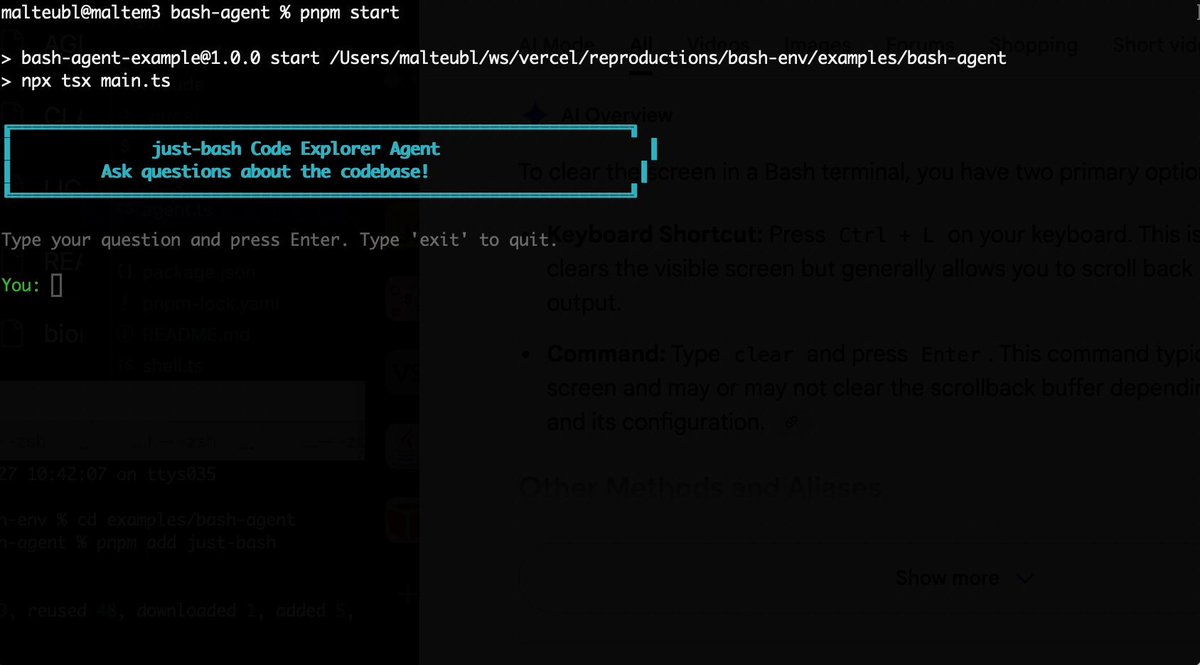
Bash is all you need! Which is why I'm introducing my holiday project: just-bash just-bash is a pretty complete implementation of bash in TypeScript designed to be used as a bash tool by AI agents. Because it turns out agents love exploring data via shell scripts, even beyond coding. It comes with grep, sed, awk and the 99th percentile features that an agent like Claude Code or Cursor would use. In fact, Claude Code can use it for secure bash execution. In the package - A bash-tool for AI SDK - A binary for use by yourself or your coding agents - An overlay filesystem to feed files to your agent securely - A Vercel Sandbox compatible API, so you can quickly upgrade to a real VM if you need to run binaries - An example AI agent that explores the just-bash code base using just-bash - I imported the Oils shell bash compatibility suite and just-bash passes a very good chunk What is interesting about this codebase: It was essentially entirely written by Opus 4.5. Coding agents love bash and they are good at reproducing it. They are also great at text-book recursive descent parsers and AST tweet-walk interpreters. That said, it is, like, a lot of code and I didn't read it all 😅. This is very much a hack, but it also seems to be _really_ useful. I haven't really found anything agents want to use that it doesn't support and it's fast and secure (caveats apply). It doesn't have write access to your computer and the filesystem is given a root that the agent cannot escape from. Find it at Related: Our recent blog post how we migrated our data analysis agent to bash tools and achieved incredible quality improvements The video shows the example agent investigating the just-bash code base

Malte Ubl

125,326 次观看 • 8 个月前

Someone just posted the full blueprint for an AI swarm that does the job of a 200-person quant research team. Six agents. Running 24/7. Finding brand-new alpha while you sleep. Citadel needs 100 PhDs to do this. Two Sigma needs 200. This does it with six bots and one laptop. Two ways to play this - spend a weekend building your own swarm, or copy the wallet of one that's already up $2M: Boris Cherny runs Claude Code at Anthropic. Two weeks ago he said: "I don't prompt Claude anymore. I have loops running that prompt Claude. My job is to write loops" Alpha research is just a pipeline. So instead of sitting in it, you hand each stage to its own agent: > one reads every new research paper overnight and pulls out the trade idea > one builds the features and cleans the data > one backtests it over 20 years, costs and slippage included > one runs the hard stats and kills anything overfit > one checks it still works in every market regime > one strips out plain momentum and value to see if any real edge is left Each of those six is a job a fund pays a $600,000-a-year quant to do. He runs all six for the price of an API bill. The rule that makes it work: the agent that builds a signal never gets to approve it. A separate, stronger agent tries to kill it first. Whatever survives all six by morning is real, new alpha. One trader's already running this exact swarm on Polymarket. That $2M wallet is public, every trade on-chain. The full build is in the post below - six agents, the tool that runs them, and the five mistakes that kill most people. Bookmark & read this before it's buried.

cvxv666

103,734 次观看 • 2 个月前

🚨A 25 YEAR OLD BUILT THE FASTEST GROWING SOFTWARE COMPANY IN HISTORY.. WITH ZERO MARKETING SPEND.. AND SPACEX JUST OFFERED $60 BILLION TO BUY IT.. His name is Michael Truell.. He started coding at 11.. Interned at Google at 18.. Dropped out of MIT to start a company that built AI tools for mechanical engineering.. That company failed.. So he pivoted.. And built Cursor.. An AI-powered code editor that writes software for you.. Here's how fast it grew.. $100 million in annual revenue in 12 months.. Fastest in SaaS history.. Broke every record ever set by Slack, Zoom, and Wiz.. $500 million by month 21.. $1 billion by November 2025.. $2 billion by February 2026.. Projected to hit $6 billion by end of year.. Zero marketing spend.. Not a single dollar.. Pure word of mouth from developers who couldn't stop talking about it.. Over 1 billion lines of code accepted per day.. Used by 70% of Fortune 1000 companies.. Every single one of Nvidia's 40,000 engineers uses it.. Coinbase hit 100% adoption among their developers.. And he did this with a team of four MIT co-founders.. One of them was a three-time International Math Olympiad competitor from Pakistan.. Another was a college squash captain with zero startup experience who built the entire product strategy.. They spent zero on sales.. Zero on ads.. Zero on growth hacking.. The product sold itself.. But here's where the story takes a turn nobody expected.. Even at $50 billion valuation.. Even generating billions in revenue.. They hit a wall.. Not a market wall.. A physics wall.. They couldn't get enough GPUs to train their next AI model.. The physical chips didn't exist in sufficient quantities for them to buy.. Money couldn't solve the problem.. Enter Elon Musk.. On April 21.. SpaceX announced a deal to potentially acquire Cursor for $60 billion.. The largest acquisition option in tech history.. The structure is insane.. SpaceX gives Cursor immediate access to Colossus.. xAI's supercomputer equivalent to one million Nvidia H100 GPUs.. For nine months of joint development.. At the end.. SpaceX can buy the company for $60 billion.. If they don't buy it.. They owe Cursor a $10 billion breakup fee.. The largest breakup fee in corporate history.. Think about what that means for Cursor.. Either they get acquired for $60 billion.. Or they walk away with $10 billion in cash and nine months of free training on the most powerful supercomputer on earth.. There is no losing scenario.. And here's why Musk wants it.. SpaceX is preparing for an IPO at $1.75 trillion.. The biggest IPO ever.. But aerospace alone can't justify that number.. By merging xAI into SpaceX.. And now acquiring Cursor.. Musk transforms SpaceX from a rocket company into an AI empire that owns the compute, the models, and the developer tools.. Cursor is the missing piece.. The application layer that puts xAI's models into the daily workflow of every Fortune 500 engineering team.. Oh and one more thing.. In 2022.. FTX's trading firm Alameda Research made a seed investment in Cursor.. During the FTX bankruptcy.. Liquidators sold that stake for $200,000.. That stake is now worth approximately $3 billion.. Sam Bankman-Fried called it the worst liquidation decision in venture capital history.. From a prison cell.. A failed mechanical engineering startup.. Pivoted by four kids from MIT.. Zero marketing.. Zero sales team.. Built the fastest growing software company in history.. And now SpaceX is writing a $60 billion check for it.. This is the most insane founder story in Silicon Valley history.. And most people haven't even heard of Michael Truell.

Evan Luthra

990,301 次观看 • 4 个月前

elon musk grabbed the source code openai open-sourced by accident, rewrote it in rust over a weekend, and shipped it as a free coding agent that does everything $200/mo chatgpt pro does. why pay $200 to openai and $200 to claude when this runs for $8 the swarm above is one weekend of exactly that: thousands of agents pouring through four endpoints, three paid seats billing $1.80 a task while the free fork bills $0. musk co-founded openai, walked out, and when they left codex on github under a permissive license, he forked it, stamped grok on it, and gave it away what the free version does that the $200 seat charges for: the agent · openai's own engine -> it reads your repo, writes patches, runs your tests, and loops until they pass, exactly like codex -> because under the hood it is codex, just faster and free. you are paying $200 for the paid skin of a tool now sitting on github the license · apache-2.0, un-revocable -> free to use, free to fork, free to ship inside your own product with zero strings -> openai cannot pull it back. musk made sure the license is the kind that never expires the switch · one line, no new tools -> point it at any openai-compatible or claude-compatible endpoint, including an $8 kimi backend -> same terminal, same workflow, gpt-5.6 and opus 5 just quietly lose the seat the bill · $400 down to $8 -> chatgpt pro plus claude max is $400 a month. the free agent plus an $8 kimi key does the same daily work -> that is a 98% cut, built out of openai's own source code, handed to you by the guy suing them here is the part they will fight me on: openai did not lose this to a better model, they lost it to their own license and an enemy with a weekend free. the $200 was never the tool, it was the toll, and musk just put openai's own logo on the road around it drop your $400/mo ai stack to $8. the run above is openai's own agent, rewritten free, doing the job it bills $200 a month for. the full breakdown is in the article below

starmex

111,101 次观看 • 23 天前

How Cloudflare cut query times by 35x without leaving Postgres: Their Postgres tables hit billions of rows, and every time-range query started getting slower. Plain Postgres scans the entire table on every query, regardless of the time window. They tried the manual route by building precomputed aggregates with cron jobs and evaluating ClickHouse, which needed a full ingestion pipeline just to handle their write pattern. Here's where most teams get stuck at exactly this point. They utilize manual partitioning, splitting data into child tables by day or month. Then they wire up cron jobs to refresh aggregate tables. Every schema change after that requires updating the cron logic and coordinating across teams. The infrastructure becomes the project. Tiger Cloud is managed TimescaleDB by Tiger Data - Creators of TimescaleDB on the Postgres you already know, with automatic time-based partitioning, continuous aggregates, and compression built in from the start. Cloudflare moved to TimescaleDB after exhausting the manual route and saw 5-35x query performance improvement on the same data. Here is how it works: → Hypertables partition data by timestamp automatically. Every time-range query hits only the relevant chunk, not the full table. → Continuous aggregates refresh incrementally in the background, with no cron jobs to maintain. To show what this looks like in practice, I built a real-time earthquake intelligence dashboard on a 3D globe using Claude Code and Tiger Cloud in a single session. The USGS earthquake catalog has 400,000+ events since 1900, each a timestamped row. The dashboard plots them as ripple animations sized by magnitude and colored by depth, with a time slider that scrubs through 120 years of seismic history. Every slider position fires a live query against the hypertable, and the side panel pulls from continuous aggregates. Claude Code connected to Tiger Cloud through the Tiger CLI MCP server, provisioned the database, pulled the USGS catalog, and assembled the full Next.js and Three.js frontend without leaving the session. The video below shows the final build in action, and I worked with the Tiger Data team to put this together. Tiger CLI is open-source (Apache 2.0) and works with Claude Code, Cursor, Codex, Gemini CLI, and VS Code. To try this yourself: → Sign up for Tiger Cloud here: New accounts get $1,000 in free credits, no credit card required. → Install Tiger CLI: curl -fsSL https(:)//cli(.)tigerdata(.)com | sh → Run tiger mcp install claude-code → Give Claude Code a prompt and let it build. I also wrote a full walkthrough on how you can turn any coding agent into a production-grade data engineer that can manage over a billion-row Postgres workloads. It covers everything from the database setup to the final build. Read it below.

Avi Chawla

22,094 次观看 • 1 个月前