Video wird geladen...

Video konnte nicht geladen werden

Zur Startseite

I had an awesome time interviewing idan shenfeld and Jonas Hübotter from MIT and ETH Zurich about self-distillation. this very promising post-training paradigm where the model acts as its own teacher by conditioning on environment feedback or demonstrations. we cover the SDPO algo for reinforcement learning with rich feedback...

13,091 Aufrufe • vor 4 Monaten •via X (Twitter)

0 Kommentare

Keine Kommentare verfügbar

Kommentare vom Original-Post werden hier angezeigt

Ähnliche Videos

Everybody is talking about recursive self-improvement (RSI) and meta learning. Here is my old 2020 talk about this [1]. It has aged well. Example: humans still define the starts & ends of trials of many modern meta learners. My RSI systems since 1994 LEARN to (re)define them [2]! [1] Meta Learning Machines in a Single Lifelong Trial (talk for workshops at ICML 2020 and NeurIPS 2021, based on earlier talks since 1994). Abstract: the most widely used machine learning algorithms were designed by humans and thus are hindered by our cognitive biases and limitations. Can we also construct meta learning algorithms that can learn better learning algorithms so that our self-improving AIs have no limits other than those inherited from computability and physics? This question has been a main driver of my research since I wrote a thesis on it in 1987 [2]. Here I summarize our work on meta reinforcement learning with self-modifying policies in a single lifelong trial (since 1994), and mathematically optimal meta-learning through the self-referential Gödel Machine (since 2003). Many additional publications on meta-learning since 1987 can be found in the RSI overview [2]. [2] J. Schmidhuber (AI Blog, 2020-2025). 1/3 century anniversary of first publication on recursive self-improvement (RSI) and meta learning machines that learn to learn (1987). For its cover I drew a robot that bootstraps itself. 1992-: gradient descent-based neural meta learning. 1994-: meta reinforcement learning with self-modifying policies. 1997: meta RL plus artificial curiosity and intrinsic motivation. 2002-: asymptotically optimal meta learning for curriculum learning. 2003-: mathematically optimal Gödel Machine. 2020-: new stuff!

Jürgen Schmidhuber

249,595 Aufrufe • vor 6 Monaten

I had a fantastic time discussing with the learning legend Justin Skycak from Math Academy about learning math in the modern age. we've talked about his quite impressive self-learning journey (3000h of math in high school) all the way to how he hand curated the initial knowledge graph for math academy to make that process more efficient. great lively 3h discussion here are the chapters: 0:00:00 - intro: 0:02:10 - justin background 0:05:45 - 3000h math self study in high school 0:11:45 - what a day looked like for that 3000h stretch 0:16:10 - meta-learning vs pure math learning 0:21:50 - when did you get into cognitive neuro? 0:29:55 - how did the fundamental math helped in your research projects 0:43:10 - what does the math academy learning system looks like 0:47:34 - how did you guys build the 2000 topic knowledge graph 1:01:15 - would LLM be useful as an interface to that knowledge graph for the students? 1:10:46 - how does the FIRe spaced repetition algorithm works? 1:17:34 - does the same knowledge graph structure would work for physics? or other topic?: 1:34:05 - how do you understand the subject vs the curiculum 1:35:50 - is there a connection between studying math and learning a sport? 1:42:00 - do you think in math doing and teaching requires different skills? 1:56:25 - could you get understanding without automaticy? 2:05:35 - do you see any upside of confusion in learning? 2:14:11 - learning math as an adult? 2:19:20 - how to fill the motivation gap after learning the fundamental? 2:24:10 - how should teaching math for kids and adults balance fundamentals and creativity? 2:33:55 - is it ever too late to learn math seriously? 2:46:00 - mastery learning vs ultra learning 2:51:30 - top-down vs bottom-up 2:53:40 - mastery learning for domain without a structured hierarchical structure? 2:56:30 - neurodivergence / adhd for structured math learning? 3:06:20 - amateur mathematician augmented with technology will be able to contribute to research? 3:14:37 - what are you most excited about right now in term of learning enjoy!

Yacine Mahdid

57,320 Aufrufe • vor 5 Monaten

auto-research is starting to gain traction as a very viable paradigm for creating useful research discovery. now, that paradigm is still in its infancy and the infrastructure to hold all that trail of context as the agents blaze through experiments isn't well defined (to say the least). on that topic, I had the chance to chat with my boys francesco and giulio from paradigma about what underlying infra is needed to make this paradigm work. the paradigma's paradigm, which involves copious amount of DAGs, make this auto-research paradigm a paradigmatic case of essential infrastructure. here's the full video in full: - 0:00 - what is missing from auto-research? - 2:02 - giulio and francesco ai journey - 8:10 - research infra is the bottleneck? - 10:18 - paradigma vision of autonomous research - 13:17 - “important discovery per joules” - 17:15 - why is DAG the unit of research for auto-research? - 20:40 - is paradigma trying to replace the research publication? - 24:50 - how does knowledge is shared between experiments in the DAG? - 27:34 - what is even auto-research lol? - 33:53 - the value of the human mind in this auto-research future. - 37:00 - how do you reconcile hallucination in this auto-research paradigm? - 41:33 - the adoption of auto-research across varied fields? - 47:30 - ✨ introduction to the auto-research infrastructure. ✨ - 56:55 - where is the code? - 59:10 - full IDE next? - 1:03:20 - the place of the human in this DAG / code quality? manual node? token spent? - 1:16:02 - who’s the user for auto-research? - 1:18:13 - how to validate bad DAG? - 1:20:18 - ✨ auto-research agent results ✨ - 1:22:53 - ✨ how a big research DAG looks like? ✨ - 1:25:10 - how to get the canonical DAG for the final result? - 1:27:50 - the auto-research DAG being the new pre-print? - 1:30:05 - what’s next for paradigma and the auto-research infra? - 1:35:00 - what are they excited about research wise? enjoyyyyy my guys 🌹

Yacine Mahdid

12,091 Aufrufe • vor 3 Monaten

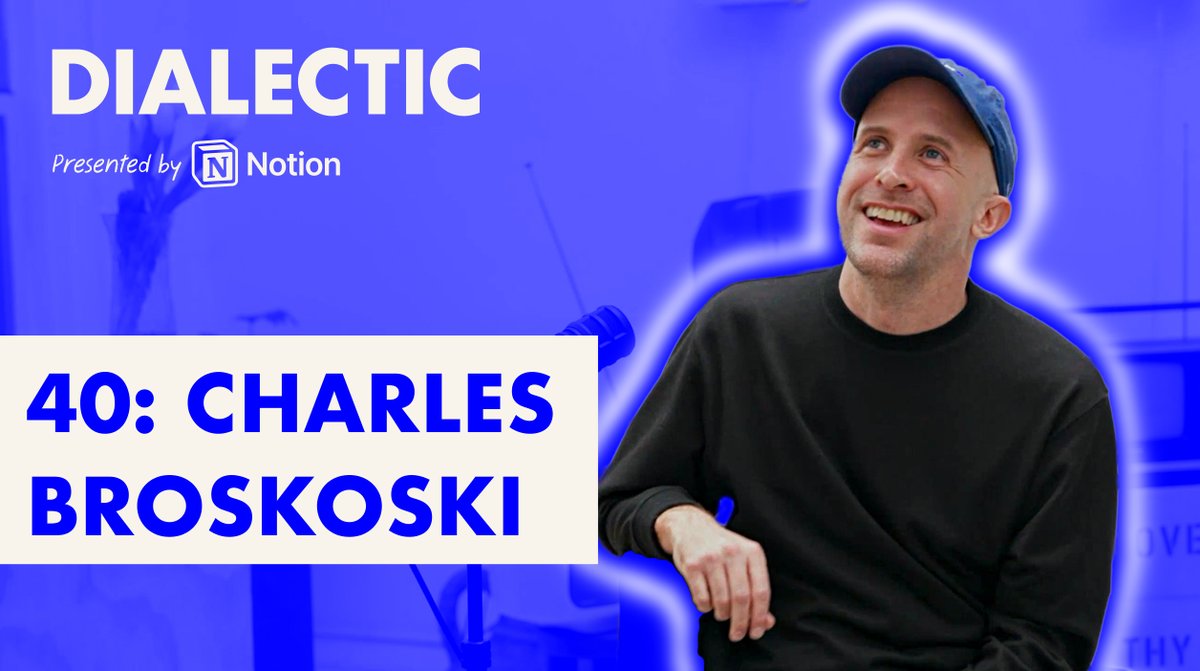
Charles Broskoski believes everything should be personal: your work, your tools, your taste, and perhaps most provocatively, the business you build. I talked to Charles Broskoski about knowing yourself, noticing patterns, casual research, and building a personal business in Are.na. Charles is an artist turned software engineer and co-founder/CEO of Arena: a platform for collecting, connecting, and self-directed learning. Arena is coming up on its 15th anniversary, and Charles hopes it can last another 15 and far beyond. I discovered him through his essay and talk, "Here for the Wrong Reasons", and was struck by his philosophy that who we are is made up of the things we pay attention to, and specifically what we see in them. We discuss that and more: - Why creativity is decision-making and problem-solving - Charles's case for "casual" research - Why skateboarding is a model for being a beginner - How information that inflects you becomes part of who you are - Personal versus performative taste (and why it shouldn't be thought of as a competitive skill) - Creating a typeface to replace Arial that looks (almost) exactly like Arial - Why more creative people should start businesses - Drawing inspiration from a 1,300 year old Japanese hot spring hotel - "The reward is the work. That you get to hang out with your friends and make something cool." - Why Arena wants to fade into the background Timestamps: 0:00 - Opening Highlights 1:21 - Intro: Charles Broskoski 4:00 - Thanks to Notion 5:26 - Start: Creativity as Self-Knowledge and Problem-Solving 13:37 - Self-directed Learning and Casual Research 21:33 - Skateboarding, Being a Beginner, In Defense of Posers 33:26 - Contextual Patterns and Channels 45:54 - Nodal Points, Your Radar, and Careful Attention 1:04:57 - Subjectivity, Self-Knowledge, and Taste 1:15:09 - Performance: Here for Fame and Not Love 1:22:53 - Aspirational Attention 1:29:02 - Designing Generous Tools 1:42:44 - Space in a Product and Fading into the Background 1:50:01 - Why Creatives Should Be Entrepreneurial & Building an Independent Business Online 1:54:11 - Patience, Durability, and Antifragility 1:59:48 - Personal Businesses 2:10:27 - Grab Bag: Authenticity, Bohm Dialogue, Skateboarding, and Keeping Things Personal 2:28:28 - Thanks Again to Notion Dialectic with Jackson Dahl Ep. 40: Charles Broskoski - Everything is Personal - is out now, below and on all platforms.

Jackson Dahl

27,561 Aufrufe • vor 6 Monaten

Inside Nemotron and NVIDIA's AI lab: my conversation with Bryan Catanzaro (Bryan Catanzaro). NVIDIA is a chip company. So why does it put hundreds of researchers on building AI models - and then give them away for free? We go deep into the Nemotron models, what it takes to build a top AI lab, and the future of frontier AI. 01:33 - Is open source AI catching the frontier? 05:29 - Do closed labs blocking distillation slow open source down? 07:42 - Is the US falling behind China? 10:30 - Why companies actually choose open models 12:39 - A "crazy" 2008 bet: machine learning on GPUs 15:33 - Working with Andrew Ng and Dario Amodei at Baidu 17:41 - Coming back to NVIDIA: DLSS and the birth of Megatron 21:55 - The real reason NVIDIA builds its own models 24:28 - Is Moore's Law really dead? 33:37 - The Nemotron family: Nano, Super, Ultra 35:09 - Built for agents: why NVIDIA bets on speed 36:02 - How you train a 550B model in 4 bits 39:25 - Hybrid Mamba-Transformer, explained simply 42:31 - Mixture of experts, and why NVIDIA built NVL72 around it 47:26 - Why a 1-million-token context window matters 49:26 - Multi-token prediction: how the model predicts 5 tokens at once 52:47 - Multi-teacher distillation: teaching one model from many 58:01 - Where reinforcement learning goes next 01:00:16 - Inside NVIDIA's research org: "the mission is the boss" 01:04:03 - How NVIDIA decides who gets the GPUs 01:10:53 - Why NVIDIA still feels entrepreneurial after 33 years 01:12:58 - Why Bryan doesn't believe in the singularity 01:17:50 - The AI backlash 01:19:18 - The controversial case: open AI is safer than closed

Matt Turck

56,954 Aufrufe • vor 2 Monaten

Thanksgiving-week treat: an epic conversation on Frontier AI with Lukasz Kaiser -co-author of “Attention Is All You Need” (Transformers) and leading research scientist at OpenAI working on GPT-5.1-era reasoning models. 00:00 – Cold open and intro 01:29 – “AI slowdown” vs a wild week of new frontier models 08:03 – Low-hanging fruit, infra, RL training and better data 11:39 – What is a reasoning model, in plain language 17:02 – Chain-of-thought and training the thinking process with RL 21:39 – Łukasz’s path: from logic and France to Google and Kurzweil 24:20 – Inside the Transformer story and what “attention” really means 28:42 – From Google Brain to OpenAI: culture, scale and GPUs 32:49 – What’s next for pre-training, GPUs and distillation 37:29 – Can we still understand these models? Circuits, sparsity and black boxes 39:42 – GPT-4 → GPT-5 → GPT-5.1: what actually changed 42:40 – Post-training, safety and teaching GPT-5.1 different tones 46:16 – How long should GPT-5.1 think? Reasoning tokens and jagged abilities 47:43 – The five-year-old’s dot puzzle that still breaks frontier models 52:22 – Generalization, child-like learning and whether reasoning is enough 53:48 – Beyond Transformers: ARC, LeCun’s ideas and multimodal bottlenecks 56:10 – GPT-5.1 Codex Max, long-running agents and compaction 1:00:06 – Will foundation models eat most apps? The translation analogy and trust 1:02:34 – What still needs to be solved, and where AI might go next

Matt Turck

168,007 Aufrufe • vor 9 Monaten

Loved this 22-minute talk on continual learning for AI agents. Must watch for anyone looking to get agents performant and into production. Credit: Soheil Feizi at AI Engineer • Agent learning can happen at three layers: the model (weights), the harness (prompts, tools, skills, code, workflows), and memory (session or persistent). • Two fundamental challenges: (1) getting feedback, meaning how do we know if the agent did well and what it should have done instead, and (2) acting on that feedback, meaning deciding which layer or component to change and how. • Feedback sources differ by stage: In development you have benchmarks with evaluators that score pass/fail. In production you only have logs, which can be judged either automatically (LLMs or code analyzing the log, which is scalable) or by human experts (low volume but critical domain knowledge). • Logs plus feedback aren't enough because they're not testable: A single log with feedback is one observation of what happened. You need to lift it into a replayable learning environment, a simulation with tools, users, and defined evaluators, so candidate fixes can be run, verified, and compared. • Three ways to optimize the agent, with tradeoffs: Model-layer updates (SFT, RL post-training like DPO/GRPO, LoRA) are expensive and need benchmarks and evaluators. Harness updates (trace-to-harness coding agents, prompt search like GEPA) are flexible but either untestable and "vibe-based" or benchmark-dependent. Memory updates (fact storage like Letta/Mem0, skill distillation) are cheapest and fastest but usually unverified. • A good learning engine makes "the smallest durable change at the right layer" of the agent. • Verifiable continual learning (VCL): Improve an agent from its own experience where every fix is proven to help and proven to break nothing that already worked. It requires an executable test (replayable failure), a measured delta (score before and after), and regression tests (prior tests still pass). • Four principles of practical VCL: Replayability (turn one-off failures into rerunnable tests), holisticness (one failure can have causes in memory, prompts, tools, workflow, or model, so route the fix to the right layer), lifelongness (fix new failures subject to no regression on past environments, with regression handled inside the optimization loop rather than post-hoc), and efficiency (the loop must run frequently and cheaply, without scaling linearly as past environments accumulate). • Three takeaways: (1) Agent continual learning isn't necessarily fine-tuning; many useful updates live in the harness and memory layers. (2) Production logs are not learning environments and must be transformed into replayable ones. (3) The frontier is regression-aware improvement: fixing new failures while verifying you don't break old ones.

Alex Lieberman

20,417 Aufrufe • vor 2 Monaten