Загрузка видео...

Не удалось загрузить видео

На главную

IN 1986 MIT FILMED THE LECTURE WHERE CODE STOPPED BEING CODE AND BECAME DATA 43 minutes from Gerald Sussman, in the most legendary intro programming course ever recorded. -> The idea that lands: to a program, your code is just data it can read and rewrite. He builds a...

22,107 просмотров • 1 месяц назад •via X (Twitter)

Комментарии: 0

Нет доступных комментариев

Здесь появятся комментарии из оригинального поста

Похожие видео

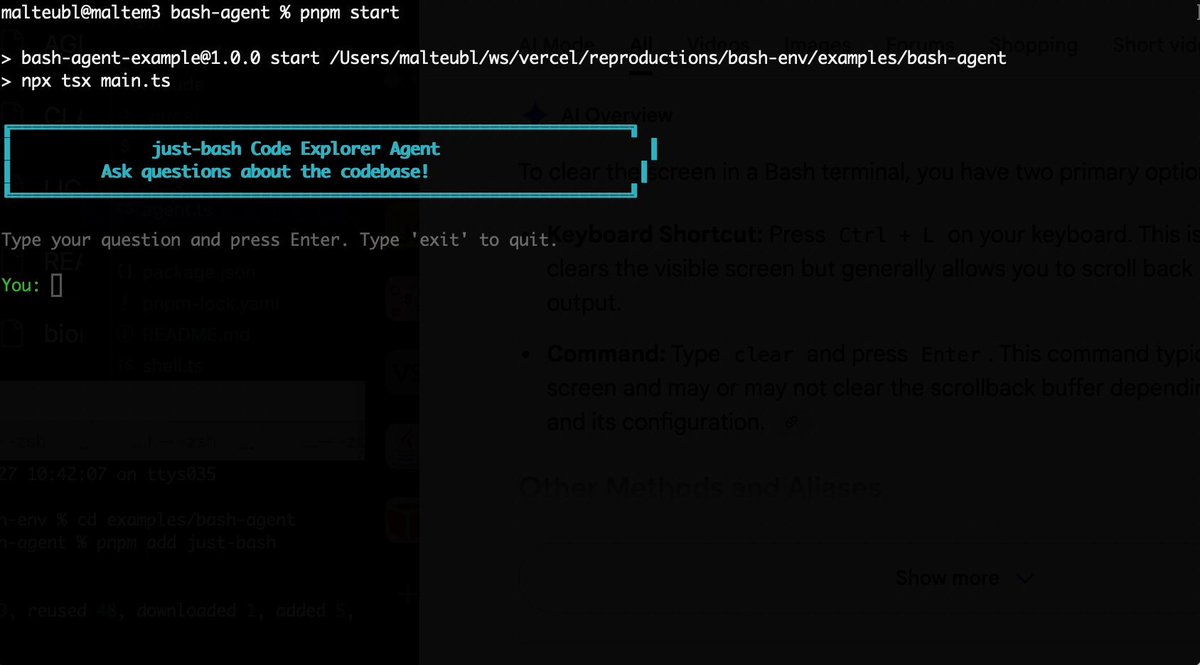
Bash is all you need! Which is why I'm introducing my holiday project: just-bash just-bash is a pretty complete implementation of bash in TypeScript designed to be used as a bash tool by AI agents. Because it turns out agents love exploring data via shell scripts, even beyond coding. It comes with grep, sed, awk and the 99th percentile features that an agent like Claude Code or Cursor would use. In fact, Claude Code can use it for secure bash execution. In the package - A bash-tool for AI SDK - A binary for use by yourself or your coding agents - An overlay filesystem to feed files to your agent securely - A Vercel Sandbox compatible API, so you can quickly upgrade to a real VM if you need to run binaries - An example AI agent that explores the just-bash code base using just-bash - I imported the Oils shell bash compatibility suite and just-bash passes a very good chunk What is interesting about this codebase: It was essentially entirely written by Opus 4.5. Coding agents love bash and they are good at reproducing it. They are also great at text-book recursive descent parsers and AST tweet-walk interpreters. That said, it is, like, a lot of code and I didn't read it all 😅. This is very much a hack, but it also seems to be _really_ useful. I haven't really found anything agents want to use that it doesn't support and it's fast and secure (caveats apply). It doesn't have write access to your computer and the filesystem is given a root that the agent cannot escape from. Find it at Related: Our recent blog post how we migrated our data analysis agent to bash tools and achieved incredible quality improvements The video shows the example agent investigating the just-bash code base

Malte Ubl

125,326 просмотров • 7 месяцев назад

AI is changing the software engineering craft. Anders Hejlsberg (Anders Hejlsberg) - creator of C#, TypeScript and industry legend - on why code review needs to get more enjoyable in response: #1 - AI is shifting the craft from writing code, to reviewing code: "In a sense, we're all turning into project managers. We can have an army of junior programmers, called agents, that will just spit out reams of code but someone's got to have the big picture and review all of that. And so, increasingly, our craft is going from one of writing the code, to one of reviewing the code and building the architecture of the code and overseeing the work. It's a different kind of craft. It's a different kind of enjoyment. I've always liked writing the code. To me that was the fulfilling part, seeing it work. In a way, AI robs a little bit of that, because I am less interested in reviewing code." #2 - The code review experience should be improved: "I think we could also make the process of reviewing code much more interesting than it is today. I mean, today, you see a list of diffs in alphabetical order and now it's up to you to make heads or tails of it. There are more pedagogical ways of presenting that. And you could have commentary generated by the AI that tells you what the changes are and whatever, and then tries to guide you along. So that symbiotic relationship, I think we need to work on that more and to keep the enjoyment in there."

The Pragmatic Engineer

39,011 просмотров • 3 месяцев назад

your eval measured one system. production ran another. they start from the same idea and end somewhere else, which is why the number was right and the outcome was not. the code is the same until someone rewrites it for prod, because the eval lived in a notebook and prod is a service. then the data diverges. clean fixtures in the test, late and incomplete data in the run. then execution diverges. the eval assumed every call lands. production has retries, timeouts and rate limits. by the end the two runs share a name and nothing else. > why nobody catches it both sides are internally correct. the eval measured what it ran. production ran what it was given. neither one is wrong, and neither one is responsible for checking they were the same artifact. so the gap widens quietly. someone patches prod without touching the eval. someone adds a fixture without touching prod. no test anywhere fails. > what to actually do ship one artifact. the code that was measured is the code that runs. model the friction. whatever the real environment charges you, charge it in the eval too. easiest way to see the gap on your own idea, without writing the harness: (only first 100 registrated) it runs the tested code live, unchanged. that is the whole point. and treat the eval as a prior, not a result. it tells you what to expect. only the live run tells you what happened. your eval was accurate. it was accurate about something you never shipped.

Hanako

45,239 просмотров • 12 дней назад