Загрузка видео...

Не удалось загрузить видео

На главную

introducing AlphaClaw Apex 🐺 a native Mac app for managing multiple OpenClaw VPS instances from one dashboard. some of you are already setting up OpenClaw for clients as a service. Apex is built for you. deploy to Hetzner VPS in one click. monitor all your instances. manage configs, updates,...

67,488 просмотров • 3 месяцев назад •via X (Twitter)

Комментарии: 0

Нет доступных комментариев

Здесь появятся комментарии из оригинального поста

Похожие видео

HERMES AGENT IS NOW IN THE CLOUD. NO VPS. NO TERMINAL. NO SETUP. PICK A MODEL. PICK A SERVER SIZE. AGENT IS LIVE IN 60 SECONDS. Nous Portal just launched hosted Hermes Agent. two clicks. one minute. done. Nous Research WHAT THIS MEANS: before today: install Hermes on a VPS or your laptop. configure providers. set up gateway. manage updates. run hermes setup. edit config.yaml. great for power users. friction for everyone else. now: go to pick a model. pick a server size. your agent is live and reachable in 60 seconds. no terminal. no SSH. no Docker. same Hermes. same features. same tools. someone else handles the infrastructure. FOR TEAMS: this is where it gets interesting. spin up agents for everyone at your org. each team member gets their own Hermes instance. granular access controls per user. unified billing through Nous Portal. your team gets Hermes on day one. no DevOps needed. no VPS per person. one admin dashboard. one bill. WHAT'S INCLUDED: → 300+ models via Nous Portal (Claude, GPT, Gemini, DeepSeek, Grok, MiniMax, and more) → Tool Gateway (web search, image generation, TTS, browser automation) → all messaging platforms (Telegram, Discord, Slack, WhatsApp, Signal) → full feature set (profiles, cron, kanban, skills, memory, sub-agents, MoA, /goal, /learn, /journey) → automatic updates ONE PORTAL. FOUR TIERS: Free: $0/month. pay-as-you-go credits from $10. Plus: $20/month. $22 in monthly usage credit. Super: $100/month. $110 in monthly credit. Ultra: $200/month. $220 in monthly credit. highest rate limits. every paid tier includes Tool Gateway. one OAuth. one subscription. no extra API keys. SELF-HOSTED IS NOT GOING ANYWHERE: Hermes is MIT licensed. open source. free forever. you can still run it on your laptop, VPS, or GPU cluster. nothing changes for self-hosted users. the cloud version is for people who want the agent running without managing the machine. pick your path: → self-hosted: full control. you manage everything. → cloud: zero ops. Nous manages infrastructure. → hybrid: self-host your main agent, cloud for team members. HOW TO START: cloud: self-hosted: hermes setup --portal both connect to the same Nous Portal. same models. same tools. same billing. learn how to replace your entire team with 8 hermes agents 👇

YanXbt

45,446 просмотров • 7 дней назад

Introducing Open Source AI CRM, that runs on your OpenClaw. A few weeks ago, we launched Ironclaw (An Open Source OpenClaw CRM Framework) which now has around 1.4k stars. A lot of people confused us with NearAI’s Ironclaw, so we changed our name to DenchClaw. OpenClaw today feels a lot like early React: the primitive is incredibly powerful, but the patterns are still forming, and everyone is piecing together their own way to actually use it. What made React explode wasn’t just React itself, but the emergence of frameworks like Gatsby and Next.js that turned raw capability into something opinionated, repeatable, and easy to adopt. That is how I think about DenchClaw. We are not just building on top of OpenClaw; we are trying to make it one of the clearest, most practical, and most complete ways to use OpenClaw in the real world. We are an OpenClaw Framework, we are aiming to be the most correct way to use OpenClaw. We entered Y Combinator with Merse (AI Audio Comic), it was an app that I personally never used. Michael Seibel confronted us on it, and said, “if you aren’t the best user of your consumer app, then who is?”. I now use DenchClaw daily for everything I do, it also works as a coding agent like Cursor, DenchClaw built DenchClaw. I am addicted to DenchClaw now that I can ask it, “hey in the companies table only show me the ones who have more than 5 employees” and it updates it live than me having to manually add a filter. On Dench, everything sits in a file system, the table filters, views, column toggles, calendar/gantt views, etc, so OpenClaw can directly work with it using Dench’s CRM skill. The CRM is built on top of DuckDB, the smallest, most performant and at the same time also feature rich database we could find. It creates a new OpenClaw🦞 profile called “dench”, and opens a new OpenClaw Gateway… that means you can run all your usual openclaw commands by just prefixing every command with `openclaw --profile dench` . It will start your gateway on port 19001 range. You will be able to access the DenchClaw frontend at localhost:3100. Once you open it on Safari, just add it to your Dock to use it as a PWA. Think of it as Cursor for your Mac which is based on OpenClaw. DenchClaw has a file tree view for you to use it as an elevated finder tool to do anything on your mac. I use it to create slides, do LinkedIn outreach using MY browser. DenchClaw sees what you see, does what you do. It’s the everything app, that sits locally on your mac. All yours. Just ask it “hey import my notion”, “hey import everything from my hubspot”, and it will literally go into your browser, export all objects and documents and put it in its own workspace that you can use. P.S. It comes with Garry Tan's GStack built in.

Mark Rachapoom

19,411 просмотров • 3 месяцев назад

Today I'm excited to share Sigilum! This is Payman's solution for Auditable Identity for AI Agents. (think One Password-ish but for AI Agents) I recorded a quick walkthrough showing how it all works (video below). This answers three pains we've seen within Financial Services (Banking) AI Agents we've built and OpenClaw🦞 AI Agents we deploy. Security, Auditability, and Control. 1. Security Making sure keys are secure and not just freely given to an AI Agent is a big deal. When working with money, you can't just expose these or skip putting controls in place. Sigilum provides a local gateway that prevents access to keys by the AI Agent without explicit authorization from a person. We provide namespaces through the service so you always know who authorized what key, for what service, to which agent. 2. Auditability If I could hit on the importance of this 100 times I would. It comes up in every financial services conversation. Sigilum provides you with the answer to "Who authorized this AI Agent to act on my behalf?" Audit logs trace back to the person, the service, and the AI Agent. With more audit logs being built through our managed service, this will be the key source for determining how an AI Agent is behaving on your behalf. This is needed for agents from OpenClaw, and especially for banking/money movement. 3. Control Revoke keys, limit access, grant authorization. All seemingly simple things, but complex to implement and make elegant. These controls dictate what the AI Agent can or cannot do. Sigilum allows you to do all of this through the managed Dashboard. We've made Sigilum open source and encourage others to contribute and keep building on the gateway. It's been a source of a lot of visibility and productization of AI Agents for us. We'll keep contributing and adding to it. Link in comments. If you want to try it out, we do have a managed service that makes it easy to spin up. Go to to sign up. Note: even though we've been pushing 100+ commits a day to get this out to folks, there are still some noticeable areas for improvement we're working on, which should get resolved soon (by us or you!): - Deeper audit trails - More providers (currently supports all OpenClaw providers) - Deeper scanning of existing keys your agent is hiding from you (we'll find them) - OpenClaw gateway persistence - Auto-purging keys - And more... If you want to contribute or have feedback, please DM or go to the GH. Happy building!

tyllen

18,497 просмотров • 4 месяцев назад

GeoLibre v1.9.0 is here! GeoLibre is a free and open-source, lightweight, cloud-native GIS platform for visualizing, exploring, and analyzing geospatial data. It runs everywhere you do, in the web browser, on the desktop, on mobile, and inside Jupyter notebooks, all while keeping your data local and private. This release brings CAD drawing import, smarter WMS and WFS service discovery, and a docked SQL workspace with autocomplete. What's new in v1.9.0 - CAD import: Add CAD drawings (DXF/DWG) as a layer, with a picker for choosing which drawing layers to load and a CRS selector for placing them correctly on the map. - Smarter service discovery: WMS and WFS panels now read the service's GetCapabilities, so you pick available layers and feature types from a populated dropdown instead of typing names by hand. - Docked SQL Workspace: The SQL Workspace now docks as a resizable panel beside the map, with editor autocomplete for tables, columns, and SQL keywords. - Generic Vector to Vector conversion: Convert between any supported vector formats by file extension, alongside the existing targeted converters. - Richer camera tours: Per-keyframe hold and transition duration controls for finer pacing, plus save and reload of a named tour setup. - Better story maps: A hide-itinerary toggle, subtitle and byline fields on the printable handout, and dedicated start and closing slides. - Styling and plugin extras: A transparent (no fill / no outline) option in the color picker, a Legend populated from a paletted raster's color table, and plugins can now use the maplibre-gl-raster stack and the projection control. Try it out - Launch GeoLibre web: - GitHub: - Documentation: - Release notes: #GIS #Geospatial #OpenSource #RemoteSensing #DataVisualization #MapLibre #Python

Qiusheng Wu

19,405 просмотров • 14 дней назад

Claude + Shopify is f*cking cracked 🤯 Shopify just dropped an official connector that lets you manage your entire store from inside Claude. One prompt → Claude adds products, checks inventory, creates discount codes, pulls sales reports, and finds your top customers. All from a single chat. All inside Claude. Perfect for DTC brands and agencies who are still bouncing between five browser tabs every time they need to answer one basic question about their store. The new Shopify connector for Claude fixes the entire workflow: → Install the official Shopify connector in Claude Desktop in 30 seconds → Authenticate to your store via OAuth → Claude reads your full catalog, customers, orders, and analytics on demand → Adds new products, creates discount codes, and bulk-updates inventory from prompts → Runs ShopifyQL analytics queries that return live charts and dashboards → Surfaces patterns across customer behavior — top sellers, bundle opportunities, restock urgency No Shopify admin tab-switching. No exporting CSVs to ask one question. No "let me check Shopify and get back to you." What you get: → Claude connected directly to your live Shopify store → Daily store ops running through one chat — products, customers, inventory, discounts, analytics → Real-time analytics that answer questions Shopify's own dashboards can't → Pattern recognition across your orders that surfaces bundle ideas and retention opportunities → An official connector built by Shopify with 25 tools and ongoing updates I put together a full playbook with the connector setup, every prompt I tested, the 25 tools it exposes, and a Loom walkthrough video showing you how to set it up. Want it for free? > Like this post > Comment "SHOP" And I'll send it over (must be following so I can DM)

Mike Futia

56,263 просмотров • 2 месяцев назад

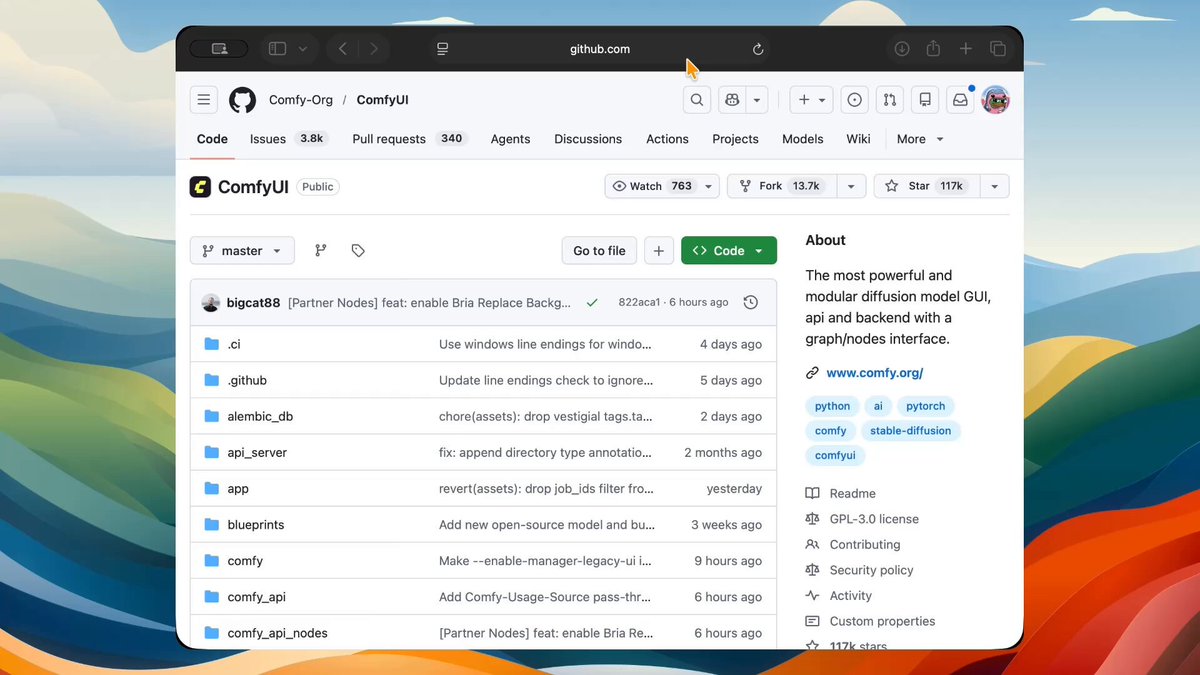
no money for grok or midjourney? this tool is for you. there's a FREE tool created by an anon dev. open-source. runs locally. 117k stars on github. it generates: > images & video > 3d models > audio > 20+ models here's how to set it up in under 5 minutes: 1️⃣download ComfyUI Desktop go to and grab the desktop app for your system. windows 10+, mac (apple silicon), or linux. it installs like any normal app, it sets up python and every dependency for you in the background. no terminal, no config files. 2️⃣open it first launch, it spins up its own environment automatically. you just wait a few seconds and you're in. you'll land on a node canvas, that's the whole interface. 3️⃣load a starter workflow top menu → Workflow → Browse Templates → Image Generation. click it. this drops a ready-made setup onto your canvas so you don't build anything from scratch. 4️⃣grab a model comfyui ships empty on purpose, the model is the brain, and you pick it. in the template, the "Load Checkpoint" node has a Download button when no model is installed. click it. it pulls one in for you (a few GB, this is the only real wait). 5️⃣install ComfyUI Manager this is the one add-on you don't skip. it lets you install models, custom nodes, and updates with a click instead of the command line. grab it from github (link in comments). it's the difference between fighting comfyui and flying in it. one honest note: an NVIDIA gpu makes this fast, apple silicon works great too, and a weak machine still runs it just slower. that's the whole setup. you now own an image, video, and 3D studio that costs you nothing per month. save this. and the next time grok or midjourney asks for your card. you won't need it. disclaimer: comfyui itself is 100% free. so are the local models (sdxl, flux, wan 2.2, ltx-2). some premium models like seedance are pay-per-use api models, only if you want top-tier quality. the free local ones cover most of what you need. (github link in the comments) follow and turn on post notification for daily AI contents.

m0h

14,542 просмотров • 1 месяц назад

BREAKING! Introducing Plus One: A hosted OpenClaw🦞 that lives in your Slack and comes pre-loaded with Every 📧's best tools, skills, and workflows. Set it up in one click, and use your ChatGPT subscription (or any other API key.) Bring your Plus One to work: Connected to the Every 📧 ecosystem Plus Ones automatically use Every 📧's agent-native apps, no setup required: - Cora for searching, sending, and managing email - Spiral for great writing in your voice - Proof ( for agent-native document editing Custom skills and workflows we use and love Plus Ones come pre-loaded with skills and workflows we use ourselves Every 📧 —some we've made, and some we think are great. - Content digest—summarizes the publications you read, starting with Every 📧 - Daily brief—your day's schedule and to-dos sent to you each morning - Animate—turn any static screenshot into an animation with Remotion - Frontend—Anthropic's front-end skill (which we use all the time!) We also make it fast to connect Google, Notion, Github, and more to your Plus One. Our goal is to give you a capable AI coworker right away, not a vanilla OpenClaw that you have to teach from scratch. Why we built Plus One OpenClaw🦞 has changed the way we work at Every. We effectively have a parallel org chart of AI coworkers, each with a name, a manager, and real responsibilities. Because of them our workflows are completely different—our company is different—and we would never go back. But getting here has been hard. Claws require a significant amount of manual setup and require a dedicated machine—like a Mac Mini—running 24/7 to stay responsive. We have learned that the hard part of Claws is the infrastructure around them—the hosting, the integrations, the skills, and the ongoing care. We’ve made them work great for our team, and we want to share everything we’ve learned with you. We're letting in 20 people a week to start, and scaling invites quickly from there. Every 📧 subscribers get priority. Bring your Plus One to work:

Dan Shipper 📧

259,448 просмотров • 3 месяцев назад

THE ULTIMATE GUIDE TO OPENCLAW (1hr free masterclass) 1. fix memory so it compounds add MEMORY.md + daily logs. instruct it to promote important learnings into MEMORY.md because this is what makes it improve over time 2. set up personalization early identity.md, user.md, soul.md. write these properly or everything feels generic. this is what makes it sound like you and understand your world 3. structure your workspace properly most setups break because the foundation is messy. folders, files, and roles need to be clean or everything downstream degrades 4. create a troubleshooting baseline make a separate claude/chatgpt project just for openclaw. download the openclaw docs (context7) and load them in. when things break, it checks docs instead of guessing this alone fixes most issues!! 5. configure models and fallbacks set primary model to GPT 5.4 and add fallbacks across providers. this is what keeps tasks running instead of failing mid-way 6. turn repeat work into skills install summarize skill early. anything you do 2–3 times → turn into a skill. this is how it starts executing real workflows 7. connect tools with clear rules add browser + search (brave api). use managed browser for automation. use chrome relay only when login is neededthis avoids flaky behavior 8. use heartbeat to keep it alive add rules to check memory + cron healthif jobs are stale, force-run themthis prevents silent failures 9. use cron to schedule real work set daily and weekly tasksreports, follow-ups, content workflowsthis is where it starts acting without you 10. lock down security properly move secrets to a separate env file outside workspace. set strict permissions (folder 700, file 600). use allowlists for telegram access. don’t expose your gateway publicly 11. understand what openclaw actually is it’s a system that remembers, acts, and improves. basically, closer to an employee than a tool this ep of The Startup Ideas Podcast (SIP) 🧃 is now out w/ Moritz Kremb it's literally a full 1hr free course to take you from from “i installed openclaw”to “this thing is actually working for me” most people are one step away from openclaw working they installed it, they tried it and it didn’t click this ep will make it click all free, no advertisers, i just want to see you build your ideas with ideas with this ultimate guide to openclaw watch

GREG ISENBERG

217,038 просмотров • 3 месяцев назад

We’re excited to introduce AgentAuth—the comprehensive auth solution designed for AI agents! We understand the pain every developer experiences regarding authentication—managing OAuth flows for Gmail, handling API keys for Linear, or setting up permissions across multiple services. It's complex enough with traditional apps. However, AI agents add an extra layer of complexity. Traditional auth solutions were not designed with this agent-specific requirement in mind. Think about it—say you're building an agent to pull data from Salesforce, send updates through Slack, and log issues in GitHub. Each service requires different authentication—OAuth2, API keys, you name it—and your agent needs to work seamlessly on your users' behalf. Building and managing all that is a massive headache, right? That’s precisely where AgentAuth by comes in. • It supports 250+ apps across categories such as CRMs, ticketing, productivity, etc. • Compatible with 15+ Agentic Frameworks, including , LlamaIndex 🦙, CrewAI etc • Offers self-hosting and white-labeling options. • Provides a unified dashboard to monitor user accounts. It takes care of all the complex authentication flows—OAuth, API Key, Basic, JWT, token refresh, and more—in the backend, so you can focus on building what truly matters for your users. This is ideal for AI developers building real-world AI automation involving multiple application interactions. Check out AgentAuth now -

Karan Vaidya

110,979 просмотров • 1 год назад

ClawTeam v0.2.0 is here. One CLI to coordinate any coding agent — Claude Code, Codex, OpenClaw, nanobot, and more — into a self‑organizing swarm that plans, builds, and ships together. What's new in v0.2.0: 1) - Gource Visualization — Watch your agent swarm’s Git activity in real time. Clear. Visual. Instant. Run: clawteam board gource --live See every commit, branch, and merge as it happens. Track what each agent is doing. 2) - Runtime Profiles — A provider‑aware configuration system. Switch between Claude, Kimi, and Gemini anytime. No need to edit environment variables. Run clawteam profile wizard. Follow the interactive setup. Done in minutes. 3) - Git-Based Context — Full worktree isolation with built‑in conflict detection and change tracking. Each agent works on its own branch, and the leader can see everything clearly in one place. 4) - Stability & Hardening — Spawn/workspace conflict fixes, improved tmux integration, message normalization, P2P liveness with lease-based detection. This release is about making the foundation rock-solid. --------------------------------------------------------- To show what a coordinated agent swarm can actually do, we ran 1 Claude Code orchestrating 8 Claude Code agents to build a robotics simulation system optimized for Apple Silicon — from scratch. 8 hours. 300+ PRs. One running simulator. Check the result: --------------------------------------------------------- Huge thanks to the open-source community for the feedback, issues, and PRs that shaped this release. ClawTeam is built in the open because we believe multi-agent coordination should be a shared primitive, not a proprietary moat. Try it: pip install clawteam Docs: GitHub: #ClawTeam #nanobot #AIAgents #openclaw #ClaudeCode #Cursor

Chao Huang

25,101 просмотров • 3 месяцев назад

One of my best engineers just showed me how to set up OpenClaw securely & without a Mac Mini. Here's his step-by-step: 1) Spin up a VPS on Hetzner It's a virtual server in the cloud. basically a computer you rent for $5-10/month. Pick 8GB RAM, Ubuntu, US East. Takes 2 minutes. 2) Install Tailscale This makes your server invisible to the public internet. Think of it like moving from a house on Google Maps into a gated community where only your devices can get in. Without this, bots start attacking your server within seconds of it going live. 3) Harden the server SSH keys only. Firewall. Intrusion prevention. Auto security updates. CJ actually uses AI to red team his own servers. Tells it to try and break in, then patches whatever it finds. 4) Install OpenClaw🦞 and run the onboarding. You pick your model provider, connect Telegram via BotFather, and configure hooks that give your agent long-term memory. The hooks auto-save sessions and context so the agent gets smarter over time. 5) Set up the gateway This is the piece that makes it actually powerful. It's a message bus that lets your main agent talk to sub-agents, receive messages from Telegram/Discord/Slack, and orchestrate everything. this is what keeps it running 24/7. 6) Hatch your claw and start training it Dump as much info about yourself as possible. tell it your preferences, your workflows, your tools. CJ's agent monitors his email, Slack, and manages his to-do list autonomously. Watch the video for the full break-down & follow CJ Hess for more AI engineering sauce.

Alex Lieberman

64,618 просмотров • 4 месяцев назад