Video wird geladen...

Video konnte nicht geladen werden

Zur Startseite

introducing OpenBench v1, an open framework for measuring AI performance and efficiency for your codebase and use case. Companies are realizing that you can't simply tokenmaxx, and are frantically looking for better ways to use and measure AI use and efficiency. One approach is evidenced by the rise in...

105,469 Aufrufe • vor 2 Tagen •via X (Twitter)

0 Kommentare

Keine Kommentare verfügbar

Kommentare vom Original-Post werden hier angezeigt

Ähnliche Videos

Our first short course with Anthropic! Building Towards Computer Use with Anthropic. This teaches you to build an LLM-based agent that uses a computer interface by generating mouse clicks and keystrokes. Computer Use is an important, emerging capability for LLMs that will let AI agents do many more tasks than were possible before, since it lets them interact with interfaces designed for humans to use, rather than only tools that provide explicit API access. I hope you will enjoy learning about it! This course is taught by Anthropic's Head of Curriculum, Colt_Steele. You'll learn to apply image reasoning and tool use to "use" a computer as follows: a model processes an image of the screen, analyzes it to understand what's going on, and navigates the computer via mouse clicks and keystrokes. This course goes through the key building blocks, and culminates in a demo of an AI assistant that uses a web browser to search for a research paper, downloads the PDF, and finally summarizes the paper for you. In detail, you’ll: - Learn about Anthropic's family of models, when to use which one, and make API requests to Claude - Use multi-modal prompts that combine text and image content blocks, and also work with streaming responses - Improve your prompting by using prompt templates, using XML to structure prompts, and providing examples - Implement prompt caching to reduce cost and latency - Apply tool-use to build a chatbot that can call different tools to respond to queries - See all these building blocks come together in Computer Use demo Please sign up here:

Andrew Ng

170,404 Aufrufe • vor 1 Jahr

BREAKING: GPT-5.6 Sol is out—AND Codex has been merged into ChatGPT Desktop as ChatGPT Codex. This combo model and desktop app harness are the gold-standard for knowledge work in AI. 5.6 is powerful, fast, half the price of Fable, and my default for almost everything. We’ve been testing it internally Every 📧 for about a month across coding, writing, design, and knowledge work. Here’s our day-zero vibe check: - An A-tier coder—but it’s not Fable. Sol scored 56/100 on our Senior Engineer benchmark compared to a 91 for Fable. I think the 56/100 undersells it, it's an excellent implementor, and very smart. But Fable just writes conceptually cleaner code and works better at the top end of task complexity. PRO-TIP: Use GPT-5.6 as Fable's subagent for the most goated combo in AI coding. - The best writer of the frontier models. It’s clearer and more concise than Fable or Opus 4.8, without the overexplaining or weird private language. It can one-shot marketing emails, help you workshop taglines, and explain complex concepts clearly. It's also super fast, which makes it easy to collaborate with. - Design is better, but not top-tier. It has noticeably more taste than 5.5, but Fable and Opus 4.8 are still playing at a different level. See examples in the video and vibe check below. - The real leap is knowledge work. Sol is the first model I’ve trusted to run whole loops of knowledge work—not just help with individual tasks. I use it to process email, surface decisions from meetings and Slack, find job candidates, scan Facebook Marketplace for furniture, and log my meals. It has shifted my job from doing the work to tending the system that does it. - The merged app is fine. I was extremely worried about this because I love the Codex app. OpenAI was caught in an interesting position: How to make an agent orchestration app for regular ChatGPT consumers, coders, and businesses all in one app. They now split the interface between ChatGPT Work and ChatGPT Codex. They're basically the same except Work hides code. And "Chat" has been demoted to 2nd tier status for quick questions in either one. It's not a big leap, but it's not a huge setback either. And it remains my favorite of the desktop agent orchestration apps. Verdict: If I really had to put my finger on it, I'd say Fable has way more big model smell. But that means it's a skill in itself to get value out of it—99% of people are still not there yet. GPT-5.6 is almost as powerful, but is easy to use, fast, and relatively cheap. It should give you an early sense of where model work is going. Full Every 📧 Vibe Check:

Dan Shipper 📧

144,588 Aufrufe • vor 14 Tagen

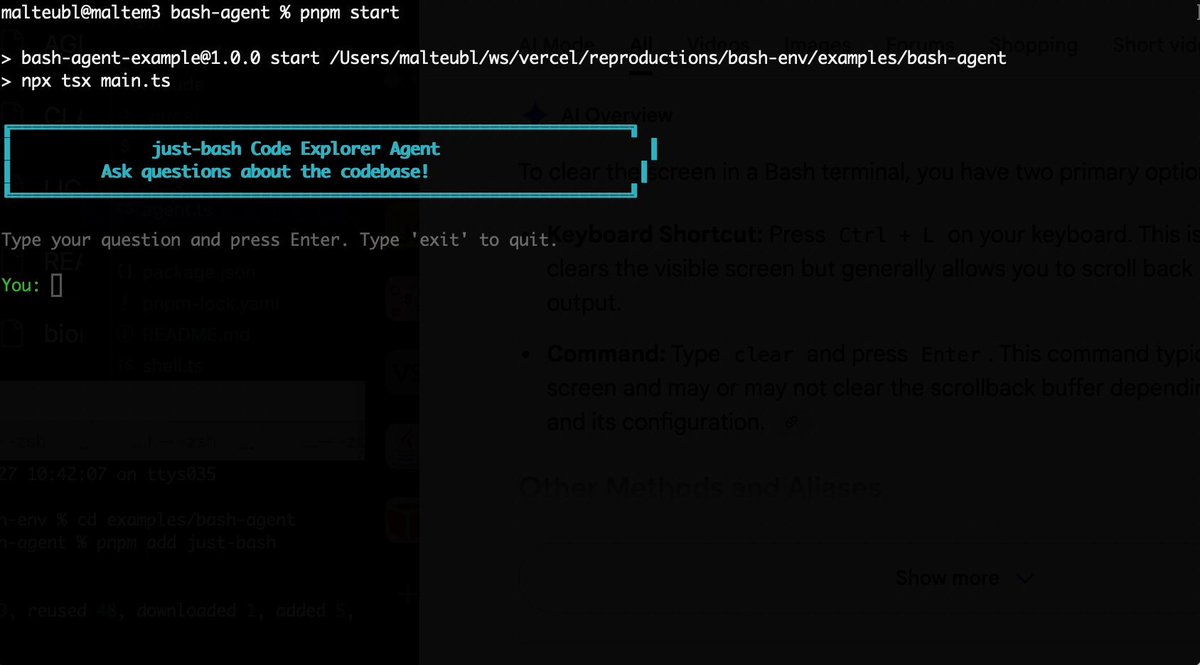
Bash is all you need! Which is why I'm introducing my holiday project: just-bash just-bash is a pretty complete implementation of bash in TypeScript designed to be used as a bash tool by AI agents. Because it turns out agents love exploring data via shell scripts, even beyond coding. It comes with grep, sed, awk and the 99th percentile features that an agent like Claude Code or Cursor would use. In fact, Claude Code can use it for secure bash execution. In the package - A bash-tool for AI SDK - A binary for use by yourself or your coding agents - An overlay filesystem to feed files to your agent securely - A Vercel Sandbox compatible API, so you can quickly upgrade to a real VM if you need to run binaries - An example AI agent that explores the just-bash code base using just-bash - I imported the Oils shell bash compatibility suite and just-bash passes a very good chunk What is interesting about this codebase: It was essentially entirely written by Opus 4.5. Coding agents love bash and they are good at reproducing it. They are also great at text-book recursive descent parsers and AST tweet-walk interpreters. That said, it is, like, a lot of code and I didn't read it all 😅. This is very much a hack, but it also seems to be _really_ useful. I haven't really found anything agents want to use that it doesn't support and it's fast and secure (caveats apply). It doesn't have write access to your computer and the filesystem is given a root that the agent cannot escape from. Find it at Related: Our recent blog post how we migrated our data analysis agent to bash tools and achieved incredible quality improvements The video shows the example agent investigating the just-bash code base

Malte Ubl

124,713 Aufrufe • vor 6 Monaten

OpenAI just announced API access to o1 (advanced reasoning model) yesterday. I'm delighted to announce today a new short course, Reasoning with o1, built with OpenAI, and taught by Colin Jarvis, Head of AI Solutions at OpenAI, to show you how to use this effectively! Unlike previous language models which generate output directly, o1 “thinks before it responds,” and generates many reasoning tokens before returning a more thoughtful and accurate response. It is great at complex reasoning -- including planning for agentic workflows, coding, and domain-specific reasoning in STEM fields like law. But how you should use it is quite different from other LLMs. I think o1 will be a game changer for many AI applications; and in this course, you'll learn how to use it effectively. In detail, you’ll: - Learn to recognize what tasks o1 is suited for, and when to use a smaller model, or combine o1 with a smaller model - Understand the new principles of prompting reasoning models: Be simple and direct; no explicit chain-of-thought required; use structure; show rather than tell - Implement multi-step orchestration in which o1 plans, and hands tasks over to gpt-4o-mini to execute specific steps; this illustrates a design pattern to optimize intelligence (accuracy) and cost - Use o1 for a coding task to build a new application, edit existing code, and test performance by running a coding competition between o1-mini and GPT 4o - Use o1 for image understanding and learn how it performs better with a "hierarchy of reasoning," in which it incurs the latency and cost upfront, preprocessing the image and indexing it with rich details so it can be used for Q&A later - Learn a technique called meta-prompting, in which you use o1 to improve your prompts. Using a customer support evaluation set, you'll iteratively use o1 to modify a prompt to improve performance You'll also learn about how OpenAI used reinforcement learning to produce a model that uses "test-time compute" to improve performance. I think you'll find this course enjoyable and valuable. Please sign up for it here:

Andrew Ng

357,661 Aufrufe • vor 1 Jahr

I asked Garry Tan how to use meta prompting to get better at AI: "My partners at YC Jared Friedman and Pete Koomen showed me how to do this. You can take almost anything that you do all the time and just drop it into a context window. And then say, “Here’s a bunch of inputs and outputs." And maybe you also add a bunch of notes. And then you tell it, “Write me a prompt that can act as an agent that takes this input and makes this output over here.” You can do this for almost any type of knowledge work. And you can even introspect. "What are things you notice that I did to convert this from the input to the output?”. And then you can just start using the prompt. Initially, it’s going to suck. Because it’s just not that smart yet. But what’s funny is now, I also use it to Iterate my writing. You can be very direct, "I would never say that", "Don’t say it like this", or "Oh, you used the long word there, use the short word". Just speak to it conversationally. And then when you're happy with the output, you can use that new output to make a new prompt. "Based on this conversation, give me a better initial prompt that incorporates all the things we talked about." And you can do this with literally everything. And in theory, there’s so much it applies to that people do day-to-day. You could use it for tweets. You could use it for editing podcasts. You can use it for pretty much everything. I have a folder of prompts that I use all the time. My YouTube prompt is on v27 or something. I'll go through this process with all the different max models. I'll use GPT 5.2 Pro. I’ll use Grok. I'll use Claude. Then, I’ll take all the outputs from all the models and put them into Claude and say "Here’s my prompt, here’s the output from four LLMs, including yourself. Rate each response and tell me what the pros and cons of each approach are." And I usually say "give it to me in numbered form". And then you can agree with one, disagree with two, tell it three is this or that. And then after that, you say given all of this, synthesize it."

The Peel

51,632 Aufrufe • vor 4 Monaten

Cerebras inference is very fast. So fast that it changes how we think about configuring our LLMs for voice agent use cases. Kimi K2.6 is a 1T parameter reasoning model that Cerebras serves at 650 - 1,000 tokens per second (end-to-end throughput), with time to first token metrics as low as 150ms (latency). These numbers are two to three times faster than other similarly capable models. The biggest lever we get from this kind of speed is that we can use the model in reasoning mode, and still have excellent "time to first non-thinking token." This solves a big pain point we have in 2026 for voice agent use cases. Almost all recent innovation in post-training has focused on making models good at reasoning ("test time compute"). This is great, but it makes the user-facing model latency much, much slower. Which is a problem for conversational voice agents. We can run Kimi K2.6 with reasoning turned on, and get responses faster than other models produce with reasoning disabled. On my 30-turn voice agent benchmark, Kimi K2.6 with reasoning enabled ties GPT 5.1 and Haiku 4.5 with reasoning disabled, and is still about 200ms seconds faster! On my primary task agent benchmark, Kimi K2.6 is now the #2 model. It ranks just behind Gemini 3.5 Flash in "high" reasoning mode, and tied with GLM 5, Sonnet 4.6, and GPT 5.4 with reasoning set to "low." But Kimi K2.6 completes each turn in the agent loop in under 500ms. The other four models are all at least 3x slower. (Models only qualify for this benchmark if they can complete task turns at a P50 <4s.) A couple of other things that this speed buys us, for production voice agents: - Tool calls happen fast enough that we don't have to work around tool call latency in our pipeline design. - We can prompt the model to output structured data at the beginning of a response, followed by plain text for voice generation. This opens up possibilities like asking the model to do complex classification/generation tasks that influence the rest of the pipeline. For example, the model could create a detailed style prompt for a steerable TTS model, for each individual conversation turn. And, of course, you can use Kimi K2.6 with reasoning turned off. Cerebras calls this "instant" mode. Here's a video of a Cerebras Kimi K2.6 voice agent with voice-to-voice response time, measured at the client, under 500ms. This is the true response latency as perceived by the user, including all network and audio codec overhead, transcription and turn detection, Kimi K2.6 token generation, and voice generation. 500ms is, effectively, instant. So the Cerebras naming for this mode is a propos. :-)

kwindla

40,319 Aufrufe • vor 1 Monat