Video yükleniyor...

Video Yüklenemedi

Ana Sayfaya Dön

JUST IN: Perplexity launched "Perplexity Computer" — and it might be the most complete AI agent system available right now. Not a chatbot upgrade. Not a research tool with a new name. A system that plans entire projects, delegates to specialist AI models, and runs autonomously for hours, days,...

219,498 görüntüleme • 4 ay önce •via X (Twitter)

0 Yorum

Yorum bulunmuyor

Orijinal gönderinin yorumları burada görünecek

Benzer Videolar

🚨PERPLEXITY JUST LAUNCHED SOMETHING THAT MAKES EVERY OTHER AI PRODUCT LOOK LIKE A TOY.. AND NOBODY IS TALKING ABOUT IT.. They built a Personal Computer.. Not an app.. Not a chatbot.. A full digital worker that runs 24/7 on a Mac mini even while you sleep.. You press both command keys.. And it wakes up.. Ready to work.. But here's where it gets insane.. This thing doesn't run on one AI model.. It runs on 19 of them.. At the same time.. It uses Claude Opus for complex reasoning.. Gemini 3.1 Pro for deep research with a 2 million token context window.. Nano Banana Pro for 4K images.. Grok for fast tasks.. It doesn't just pick one model and hope for the best.. It reads your task.. Breaks it into subtasks.. And routes each one to whichever model is best at that specific thing.. All running in parallel.. While ChatGPT is still thinking about your first question.. Perplexity has already split your project into 6 pieces and assigned each one to a different AI.. And here's the part that should worry OpenAI.. Perplexity hallucinates at 3.3%.. ChatGPT hallucinates at 12%.. Claude at 15%.. It's not even close.. Because Perplexity is built differently.. Every other AI tries to remember facts.. Perplexity searches for them first.. It's structurally forced to cite live sources before it's even allowed to generate a response.. OpenAI Operator launched with a 32.6% success rate on computer-use tasks.. People called it "the world's most anxious intern" because it pauses every 5 seconds to ask if it's doing the right thing.. Perplexity runs multi-hour and multi-day workflows independently.. Only interrupts you when it hits a decision that actually matters.. You can start a task from your iPhone on the train.. And it executes on your Mac mini at home.. The economics are wild too.. Internal studies show it saved teams an average of $1.6 million in labor costs.. Performing 3.25 years of work in four weeks.. And unlike every other AI company.. Perplexity dropped ads entirely.. They charge $200 a month because they said they're in the "accuracy business".. Not the advertising business.. They even launched a $42.5 million publisher program to pay media partners when their content gets cited.. While OpenAI is getting sued by every newspaper on earth.. Google and OpenAI want you locked into their ecosystem.. If a better model comes out tomorrow you're stuck.. Perplexity just updates its routing matrix.. You get the best model on earth automatically.. No switching.. No migrations.. No friction.. This isn't an AI assistant anymore.. This is the first real AI employee.. And it costs $200 a month.

Evan Luthra

1,096,928 görüntüleme • 3 ay önce

AI AGENTS 101 (58 minute free masterclass) send this to anyone who wants to understand ai agents, claude skills, md files, how to get the most out of AI etc in plain english: 1. chat vs agents - chat models answer questions in a back and forth while agents take a goal, figure out the steps, and deliver a result 2. agents don’t stop after one response. they keep running until the task is actually finishedno babysitting required 3. everything runs on a loop. they gather context, decide what to do, take an action, then repeat until done 4. the loop is the system. they look at files, tools, and the internet. decide the next step. execute and then feed that back into the next step. over and over until completion 5. the model is just one piece. gpt, claude, gemini are the reasoning layer. the key is model + loop + tools + context 6. mcp is how agents use tools. it connects things like browser, code, apis, and your internal software. once connected, the agent decides when to use them to get the job done 7. context beats prompt all day. you don't need to write perfect prompts. load your agent with context about your business, style, and goals and then simple instructions work 8. claude.md or agents.md is the onboarding doc it tells the agent who it is, how to behave, what it knows, and what tools it can use. this gets loaded every time before it starts 9. memory.md is how it improves. agents don’t remember by default. this file stores preferences, corrections, and patterns you tell the agent to update it, and it gets better over time 10. skills + harnesses make it usable. skills are reusable tasks like writing, research, analysis the harness is the environment like claude code or openclaw that runs everything. basiclaly, different interfaces, same system underneath this episode with remy on The Startup Ideas Podcast (SIP) 🧃 was one of the clearest ways of understanding a lot of the core concepts of ai agents could be the best beginners course for ai agents 58 mins. all free. no advertisers. i just want to see you build cool stuff. im rooting for you. send to a friend watch

GREG ISENBERG

375,365 görüntüleme • 4 ay önce

OpenClaw has 186K GitHub stars and 1.5M compromised API keys. I needed a secure alternative. So, I built it with n8n and Claude Opus 4.6. It can already: - Reply to your Telegram messages - Access selected folders from your laptop - Access Gmail, Drive, Notion, Linear, etc. - Install new local tools in a sandbox - Run autonomously for hours - Create multiple subagents - Learn from experience - Wake up regularly But, unlike OpenClaw, it: - Can't access your API keys - Can't modify its environment - Can't access folders you haven't shared - Can't access tools you haven't approved - Must get your confirmation, e.g., when sending emails These aren’t prompt instructions. They’re hard architectural boundaries — Docker isolation, mounted folder permissions, n8n’s tool approval system. Key components: ✅ The VPS on Hostinger hosts n8n and a sandbox container. Agents can also connect to my laptop's sandbox via a Claudeflare tunnel + Desktop Commander MCP. ✅ The Manager agent is the brain. It plans, decides, delegates, and talks to the user. It never touches files. It never runs scripts. It works entirely from executor summaries. ✅ The Executor agents are the hands. Each receives a task (what to do + why it matters), decides how to execute it, and reports back. They can install new tools and execute code only in their dedicated sandboxes. ✅ Data Tables in n8n store both memories and sessions — no external database, no vector store, no infrastructure. Just rows in a table. Turns out, that's enough. Two memory types: - Manager memory: user preferences, facts, corrections, relationship, skills, context - Executor memory: what tools are installed, what’s broken, workarounds ✅ Sessions are short-term state for multi-step tasks. Original request, plan, assumptions, and what happened so far. When the Manager loops with fresh context, the session is all it gets. That's a Ralph Wiggum loop. I've been using it for 5 days. And already can't imagine not having it on my phone. What's next: - Heartbeat via Cron (a scheduled prompt) - Civic Nexus governance + MCPs - Supermemory integration - WhatsApp as an additional surface - Hardening The architecture supports all of it. OpenClaw proved people want personal AI agents. It also proved that 'just trust the prompt' isn't a security model. Docker isolation, mounted folder permissions, tool approval — none of this is new technology. It's just discipline. You can easily do this even with n8n — no coding required. --- Want to try it or read more? More, what I learned, and a setup guide: productcompass[.]pm

Paweł Huryn

53,999 görüntüleme • 5 ay önce

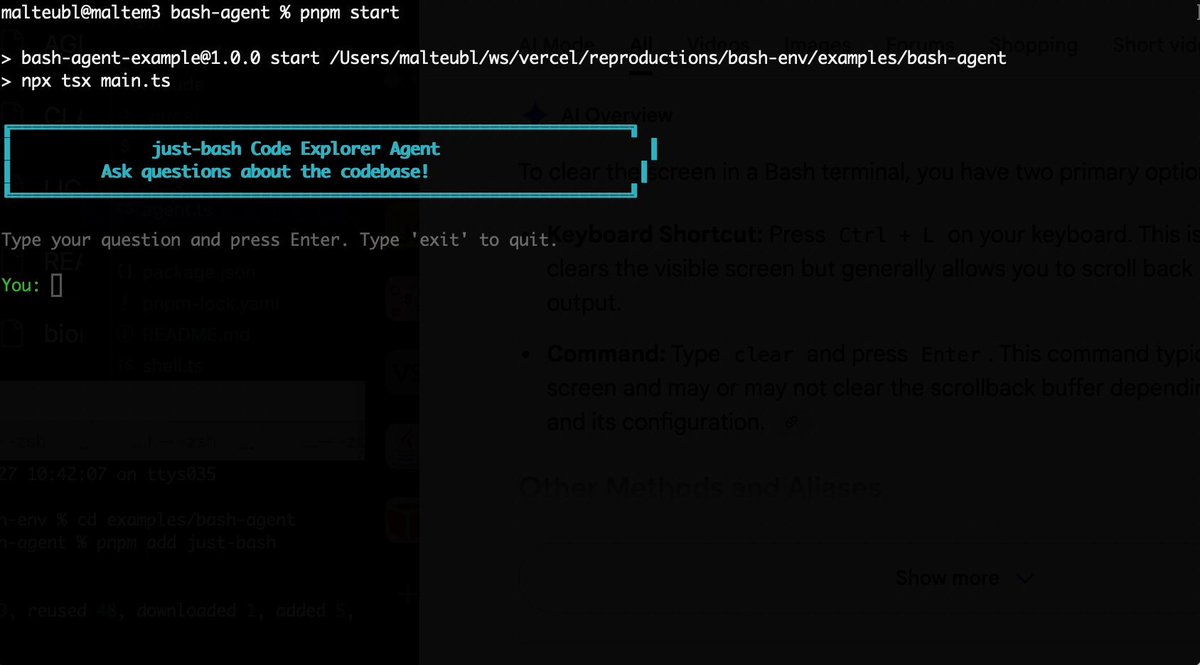
Bash is all you need! Which is why I'm introducing my holiday project: just-bash just-bash is a pretty complete implementation of bash in TypeScript designed to be used as a bash tool by AI agents. Because it turns out agents love exploring data via shell scripts, even beyond coding. It comes with grep, sed, awk and the 99th percentile features that an agent like Claude Code or Cursor would use. In fact, Claude Code can use it for secure bash execution. In the package - A bash-tool for AI SDK - A binary for use by yourself or your coding agents - An overlay filesystem to feed files to your agent securely - A Vercel Sandbox compatible API, so you can quickly upgrade to a real VM if you need to run binaries - An example AI agent that explores the just-bash code base using just-bash - I imported the Oils shell bash compatibility suite and just-bash passes a very good chunk What is interesting about this codebase: It was essentially entirely written by Opus 4.5. Coding agents love bash and they are good at reproducing it. They are also great at text-book recursive descent parsers and AST tweet-walk interpreters. That said, it is, like, a lot of code and I didn't read it all 😅. This is very much a hack, but it also seems to be _really_ useful. I haven't really found anything agents want to use that it doesn't support and it's fast and secure (caveats apply). It doesn't have write access to your computer and the filesystem is given a root that the agent cannot escape from. Find it at Related: Our recent blog post how we migrated our data analysis agent to bash tools and achieved incredible quality improvements The video shows the example agent investigating the just-bash code base

Malte Ubl

124,713 görüntüleme • 6 ay önce

Imagine if your way of thinking - your edge, your taste, your strategy - could be turned into a high-performance worker. Not a copy of you. Something better. An agent that acts on your judgment at scale, powered by superintelligent systems and refined through real-world results. That’s what Fraction AI makes possible. It launches today on Base mainnet. The core idea is simple: You create AI agents based on your own way of approaching problems. These agents compete on live tasks - writing, coding, finance, whatever - get feedback, learn from their performance, and improve over time. The better they get, the more they win. And so do you. No code required. Just your insight. Why now? Until now, building agents like this took huge teams and even bigger budgets. But with Fraction, anyone can do it. You can test ideas instantly. You can iterate fast. You can build a fleet of smart workers that evolve through competition. And it works. 30M+ sessions on testnet 320K users 1.2M agents already competing How it works? Agents join sessions within a Space - a domain like finance, writing, or games. Each session runs as a series of competitive rounds. In every round, agents try to generate the best solution to a task. Their outputs are scored by a decentralized network of AI judges trained to evaluate quality for that domain. The top agents in each round earn rewards from the pooled entry fees. The losers get to learn. Feedback from each round helps them adjust and improve, and every session becomes a training loop. What it means? Fraction is a decentralized intelligence economy - a system where your ideas become agents, and agents earn by proving they work. You don’t need credentials or code. Just a clear point of view. If your thinking holds up under pressure, your agents will rise. This kind of AI used to live in corporate labs, built by PhDs with massive compute. Now anyone with a smart idea and an internet connection can build agents that compete, learn, and earn on their behalf.

Fraction AI

67,772 görüntüleme • 1 yıl önce

New Course: ACP: Agent Communication Protocol Learn to build agents that communicate and collaborate across different frameworks using ACP in this short course built with IBM Research's BeeAI, and taught by Sandi Besen, AI Research Engineer & Ecosystem Lead at IBM, and Nicholas Renotte, Head of AI Developer Advocacy at IBM. Building a multi-agent system with agents built or used by different teams and organizations can become challenging. You may need to write custom integrations each time a team updates their agent design or changes their choice of agentic orchestration framework. The Agent Communication Protocol (ACP) is an open protocol that addresses this challenge by standardizing how agents communicate, using a unified RESTful interface that works across frameworks. In this protocol, you host an agent inside an ACP server, which handles requests from an ACP client and passes them to the appropriate agent. Using a standardized client-server interface allows multiple teams to reuse agents across projects. It also makes it easier to switch between frameworks, replace an agent with a new version, or update a multi-agent system without refactoring the entire system. In this course, you’ll learn to connect agents through ACP. You’ll understand the lifecycle of an ACP Agent and how it compares to other protocols, such as MCP (Model Context Protocol) and A2A (Agent-to-Agent). You’ll build ACP-compliant agents and implement both sequential and hierarchical workflows of multiple agents collaborating using ACP. Through hands-on exercises, you’ll build: - A RAG agent with CrewAI and wrap it inside an ACP server. - An ACP Client to make calls to the ACP server you created. - A sequential workflow that chains an ACP server, created with Smolagents, to the RAG agent. - A hierarchical workflow using a router agent that transforms user queries into tasks, delegated to agents available through ACP servers. - An agent that uses MCP to access tools and ACP to communicate with other agents. You’ll finish up by importing your ACP agents into the BeeAI platform, an open-source registry for discovering and sharing agents. ACP enables collaboration between agents across teams and organizations. By the end of this course, you’ll be able to build ACP agents and workflows that communicate and collaborate regardless of framework. Please sign up here:

Andrew Ng

105,343 görüntüleme • 1 yıl önce

A Bloomberg Terminal costs $30,000/yr and still can't do a fraction of what Perplexity Computer just launched today 💻 It now connects directly to your bank accounts, credit cards, loans, and brokerage accounts through Plaid. Your full financial picture, from monthly spending to net worth to individual stock positions, sitting on top of 40+ live finance data sources including SEC filings, FactSet, S&P Global, and Coinbase. Every dollar you earn, spend, owe, and invest, cross-referenced against institutional-grade data in real time. You can walk up to this thing and say: → Run a risk analysis on my portfolio against the current tariff environment → Show me where my spending spiked last month and what's driving it → Build a net worth dashboard that tracks everything in one place → Flag any holdings that overlap with what insiders have been selling this quarter And it just does it. Pulls from your linked accounts, cross-references SEC filings, builds the output, and delivers a finished product. The system running underneath is Perplexity Computer. It orchestrates 19 models simultaneously, breaks any goal into subtasks, spins up specialized agents for each one, and keeps working after you walk away. One model handles the reasoning. Another does the research. Another writes the code. Another builds the visualization. All coordinated automatically. Last month they launched with brokerage data only and someone built a Bloomberg Terminal clone in a single afternoon. That post did 7.5 million views. Now they've expanded to your entire financial life: checking, savings, credit cards, loans, and investments all in one place. Wall Street pays $30K a year for a terminal with 30,000 function commands built over four decades. It won't replace Bloomberg for institutional traders executing billion-dollar orders. But for everyone else, the gap just got a lot smaller.

Josh Kale

151,395 görüntüleme • 3 ay önce