Video wird geladen...

Video konnte nicht geladen werden

Zur Startseite

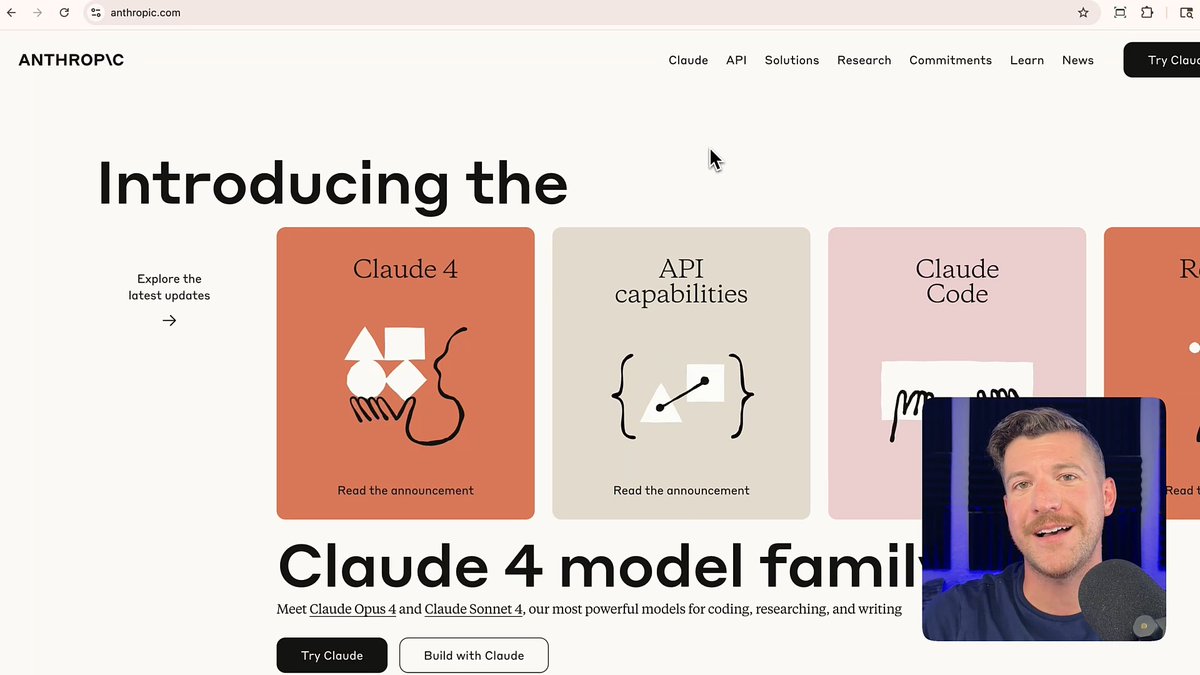
Kicking off my favorite week at Gauntlet AI: Adding significant user-facing features to massive legacy codebases. Older programming languages, versioning issues, convoluted templating, funky CI/CD. AI still must write 100% of the code. Challengers have one week.

32,953 Aufrufe • vor 1 Jahr •via X (Twitter)

0 Kommentare

Keine Kommentare verfügbar

Kommentare vom Original-Post werden hier angezeigt

Ähnliche Videos

Everyone's talking about vibe coding without looking at code. I was skeptical. I decided to give it a shot on a challenging problem and was blown away by what I could accomplish in 8 hours. I'm not skeptical anymore, but I also do NOT think it kills SaaS Notes: - I tried to replicate some of my favorite features from the Solve-It platform as a jupyter extension - I've tried this many times before, and it didn't work. - I gave my agent specific testing tools that I packaged as skills. I used AI to write the skills. I found the right testing workflow for this Jupyter extension by having AI peruse lots of other extensions and the Jupyter source code. - I had the AI write and maintain a large suite of tests the whole time. I think this was important in keeping the AI on track. - I watched the diffs and the thinking traces as they streamed by. From time to time, I would see something very suspicious like " try ... except: pass" And would stop the AI and tell it to stop this behavior. Then trigger a comprehensive code review using AI. - Most importantly, I don't think this kills SasS at all. Even if I can create software that replicates some of my favorite features, there is an insanely long tail of paper cuts and features I don't want to manage. The models and capabilities are improving so fast that I don't want to constantly tune everything. So I would rather leave that up to people who are focused on that daily and have good taste, with the knowledge that it has been battle tested against many users.

Hamel Husain

48,930 Aufrufe • vor 7 Monaten

In our latest Box AI Enterprise Eval, we tested Paul Jankura’s Claude 4 Sonnet and Opus models, now integrated into Box AI, across enterprise Q&A tasks, technical workflows, and advanced coding scenarios—revealing major advancements in developer productivity and content intelligence. AI-assisted coding and development just reached a new milestone! Here's what we discovered: Claude 4 significantly improves understanding, generating, and debugging code across multiple programming languages. Developers can: ↳ Accelerate code generation ↳ Improve debugging ↳ Enhance technical documentation ↳ Build smarter AI agents 👉 Automating Financial Analysis with Code Generation: We evaluated Claude 4 by using the Box AI API to analyze ten complex 10-K financial reports. Claude 4 dynamically generated Python code to fetch file IDs from a Box folder, automating data extraction. Within two minutes, it accurately extracted key company data such as revenues, metrics, and highlights—demonstrating its potential to streamline demanding analytical tasks. 👉 Understanding Enterprise Content: Our evaluation confirms Claude 4 maintains strong performance on enterprise Q&A tasks, effectively extracting precise details from single documents and reliably synthesizing information across multiple sources. This ensures seamless integration of structured and unstructured data alongside powerful coding capabilities. 🔓 Developer-Centric Use Cases Unlocked: Organizations can leverage Claude 4 within Box AI to: ↳ Create custom engineering agents referencing technical documents stored in Box, pulling real-time data from Jira, or finding solutions on Stack Overflow. ↳ Build intelligent technical support bots capable of analyzing user-provided code snippets against internal manuals. ↳ Automate secure code reviews by evaluating repository code (stored in Box) against security policies. ↳ Efficiently migrate legacy systems by translating old codebases into modern languages or platforms. Ready to empower your developers and accelerate innovation? To explore Claude 4 Sonnet and Opus through Box AI Studio and APIs, contact us at [email protected] and request early access today! Learn more:

Box

285,676 Aufrufe • vor 1 Jahr

🚨 OpenAI just launched Codex, a brand-new autonomous coding agent that can build features and fix bugs on its own. We’ve been using it Every 📧 for a few days, and I’m impressed. I invited Alexander Embiricos (ben davies), a member of the product staff responsible for Codex, to demo Codex and talk about it live on a special edition of AI & I: What Codex is and how it works Codex is designed to be used by senior engineers—it performs coding tasks like adding features or fixing bugs autonomously. It's built to allow you to start many sessions at once, so you can have multiple agents working in parallel. Codex is built to have "taste" OpenAI trained Codex to have the taste of a senior software engineer. It knows how big codebases work, how to write a good PR, and uses clean, minimal code. Why an “abundance mindset” is best for interacting with agents Codex is designed to allow users to delegate many tasks at once without getting caught up in the details. This lets you point an abundance of agents at a specific task like a difficult bug—it’s worth it even if only one of them succeeds. How OpenAI is thinking about agents Codex is one piece of a unified super-assistant OpenAI wants to eventually build—an agent that helps users easily get things done by selecting the right tools for them behind the scenes. OpenAI’s vision for the future of programming In the future developers will probably spend less time writing routine code and more time guiding agents, reviewing their work, and making strategy decisions. Programming will become more social, letting teams easily delegate multiple tasks at once, allowing people to focus on ideas and collaboration instead of routine coding. Watch below!

Dan Shipper 📧

145,487 Aufrufe • vor 1 Jahr

Marc Andreessen explains why AI coding won't replace programmers, but fundamentally change what they do. He argues that AI coding is just the latest abstraction layer, and the job of a programmer has always evolved with each one. Andreessen's key reframe of what's actually happening: "AI coding actually abstracts away the process of actually writing the scripting code... This is the next layer of the task redefinition under the job of programmer." He's clear that the best programmers aren't being replaced. They're already adapting, even if their day-to-day looks radically different now. Their job has shifted from writing code line by line to managing dozens of AI agents working in parallel. "The world's best programmers today will tell you, 'My job is I'm sitting there and I'm orchestrating 10 code bots running in parallel.' Their day job now is kind of arguing with the AI bots to try to get them to write the right code." But Marc Andreessen 🇺🇸 is adamant this doesn't make foundational knowledge obsolete — it makes it more important. "You need to still fully understand and learn how to write and understand code, because if it doesn't work or it's not doing what you expect, you need to be able to understand the results of what the AI is giving you." He draws a direct parallel: Just as someone writing scripting languages still needs to understand how a microprocessor works, someone orchestrating AI bots needs to understand the code those bots produce. "It's this upleveling of capability where you actually want the depth to go down and understand what the thing is actually doing, even if you're not spending your day doing that by hand." The result, in his view, is transformative: "Now programmers are going to be 10 times or 100 times or a thousand times more productive. And that is overwhelmingly a good thing." The pattern: New abstraction layer emerges → tasks change → the job gets redefined upward → productivity explodes It raises a question every programmer should be sitting with... Are you building the depth to evaluate what AI gives you, or just accepting the output?

Big Brain AI

45,325 Aufrufe • vor 5 Monaten