Video wird geladen...

Video konnte nicht geladen werden

Zur Startseite

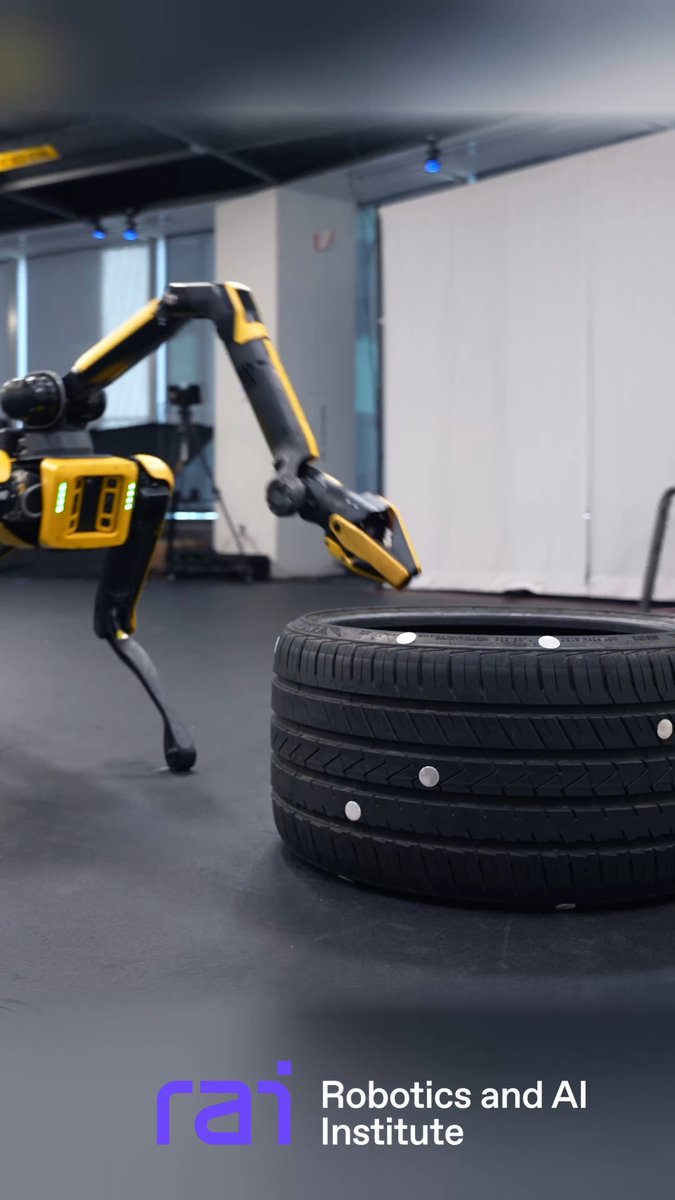
Learning H-Infinity Locomotion Control Stable locomotion in precipitous environments is an essential capability of quadruped robots, demanding the ability to resist various external disturbances. However, recent learning-based policies only use basic domain randomization to

38,639 Aufrufe • vor 2 Jahren •via X (Twitter)

10 Kommentare

Profilbild von AK
AKvor 2 Jahren

improve the robustness of learned policies, which cannot guarantee that the robot has adequate disturbance resistance capabilities. In this paper, we propose to model the learning process as an adversarial interaction between the actor and a newly introduced

Profilbild von AK
AKvor 2 Jahren

disturber and ensure their optimization with H_{infty} constraint. In contrast to the actor that maximizes the discounted overall reward, the disturber is responsible for generating effective external forces and is optimized by maximizing the error between the task reward

Profilbild von AK
AKvor 2 Jahren

and its oracle, i.e., "cost" in each iteration. To keep joint optimization between the actor and the disturber stable, our H_{infty} constraint mandates the bound of ratio between the cost to the intensity of the external forces. Through reciprocal interaction

Profilbild von AK
AKvor 2 Jahren

throughout the training phase, the actor can acquire the capability to navigate increasingly complex physical disturbances. We verify the robustness of our approach on quadrupedal locomotion tasks with Unitree Aliengo robot, and also a more challenging task with Unitree

Profilbild von AK
AKvor 2 Jahren

A1 robot, where the quadruped is expected to perform locomotion merely on its hind legs as if it is a bipedal robot. The simulated quantitative results show improvement against baselines, demonstrating the effectiveness of the method and each design choice. On the

Profilbild von AK
AKvor 2 Jahren

other hand, real-robot experiments qualitatively exhibit how robust the policy is when interfering with various disturbances on various terrains, including stairs, high platforms,

Profilbild von AK
AKvor 2 Jahren

slopes, and slippery terrains. All code, checkpoints, and real-world deployment guidance will be made public.

Profilbild von AK
AKvor 2 Jahren

paper page:

Profilbild von AK
AKvor 2 Jahren

daily papers:

Profilbild von UserInterface
UserInterfacevor 2 Jahren

Unveiling the Future of Prompt Engineering for Better AI Interactions #tech

Ähnliche Videos

Today, we're joined by Nikita Rudin, co-founder and CEO of Flexion Robotics to discuss the gap between current robotic capabilities and what’s required to deploy fully autonomous robots in the real world. Nikita explains how reinforcement learning and simulation have driven rapid progress in robot locomotion—and why locomotion is still far from “solved.” We dig into the sim2real gap, and how adding visual inputs introduces noise and significantly complicates sim-to-real transfer. We also explore the debate between end-to-end models and modular approaches, and why separating locomotion, planning, and semantics remains a pragmatic approach today. Nikita also introduces the concept of "real-to-sim", which uses real-world data to refine simulation parameters for higher fidelity training, discusses how reinforcement learning, imitation learning, and teleoperation data are combined to train robust policies for both quadruped and humanoid robots, and introduces Flexion's hierarchical approach that utilizes pre-trained Vision-Language Models (VLMs) for high-level task orchestration with Vision-Language-Action (VLA) models and low-level whole-body trackers. Finally, Nikita shares the behind-the-scenes in humanoid robot demos, his take on reinforcement learning in simulation versus the real world, the nuances of reward tuning, and offers practical advice for researchers and practitioners looking to get started in robotics today. 🗒️ For the full list of resources for this episode, visit the show notes page: 📖 CHAPTERS =============================== 00:00 - Introduction 04:07 - Is robot locomotion solved? 06:04 - Sim-to-real gap 08:58 - Adding semantics to policies 09:42 - Modular vs end-to-end architectures 10:29 - Planner model 12:21 - Adapting RL techniques from quadrupeds to humanoids 15:39 - Behind robot demos 18:09 - Humanoid robots in home environments 22:03 - Training approach 23:56 - VLA models 27:59 - Closing the sim-to-real gap 32:55 - Task orchestration using VLMs 36:38 - Tool use 38:10 - Model hierarchy 43:37 - Simulator versus simulation environment 44:57 - Combining imitation learning and reinforcement learning 46:42 - RL in real world versus RL in simulation 52:58 - Reward tuning and value functions in robotics 56:38 - Predictions 1:00:10 - Humanoids, quadropeds, and wheeled platforms 1:02:45 - Advice, recommended robot kits, and community pla

The TWIML AI Podcast

22,264 Aufrufe • vor 6 Monaten

Experiments in progress. The one on the right has been learning for ~3 hours, the one in the middle for ~1 hour, and the one on the left just started a few minutes ago. The initial motivation for making the physical Atari was just to commit ourselves to a subset of algorithms that can make progress in this setup. This commitment rules out algorithms that require billions of samples to learn (or worse, require multiple environments running in parallel). Atari games are simple enough that we should be able to show learning on them in a short amount of time with no prior knowledge. Since then, I've realized that this setup is also a good way to compare different paradigms in robotics in a principled way. These paradigms are sim2real, learning from tele-operated data, and learning directly on the robots. So far, I have observed that getting sim2real to work reliably is hard. It requires tweaks that don't scale. Policies that can play perfectly in simulation fall apart because of latencies and the messiness of the real world. These aspects could be modeled to improve the simulation, but not without sinking significant human engineering hours. I have higher hopes for learning from tele-operated data, but that requires a human to learn the task first. These experiments are on my to-do list. I have to learn to play some of the games well through the robot. I’m half-decent at playing Pong and Ms Pacman now. Learning directly on robots is looking like the most promising approach. This approach takes away pesky distribution shifts and makes it possible to have algorithms that continually improve with more data and time without any human intervention. It feels great to let experiments run overnight and wake up to find improved policies. With learning on robots, I should, in principle, be able to go on a long vacation and come back to find better policies for complex tasks beyond Atari games. Whether that is possible with current learning algorithms is a different question.

Khurram Javed

52,110 Aufrufe • vor 7 Monaten