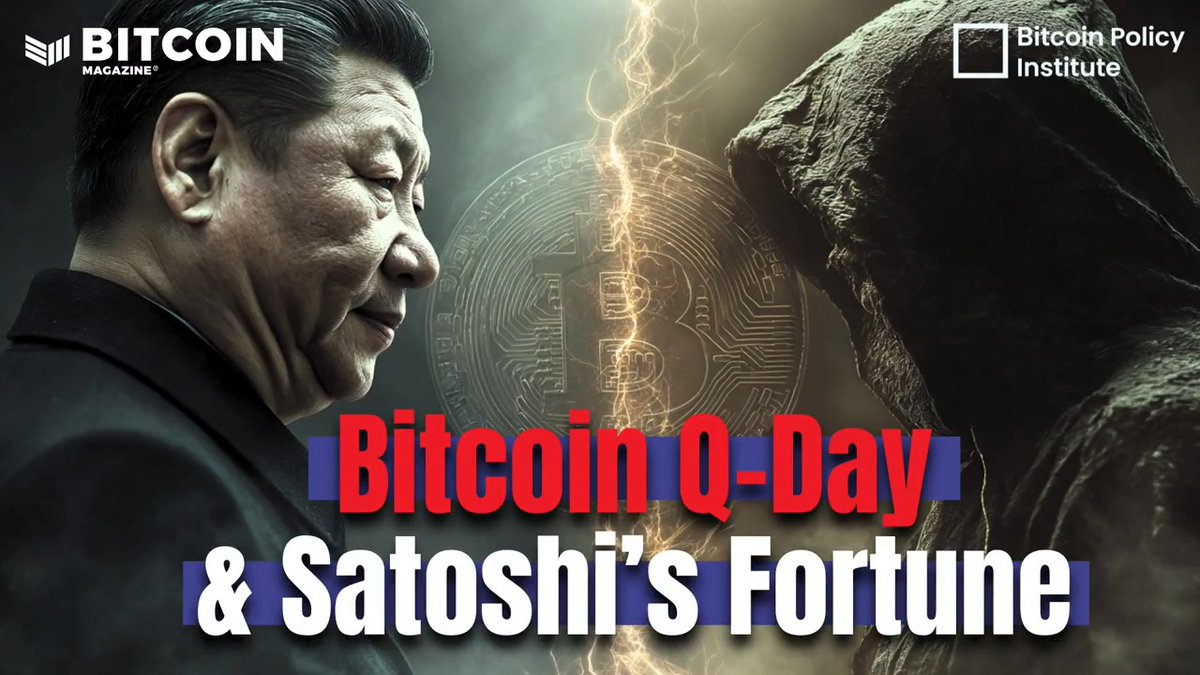
Video wird geladen...

Video konnte nicht geladen werden

Zur Startseite

LIVE NOW - Ethereum’s Quantum Plan Before Q-Day Quantum is no longer a distant thought experiment. Justin Drake joins Bankless to unpack: - when Q-Day could actually arriv,e - why Bitcoin and Ethereum face very different quantum risks, - what Ethereum’s post-quantum roadmap looks like, - why this upgrade...

50,230 Aufrufe • vor 5 Monaten •via X (Twitter)

0 Kommentare

Keine Kommentare verfügbar

Kommentare vom Original-Post werden hier angezeigt

Ähnliche Videos

.Sui has a massive headstart and the most flexible architecture for the post-quantum and AI era. This conversation with Kostas Kryptos tells you exactly why, and what every other chain still has to figure out. If you hold anything onchain, watch this pod. Timestamps: 0:00 Intro 6:00 What a quantum computer actually is (the 10-year-old version) 10:00 Quantum will be used for trading before it ever breaks Bitcoin? 13:00 Post-quantum algorithms (solved) vs hardware (decades out) 17:00 "If you think quantum breaks crypto by 2030, you can make free money" 19:00 Everyone missed this: AI is now researching quantum alongside humans 25:00 The post-quantum-algorithm debate: Falcon, Dilithium, Sphincs and why each chain picks differently 27:00 Why Bitcoin will ONLY adopt hash-based post-quantum algorithms 31:00 This is why Sui's architecture wins: 128KB transactions, native multi-sig, flexible authenticator 36:00 How Sui can natively support any signature scheme 40:00 The Sui-only algorithm: protect existing EdDSA addresses without moving a coin 44:00 Design philosophy: what Sui kept from Libra, and what it threw out 47:00 Why Sui can keep gas low even with post-quantum signatures 49:00 How Kostas first started working on this in 2016 at R3 Corda 51:00 Attending tech conference one day after his son was born: meeting Sam Blackshear , joining Libra 55:00 The bigger near-term threat: AI-aided attacks, not quantum 58:00 Why Mysten Labs is now sharing its security tooling with the community 1:02:00 Sui's $100K post-quantum bounty: break it, keep it

Sooraj

13,761 Aufrufe • vor 3 Monaten

BITCOIN RAILS EPISODE #18: MAKE BITCOIN QUANTUM RESISTANT | with BIP360 author Hunter Beast Hunter Beast 🕯️ Quantum computing is a complicated topic—one that incites equal amounts of fear and skepticism depending on who you talk to… especially in Bitcoin. In this episode, BIP360 author Hunter Beast wisely shares why the “truth is likely somewhere in the middle,” citing incremental advancements in quantum computing that may eventually pose a legitimate threat to some Bitcoin addresses—as well as steps we can take to protect ourselves in the short, medium and long term. The correct posture is to “be prepared, not scared,” says Hunter Beast 🕯️ Ultimately, the introduction of quantum resistant cryptography—via proposals like BIP360—will be needed for higher degrees of security. That said, individuals can mitigate personal risk substantially through proper address-use hygiene. This episode breaks down the specific challenges Bitcoin will face in the event of a quantum attack, the likelihood of an attack over time, and the steps we’ll need to take at the individual and communal level to ensure Bitcoin’s safety. This episode includes detailed discussion of: 1) How quantum computing could potentially affect Bitcoin public/private key cryptography—and technologies built on vulnerable addresses (e.g. Taproot) 2) Best practices for protecting yourself against quantum in the short and long term 3) Implications of vulnerable address types—e.g. what about Satoshi’s coins? 4) Deep Dive into BIP360 + proposed long-term solutions 5) Industry roadmaps for quantum computing + how banks and governments are preparing for “Q Day” As always, this episode can be viewed on Spotify or YouTuve—full episode in the comments or linktree in my bio. This episode is powered by Best In Slot—the leading API for Ordinals and BRC20 data aggregation and indexing. TIMESTAMPS: 00:00 Intro 02:05 What is quantum computing? 04:30 How could quantum threaten your Bitcoin wallet? 06:50 Addresses that are safe from quantum 09:13 Satoshi’s coins are in danger! 11:25 What happens if Satoshi’s coins are touched? 14:45 Do we softfork to shield Satoshi’s coins? 16:38 “Transitory inflation” for bitcoin after quantum 21:05 Why Taproot addresses are vulnerable 23:50 Do NOT reuse your Bitcoin addresses! 26:03 When will Quantum become a threat? 28:34 The long/short exposure attack; explained 31:45 Protection using private mempools 33:20 Why all the new Bitcoin L2s are in danger 37:45 Quantum is 5 to 10 years away, governments fear 40:34 Non-Bitcoin systems threatened by quantum 42:26 Centralized systems can adapt to quantum 43:50 Hunter’s BIP: Post quantum cryptography in Bitcoin 47:40 Hunter’s three new signature algorithms 53:48 Is new cryptography on Bitcoin risky? 56:33 Why not just stick to hash-based cryptography? 58:49 A 16X discount for quantum resistant addresses? 01:02:30 Creating quantum resistant multisig addresses 01:04:00 What is Frost? 01:06:50 The long process of approving a BIP 01:08:30 What developers think of Hunter’s BIP 01:10:00 Matt Corallo’s concerns with Hunter’s approach 01:11:00 Steps to implementing the BIP 360 01:17:00 Where to learn more about BIP 360 01:17:50 Who can push the button to change Bitcoin?

Isabel Foxen Duke⚡️

31,148 Aufrufe • vor 1 Jahr

Bitcoin Rails x MARA Foundation presents: THE POLITICS OF POST-QUANTUM BITCOIN | with Nic Carter 🔗 YouTube: 🌿Spotify: Less than nine months ago, investor and researcher nic carter sparked one of the most heated debates in Bitcoin's recent history — when he published a series of essays arguing that the network should prepare for its post-quantum transition sooner rather than later. While the essays broadly persuaded investors and institutions, many of Bitcoin's technical leaders dismissed them as alarmist — that is, until Google's quantum resource estimates were updated just a few months later. Crediting Google's paper with "shifting the Overton Window" on quantum and strengthening the case for post-quantum preparation, Nic shares his thoughts on the delicate politics surrounding this transition — and how he believes a quantum attack and response could potentially play out in practice. In more detail, this special episode of Bitcoin Rails X MARA Foundation TV covers: - How a quantum attack could realistically unfold + the different ways stakeholder groups might respond - The constitutional tensions surfaced by quantum vulnerable coins and how incentives will ultimately dictate outcomes - How a state actor could facilitate "benevolent" quantum recovery and eliminate the need for a contentious fork - The role and influence of institutional investors as key players in quantum outcomes - How Bitcoin's post-quantum transition could permanently reshape Bitcoin’s governance structures ...or build them from the ground up TIMESTAMPS: 00:00 — Intro 00:18 — Nick's path from Fidelity to founding Castle Island 07:00 — How quantum went from FUD to Nick's biggest concern 12:45 — Why Core devs refuse to be accountable 26:09 — Investors vs developers: who took quantum seriously first 32:33 — Bitcoin's "pre-constitutional" governance problem 39:18 — Satoshi's coins: liquidate, burn, slow-bleed, or let the government take them 47:36 — Why there will never be another Bitcoin fork war 01:01:35 — Bitcoin is about to choose the wrong signature scheme 01:09:42 — The actual deadline: why PQ signatures need to ship in 2026 01:13:09 — The happy path, the coup, and why Bitcoin won't die

Isabel Foxen Duke⚡️

51,026 Aufrufe • vor 2 Monaten

BITCOIN RAILS #34: Bitcoin’s Security & Quantum Risks—and the Future of Satoshi’s Coins | with Jameson Lopp Jameson Lopp “Most people don’t think about security until it’s too late,” says the Casa co-founder and CSO. One of the most prolific thought-leaders in Bitcoin security and privacy, there are few people who understand the nuances of Bitcoin security quite as deeply - not to mention the OPSEC practices required to protect against wrench attacks, for instance, which are rising globally as Bitcoin price increases. More recently, Lopp has turned his attention to mitigating Bitcoin’s quantum vulnerabilities, including market risks associated with quantum-vulnerable Satoshi’s Coins + longer-term strategies for quantum-hardening of Bitcoin addresses long term. In this special episode of Bitcoin Rails, we cover: - Lopp’s experiences designing self-custody products at both BitGo and Casa - The swatting attack he suffered in 2017, and the radical steps he’s taken to secure his home location since - The ‘quantum computing’ challenge for Bitcoin and its impacts on Satoshi’s Coins - How the network may respond to QCs in the face of ossification and why QC preparation may be the hardest governance test the network has ever faced This episode is powered by: - Best In Slot (Best in Slot | BRC2.0 🧑‍🍳), the leading API for Ordinals and BRC20 data aggregation and indexing - Spark (Lightspark), a statechains implementation leading the path towards institutional adoption of Bitcoin-powered payments - Citrea (Citrea), the leading Bitcoin Rollup technology and contributor to the BitVM alliance 📌 Timestamps 00:00 – Intro: Quantum Computing Meets Bitcoin 00:19 – Jameson Lopp on the Bitcoin Rails 00:53 – The Quantum Threat to Bitcoin Security 06:32 – Lopp’s Path into Bitcoin & Security 12:58 – The Swatting Attack During the Block Size Wars 25:28 – Could Quantum Crack Satoshi’s Coins? 43:55 – Announcements & Sponsors Messages 45:30 – Building Bitcoin’s Quantum Resistance 47:00 – QBTC and the Push for Quantum-Resistant Bitcoin 48:43 – Why Changing Bitcoin Is So Hard 51:19 – Email Protocols, Ossification, and Bitcoin’s Future 01:01:53 – A Roadmap for Quantum Resistance

Isabel Foxen Duke⚡️

14,538 Aufrufe • vor 11 Monaten

Can a sufficiently powerful quantum computer forge the signatures used to authorize Bitcoin and Ethereum transactions? What would it take to upgrade both networks before that happens? In this new lecture, Stanford cryptographer Dan Boneh explores why blockchains may turn to signatures built from hash functions. He also presents new research on threshold signing. The talk ends with the questions Bitcoin still has to answer, including whether post-quantum signatures will require larger blocks, what happens to abandoned coins, and how someone such as Satoshi could prove ownership after Bitcoin’s current signatures have been retired. 00:00 Why blockchains need to prepare for quantum computers 03:05 Why Bitcoin may bet on hash-based signatures 06:25 The “big footgun” in stateful signatures 08:58 A quantum-safe signature that takes one billion hashes 14:13 Inside SLH-DSA’s virtual tree 20:30 How Bitcoin and Ethereum could make the switch 23:48 What happens when a wallet loses its state? 32:47 Can threshold signing survive the quantum transition? 36:39 How to hide lattice cryptography from the blockchain 38:49 Why threshold one-time signatures seem impossible 45:36 How context prevents forged signatures 49:37 The forgotten idea behind Winternitz signatures 54:50 Turning one-time signatures into threshold signatures 1:04:27 Will quantum-safe signatures require bigger Bitcoin blocks? 1:06:26 Abandoned bitcoin and Satoshi’s recovery problem

a16z crypto

115,401 Aufrufe • vor 7 Tagen

BITCOIN RAILS #59: Post-Quantum Bitcoin Signatures (+ their tradeoffs) | with BIP 360 co-author Ethan ✨ is on BlueSky✨ Heilman 🐱 and Blockstream Head of Research Jonas Nick 🔗 YOUTUBE: 🌿 SPOTIFY: According to BIP 360 co-author Ethan Heilman, Bitcoin needs a minimum of two soft forks to become quantum resistant: P2MR (or an output type that can safely execute PQ signatures) + a post-quantum checksig (signature scheme). Ethan and the BIP 360 team (including myself and Hunter Beast 🕯️) introduced the P2MR part via a BIP 360 update late last year—but the question remains, what’s the most appropriate PQ signature scheme for Bitcoin? They all have substantive tradeoffs, but hash-based signatures seem to be leading technical discourse—likely due to recent optimizations by Jonas Nick and the broader Blockstream research team. It was an honor to sit down with both of these men - arguably the two most influential and productive cryptographers in Bitcoin quantum mitigation right now - for an in-depth review of the leading PQ signature schemes and a temperature check on Bitcoin’s post-quantum planning process. TBH, if you want to skip the noise and jump straight to the signal on quantum, this is the interview to watch. In this episode, we discuss: - What needs to happen at the soft fork, infra, and mitigation levels to fully quantum-harden Bitcoin - Recent updates to BIP 360 + breakdown of the leading hash-based signatures schemes for Bitcoin (SHRINCS + SHRIMPS) - Why we may actually get consensus around a stateful scheme for Bitcoin - Comparisons of hash-based signatures vs Lattice and Isogeny-based schemes - Assessing the risks of both waiting too long and acting too fast (and why quantum is a better threat to be facing than a potential classical attack) This episode of Bitcoin Rails is brought to you by my NEW sponsors: - LayerTwo Labs LayerTwo Labs — developing research, software, and technologies for scaling Bitcoin via the integration of Drivechains (BIP 300/301) - Hashi on Sui — a primitive for executing Bitcoin Defi transactions, without having to trust a federated bridge or other centralized entity - BitBox BitBox — an open-source Bitcoin-only hardware wallet, with smooth UX and no compromises on security. Check out Bitbox [dot] swiss and use code BITCOINRAILS to get a discount TIMESTAMPS: 00:00 Intro 02:18 Ethan’s Quantum Wakeup 05:18 How Blockstream Enters Post Quantum 09:25 BIP 360 Explained 12:11 How Bitcoin Transitions to PQ 17:35 Choosing Post Quantum Signatures 23:20 How Blockstream Created SHRINCS 27:22 Signature Budgets Importance Explained 41:13 What are SHRIMPS? 44:51 SHRIMPS vs SHRINCS 47:48 Why SLH-DSA Alone Won’t Cut It 49:24 Is a SHRIMPS + SHRINCS BIP Coming? 51:51 Blockstream’s Big Plans for Liquid 59:04 Quantum Readiness Roadmap 01:02:22 Importance of a PQ Recovery Plan 01:05:35 How Long Would a PQ Migration Take 01:11:17 Quantum Watchlist Recommendations

Isabel Foxen Duke⚡️

23,783 Aufrufe • vor 3 Monaten

E184: Trezor CTO: Why Smart People Still Get Scammed and How To Spot An AI Deepfake Before It Drains Your Wallet Tomas Susanka is the CTO of Trezor. He studied cryptography before building the hardware wallets that pioneered self-custody. We get into why people are so bad at judging risk, how scammers now use AI to sound completely legit, and whether quantum computers are actually coming for Bitcoin. Timestamps 0:00 Intro 4:15 What Tomas Actually Builds 6:28 Why Bitcoin Still Matters 8:25 Who Is Tomas Susanka? 10:10 Why Humans Suck At Security 12:58 Why We Downplay Risk 14:27 How To Actually Think About Risk 15:25 Does Being Smart Lower Your Risk? 16:54 Why Smart People Fall For Scams 23:39 How To Actually Fix The Scam Problem 25:12 Partnerships: Piero Negrini Bitwise 28:57 How Tomas Protects His Own Assets 29:49 The Craziest Hack Tomas Has Seen 31:24 The Security Habit That Looks Insane 32:27 Why Self-Custody Actually Matters 36:05 When You Actually Need A Hardware Wallet 41:42 Hardware Wallet Myths Debunked 44:16 Solving Crypto's Inheritance Problem 46:29 Should You Keep Assets On An Exchange? 47:32 Partnership: KAST 48:20 The Security Setup For Kevin's Grandma 50:08 How To Stop Hacks And Scams 1:01:57 Should You Upgrade Your Trezor? 1:04:02 The Weirdest Seed Phrase Hiding Spot 1:05:28 How Self-Custody Stops Being Archaic 1:08:07 Partnerships: Jupiter Ethena 1:08:50 The Biggest Problem With Self-Custody 1:09:52 Is Quantum Computing A Real Threat? 1:14:48 Who's Actually Taking Quantum Seriously? 1:20:41 Who's Protecting Bitcoin From Quantum? 1:23:58 The Crypto Belief Tomas Rejects 1:25:03 Is Self-Custody Oversold? 1:26:12 Is There A Future For Digital Identity? 1:27:56 Is Self-Custody Getting Too Complicated? 1:28:42 The Worst Advice Tomas Has Heard 1:29:43 Does AI Make You Safer Or More Vulnerable? 1:31:25 Closing Thoughts

MR SHIFT 🦁

50,173 Aufrufe • vor 5 Tagen