Video yükleniyor...

Video Yüklenemedi

Ana Sayfaya Dön

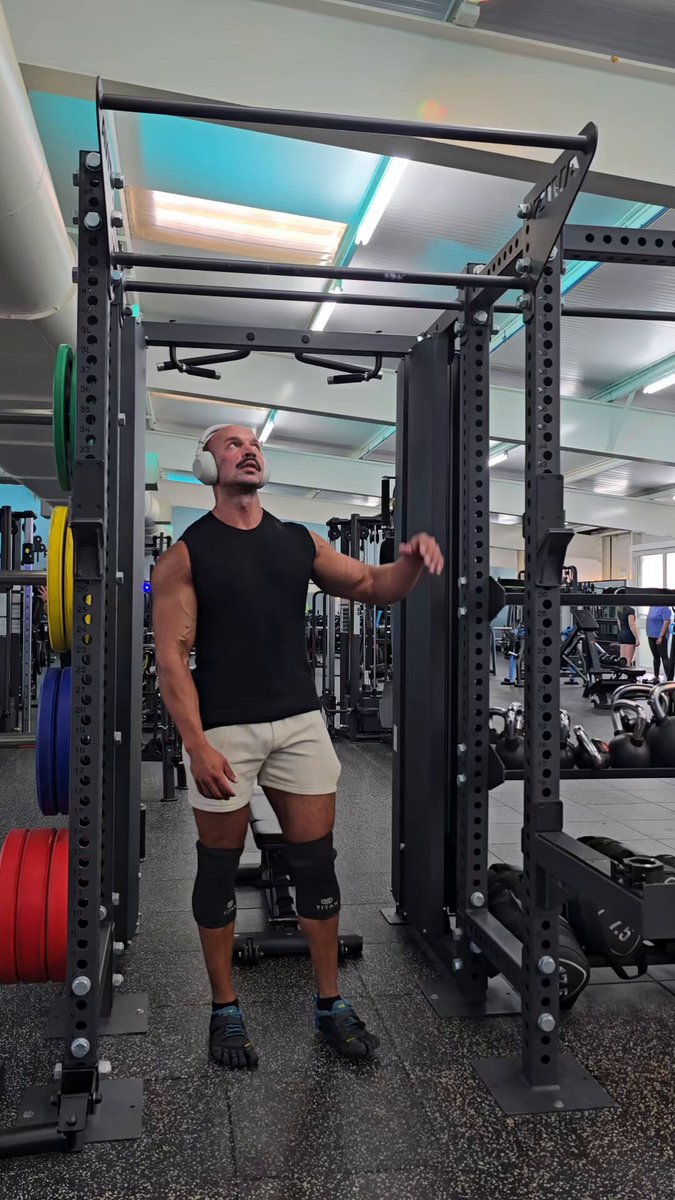
Make pull ups a primary exercise. Train all sets to failure and vary your grip every workout to hit different angles. When I started I could only do 1 rep per set so I did 50 sets of 1 rep until my body adapted. Today my typical session looks...

330,039 görüntüleme • 3 ay önce •via X (Twitter)

0 Yorum

Yorum bulunmuyor

Orijinal gönderinin yorumları burada görünecek

Benzer Videolar

Here’s EVERYTHING you need to know about warm up sets: Most people are doing warm up sets ALL wrong and they’re costing themselves from an efficiency/effectiveness standpoint as a result Warm ups are designed to A) guard against injury B) prepare you for your working sets Warm up sets should NEVER be taken in close proximity to failure…most should see you leaving 6, 7, 8+ reps in reserve (the lone exception to this = sets performed for 1-2 reps @ ~90+ of your intended working weight) This is in STARK CONTRAST to working sets which should all end around 0-2 RIR You probably need about ~2 warm up sets before your first exercise or two depending on the specifics of your programming Here is an example of a typical warm up protocol: - a 5-10 minute brisk walk on the treadmill (optional) - 50% of your working weight on your first exercise for ~12 reps (mandatory) - 75% of your working weight on your first exercise for ~6 reps (mandatory) - 90% of your working weight on your first exercise for ~2 reps (optional) After you complete the working sets for your first exercise, you may want to repeat the last 3 steps prior to performing your next exercise IF it is an antagonist exercise (Ex: Lat Pull-Down after Sternal Pecs Machine Press OR Seated Leg Curls after Hack Squats) After that, you probably don’t need any additional warm up sets unless you are just using them as “primers” (sets to make sure your movement pattern / the machine settings / etc. are on point) - If doing a PUSH workout, I’m probably using 2-3 warm up sets before my first exercise only (assuming it’s a multi joint movement) - If doing a PULL workout, I’m probably using 2-3 warm up sets before my first exercise only (assuming it’s a multi joint movement) - If doing an UPPER workout, I’m probably using 2-3 warm up sets before my first exercise and 1-2 warm up sets before my second exercise (assuming they’re antagonist multi joint movements) - If doing an LOWER workout, I’m probably using 2-3 warm up sets before my first exercise and 1-2 warm up sets before my second exercise (assuming they’re antagonist multi joint movements) - If doing a FULL BODY workout, I’m probably using 2-3 warm up sets before my first exercise, 1-2 warm up sets before my second exercise, and may even 1-2 warm up sets before my third and fourth exercises as well (assuming they’re all multi joint movements — antagonist push/pull movements for both upper & lower) (As you can see, the major downside of FULL BODY workouts is often the excess warm up time needed — this is why they work best for beginners much of the time) General rule of thumb: If your first set of an exercise is NOT your best set of that exercise in terms of performance (assuming we equate RIR), you are NOT warming up properly You should see a fall off in performance as sets transpire on a given exercise…this is a feature, not a bug of productive/effective resistance exercise WHEN WARMED UP PROPERLY

Dean Turner

49,107 görüntüleme • 10 gün önce

Example of a true working set... You’re probably doing way more sets than you need Trust me ⁠ Back in high school and college, I would lift 7 days a week, doing anywhere from 30 to 50 sets per day I used to think those 30-50 sets were the key to growth, but over time, I realized that most of those weren’t true working sets ⁠ Here’s the thing... If you can do 4 sets of 8 reps with the same weight each set, you’re probably not pushing yourself hard enough A true working set should leave you near failure within the target rep range ⁠ For example, let’s say your plan calls for 2 sets of 6-8 reps After a few warm up sets, you try 135 lbs and hit 8 reps, but you know you could have done 6 more That’s still a warm up set since you’re not reaching failure in the 6-8 rep range You’d then go up to 145 lbs and aim to fail around 6-8 reps If 145 still feels too light, that’s another warm up set You keep going up in weight until you find the load that challenges you to fail within that 6-8 range If you don’t have a spotter, leaving one or two reps in the tank is okay ⁠ This is where true muscle growth happens, by pushing close to your limit Sleep and diet is actually where muscle growth occurs but you never push yourself hard enough in the gym and give your body a reason to grow, hypertrophy will never happen The gym is just the stimulus to give the muscle a reason to grow We then get bigger through sleep and diet ⁠ Back to the working sets... For example, in the video, I hit 540 lbs for 8 reps on this hack squat Looking back, I feel I had one or two reps left, but it’s a solid starting point and it was a new PR for me at the time The next week, I would aim for 540 for 9-10 reps or bump up the weight to 545-550 and try to hit 8 reps aka progressive overload ⁠ I typically keep my quad and hamstring workouts separate and do only about 4-7 sets per muscle group, but each set is intense, and I’m struggling by the last few reps on each set ⁠ Give this approach a shot, and I promise you won’t need nearly as many sets as you think

Bailey Schober | Men’s Fitness & Nutrition Coach

23,353 görüntüleme • 6 ay önce

Here’s my take on technique/form/finding the right weight to use for a given exercise: Let’s say you do a set of 8 reps and if we were to rate each rep on quality, the breakdown would be… Rep 1 - 10/10 Rep 2 - 10/10 Rep 3 - 10/10 Rep 4 - 10/10 Rep 5 - 10/10 Rep 6 - 10/10 Rep 7 - 9/10 Rep 8 - 8/10 That is a perfectly acceptable outcome It is an indication that you selected the right weight and did the set properly Now let’s say you do a set of 8 reps and if we were to rate each rep on quality, the breakdown would be… Rep 1 - 10/10 Rep 2 - 10/10 Rep 3 - 10/10 Rep 4 - 9/10 Rep 5 - 8/10 Rep 6 - 7/10 Rep 7 - 6/10 Rep 8 - 5/10 That is a surefire sign you need to reduce the load and pick a weight you can actually handle with better overall technique/form for the FULL DURATION of the set Some minor slippages in technique/form are probably going to happen in plenty of instances when you’re training hard/pushing yourself I’ve often said “your first rep should look very similar to your last rep sans concentric rep velocity” Very similar = it should be close enough Ultimately, there is FINE LINE between (A) pushing hard yet maintaining technique to the point that it could still be considered “pretty good” even when approaching/reaching failure and (B) pushing hard but letting technique fall by the wayside in the pursuit of continuing to move weight from point A to point B by any means necessary Example of elite technique from end to end:

Dean Turner

83,319 görüntüleme • 9 ay önce

How I currently leg press to maximize hypertrophy 🤓 1. No quarter or half repping with tons of weight with your feet high up like a BITCH 2. Choose a weight you can take through a comfortable but reasonably deep range of motion 3. Move feet low enough to have deep but comfortable dorsiflexion (toe stretch to shin) 4. Execute a range of motion that stretches the quads but keeps the tension on them through the entire rep, for me this is when I feel light pressure between my calves and hamstring (I could technically let the weight squish me to such a point that my own hamstring and body are removing tension at the bottom 5. Lay hands on knees for a totally useless safety blanket (ok half serious I do think perceived stability neurologically increases large motor unit recruitment regardless of or in tangent with actual stability but this is just a working theory I have 6. Embrace pain feel sadge For Rep schemes personally I think (after warming up) a heavy first working set 5-10 reps 1-2 reps shy of failure to maximize large motor unit recruitment followed by 1-3 lighter sets within 1-3 reps of failure of 12-15 reps works best because lighter sets following a heavy first set seems to offset the fall-off in strength for the second set due to contrast overcompensation of the muscles (think about how after a heavy set the next set FEELS lighter and often you can take the second set FURTHER) it’s almost like having 2 first sets!

Hench D. Kunt🥛

24,198 görüntüleme • 1 yıl önce

The most underrated exercise on the planet is the Bar Hang. But 99% of people don't even do them. Here are 4 powerful reasons to do bar hangs every day: 1. They improve your posture Don't want to look like a croissant? Bar hangs help strengthen & mobilize your upper body. They also provide a constant stretch on the shoulders, back arms & lats. This helps reverse upper body posture defects that come from sitting for too long. 2. They improve your strength Your weight is supported first by the grip of your hand. A good grip improves your performance across all exercises like the pull-up, rows, deadlifts...pretty much any activity requiring a grip. 3. They build stronger shoulders Bar hangs can improve mobility, and strengthen the shoulders & lats while reducing shoulder pain. They stretch the brachial muscles while strengthening the supraspinatus tendon, which is responsible for shoulder strength & endurance. 4. They may help you live longer Grip strength can be a biomarker for your inner age & determines your mobility & strength as you get older. In some studies, decreased grip strength is associated with accelerated biological age. There are 2 ways to do bar hangs: The first is a passive hang (video) Take an overhand grip. Let shoulders & lats relax. Your body should sink with your shoulders touching your ears. Hang there with feet slightly forward, core braced & let your weight passively stretch your shoulders, lats, & back. The second is an active hang. Start in a passive hang. Retract your shoulder blades down and away from your ears. Stop retracting when your ears reach your elbows. Hold for as long as you can. This puts more emphasis on the muscles in your shoulders and back. If you're a beginner aim for 10 seconds to start. Work your way up to one minute and eventually 2 minutes at a time. As long as you're not sore you can do these daily. If you can't hang from a bar you can step on a box at first to help support your weight. Another way is to attach a resistance band to the bar putting while putting your feet on it. Bar hangs are one of the most underrated exercises on the planet especially if you work at a desk. Add these to your daily workouts and experience the benefits.

Dan Go

1,340,930 görüntüleme • 3 yıl önce