Video wird geladen...

Video konnte nicht geladen werden

Zur Startseite

Marketing agents are the NEW coding agents. It's code in the cloud that makes decisions off your live business data on a loop. It researches, acts, reads the results, improves, and goes again. Picture an agent that runs your entire Facebook ad account by itself. It researches your customer's...

124,419 Aufrufe • vor 3 Tagen •via X (Twitter)

0 Kommentare

Keine Kommentare verfügbar

Kommentare vom Original-Post werden hier angezeigt

Ähnliche Videos

Imagine if your way of thinking - your edge, your taste, your strategy - could be turned into a high-performance worker. Not a copy of you. Something better. An agent that acts on your judgment at scale, powered by superintelligent systems and refined through real-world results. That’s what Fraction AI makes possible. It launches today on Base mainnet. The core idea is simple: You create AI agents based on your own way of approaching problems. These agents compete on live tasks - writing, coding, finance, whatever - get feedback, learn from their performance, and improve over time. The better they get, the more they win. And so do you. No code required. Just your insight. Why now? Until now, building agents like this took huge teams and even bigger budgets. But with Fraction, anyone can do it. You can test ideas instantly. You can iterate fast. You can build a fleet of smart workers that evolve through competition. And it works. 30M+ sessions on testnet 320K users 1.2M agents already competing How it works? Agents join sessions within a Space - a domain like finance, writing, or games. Each session runs as a series of competitive rounds. In every round, agents try to generate the best solution to a task. Their outputs are scored by a decentralized network of AI judges trained to evaluate quality for that domain. The top agents in each round earn rewards from the pooled entry fees. The losers get to learn. Feedback from each round helps them adjust and improve, and every session becomes a training loop. What it means? Fraction is a decentralized intelligence economy - a system where your ideas become agents, and agents earn by proving they work. You don’t need credentials or code. Just a clear point of view. If your thinking holds up under pressure, your agents will rise. This kind of AI used to live in corporate labs, built by PhDs with massive compute. Now anyone with a smart idea and an internet connection can build agents that compete, learn, and earn on their behalf.

Fraction AI

67,804 Aufrufe • vor 1 Jahr

What does it actually mean to be AI native? There was no clear guide on the internet for how to become AI native so we built the definitive one (60 min masterclass): 1. An AI native org has 3 layers: people for strategy and taste, agents for execution, and a shared context layer that makes the entire company readable to agents. 2. AI eats the middle of your work. You used to spend 80% of your day on execution. Now agents do that. Your job is the bookends: deciding what to do and judging whether it's good enough. 3. Everyone is a manager now. Your output is the output of your agents. If your agents produce garbage, that's on you. You set them up wrong. 4. Using ChatGPT doesn't make you AI native. That's like having a website and calling yourself a tech company lol. 5. No AI native org without AI native people. Most companies skip straight to the tools. That's why it fails. If your people don't understand how to manage agents, the tech doesn't matter. 6. Making your company "readable" to agents is the real work. Every process, every decision, every piece of knowledge needs to exist in a format an agent can consume. Most companies are nowhere close. 7. Speed without signal is just expensive chaos. You need the system to move fast AND know if you're moving in the right direction. 8. The skill chain is how agents get good at your specific workflows. Skills build on skills. The more you invest in them, the more your company compounds. 9. The moat is the system. People managing agents, agents reading from rich context, the whole thing getting smarter every week. That compounds. Your competitor can copy your tools. They can't copy your system. Full episode with Theo Tabah from LCA on The Startup Ideas Podcast (SIP) 🧃. This is the stuff we normally keep internal but all the sauce is yours. Theo Tabah is the brains behind advising the world's biggest companies on AI and building AI products. Your fav CEO's first call for figuring out AI. You are in for a treat Become AI native in under 60 minutes Watch

GREG ISENBERG

84,218 Aufrufe • vor 1 Monat

AI AGENTS 101 (58 minute free masterclass) send this to anyone who wants to understand ai agents, claude skills, md files, how to get the most out of AI etc in plain english: 1. chat vs agents - chat models answer questions in a back and forth while agents take a goal, figure out the steps, and deliver a result 2. agents don’t stop after one response. they keep running until the task is actually finishedno babysitting required 3. everything runs on a loop. they gather context, decide what to do, take an action, then repeat until done 4. the loop is the system. they look at files, tools, and the internet. decide the next step. execute and then feed that back into the next step. over and over until completion 5. the model is just one piece. gpt, claude, gemini are the reasoning layer. the key is model + loop + tools + context 6. mcp is how agents use tools. it connects things like browser, code, apis, and your internal software. once connected, the agent decides when to use them to get the job done 7. context beats prompt all day. you don't need to write perfect prompts. load your agent with context about your business, style, and goals and then simple instructions work 8. claude.md or agents.md is the onboarding doc it tells the agent who it is, how to behave, what it knows, and what tools it can use. this gets loaded every time before it starts 9. memory.md is how it improves. agents don’t remember by default. this file stores preferences, corrections, and patterns you tell the agent to update it, and it gets better over time 10. skills + harnesses make it usable. skills are reusable tasks like writing, research, analysis the harness is the environment like claude code or openclaw that runs everything. basiclaly, different interfaces, same system underneath this episode with remy on The Startup Ideas Podcast (SIP) 🧃 was one of the clearest ways of understanding a lot of the core concepts of ai agents could be the best beginners course for ai agents 58 mins. all free. no advertisers. i just want to see you build cool stuff. im rooting for you. send to a friend watch

GREG ISENBERG

375,365 Aufrufe • vor 4 Monaten

Andrew Wilkinson owns 40+ businesses. He just showed me how he's using OpenClaw, Claude Code and AI agents to run latest business, start new ones, and automate everything. Here's what I learned: 1. In December 2025, something clicked. He started waking up at 3AM with a smile, sitting in terminal with 10 Claude Code tabs open. He hasn't stopped since. He calls it chasing the dragon. 2.He built a full SaaS product called Deep Personality. A 40-minute personality test that generates a 100-page report written like Robert Greene. $20 000 in revenue. Zero employees. The entire business runs on AI agents. 3. He has agents for support, marketing, and dev. When a support ticket comes in, the agent either handles it or sends it to the dev agent. If it's critical, the agent fixes the bug and merges the PR before he wakes up. Then it emails the customer back. 4. His marketing agent is connected to PostHog, manages Meta and Reddit ads, creates ad creative, runs multivariate tests, and sets budgets. He's about to give it a $100 k/month ad budget and see what happens. 5. He forgot his laptop on a trip to Arizona. He ran his entire business from the back of Ubers using OpenClaw. Nobody picked up that every single email was written by AI. 6. His take on vibe coding: the worst part about business is people. Between your vision and execution are 100 people you have to convince. Vibe coding removes all of them. For the first time he can do every part of building a product himself. 7. He was trying to build OpenClaw before OpenClaw existed. Now he uses a tool called Harbor, which is basically a GUI for managing multiple agents. You can see all your agents, their status, knowledge bases, and databases in one place. 8. He built a custom AI for his relationship. He and his girlfriend took 15 psychological tests, put the results into ChatGPT, and asked it to analyze their relationship. It nailed every fight they've ever had. That became the product idea for Deep Personality. 9. His honest take: he spends 50% of his time debugging, 30% improving the setup, and 20% being productive. It's a treadmill. But the 20% that works is so powerful he can't stop. 10. His prediction: we're 3-6 months from being able to hand basic businesses off to AI to run entirely. And pretty soon Anthropic and OpenAI are going to launch AI CEOs. This is an inside look at how a serious operator Andrew Wilkinson is using AI agents in the real world. The good, the bad, the debugging, all of it. Most people don't show you this. Episode is live on The Startup Ideas Podcast (SIP) 🧃 watch

GREG ISENBERG

144,005 Aufrufe • vor 2 Monaten

There's probably $100+ billion up for grabs for people who build startup for AI agents Over the next 10 years you're going to have a market of billions of customers (agents) with millions of wallets that want to use your services. TLDR; The internet was built for people: 1. Search google 2. Read landing page 3. Book demo 4. Talk to sales 5. Buy Agents don’t do that. Agents will: 1. Ask which product to use 2. Read your docs/pricing/security pages 3. Compare you to competitors 4. Check if you have an MCP/API/tool layer 5. Buy or recommend you without ever “visiting” your site like a person Everyone is going to have personal agents and business agents. This feels inevitable at this point. OpenClaw, Hermes, Claude Code, Codex, Google Spark. The tools are here. Which means there will be more agents on the internet than humans. So, where's the opportunity?? Go look at every SaaS tool you use. Notion. Slack. Jira. Google Analytics. Now ask: what is the version of this built purely for agents? Agent-native payments. Agent-native communication. Agent-native memory. Every category gets rebuilt. I clearly break down this shift and explain you everything on today's ep of The Startup Ideas Podcast (SIP) 🧃. Over the next 10 years you're going to have a market of billions of customers (agents) with millions of wallets that want to use your services. The founders who build for them now are going to look like the people who built websites in 1995. Might feel janky at the moment, but also obvious in hindsight. This is the next shift. Link over here: Watch

GREG ISENBERG

55,398 Aufrufe • vor 1 Monat

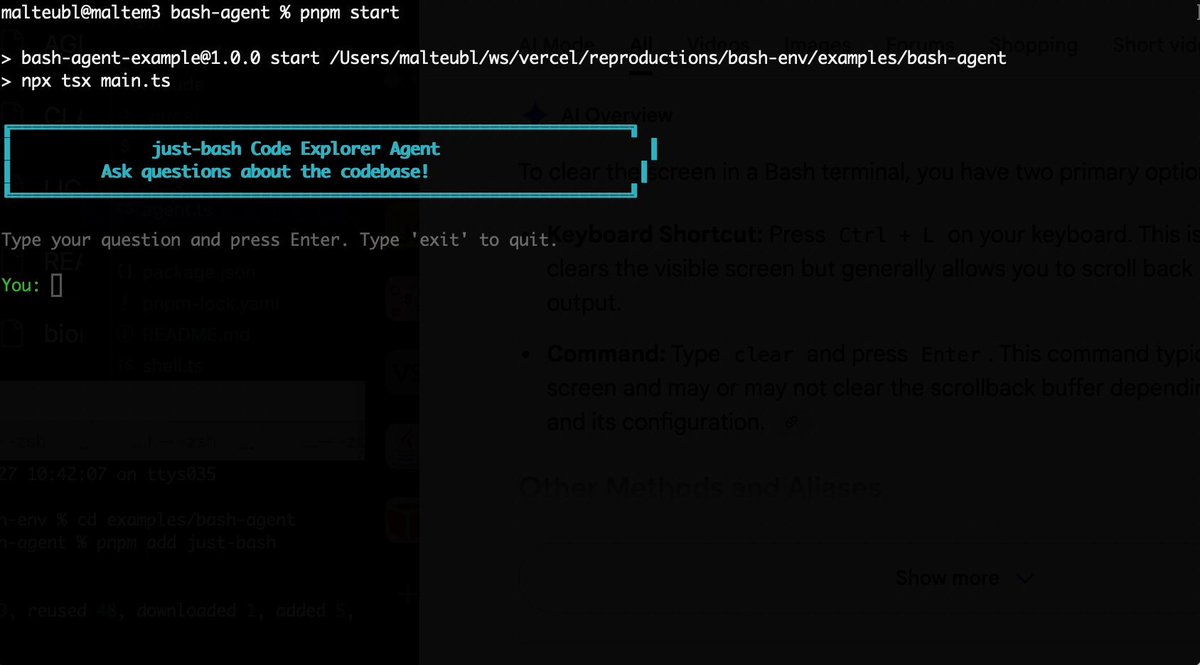
Bash is all you need! Which is why I'm introducing my holiday project: just-bash just-bash is a pretty complete implementation of bash in TypeScript designed to be used as a bash tool by AI agents. Because it turns out agents love exploring data via shell scripts, even beyond coding. It comes with grep, sed, awk and the 99th percentile features that an agent like Claude Code or Cursor would use. In fact, Claude Code can use it for secure bash execution. In the package - A bash-tool for AI SDK - A binary for use by yourself or your coding agents - An overlay filesystem to feed files to your agent securely - A Vercel Sandbox compatible API, so you can quickly upgrade to a real VM if you need to run binaries - An example AI agent that explores the just-bash code base using just-bash - I imported the Oils shell bash compatibility suite and just-bash passes a very good chunk What is interesting about this codebase: It was essentially entirely written by Opus 4.5. Coding agents love bash and they are good at reproducing it. They are also great at text-book recursive descent parsers and AST tweet-walk interpreters. That said, it is, like, a lot of code and I didn't read it all 😅. This is very much a hack, but it also seems to be _really_ useful. I haven't really found anything agents want to use that it doesn't support and it's fast and secure (caveats apply). It doesn't have write access to your computer and the filesystem is given a root that the agent cannot escape from. Find it at Related: Our recent blog post how we migrated our data analysis agent to bash tools and achieved incredible quality improvements The video shows the example agent investigating the just-bash code base

Malte Ubl

124,713 Aufrufe • vor 7 Monaten

🚨 OpenAI just launched Codex, a brand-new autonomous coding agent that can build features and fix bugs on its own. We’ve been using it Every 📧 for a few days, and I’m impressed. I invited Alexander Embiricos (ben davies), a member of the product staff responsible for Codex, to demo Codex and talk about it live on a special edition of AI & I: What Codex is and how it works Codex is designed to be used by senior engineers—it performs coding tasks like adding features or fixing bugs autonomously. It's built to allow you to start many sessions at once, so you can have multiple agents working in parallel. Codex is built to have "taste" OpenAI trained Codex to have the taste of a senior software engineer. It knows how big codebases work, how to write a good PR, and uses clean, minimal code. Why an “abundance mindset” is best for interacting with agents Codex is designed to allow users to delegate many tasks at once without getting caught up in the details. This lets you point an abundance of agents at a specific task like a difficult bug—it’s worth it even if only one of them succeeds. How OpenAI is thinking about agents Codex is one piece of a unified super-assistant OpenAI wants to eventually build—an agent that helps users easily get things done by selecting the right tools for them behind the scenes. OpenAI’s vision for the future of programming In the future developers will probably spend less time writing routine code and more time guiding agents, reviewing their work, and making strategy decisions. Programming will become more social, letting teams easily delegate multiple tasks at once, allowing people to focus on ideas and collaboration instead of routine coding. Watch below!

Dan Shipper 📧

145,487 Aufrufe • vor 1 Jahr