Video wird geladen...

Video konnte nicht geladen werden

Zur Startseite

Marketing agents are the NEW coding agents. It's code in the cloud that makes decisions off your live business data on a loop. It researches, acts, reads the results, improves, and goes again. Picture an agent that runs your entire Facebook ad account by itself. It researches your customer's...

132,834 Aufrufe • vor 1 Monat •via X (Twitter)

39 Kommentare

Profilbild von Cody Schneider
Cody Schneidervor 1 Monat

WOAH

Profilbild von GREG ISENBERG
GREG ISENBERGvor 1 Monat

ikr

Profilbild von The Boring Marketer
The Boring Marketervor 1 Monat

nice one, marketing agents ftw!

Profilbild von GREG ISENBERG
GREG ISENBERGvor 1 Monat

You know it!

Profilbild von Andrey Melnikov
Andrey Melnikovvor 1 Monat

as they say "yes but". Coding and design can be automated. With marketing automation this may generate even more AI slop from cold inbound. It is already intolerable. Will get only worse. Coding is yes, marketing (except assets production and may be SEO) likely no.

Profilbild von Don · fireply.ai
Don · fireply.aivor 1 Monat

builder side this is a weekend stack. market side the hard part was always the budget owner trusting a loop with spend

Profilbild von Reza Khadjavi
Reza Khadjavivor 1 Monat

Keep an eye on @runneth for this. It’s a purpose built marketing agent that comes with its own virtual machine. Happy to give you $10,000 in credits if you want to take it for a spin.

Profilbild von Justin Brooke ❤️‍🔥
Justin Brooke ❤️‍🔥vor 1 Monat

lol I see you dude

Profilbild von GREG ISENBERG
GREG ISENBERGvor 1 Monat

👀

Profilbild von Pr⭕️f. J (profj.base.eth) 🟦
Pr⭕️f. J (profj.base.eth) 🟦vor 1 Monat

Totally agree. Gonna add some of this to my system. Already connects with x and LinkedIn MCP, higgsfiled, HEYgen, facebooks ads and more.

Profilbild von Deepak Kumar
Deepak Kumarvor 1 Monat

@gregisenberg You should see , same agents and loops already in place

Profilbild von Phil Greene
Phil Greenevor 1 Monat

As always, thank you, Greg, for bringing the sauce!!

Profilbild von GREG ISENBERG
GREG ISENBERGvor 1 Monat

❤️

Profilbild von Ali Öztürk | Dubliom
Ali Öztürk | Dubliomvor 1 Monat

🎙️Dubliom ile Türkçe dublajlanmıştır🎞️ ————————————————— 🚨 Bu video muhtemelen bugüne kadar izlediğiniz en değerli pazarlama ajanı anlatımlarından biri. YAPAY ZEKÂ AJANLARI GİRİŞİMCİSİ VE REKLAM STRATEJİSTİ CODY SCHNEIDER, şu anda kendi kurduğu yapay zekâ ajanlarıyla gerçek şirketlerin reklamlarını yönetiyor ve kullandığı sistemi baştan sona gösteriyor. Podcast sunucusu Greg Isenberg ile yaptığı bu söyleşide ortaya attığı iddia ise oldukça büyük: "Artık pazarlama kampanyalarını insanlar değil, canlı şirket verileriyle karar veren yapay zekâ ajanları yönetmeye başlıyor." • Gerçek pazarlama ajanı nedir? • Facebook reklamlarını tamamen yöneten bir ajan nasıl kurulur? • Reklam metinleri, görseller ve videolar yapay zekâ tarafından nasıl üretilir? • Facebook, Google Analytics, HubSpot ve Stripe verileri tek bir veri ambarında nasıl birleştirilir? • Ajanlar kötü performans gösteren reklamları nasıl kapatır ve kazanan reklamları nasıl ölçeklendirir? • WordPress'in %43'lük pazarında neden hâlâ çok büyük bir yapay zekâ fırsatı olduğunu neden düşündüğünü anlatıyor. Videoda özellikle hoşuma giden nokta ise şu oldu: Pazarlama ajanını bir otomasyon olarak değil, şirketinizin canlı verileriyle çalışan dijital bir pazarlama çalışanı olarak anlatıyor. Bence bu video sadece pazarlama ajanlarını öğretmiyor. Önümüzdeki birkaç yıl içinde müşteri kazanma, reklam yönetimi ve şirket büyütme süreçlerinin nasıl değişeceğine dair oldukça güçlü bir bakış açısı sunuyor.

Profilbild von Youssef Noureldin
Youssef Noureldinvor 1 Monat

Interested!

Profilbild von Jurly
Jurlyvor 1 Monat

That's actually a solid way to frame it. Marketing is just code deciding where to allocate attention and budget.

Profilbild von Cody McLain
Cody McLainvor 1 Monat

local service businesses are the real opportunity here. plumbers, dentists, HVAC companies paying $2-5k/mo to agencies for mediocre ads. point a marketing agent at that and you've got a 10x better product at 1/3 the price

Profilbild von Ejaj AHmed 🦅
Ejaj AHmed 🦅vor 1 Monat

Marketing agent sucks I have never seen anyone get a great result from those marketing agents

Profilbild von Naaackers
Naaackersvor 1 Monat

Greg am I crazy or is your face cam in the intro 15 fps? It's almost slow enough where your lips don't make out full words, and the slight audio delay is making it quite the viewing experience 😂

Profilbild von Elie Steinbock
Elie Steinbockvor 1 Monat

Loop marketing is the way 💪

Profilbild von mariagudelis
mariagudelisvor 1 Monat

yes totally would love more on marketing agents in the cloud!! thanks Greg!

Profilbild von Vlad Oleksiienko
Vlad Oleksiienkovor 1 Monat

Wow! Marketing is a bit underrated in 2026. Every dashboard that tells you what's wrong is now a to-do list waiting for an agent to pick up. So yeah, marketing agents sound cool

Profilbild von mariagudelis
mariagudelisvor 1 Monat

also you should have @IMJustinBrooke on your podcast he has been next level at this!

Profilbild von Geneviève Benoit
Geneviève Benoitvor 1 Monat

Want a real marketing flow that improves and stay on brand? Check out

Profilbild von Hussain Hashim | Building SundayBack
Hussain Hashim | Building SundayBackvor 1 Monat

@gregisenberg honestly sounds like magic until it glitches and spends your whole budget in one day 😂

Profilbild von Bruce Martin
Bruce Martinvor 1 Monat

the hard part won't be running the ads, it'll be stopping the agent from scaling garbage confidently

Profilbild von Adeniyi Adegoke
Adeniyi Adegokevor 1 Monat

Marketing agents are exciting, but I think we’ll see the same shift in engineering. Imagine AI agents that continuously monitor solar systems, detect faults before they happen, optimize battery charging, and schedule maintenance automatically. The future isn’t just AI writing code, it’s AI running real-world infrastructure.

Profilbild von Flo Hart
Flo Hartvor 1 Monat

good episode. curious what you'd do when a company has the data but it's spread across 6 saas tools and nobody owns any of it...well that's basically every company i've walked into

Profilbild von Peter Dedene
Peter Dedenevor 1 Monat

Software still eats the world. We just call them "agents" now.

Profilbild von Vance Lever
Vance Levervor 1 Monat

Built this exact loop in February for our own outbound. Agent researches pain points, writes the ad, publishes, kills losers, scales winners, all on its own. Only problem is it decided our own pricing page was the pain point and started running ads against us. Head of Growth called it "aggressive self-awareness." Spend is up 340%, conversions are still zero.

Profilbild von Sanket Datta
Sanket Dattavor 1 Monat

Mostly agree, but this only works when the signal is clean. A marketing agent amplifying fuzzy positioning or weak conversion just automates bad decisions at scale. The real unlock is not the loop, it is the clarity of what "improvement" actually means.

Profilbild von Teneo Protocol
Teneo Protocolvor 1 Monat

The biggest shift isn't replacing marketers. It's replacing repetitive optimization with continuous, data-driven execution.

Profilbild von Myles 🛠️
Myles 🛠️vor 1 Monat

the coding agents are why i exist as a founder. 17, no CS degree, shipped an iOS app to the app store this summer. if marketing agents do the same for distribution, the solo founder stack is basically complete

Profilbild von Relaystack
Relaystackvor 1 Monat

This sounds very interesting Especially since marketing is something a lot of founders and entrepreneurs struggle with

Profilbild von jwhite yap era
jwhite yap eravor 1 Monat

This it’s my next level. Still on working out organic social for now. I’ve had so me small success posting videos on TikTok of my experiments. I have Claude gather and analyze all my analytics every morning. It’s super interesting especially for me who is not in that social media game till now. I’ve learned a lot more, more quickly using Ai. But it’s not going to be like that for everyone

Profilbild von Daniel Morel
Daniel Morelvor 1 Monat

The real unlock is the feedback loop. Creative generation is easy, consistent learning from live data is the hard part.

Profilbild von Gaurav Shetty
Gaurav Shettyvor 1 Monat

It is so interesting that the marketing is big enough to have standalone agentic apps like this as well as proper company brain and swarm of agents. The first is an entry point. The second is what you mature into once you outgrow a Yoast.

Profilbild von Jonathan Bar
Jonathan Barvor 1 Monat

This is already my daily reality as a solo founder. Agents sweep X for the conversations worth joining, audit my ad campaigns, and fact-check my posts before I publish. The loop that matters: agent researches, I decide, agent verifies. Deciding is the part I won't hand over.

Profilbild von Creao AI
Creao AIvor 1 Monat

The loop is really the whole thing tbh once it's running without you in it, the compounding just happens

Ähnliche Videos

The "marketing engineer" is the NEW forward deployed engineer, and I think the BEST ones will make $1M a year! A forward deployed engineer embeds with your team and uses AI to build the workflows The marketing engineer does that BUT for growth, they build AI agents that find your customers, write your outbound, test your ads, and get smarter every week. The most valuable marketer changes with EVERY major tech wave: 1. Traditional marketer: make people care with story (print, radio etc) 2. Digital marketer: the marketer who owned new digital channels (SEO, PPC) 3. Growth hacker: the growth marketer who lived in loops, PLG and retention 4. Marketing engineer: the marketer who builds AI agents that run the whole system. The type of agents a marketing engineer would create: 1. The customer language agent. It pulls your Gong call transcripts, your Intercom tickets, and your G2 reviews every week, extracts the exact words customers use to describe the problem, and drops a memo ranked by how often each phrase shows up. 2. The buying trigger agent. It watches for signals that someone's ready, a company posting a job for the role you sell to, a funding announcement, a competitor getting torched in a review, then enriches the contact through Apollo and drafts the outbound tied to that exact trigger the second it fires. 3. The SEO gap agent. It pulls keyword gaps from Ahrefs, checks who's already ranking on page one, reads the top three results, then writes a better post with the founder's actual take baked in, plus the meta title and internal links, and drops it in for approval. 4. The creative testing agent. It takes one offer, generates 100 ad variations across three different angles with Nano Banana and your copy model, pushes them live through the Meta API, and kills anything under a 1% CTR on its own so only the winners keep spending. AND MANY MORE. If you're a marketer, this is how you stop being replaceable. If you're a founder, this is how you grow your company efficiently. AI agents are here and marketers are about to have a field day!! I explain everything (tools, agents, 30d plan) on today's episode of The Startup Ideas Podcast (SIP) 🧃 Watch: --> Marketing engineers are here. Whatever we end up calling them, the top 1% of them are going to make an absurd amount of money.

GREG ISENBERG

237,238 Aufrufe • vor 21 Tagen

Imagine if your way of thinking - your edge, your taste, your strategy - could be turned into a high-performance worker. Not a copy of you. Something better. An agent that acts on your judgment at scale, powered by superintelligent systems and refined through real-world results. That’s what Fraction AI makes possible. It launches today on Base mainnet. The core idea is simple: You create AI agents based on your own way of approaching problems. These agents compete on live tasks - writing, coding, finance, whatever - get feedback, learn from their performance, and improve over time. The better they get, the more they win. And so do you. No code required. Just your insight. Why now? Until now, building agents like this took huge teams and even bigger budgets. But with Fraction, anyone can do it. You can test ideas instantly. You can iterate fast. You can build a fleet of smart workers that evolve through competition. And it works. 30M+ sessions on testnet 320K users 1.2M agents already competing How it works? Agents join sessions within a Space - a domain like finance, writing, or games. Each session runs as a series of competitive rounds. In every round, agents try to generate the best solution to a task. Their outputs are scored by a decentralized network of AI judges trained to evaluate quality for that domain. The top agents in each round earn rewards from the pooled entry fees. The losers get to learn. Feedback from each round helps them adjust and improve, and every session becomes a training loop. What it means? Fraction is a decentralized intelligence economy - a system where your ideas become agents, and agents earn by proving they work. You don’t need credentials or code. Just a clear point of view. If your thinking holds up under pressure, your agents will rise. This kind of AI used to live in corporate labs, built by PhDs with massive compute. Now anyone with a smart idea and an internet connection can build agents that compete, learn, and earn on their behalf.

Fraction AI

67,889 Aufrufe • vor 1 Jahr

What does it actually mean to be AI native? There was no clear guide on the internet for how to become AI native so we built the definitive one (60 min masterclass): 1. An AI native org has 3 layers: people for strategy and taste, agents for execution, and a shared context layer that makes the entire company readable to agents. 2. AI eats the middle of your work. You used to spend 80% of your day on execution. Now agents do that. Your job is the bookends: deciding what to do and judging whether it's good enough. 3. Everyone is a manager now. Your output is the output of your agents. If your agents produce garbage, that's on you. You set them up wrong. 4. Using ChatGPT doesn't make you AI native. That's like having a website and calling yourself a tech company lol. 5. No AI native org without AI native people. Most companies skip straight to the tools. That's why it fails. If your people don't understand how to manage agents, the tech doesn't matter. 6. Making your company "readable" to agents is the real work. Every process, every decision, every piece of knowledge needs to exist in a format an agent can consume. Most companies are nowhere close. 7. Speed without signal is just expensive chaos. You need the system to move fast AND know if you're moving in the right direction. 8. The skill chain is how agents get good at your specific workflows. Skills build on skills. The more you invest in them, the more your company compounds. 9. The moat is the system. People managing agents, agents reading from rich context, the whole thing getting smarter every week. That compounds. Your competitor can copy your tools. They can't copy your system. Full episode with Theo Tabah from LCA on The Startup Ideas Podcast (SIP) 🧃. This is the stuff we normally keep internal but all the sauce is yours. Theo Tabah is the brains behind advising the world's biggest companies on AI and building AI products. Your fav CEO's first call for figuring out AI. You are in for a treat Become AI native in under 60 minutes Watch

GREG ISENBERG

84,760 Aufrufe • vor 3 Monaten

AI AGENTS 101 (58 minute free masterclass) send this to anyone who wants to understand ai agents, claude skills, md files, how to get the most out of AI etc in plain english: 1. chat vs agents - chat models answer questions in a back and forth while agents take a goal, figure out the steps, and deliver a result 2. agents don’t stop after one response. they keep running until the task is actually finishedno babysitting required 3. everything runs on a loop. they gather context, decide what to do, take an action, then repeat until done 4. the loop is the system. they look at files, tools, and the internet. decide the next step. execute and then feed that back into the next step. over and over until completion 5. the model is just one piece. gpt, claude, gemini are the reasoning layer. the key is model + loop + tools + context 6. mcp is how agents use tools. it connects things like browser, code, apis, and your internal software. once connected, the agent decides when to use them to get the job done 7. context beats prompt all day. you don't need to write perfect prompts. load your agent with context about your business, style, and goals and then simple instructions work 8. claude.md or agents.md is the onboarding doc it tells the agent who it is, how to behave, what it knows, and what tools it can use. this gets loaded every time before it starts 9. memory.md is how it improves. agents don’t remember by default. this file stores preferences, corrections, and patterns you tell the agent to update it, and it gets better over time 10. skills + harnesses make it usable. skills are reusable tasks like writing, research, analysis the harness is the environment like claude code or openclaw that runs everything. basiclaly, different interfaces, same system underneath this episode with remy on The Startup Ideas Podcast (SIP) 🧃 was one of the clearest ways of understanding a lot of the core concepts of ai agents could be the best beginners course for ai agents 58 mins. all free. no advertisers. i just want to see you build cool stuff. im rooting for you. send to a friend watch

GREG ISENBERG

377,138 Aufrufe • vor 6 Monaten

Grok Bot might be the first tool that lets one non-technical person run an entire business with a team of AI agents. My friend Billy runs his whole newsletter business on Grok Bot agents, and I think we're about to see 100,000+ businesses like his. BEST PRACTICES: 1. The agents run on a shared cloud computer, so running your newsletter, your X, and your receipts all in one place creates context bloat and burns tokens fast. One mission per setup. 2. Start with a Chief of Staff. Give it access to your existing docs (Notion, Slack, Gmail), have it audit the business, then tell you the top three agents to build first to drive revenue. 3. Perfect a task with the Chief of Staff before spinning up a new agent. Have it do the outbound sales once, review it, and only then say "now build a bot that does exactly that." You earn each new hire by proving the task works first. 4. Constraints are the feature. You get a limited number of agents, one thread per bot, like DMs with a teammate. It forces you to stay mission-oriented instead of spinning up a bot for every random idea. 5. You make the decisions, not the agent. Billy's team spent three weeks unable to pick where content should live. At some point you say "we're doing Notion, no more tinkering" and move on. 6. Run week one with no new agents. Build the team, learn to fly the plane, just execute. Week three is when you find the real gaps and expand, someone to man the inbox, someone for the Shopify shop. 7. Then add routines so it works while you sleep. Ask your Chief of Staff what recurring jobs would move the business forward overnight, and it builds the automations that run without you. Thanks to Billy Howell for sharing the sauce on The Startup Ideas Podcast (SIP) 🧃 (follow for more). Grokbot is really cool. Watch below:

GREG ISENBERG

4,029,739 Aufrufe • vor 1 Monat

Andrew Wilkinson owns 40+ businesses. He just showed me how he's using OpenClaw, Claude Code and AI agents to run latest business, start new ones, and automate everything. Here's what I learned: 1. In December 2025, something clicked. He started waking up at 3AM with a smile, sitting in terminal with 10 Claude Code tabs open. He hasn't stopped since. He calls it chasing the dragon. 2.He built a full SaaS product called Deep Personality. A 40-minute personality test that generates a 100-page report written like Robert Greene. $20 000 in revenue. Zero employees. The entire business runs on AI agents. 3. He has agents for support, marketing, and dev. When a support ticket comes in, the agent either handles it or sends it to the dev agent. If it's critical, the agent fixes the bug and merges the PR before he wakes up. Then it emails the customer back. 4. His marketing agent is connected to PostHog, manages Meta and Reddit ads, creates ad creative, runs multivariate tests, and sets budgets. He's about to give it a $100 k/month ad budget and see what happens. 5. He forgot his laptop on a trip to Arizona. He ran his entire business from the back of Ubers using OpenClaw. Nobody picked up that every single email was written by AI. 6. His take on vibe coding: the worst part about business is people. Between your vision and execution are 100 people you have to convince. Vibe coding removes all of them. For the first time he can do every part of building a product himself. 7. He was trying to build OpenClaw before OpenClaw existed. Now he uses a tool called Harbor, which is basically a GUI for managing multiple agents. You can see all your agents, their status, knowledge bases, and databases in one place. 8. He built a custom AI for his relationship. He and his girlfriend took 15 psychological tests, put the results into ChatGPT, and asked it to analyze their relationship. It nailed every fight they've ever had. That became the product idea for Deep Personality. 9. His honest take: he spends 50% of his time debugging, 30% improving the setup, and 20% being productive. It's a treadmill. But the 20% that works is so powerful he can't stop. 10. His prediction: we're 3-6 months from being able to hand basic businesses off to AI to run entirely. And pretty soon Anthropic and OpenAI are going to launch AI CEOs. This is an inside look at how a serious operator Andrew Wilkinson is using AI agents in the real world. The good, the bad, the debugging, all of it. Most people don't show you this. Episode is live on The Startup Ideas Podcast (SIP) 🧃 watch

GREG ISENBERG

144,005 Aufrufe • vor 4 Monaten

There's probably $100+ billion up for grabs for people who build startup for AI agents Over the next 10 years you're going to have a market of billions of customers (agents) with millions of wallets that want to use your services. TLDR; The internet was built for people: 1. Search google 2. Read landing page 3. Book demo 4. Talk to sales 5. Buy Agents don’t do that. Agents will: 1. Ask which product to use 2. Read your docs/pricing/security pages 3. Compare you to competitors 4. Check if you have an MCP/API/tool layer 5. Buy or recommend you without ever “visiting” your site like a person Everyone is going to have personal agents and business agents. This feels inevitable at this point. OpenClaw, Hermes, Claude Code, Codex, Google Spark. The tools are here. Which means there will be more agents on the internet than humans. So, where's the opportunity?? Go look at every SaaS tool you use. Notion. Slack. Jira. Google Analytics. Now ask: what is the version of this built purely for agents? Agent-native payments. Agent-native communication. Agent-native memory. Every category gets rebuilt. I clearly break down this shift and explain you everything on today's ep of The Startup Ideas Podcast (SIP) 🧃. Over the next 10 years you're going to have a market of billions of customers (agents) with millions of wallets that want to use your services. The founders who build for them now are going to look like the people who built websites in 1995. Might feel janky at the moment, but also obvious in hindsight. This is the next shift. Link over here: Watch

GREG ISENBERG

55,882 Aufrufe • vor 3 Monaten

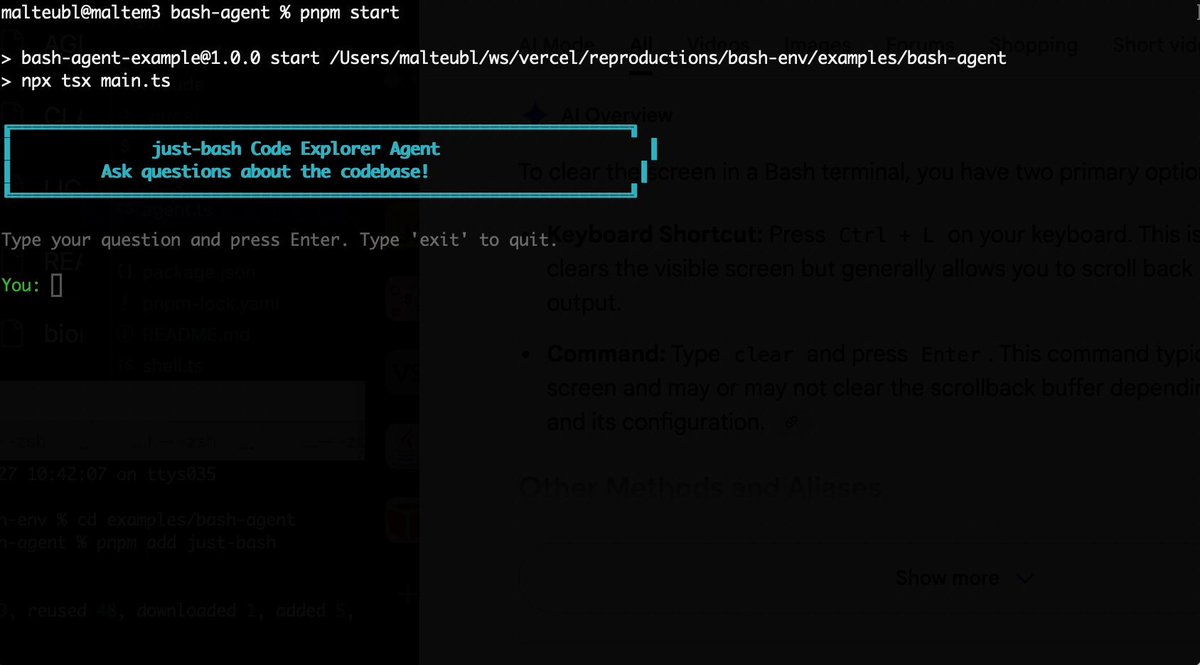
Bash is all you need! Which is why I'm introducing my holiday project: just-bash just-bash is a pretty complete implementation of bash in TypeScript designed to be used as a bash tool by AI agents. Because it turns out agents love exploring data via shell scripts, even beyond coding. It comes with grep, sed, awk and the 99th percentile features that an agent like Claude Code or Cursor would use. In fact, Claude Code can use it for secure bash execution. In the package - A bash-tool for AI SDK - A binary for use by yourself or your coding agents - An overlay filesystem to feed files to your agent securely - A Vercel Sandbox compatible API, so you can quickly upgrade to a real VM if you need to run binaries - An example AI agent that explores the just-bash code base using just-bash - I imported the Oils shell bash compatibility suite and just-bash passes a very good chunk What is interesting about this codebase: It was essentially entirely written by Opus 4.5. Coding agents love bash and they are good at reproducing it. They are also great at text-book recursive descent parsers and AST tweet-walk interpreters. That said, it is, like, a lot of code and I didn't read it all 😅. This is very much a hack, but it also seems to be _really_ useful. I haven't really found anything agents want to use that it doesn't support and it's fast and secure (caveats apply). It doesn't have write access to your computer and the filesystem is given a root that the agent cannot escape from. Find it at Related: Our recent blog post how we migrated our data analysis agent to bash tools and achieved incredible quality improvements The video shows the example agent investigating the just-bash code base

Malte Ubl

125,326 Aufrufe • vor 8 Monaten

WHAT IS AN AI "SOFTWARE FACTORY" AND IS IT HYPE (31 MINUTE BREAKDOWN) I think it's a silly name for a genuinely USEFUL idea! A software factory is 5-6 markdown files that sit next to your code and tell your agents how you like to work, so you can build high quality apps 24/7. It's going viral because AI coding has a trust problem. The model can build the feature, but with no structure around it you end up babysitting the agent, wondering what changed and hoping it didn't break something important. So you build with agents the same way a factory builds physical products! 1. Each feature gets its own station, which in software means its own branch, so multiple agents can work at the same time without stepping on each other. 2. The build station gives the agent rules for how to write the code, because "it works" is very different from "a developer could open this repo next month and understand what happened." 3. The proof station makes the agent show evidence. Screenshots, videos, speed numbers, before-and-after states. It has to prove the thing works instead of saying it works. 4. The review station runs the work through a code review agent, and if it doesn't clear the bar, it goes back through the line. 5. Then you show up at the end to merge. For a 100+ years people have run production this way, and it worked because the structure is good. The full episode on what’s a software factory is NOW live on The Startup Ideas Podcast (SIP) 🧃 with the wonderful Micky Watch: So is it hype?!? I don't think it is, because of what it does to your output! WITHOUT a factory, you build ONE feature at a time and you're the bottleneck at every step, prompting, checking the diff, testing it yourself, hoping nothing else broke (spoiler alert it often does). WITH a factory, EACH feature runs in its own isolated copy of the app, so you can have 10+ of them going at once, and each agent has to prove its own work and pass a code review before it ever reaches you. Instead of supervising the work, you're APPROVING finished work that already has evidence attached. REALLY interesting to see how work with agents is evolving to be….well, similar to working with people!

GREG ISENBERG

29,566 Aufrufe • vor 7 Tagen

🚨 OpenAI just launched Codex, a brand-new autonomous coding agent that can build features and fix bugs on its own. We’ve been using it Every 📧 for a few days, and I’m impressed. I invited Alexander Embiricos (ben davies), a member of the product staff responsible for Codex, to demo Codex and talk about it live on a special edition of AI & I: What Codex is and how it works Codex is designed to be used by senior engineers—it performs coding tasks like adding features or fixing bugs autonomously. It's built to allow you to start many sessions at once, so you can have multiple agents working in parallel. Codex is built to have "taste" OpenAI trained Codex to have the taste of a senior software engineer. It knows how big codebases work, how to write a good PR, and uses clean, minimal code. Why an “abundance mindset” is best for interacting with agents Codex is designed to allow users to delegate many tasks at once without getting caught up in the details. This lets you point an abundance of agents at a specific task like a difficult bug—it’s worth it even if only one of them succeeds. How OpenAI is thinking about agents Codex is one piece of a unified super-assistant OpenAI wants to eventually build—an agent that helps users easily get things done by selecting the right tools for them behind the scenes. OpenAI’s vision for the future of programming In the future developers will probably spend less time writing routine code and more time guiding agents, reviewing their work, and making strategy decisions. Programming will become more social, letting teams easily delegate multiple tasks at once, allowing people to focus on ideas and collaboration instead of routine coding. Watch below!

Dan Shipper 📧

145,487 Aufrufe • vor 1 Jahr