Loading video...

Video Failed to Load

Go Home

MeshLRM Large Reconstruction Model for High-Quality Mesh We propose MeshLRM, a novel LRM-based approach that can reconstruct a high-quality mesh from merely four input images in less than one second. Different from previous large reconstruction models (LRMs) that focus on
69,111 views • 2 years ago •via X (Twitter)

5 Comments

AK's profile picture
AK2 years ago

NeRF-based reconstruction, MeshLRM incorporates differentiable mesh extraction and rendering within the LRM framework. This allows for end-to-end mesh reconstruction by fine-tuning a pre-trained NeRF LRM with mesh rendering. Moreover, we improve the LRM architecture by

AK's profile picture
AK2 years ago

simplifying several complex designs in previous LRMs. MeshLRM's NeRF initialization is sequentially trained with low- and high-resolution images; this new LRM training strategy enables significantly faster convergence and thereby leads to better quality with less compute.

AK's profile picture
AK2 years ago

Our approach achieves state-of-the-art mesh reconstruction from sparse-view inputs and also allows for many downstream applications, including text-to-3D and single-image-to-3D generation.

AK's profile picture
AK2 years ago

paper page:

AK's profile picture
AK2 years ago

daily papers:

Related Videos

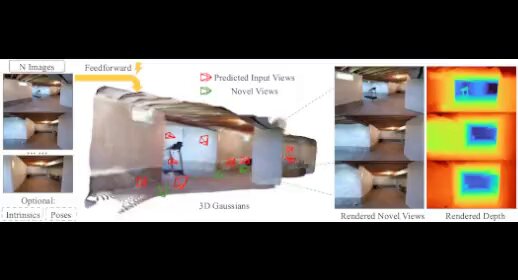
[SIGGRAPH 2025] Photoreal Scene Reconstruction from an Egocentric Device Contributions: 1. We address the importance of employing visual-inertial bundle adjustment (VIBA) that accounts for the rolling-shutter behavior of the RGB camera. This provides a continuous camera trajectory to model pixel movement in neural reconstruction. Our experiments demonstrate that using VIBA consistently improves the novel view quality in Gaussian Splatting by +1 dB in PSNR. 2. We introduce a rasterization-based image formulation pipeline that addresses common artifacts in physical image formation, including rolling shutter, lens shading, exposure, and gain compensation. Our approach is distinct in that we represent image poses as posed pixel arrays sampled from a continuous trajectory, rather than assigning a single camera pose per image, and preserve the merit of Gaussian rasterization. Unlike existing methods that require ray-tracing Gaussians, e.g., [Moenne-Loccoz et al. 2024], our formulation is applicable to general-purpose rasterization-based Gaussian splatting. When applied to 3D Gaussian Splatting (3DGS) [Kerbl et al. 2023], our approach can further enhance reconstruction quality by +1 dB. We outperform existing baselines and demonstrate a substantial quality improvement in handling complex scenes observed by egocentric devices. 3. To reduce the effect of blur from rapid head motion in darker indoor scenes, we propose a strategy of deliberately underexposing input videos during capture, inspired by HDR+ [Hasinoff et al. 2016]. We demonstrate that we can reconstruct high-quality, noise-free scene radiance from noisy, dim input videos, and further render sharp, blur-free videos at a higher dynamic range.

MrNeRF

15,244 views • 1 year ago

📢📢 𝐀𝐯𝐚𝐭𝟑𝐫 📢📢 Avat3r creates high-quality 3D head avatars from just a few input images in a single forward pass with a new dynamic 3DGS reconstruction model. Video: Project: Our core idea is to make Gaussian Reconstruction Models animatable. We find that a simple cross-attention to an expression code sequence is already sufficient to model complex facial expressions. We then incorporate position maps from DUSt3R and feature maps from Sapiens to facilitate the prediction task. While DUSt3R's position maps act as a pixel-aligned initialization for the Gaussians' positions, the Sapiens feature maps help the cross-view transformer to match corresponding image tokens in the 4 input images. One major challenge in creating a 3D head avatar from smartphone images comes from inconsistent facial expressions when the subject could not remain perfectly static during the capture. We eliminate this static requirement by simply showing our model input images with different facial expressions during training. This technique makes our model robust to inconsistent input images later on. Finally, we show that despite the model has been trained with 4 input images, one can even create a 3D head avatar when only a single image is available. To achieve this, we employ a pre-trained 3D GAN to lift the single image to 3D and then render the 4 input images for our model. This allows us to create 3D head avatars from single images and even highly out-of-distribution examples like AI generated faces, paintings or statues. Great work by Tobias Kirschstein from his internship at Meta with Javier Romero, Artem Sevastopolsky, and Shunsuke Saito

Matthias Niessner

74,698 views • 1 year ago